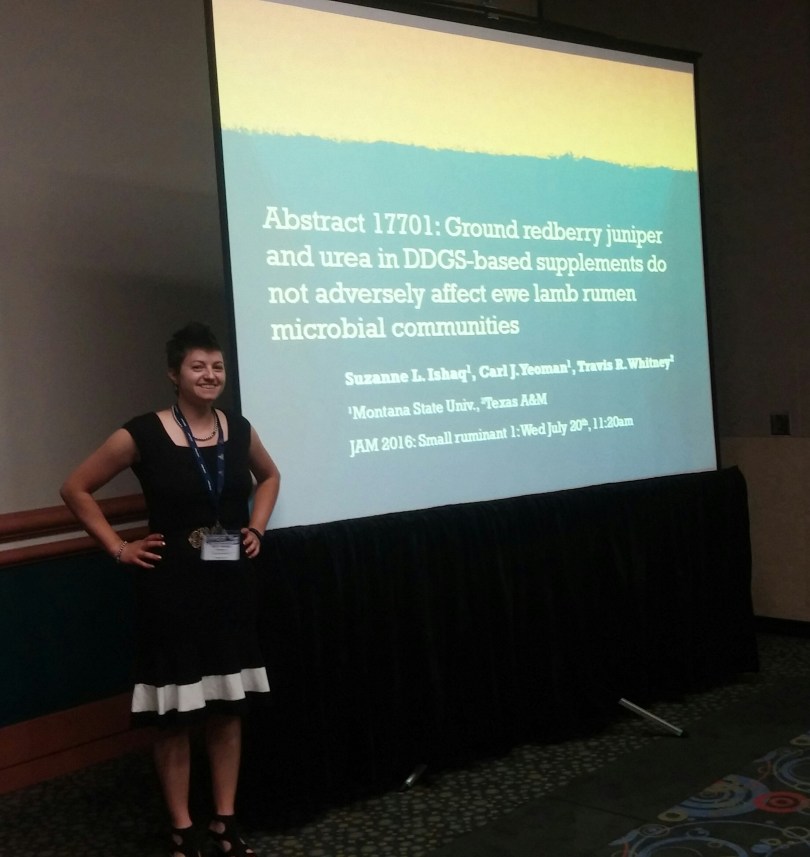
In 2015, while working in the Yeoman Lab, I was invited to perform the sequence analysis on some samples from a previously-run diet study. The study was part of ongoing research by Dr. Travis Whitney at Texas A & M on the use of juniper as a feed additive for sheep. The three main juniper species in Texas can pose a problem- while they are native, they have significantly increased the number of acres they occupy due to changes in climate, water availability, and human-related land use. And, juniper can out-compete other rangeland species, which can make forage less palatable, less nutritious, or unhealthy for livestock. Juniper contains essential oils and compounds which can affect some microorganisms living in their gut. We wanted to know how the bacterial community in the rumen might restructure while on different concentrations of juniper and urea.
Coupled with the animal health and physiology aspect led by Travis, we published two companion papers in the Journal of Animal Science. We had also previously presented these results at the Joint Annual Meeting of the American Society for Animal Science, the American Dairy Science Association, and the Canadian Society for Animal Science in Salt Lake City, UT in 2016. Travis’ presentation can be found here, and mine can be found here. The article can be found here.
Ground redberry juniper and urea in supplements fed to Rambouillet ewe lambs.
Part 1: Growth, blood serum and fecal characteristics, T.R. Whitney
This study evaluated effects of ground redberry juniper (Juniperus pinchotii) and urea in dried distillers grains with solubles-based supplements fed to Rambouillet ewe lambs (n = 48) on rumen physiological parameters and bacterial diversity. In a randomized study (40 d), individually-penned lambs were fed ad libitum ground sorghum-sudangrass hay and of 1 of 8 supplements (6 lambs/treatment; 533 g/d; as-fed basis) in a 4 × 2 factorial design with 4 concentrations of ground juniper (15%, 30%, 45%, or 60% of DM) and 2 levels of urea (1% or 3% of DM). Increasing juniper resulted in minor changes in microbial β-diversity (PERMANOVA, pseudo F = 1.33, P = 0.04); however, concentrations of urea did not show detectable broad-scale differences at phylum, family, or genus levels according to ANOSIM (P> 0.05), AMOVA (P > 0.10), and PERMANOVA (P > 0.05). Linear discriminant analysis indicated some genera were specific to certain dietary treatments (P < 0.05), though none of these genera were present in high abundance; high concentrations of juniper were associated with Moraxella and Streptococcus, low concentrations of urea were associated with Fretibacterium, and high concentrations of urea were associated with Oribacterium and Pyramidobacter. Prevotella were decreased by juniper and urea. Ruminococcus, Butyrivibrio, and Succiniclasticum increased with juniper and were positively correlated (Spearman’s, P < 0.05) with each other but not to rumen factors, suggesting a symbiotic interaction. Overall, there was not a juniper × urea interaction for total VFA, VFA by concentration or percent total, pH, or ammonia (P > 0.29). When considering only percent inclusion of juniper, ruminal pH and proportion of acetic acid linearly increased (P < 0.001) and percentage of butyric acid linearly decreased (P = 0.009). Lamb ADG and G:F were positively correlated with Prevotella(Spearman’s, P < 0.05) and negatively correlated with Synergistaceae, the BS5 group, and Lentisphaerae. Firmicutes were negatively correlated with serum urea nitrogen, ammonia, total VFA, total acetate, and total propionate. Overall, modest differences in bacterial diversity among treatments occurred in the abundance or evenness of several OTUs, but there was not a significant difference in OTU richness. As diversity was largely unchanged, the reduction in ADG and lower-end BW was likely due to reduced DMI rather than a reduction in microbial fermentative ability.
Academics love to keep books, such that they accumulate over the years until, one day, you move offices, change universities, or retire and give them all away. I happened upon one of these give-away treasure troves recently and grabbed several older books. I began my journey with a historical perspective on island biogeography, and I enjoyed it so much I thought I’d write about it.
The book is “The Song of the Dodo: Island Biogeography in an Age of Extinctions”, written in 1996 by David Quammen. David is a science writer, but has also written some fiction, and at the time this book was published lived in Montana, from where I so recently emigrated. It’s written in a meandering way, weaving together textbook information, historical accounts of ecologists from the last few centuries, and his own experiences traveling the world to visit the unique locations that inspire(d) scientists to brilliance. While it certainly helps to have a background in biology or ecology in order to fully appreciate the book, it’s seems interesting enough to grab a more general audience.
Be prepared for a feast of delicious jargon, though:
“The Origin of Species is a book of encyclopedic richness and inexhaustible tediousness, a great potpourri of argument and fact in which a reader can find almost anything a reader might want: Lamarckism, animal husbandry, geology, ethology, experimental botany, the kitchen sink, island biogeography.” pg. 200
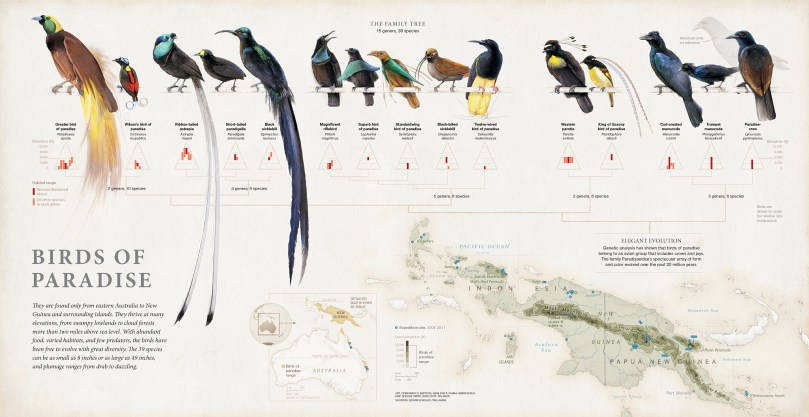
So what is island biogeography? It’s the study of how species are distributed across an environment; specifically on islands. Sounds simple enough. Let’s go back to the Age of Exploration (late 1400s to the late 1700s) when new technology and a growing appreciation for the size of the planet gave rise to a burst of exploration. Suddenly- and this historical perspective is very Euro-centric- new lands, geology, peoples, plants, and animals were being discovered, and tales of the exotic made it back to Europe. Sometimes, preserved animal specimens would make it back to Europe, which was extremely tricky as they had to be prepared in the field, usually by skinning or pickling. Often, the heads, feet, tails, or wings would be removed during the process, accidentally or intentionally. This only fueled the mystery more: many species of Birds of Paradise had their feed removed during processing, leading British ecologists, many of whom were working off secondary information and had never traveled to these locales, to believe that these birds had no feet at all and lived entirely among the clouds until their death when they fell to the ground.
The lure of discovering new, fabulous species was irresistible, and naturalists began expeditions all over the globe to make observations and collect specimens. Largely, collectors interested in one particular animal or insect would select a small number of specimens for each species they collected, thus they accidentally missed the natural variations in size or color that one sees in wild animals. After all, one doesn’t always notice little differences when only looking at a few examples. Or, they would fail to record the particular location of their find, often only labeling it only by the continent on which is was collected. But some naturalists were more curious. They collected more specimens, more data, and began to notice patterns.
The most important pattern was that not all animals were found everywhere. Certainly, it was noted that certain animals were specific to a habitat- sharks to the ocean, camels to the desert, etc. But it wasn’t until people discovered animals found exclusively on islands that it really sunk in. And this is extremely important, because it begged the question: why? Why are some animals in one place and not another? How did they get there? The prevailing theories until that point were largely based on stories from the Christian bible, but with the discovery of so many new species, a literal ark was increasingly going to be improbably overcrowded.
Long story short, many ecologists actually began as geologists- Charles Darwin included, and in studying island formation it became understood that some island animals had crossed on land bridges, while others flew, swam, or drifted onto islands. The species and mode of arrival very much determined whether you could then get back off the island, or whether you were stuck. Ok, so now we know that animals can travel and change their own habitat location (which is different from migration), which went against the prevailing theory that animals were located where they had been put during a creation event.
The next important pattern was that multiple, closely-related species could exist in a place at the same time. In the years following his voyage while studying the specimens he collected, Charles Darwin noticed this of the mockingbirds, tortoises, and eventually the finches on the Galapagos, which was just a brief stop on his 5 year geology cruise aboard the Beagle (1831-1836). Again, this was important, because what was the likelihood that all these similar bird species came to the same island chain at the same time? It was more likely that a few birds of a single species had come over, and these birds had changed over thousands of generations into several new species. The accepted notion was that animals didn’t change- they remained as they had been created. The idea that a species could change or evolve over time was, at best, silly and at worst, blasphemous.
Nevertheless, a number of ecologists had made reference to the possibility of change during the Age of Exploration, but lacked solid data and a concrete theory of how. The mockingbirds represented true archipelago speciation; one species came to the Galapagos islands and populations became isolated on separate islands until through genetic drift they became different species, but there were only four mockingbird types and that was little enough to go on. On the other hand, Darwin had 31 individuals representing what he thought was 14 unrelated bird species, but it wasn’t until after his voyage, when an ornithologist properly classified the birds as all being closely-related finches, that Darwin paid any attention to them at all. In fact, Darwin nearly missed the idea of evolution because he failed to label which island his finches came from and very little about their ecology or behavior- he had to gather missing data from other accounts for years before he could see a real pattern. To be fair, the finches are a much more complicated pattern because they display adaptive radiation; one species arrived on the islands, but populations were only transiently isolated and when they crossed paths again they were still similar enough to compete, so different species evolved to fill different ecological roles (niches) in order to avoid starvation due to competition.
Darwin’s first account of his Beagle voyage made just a brief mention of this observation on closely-related species, but it changed the life of Alfred Wallace. Wallace came from a poor background, and eventually paid for his love of naturalism and data collection by selling the specimens he collected. Many British naturalists at the time were wealthy, and selling one’s collection seemed base- thus Wallace, with no title or reputation, was dismissed for most of his early career. Years after Darwin went to the Galapagos, Wallace went to South America and Indonesia and came to the same conclusion about multiple closely related species: that one species had become many. Wallace made the jump to speciation much faster, and sent Darwin a manuscript that was frighteningly similar to the yet-unpublished Origin of Species, which Darwin had worked on for 20 years to gain enough proof to avoid being laughed at. Social politics aside, which are discussed in the book, a joint manuscript was presented, On the Tendency of Species to form Varieties; and on the Perpetuation of Varieties and Species by Natural Means of Selection, and a year later Darwin publishedOn the Origin of Species by Means of Natural Selection, or the Preservation of Favoured Races in the Struggle for Life, which, incidentally doesn’t even mention Galapagos finches.
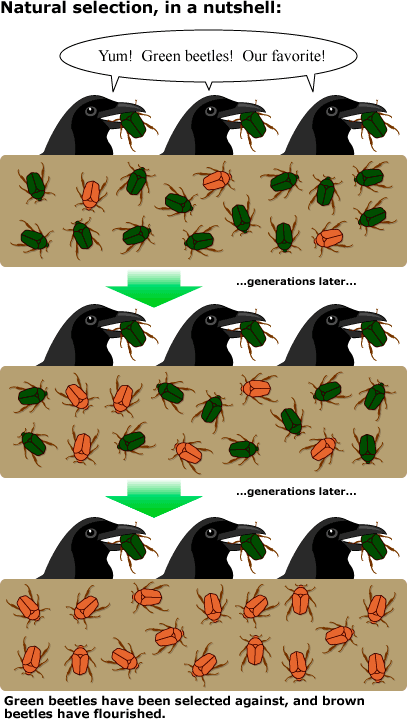
The idea of macroorganismal evolution was difficult to come by, largely because it’s a much longer process than a human can witness, and because a possible mechanism for change was completely unknown (genetics was a long way away). By studying islands, ecologists could study evolution in miniature worlds where the pressure to stay alive was great- indeed, many species were marooned on the islands they colonized. Studying this, and the livestock breeding industry, gave rise to the idea in Darwin’s mind of Natural Selection– that external forces could change a species over time by forcing the species to change.
Because animals are isolated on islands, they change to fit that particular ecosystem in a very visible way. Wallace noticed this happening in his travels in South America where large rivers converged: animals that could not cross the river became isolated and there would be similar but distinct species on each side of the river. Again, the whimsical biogeography of a deity became less probable than natural forces (food, geography, predation, competition) driving the distribution of animals and plants. Still, it took decades to iron out the particulars of evolution, and even today people refuse to acknowledge it.
But this book isn’t solely a historical account- all of that is setting the stage for a larger picture: extinction. For even as island pressures select for the creation of species distinct from those found on mainlands, it also selects them for extinction. Islands are partially or completely isolated, and this means any breeding population is small to begin with, and eventually can become inbred. Island populations often collapse: the gene pool becomes too stagnant, a natural disaster hits, food becomes scarce, a predator appears. Because there are only so many individuals, and because they are adapted to a very specific location, island species can’t deal with change. Unfortunately, humans bring nothing but change. As we develop natural land for our own use we fragment habitat, and for animals that can’t cross a city to get to the other populations, their gene pool and food options are limited. They become reliant on very specific living conditions in their small habitat fragments, and they are more susceptible to disease, inbreeding, predators, and climate change. The smaller the habitat, the fewer the individuals, and the ore they struggle to survive. As humans colonize all parts of the globe we are leaving man-made islands in our wake, with marooned populations of plants and animals that find it increasingly difficult to sustain themselves- we are the cause of the mass extinction of animals and plants around the globe that only trickles into our mainstream news.
“We still argue about when it [the dodo] actually became extinct, but it probably disappeared around the 1660s. It’s become the sort of legendary bird of extinction. And a very important bird. There were extinctions before and there’s been lots of extinctions since, but it was an important extinction because that was the first time, the first time in the whole of man’s history, that he actually realized he had caused the disappearance of a species.”
-interviewing Carl Jones about the extinction of the dodo, pg. 277
The level of detail provided in The Song of the Dodo is fascinating, especially because historical accounts so often lose sight of a who a person was and the journey they had to take. Darwin wasn’t always correct, other scientists had the right theories but the wrong data to prove them, and the elitism of early science often led to the adoption of incorrect theories from otherwise brilliant men. The book gives an honest perspective- that all scientists are trying their best to make sense of the information they have, and that it can take an extremely long time to put the entire puzzle together. And it gives cause for hope. While we may not be able to bring back populations of species we have pushed to the brink, life is pluripotent. If we give the natural world some space- it’ll grow back.
From iDigBioA couple of weeks ago, I attended my first Ecological Society of America meeting in Portland, which assembles a diverse community of researchers looking at system-wide processes. It was an excellent learning experience for me, as scientific fields each have a particular set of tools to look at different problems and our collective perspectives can solve research problems in more creative ways.
In particular, it was intriguing to attend talks on the ecology of the human microbiome. Due to the complexity of host-associated microbial communities, and the limitations of technology, the majority of studies to date have been somewhat observational. We have mapped what is present in different animals, in different areas of the body, under different diet conditions, in different parts of the world, and in comparison between healthy and disease states. But given the complexity of the day-to-day life of people, and ethics or technical difficulty of doing experimental studies in humans, many of the broader ecological questions have yet to be answered.
For example, how quickly do microbial communities assemble in humans? When you disturb them or change something (like adding a medication or removing a food from your diet) how quickly does this manifest in the community structure and do those changes last? How does dysbiosis or dysfunction in the body specifically contribute to changes in the microbial community, or do seemingly harmless events trigger a change in the microbial community which then causes disease in humans? Some of the presentations I attended have begun teasing out these problems with a combination of observational in situ biological studies, in vitro laboratory studies, and in silico mathematical modeling. The abstracts from all the meeting presentations can be found on the meeting website under Program. I have also summarized several of the talks I went to on Give Me The Short Version.
One of my favorite parts was attending an open lunch with 500 Women Scientists, a recently-formed organization which promotes diversity and equality in science, and supports local activists to help change policy and preconceived notions about diversity in STEM. The lunch meeting introduced the organization to the conference participants in attendance, asked us to voice our concerns or difficulties we had faced, encouraged us to reach out to others in our work network to seek advice and provide mentoring, and walked us through exercises designed to educate on how to build a more inclusive society.
500 Women Scientists at ESA, August 2017
My poster presentation was on Wednesday, halfway through the meeting week, which gave me plenty of time to prepare. You never know who might show up at your poster and what questions they’ll have. In the past, I’ve always had a steady stream of people to chat with at my poster which has led to a number of scientific friendships and networking, and this year was no different. The rather large (but detailed) poster file can be found here: Ishaq et al ESA 2017 poster . Keep in mind that this is preliminary work, and many statistical tests have not yet been applied or verified. I’ve been working to complete the analysis on the large study, which also encompasses a great deal of environmental data. We hope to have manuscript drafted by this fall on this part of the project, and several more over the next year from the research team as this is part of a larger study; stay tuned!
The video presentation of my work on the effects of juniper diets on rumen bacteria is finally available for public use! I apologize for any side comments in the audio, the projector in the room kept flicking off! Stay tuned, our publication was just accepted and will be in press soon…
Abstract 1768. Ground redberry juniper and urea in DDGS-based supplements do not adversely affect ewe lamb rumen microbial communities.
The video presentation of my work on the effects of maternal biotic influences on the developing calf digestive tract bacteria is finally available for public use!
I’m counting down the days for my first Ecological Society of America (ESA) conference next week in Portland, OR. Over the last few weeks, I’ve been diligently working to finish as much analysis as possible on the data from my recent post-doc, as I am presenting a poster on Wednesday, August 9th from 4:30 to 6:30 pm; PS 31-13 –Soil bacterial diversity in response to stress from farming system, climate change, weed diversity, and wheat streak virus.
The theme for this year’s ESA meeting is “Linking biodiversity, material cycling and ecosystem services in a changing world”, and judging from the extravagant list of presenting authors, it’s going to be an extremely large meeting. It’s worth remembering that large conferences like these bring together researchers from each rung of the career ladder, and many of the invited speakers will be presenting on work that might have been done by dozens of scientists over decades. Seeing only the polished summary can be intimidating, lots of scientists I’ve spoken to can feel intimidated by these comprehensive meeting talks because the speakers seem so much smarter and more successful than you. It’s something I jokingly refer to as “pipette envy”: when you are at a conference thinking that everyone does cooler science than you. Just remember, someone also deemed your work good enough to present at the same conference!
July is quickly becoming busier than anticipated! It’s only half over, but already this month I have helped submit two major grant proposals with the BioBE and ESBL teams, reviewed five scientific manuscripts and counting (some still pending), received reviews back on two of my own manuscripts for which I will need to make edits, taken University regulations compliance training and arranged for more, and have been wrangling a large and unruly dataset in preparation for ESA2017 in Portland in a few weeks. To add to that, I’ve reached a personal best of 55 miles commuting by bike per week, and probably also a personal best for “amount of locally-produced Bree cheese consumed”.
In the six weeks that I’ve been in Oregon, I’ve been enjoying both work and life, and it’s slowed down my frequency of in-depth posts. But, in the next two or three months, I should have posts up about the ESA conference and the work I’m presenting there, my presentations from last year’s JAM meeting which will soon become open-access, hopefully a few posts about new, accepted manuscripts, and perhaps another “day in the life of an academic” similar to some of my previous postings. If you have a particular interest in any aspect of my work or academia in general, and you’d like to see a post dedicated to it, feel free to comment or email me a topic suggestion!
Interviewing for research positions is challenging, and when it’s for a job at a university, the process can be lengthy and the competition fierce. Some jobs for which I applied reported receiving 60 to 160 applications for a single opening. When it comes to highly coveted positions, like tenure-track faculty jobs, the slow reduction in research funding and ever-increasing pool of PhDs can result in up to 400 applications per opening. One faculty member eloquently provided stats on their job search, which involved more than 100 applications over two years. I applied to a mere 22 jobs over a period of seven months (just counting the 2016-2017 season), but the lengthy process generated plenty of questions from family and friends who were dismayed by the slow trickle of news.
The Search Committee
The job posting needs to be carefully crafted. While most academic positions are looking for candidates with specific skills or research backgrounds, many faculty positions are open-ended so that a wide variety of candidates may apply. Any required elements of the job, such as teaching specific courses, advising, or extension activities, are often explicitly stated in the posting. Once funding for a job position and a post has been approved, the search officially opens. A search committee is formed, which is comprised of several members of the department, and perhaps members of other, closely related departments at the university. They may aid in the drafting of a job posting, but will be in charge of reviewing every application, selecting candidates for and performing preliminary and full interviews, following up on references, and making final recommendations.
The Application
Applications require a Curriculum Vitae, which lists your education and other professional training, all the positions you have held, professional memberships you belong to, certifications, awards, publications, public presentations, courses taught, career development activities, students you have mentored, and any other skills that might be relevant. Some applications require official transcripts, and all require letters of reference. These may need to be provided at the time of the application, or may be requested later by the committee when you have been added to the short-list of potential candidates. Your letters of reference not only confirm the skills you have claimed in your application, but they provide a glimpse into what it is like to work with you, so it’s best to pick someone who knows you well.
The brunt of the academic application is several essays that detail your experience, philosophy, and vision for each aspect of the job in question. Some universities limit these to one to three pages each, but others allow you the freedom of word count. Typically, you must provide a Statement of Research and a Statement of Teaching, and some may request Statements of Mentoring, or Diversity.
The Statement of Research asks you to detail previous work, the skills you have acquired, and important contributions your research has made. Here, you outline your experience in obtaining grants, or your plan to obtain them in the future, as well as describe the work you would like to perform at the university and the lab members you would like to bring in (undergraduates, graduates, technicians, postdocs). Outlining your proposed research can be tricky, as you want to add your expertise to the ongoing departmental research, but without being redundant or too novel. That might seem counter-intuitive, but if a department doesn’t have the equipment or funding to support your research, or similar researchers that can provide a research support network, it may be difficult for you to perform your work there.
Similarly, the Statement of Teaching asks you to explain in detail your previous teaching experience, and your philosophy of how courses should be developed to improve student learning, incorporate current research or hands-on experience into the curriculum, and use technology to increase student engagement. Here you can suggest courses that you would like to develop or take over teaching, based on your knowledge base, if the position involves teaching.
Additional Statements may be requested to provide specific information on your philosophy of mentoring students, especially your Statement of Diversity for training new graduate students, or recruiting minority students to science and providing career development opportunities to underrepresented demographics. The cherry on top is the cover letter that summarizes why you want the job and why you are the best choice.
The Wait
Applications may be solicited for several weeks or months, and some accept applications on a rolling basis until the position is filled. You will receive a notification, usually automatic, that your application has been received by the system, and perhaps another one to notify you that the review has begun. Otherwise, you have little communication unless you are selected for the short-list or the position has been filled. I have waited more than 6 months to hear back about an application before.
It’s time to meet our first three eligible candidates…
The short-list is a subset of applicants, several or several dozen perhaps, that the committee would like to have a phone or video interview with, typically lasting 15 to 60 minutes. Depending on the number of applications received and when the job posting closed in relation to the end of the semester, you may not hear about a preliminary interview until several months after you have applied. Questions requiring detailed answers are often provided in advance, but otherwise, preliminary interview questions usually ask you to reiterate what you might have put in your application: why you want the job, whether you have experience working collaboratively, where you see yourself in five years, etc. These questions may probe your interpersonal skills, such as whether have you managed others, or whether you have dealt with academic conflicts. Having been through a number of tele-interviews, I can say that they are more difficult than they seem. You have a brief time in which to make an impression, and it can be difficult to read a room which you can’t see.
Round 2
From the short-list, two to four candidates are selected for full, in-person interviews, which are scheduled as soon after the phone interviews as possible. These are complicated to schedule, as they are one to two full days for which the candidate and most members of the department need to be available. You are required to present a seminar of your research, both past and future. Depending on the position, you may be required to present a teaching seminar as an example of your style, or perhaps a “chalk-talk” where the committee can ask you questions on potential grants or experimental designs. You will also have one-on-one interviews with university faculty and staff that you may be working with, tours of the research facilities, and a chance to tour the university. From experience, even when the interview goes perfectly, they are exhausting. For two days straight you are talking about yourself, your work, your ideas, other people’s work, and potential collaborations. You are listening attentively, trying to give the best impression possible, and eating meals as quickly as possible while still talking about yourself and hoping you don’t have food stuck in your teeth.
Only once all the selected candidates have been interviewed will the search committee deliberate. They solicit impressions and opinions from everyone you met- faculty, staff, graduate students, technicians, as well as from your professional references. They will decide if a candidate is ineligible for an offer for any reason, and rank the eligible candidates. They will then make recommendations to the department chair or administrator, who will decide whether to extend an offer.
Negotiations
When a job offer is first made, it is a non-binding offer. Negotiations then take place until both parties are satisfied, and a written, contractual offer will be offered. University positions have salary ranges by hiring level and experience, and a certain, somewhat unknown, amount of additional funding available for other benefits like relocation, computers, or basic research materials. Tenure-track or other high-level research positions in the STEM fields typically come with start-up funds, which provide initial funding to buy equipment and lab materials, or fund lab personnel to get you started on pilot studies that can be leveraged for grant funding.
This is the most delicate phase because this is your best chance to determine your salary, your title, and the specifics of your job requirements. For example, you can use this opportunity to discuss when and how much you will be asked to teach, what your start date is, whether the department will reserve a teaching or research assistantship so that you may offer it to a new graduate student, and other non-specific benefits. If you have multiple offers, you might ask one to meet the benefits proffered by another. On the other hand, universities only have so much they can offer you, regardless of how much they like you. Remember, you aren’t out to “win”, you are out to satisfactorily arrange a contract with the people you will soon be working with- both parties need to be pleased with the offer. If an agreement can’t be reached, or if you accept a different offer, the second-ranked candidate will be offered the job, and so on.
Nothing is finalized until both parties have agreed to terms, a background check has been completed, and the contract is signed. From application to contract, the process may take 6 to 12 months, and it may be a further several months before you officially begin, which is a long time to provide vague answers to eager questions from friends and family. On top of that, most interviews are semi-confidential: you are not supposed to know who the other candidates are, so it is bad form to ask about them or for the department to discuss them with you, even after you have accepted the job. And, most applicants keep their interviews quiet until they have a job offer. For one thing, it’s not worth getting everyone’s hopes up for every application. For another, you don’t want a prospective job to pass you over because it looks like you are going to accept another offer, as candidate searches are expensive to conduct and occasionally don’t lead to a hire (failed search). There is also the potential for an uncomfortable situation to arise at your current job when they know you are leaving, although the pervasive search for job security and work-life balance in academia means most people sympathize with your search for the right job.
I choose… Candidate #3!
In the end, much of it comes down to luck: the right department needs to be looking for a candidate like you and have their hiring line approved, you need to find their posting, you need to craft an application that appeals to them while representing your interests and goals, and you have little to no idea who else might be applying. Often jobs will be posted at an open hiring level to attract a wider variety of candidates, so you might be applying at the lower hiring end but are competing with people who have years more experience than you do. And it’s important to remember that everyone in science has a large amount of technical training – we are all fantastic candidates and that makes it difficult to choose only one of us.
Since departments or fields don’t relist open positions predictably, most research job hunters will apply to jobs in their field to cover your bases, as well as several closely related fields (for me, it was animal science, microbiology, molecular genetics, microbiomes, bioinformatics, and any combination of those words); you are afraid to lose a whole year because you didn’t apply to enough postings. This increases the applicant pool size, and provides departments with interesting research directions to take the potential hire in; sometimes you don’t know what kind of candidate you want until you meet them. Moreover, you don’t really know if you will fit with a university, department, or research team until you have had some time to interact with them during the interview. Really, applying for a job in academia is a lot like dating. Some people go on many first date interviews, some on very few, in order to find the right match. Either way, it’s fun to play the game, but to win you need to ‘make a start date’.






![IMG_20170808_083850[4637].jpg](https://sueishaqlab.org/wp-content/uploads/2017/08/img_20170808_0838504637.jpg?w=162&h=218)