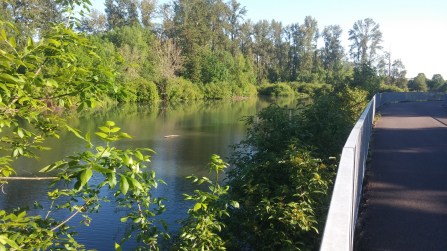
My first day started auspiciously as I charted a new bike route to work, about 4.5 mi of which is along a path snaking next to the Willamette River. It goes through several parks, and by a few small lakes and swamps which are home to dozens of species of birds, mammals, amphibians, and reptiles. I haven’t seen any river otters yet, but I have been keeping a close eye out.
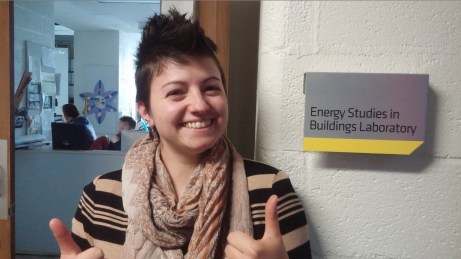
Arriving on campus, most of my first day, and first week, were spent visiting the various places around campus to get myself established as a new employee- obtaining my ID card and email address, filing out paperwork, attending orientation, and finding all the coffee places within walking distance of the building. ESBL is renovating and expanding its offices across several large, pluripotent rooms to accommodate a growing research team, so I got a brand new standing desk, chair, shelving, and computers (on order), all to my specifications. The flexibility of working position, screen size, and screen angle provided by my new station are comfortable and great for productivity, and it’s neat to design the new space into offices, meeting tables, and storage which are based on our personalized usage needs and preferences. And of course, there is plenty of space for all the mementos and science toys I’ve accumulated.
Most importantly, my first week was spent acclimating to my new department and getting up to speed on the ongoing and planned projects. BioBE and ESBL have dozens on ongoing or planned projects on the built environment, with a combination of building and biology facets. Over the course of the summer, I’ll be writing several grants and organizing new projects that explore how building use, occupancy, and human habits affect human health and the indoor microbiome, as well as contributing to the BioBE blog, providing building microbiome posts to Give Me the Short Version, and getting some older projects out for publication. On top of that, I’m looking forward to exploring the Pacific coast and the Northwestern landscape, and availing myself of the Willamette Valley wine industry.
Last week, I went to Portland, Oregon for the first ever meeting of the Health and Energy Research Consortium (HERC), which brings together researchers, foundations, consultants, and industry leaders from different fields to discuss these research issues and foster interdisciplinary work in the built environment. This includes everything from designing lighting control systems that better integrate human behavior and preferences, to understanding how our human microbiomes interact with building materials to create a unique building microbiome that can feed back onto us in a positive or negative way. More information can be found on the BioBE site, as well as microBEnet. And of course, I’ll be sure to keep you updated right here.
Lee, Izzy, and I have been in Montana for just over two wonderful years, and while we will miss being just 30 min away from great skiing, we are also excited for this next chapter of our life. Is it a coincidence that the next chapter is located in wine country and less than an hour from the beach? Too early to say. One thing is for sure, though, the friendships and collaborations I’ve made here will continue to be cultivated in the years to come.
A few months ago, I was invited to submit an article to the special issue “Plant Probiotic Bacteria: solutions to feed the World” in AIMS Microbiology on the interactions between agricultural plants and microorganisms. As my relevant projects are still being processed, I chose to write a review of the current literature regarding these interactions, and how they may be altered by different farming practices. The review is available as open-access here!
“Plant-microbial interactions in agriculture and the use of farming systems to improve diversity and productivity”
A thorough understanding of the services provided by microorganisms to the agricultural ecosystem is integral to understanding how management systems can improve or deteriorate soil health and production over the long term. Yet it is hampered by the difficulty in measuring the intersection of plant, microbe, and environment, in no small part because of the situational specificity to some plant-microbial interactions, related to soil moisture, nutrient content, climate, and local diversity. Despite this, perspective on soil microbiota in agricultural settings can inform management practices to improve the sustainability of agricultural production.
Citation: Suzanne L. Ishaq. Plant-microbial interactions in agriculture and the use of farming systems to improve diversity and productivity. AIMS Microbiology, 2017, 3(2): 335-353. doi: 10.3934/microbiol.2017.2.335
Today was a big day out in the field at Fort Ellis: virus inoculation day for the project I’ve been part of, on how farming system can alter reactions to adverse growing conditions (like climate change, weed competition, and disease). This is the second year of the project, and the fifth year of the larger crop rotation study, so a lot is riding on being able to keep to the schedule.
Spring has been cool and wet here in Montana, which has presented us from being able to do work in the muddy fields but hasn’t slowed down the wheat or the weeds. If the wheat is too developed when the virus is sprayed, the infection won’t manifest well enough to measure. Thanks to carefully prepared protocols, seasoned personnel, and a stretch of sunny, dry days, we treated our plots and went home early!
My greenhouse trial on the legacy effects of farming systems and climate change has concluded! Over this past fall and winter, I maintained a total of 648 pots across three replicate trials (216 trials per). In the past few weeks, we harvested the plants and took various measurements: all-day affairs that required the help of several dedicated undergraduate researchers.
In case you were wondering why research can be so time and labor intensive, over the course of the trials we hand-washed 648 pot tags twice, 648 plant pots twice, planted 7,776 wheat seeds across two conditioning phases, 1,944 wheat seeds and 1,944 pea seeds for the response phase. We counted seedling emergence for those seeds every day for a week after each of the three planting dates in each of the three trials (9 plantings all together). Of those 11,664 plants, we hand-plucked 7,776 seedlings and grew the other 3,888 until harvesting which required watering nearly every day for over four months. At harvest, we counted wheat tillers or pea flowers, as well as weighed the biomass on those 3,888, and measured the height on 1,296 of them. And this is only a side study to the larger field trial I am helping conduct! All told, we have a massive amount of data to process, but we hope to have a manuscript ready by mid-summer – stay tuned!
Yesterday I participated in the Expanding Your Horizons for Girls workshop at Montana State University! EYH brings almost 300 middle-school aged girls from all over Montana for a one-day conference in STEM fields. Twenty-seven instructors, including myself and other female scientists and educators, ran workshops related to our current research. My presentations were on “Unlocking the Hidden World of Soil Bacteria”, with the help of undergraduate Genna Shaia from the Menalled Lab.
Setting up a soil microbes workshop for Expanding Your Horizons for Girls.
Genna Shaia, undergraduate researcher.
I gave the girls a brief presentation on microbial ecology, and how bacteria and fungi can affect plants in agricultural soil. We talked about beneficial versus pathogenic microorganisms, and how different farming strategies can influence soil microbiota. This was followed by two hands-on activities that they were able to talk home with them. First, the girls made culture plates from living or sterile soil that was growing wheat or peas to see what kind of microbes they could grow. Then, they planted wheat seeds in either living or sterile soil so they could track which soil made the seeds germinate faster.
The girls were enthusiastic to learn, asked lots of insightful questions, and it was awesome being able to share microbiology with kids who hadn’t given it much thought before! If you are a woman in STEM, and have the opportunity to participate in a workshop or mentor a young scientist, it is not only rewarding but can make a huge impact on encouraging women into STEM.
This slideshow requires JavaScript.
Slideshow photos: Genna Shaia, reproduced with student permission.
This change of political tone has encouraged many scientists to voice their concerns, but we scientists also need the support of the general public. After all, science is largely designed to improve the lives and economies of everyone. According to the U.S. Bureau of Labor Statistics, STEM jobs accounted for 8.6 million US jobs in 2015 in the U.S., but an estimated 26 million jobs (20% of jobs in 2011) require knowledge of a STEM field, a sector that consistently has low rates of unemployment, and expands the US economy. Thus, even without thinking about the politics of science, we can agree that scientific research is a vital part of the U.S. economy. Additionally, 93% of STEM occupations have wages above the national average. If you are a scientist, know a scientist, or generally want to show your support, here are some ways you can get involved.
On Saturday April 22, 2017, people will March for Science in cities across the United States to peacefully show their support for scientific literacy, education, policy, and freedom of speech. Please consider joining them.
Support for scientific funding, education, and policy may not be at the top of your list of reasons for supporting political candidates, but it should be on there somewhere. After the first few months of 2017, a number of scientists have decided to hang up their lab coat and run for public office, so you’ll have plenty of options in the coming elections.
I would like to acknowledge Drs. Irene Grimberg and Fabian Menalled for their edits to this post, as well as the ongoing efforts of my editor, Mike Haselton, MA, towards improving my writing.
I’m pleased to announce that a paper that I contributed to was recently accepted for publication in the Journal of Animal Science!
“Feed efficiency phenotypes in lambs involve changes in ruminal, colonic, and small intestine-located microbiota”, Katheryn Perea; Katharine Perz; Sarah Olivo; Andrew Williams; Medora Lachman; Suzanne Ishaq; Jennifer Thomson; Carl Yeoman (article here).
Katheryn is an undergraduate at New Mexico Institute of Mining and Technology who received an INBRE grant to support her as a visiting researcher at Montana State University in Bozeman, MT over summer 2016. Here, she worked with Drs. Carl Yeoman and Jennifer Thomson to perform the diversity analysis on the bacteria in the gastrointestinal tract of sheep from a previous study. These sheep had been designated as efficient or inefficient, based on how much feed was needed for them to grow. Efficient sheep were able to grow more with less feed, and it was thought this might be due to hosting different symbiotic bacteria which were better at fermenting fibrous plant material into usable byproducts for the sheep.
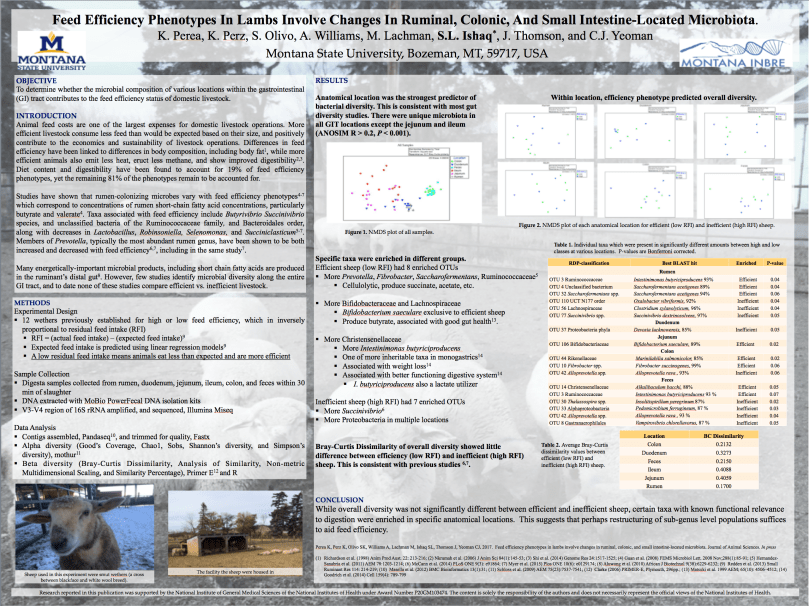
Samples from the sheep were collected as part of a larger study on feed efficiency performed by MSU graduate students Kate Perz and Medora Lachman, as well as technicians Sarah Olivo and Andrew Williams, and Katheryn performed the data and statistical analysis using some of my guidelines. This is Katheryn’s first published article, and one I just presented a poster on at the Congress on Gastrointestinal Function in Chicago, IL!
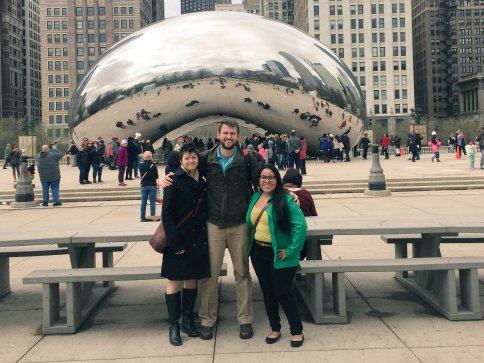
I just got back from my very first Congress on Gastrointestinal Function, a small meeting for researchers with a specific focus on the gastrointestinal tract, which is held every two years in Chicago, Illinois. The special session this year was on “Early Acquisition and Development of the Gut Microbiota: A Comparative Analysis”. The rest of the sessions opened up the broader topics of gut ecosystem surveillance and modulation, as well as new techniques and products with which to study the effect of microorganisms on hosts and vice versa. The research had a strong livestock animal focus, as well as a human health focus, but we also heard about a few studies using wild animals.
As I’ve previously discussed, conferences are a great way to interact with other scientists. Not only can you learn from similar work, but you can often gain insights into new ways to solve research problems inherent to your system by looking at what people in different fields are trying, something that you might otherwise miss just by combing relevant literature online. A meeting or workshop is also a great place to meet other similarly focused scientists to set up collaborators that span academia, government, non-profit, and industry sectors.
It was great to catch up with Dr. Ben Wenner, now at Purdue Agribusiness, and meet Yairy Roman-Garcia, grad student at the Ohio State University.
This year, I was excited for one of my abstracts to be accepted as a poster presentation, and honored to have the other upgraded from poster to talk! Stay tuned for details about both of those projects in the coming weeks, and be sure to check this meeting out in April, 2019.
In a recent post on The Rare Knowledgesphere, I mentioned that I when I tell people that I went to graduate school or explain what I do now, the replies can be overly modest or self-deprecating. Sometimes, people tell me that they don’t feel smart enough to make it through grad school or to dowhatIdo. Graduate school or other professional schools aren’t for everyone, but there is a big difference between not wanting to go and not feeling good enough to go. In my experience, people who think they can’t do it aren’t so much incapable as incapacitated by Imposter Syndrome. In my 9 total years of acquiring higher education, plus 2 years and counting of post-doctoral training, I find that when it comes to academic success, academic achievement frequently takes a backseat to having the right personality. In this post, I thought it would be helpful to describe some of those qualities that help set the most successful researchers apart.
Learning is a skill
Don’t get me wrong, you need to pass the graduate record examinations (GREs- general and subject) in order to be accepted, be able to understand the material once you are there, do well on exams, and maintain a certain grade point average (GPA). While grades and exam performance can be good metrics for intelligence, there are a lot of circumstances that could preclude someone from doing well, thus they aren’t the only metrics. Certainly you need a solid knowledge base in any subject in order to participate in it. But I don’t usually get asked by people I pass on the sidewalk to explain how 20 different enzymes react instantaneously when you consume a meal in order to alter your metabolism to maintain homeostasis. I am asked on a daily basis to assimilate new information, process it, and then apply it to my work. Whether it is learning a new skill (like learning to perform a laboratory technique or how to analyze data I have not worked with before), whether it is evaluating a proposed experiment and looking for flaws in the experimental design, or whether it is reviewing someone’s manuscript for validity and publish-ability, I need to be able to learn new things efficiently.
Learning is a skill, just like wood-working or weight-lifting: you need to start small and practice regularly. Learning a new skill, language, or activity challenges us. Not only can it broaden our view of the world, but continuing to learn throughout your adult life can improve health and cognitive function: essentially, the more you learn the better you become at learning. In addition to physically performing new tasks, reading is a great way to inform yourself while improving your reading comprehension skills, verbal IQ, and critical thinking so that you can assess the accuracy of the information. Scientific texts, even for those who are trained to read them, can be extremely difficult to fully comprehend. Articles are full of very technical language, explain new concepts, and often rely on a certain amount of knowledge inherent to the field. It’s tempting to read quickly, but in order to do this you efficiently it can help to be systematic and thorough.
You may not feel you are ready for graduate school, that you belong in grad school, or that you are ready to leave, but grad school isn’t the end point- it’s a learning experience to become a good researcher. Even once you leave, you never stop learning. Good graduate students don’t have to know everything, but they do need to know how to learn and how to search for answers.
Put on a happy face
You don’t need to love grad school, your work, or the process of research every second of every day, and you don’t need to pretend to, either. It can be difficult, and like with any job, there are good days and bad days. A hardy personality falls a close second to being able to learn new skills. The road through graduate school is arduous and different for everyone, and it takes a tough person to make it out of the labyrinth of Academia. Moreover, you are truly surrounded by your peers; everyone in graduate school has already maintained a high GPA, passed the GREs, gotten into grad school, etc. You are probably never going to be the smartest or most accomplished person in the room again, certainly not for a long time.
You need to be able to take criticism, and not just the constructive kind: not everyone maintains polite professionalization and at some point, someone will bluntly tell you that you don’t belong in graduate school. For me, this occurred about two years in, when I submitted my first manuscript. A reviewer mistook my statement that a certain type of photosynthetic, water-based bacteria were present in the rumen of moose (who acquire them by drinking swamp water) for saying that those bacteria normally lived in the rumen of the moose, and commented that the latter was incorrect, that I did not know what I was doing, and that I did not belong in science. To be sure, being able to deliver information in journal articles in an accurate manner is critical, and if a reviewer mistakes what you say in a manuscript, then you need to clarify your statements. If a journal article is found to be unsuitable for publication, the reviewer can recommend it be rejected and offer commentary on how to improve re-submissions. However, it is widely accepted to be inappropriate and unprofessional to make personal comments in a review. I was taken aback at how one misinterpreted sentence in a 5,000 word article could lead someone who had never met me to determine that I wasn’t suited for science.
In the end, I clarified that sentence, resubmitted, and the paper got accepted. Four years later, that article has been viewed over 6,500 times and several other papers have come out identifying bacteria of that type living in the gastrointestinal tract of animals. Research is a competitive field, and by its nature requires repetition and trouble-shooting. You need to be able to fail on a daily basis and still find the enthusiasm to learn from the results and try it again tomorrow.
Two heads are better than one
Working well with others is extremely important in graduate school (and really any work environment). In graduate school, other people can challenge you, help you reason through problems, identify holes in your logic, or add a perspective based on their personal experiences. In science, you can never be an expert in everything, and to be able to really answer a research question you need to be able to look at it from different angles, methods, or fields. Collaborations with other scientists allow you to bring a breadth of expertise and techniques to bear in projects, and can improve the quality of your research (1, 2, 3).
However, it can be difficult to wrangle so many researchers, especially when everyone is so busy and projects may span years. Emotional intelligence, the ability to empathize, has been found to contribute to academic intelligence and can foster interpersonal relationships and collaborations. When money, prestige, and ideas are on the line, the drive to be recognized for your work needs to be balanced with empathy in service to completing the experiments and disseminating the results. At some point in academia, personal conflict will jeopardize a project. As much as you have a right to recognition and reward for your hard work, you need to remember that other project members are due the same. That being said, as a graduate student you don’t always feel in a position to negotiate and may feel pressured to minimize your contribution or the thanks to which you are due. Settling on an order for authorship, or credit for contributions, is a conversation that needs to happen early, often throughout the project, and inclusively to acknowledge that you all worked hard for this.
Organization
Being able to juggle taking classes, teaching and grading, performing research, attending meetings, and all the other hundred things one must do in an academic day, takes a high degree of coordination. Your calendar is your friend: schedule everything from meetings to reminders about tasks. And using shared calendars really helps to schedule meetings or remind others. There are plenty of apps that are specific to laboratory scheduling needs to help coordinate meetings or assign tasks across multiple parties.
30 Rock
Even more important these days is digital organization: whether it be your email or your hard drive. You need to be able to confidently curate and store data or electronic materials so that you or someone else can find them, even years later. You never know when you will need to resurrect an old project or check on a method you once used, and without a solid paper trail you may not be able to locate or understand your digital breadcrumbs. Lab notebooks, protocols, data files, and knowledge need to be accessible to future members, and it is your responsibility to make them available and intelligible. There is nothing more frustrating than finding an unlabelled box of samples in a freezer and being unable to identify their owner or contents. While the Intellectual Property might be yours, if that research or your salary was paid by a university or governmental agency, you have a responsibility to make that information public at some point.
A high degree of organization can help you manage your time, keep track of your results, coordinate with others, and maintain a project schedule.
A spoonful of extra-curricular helps the biochemistry go down
Work-week expectations, course load, teaching load, research load, and financial compensation of graduate students vary by the nature of their appointment, by university policy, or even by department within a university.
Graduate Teaching Assistants are paid a stipend for providing undergraduate teaching and other miscellaneous help to the department (typically 20 hours per week), and may receive tuition compensation for the classes they take. Depending on the nature of the program, they may do research as well in order to write a thesis (masters) or dissertation (doctorate), or not do any research for their degree (non-thesis major). Graduate Research Assistants (GRAs) are hired strictly to perform research (again, usually 20 hours per week), for which they receive a stipend and/or tuition compensation, and also take classes. Most programs require GRAs to teach for one semester to gain the experience, and GRAs are almost exclusively performing research for a thesis/dissertation-based degree. Regardless of the type of appointment, there are a certain number of classes and hours of research which must be logged before a degree may be obtained. Between courses, teaching, and research, there is enormous pressure on graduate students to work more than 40 hours per week.
It might seem that immersing yourself in graduate school is the best way to be a good student. Or, maybe you are overwhelmed by the amount of work you are being asked to accomplish and feel pressured to spend 12 – 18 hours a day at it just to meet deadlines. Firstly, you are not lab equipment and should not be treated as such. As a student, as an employee, and as a person, you have rights in the workplace. It’s worth looking into university policy to see exactly what it required of you. Secondly, over-working yourself is a terrible way to be more productive, as I discussed in a previous post on work-life balance. To summarize that post, over-working yourself negatively affects your health, your cognitive function, and the quality of your work. On the other hand, taking regular breaks and vacation can help keep you focused and solve abstract problems.
In addition to helping you manage stress, having an active life outside of your program helps give you other experiences from which you can draw upon to aid your graduate work. For example, I worked for several years at a small-animal veterinary hospital before going to graduate school, at which I trained employees and had extensive interactions with customers. There, I gained the skills to manage others, simplify technical information, be very specific in my instructions, or maintain a professional demeanor in the face of emotional or chaotic events. My interests in painting and photography have improved the quality and presentation of graphical results, or visually document my experiments.
Learn to Type
Seriously. I spend most of my time at a computer: reading, writing, cut/pasting. If you can type as quickly as you can gather your thoughts,you’ll find that you are much more productive.




![IMG_20170610_211058_268[1]](https://i0.wp.com/sueishaqlab.org/wp-content/uploads/2017/06/img_20170610_211058_2681.jpg?w=489&h=275&ssl=1 "IMG_20170610_211058_268[1]")



 a small meeting for researchers with a specific focus on the gastrointestinal tract, which is held every two years in Chicago, Illinois. The