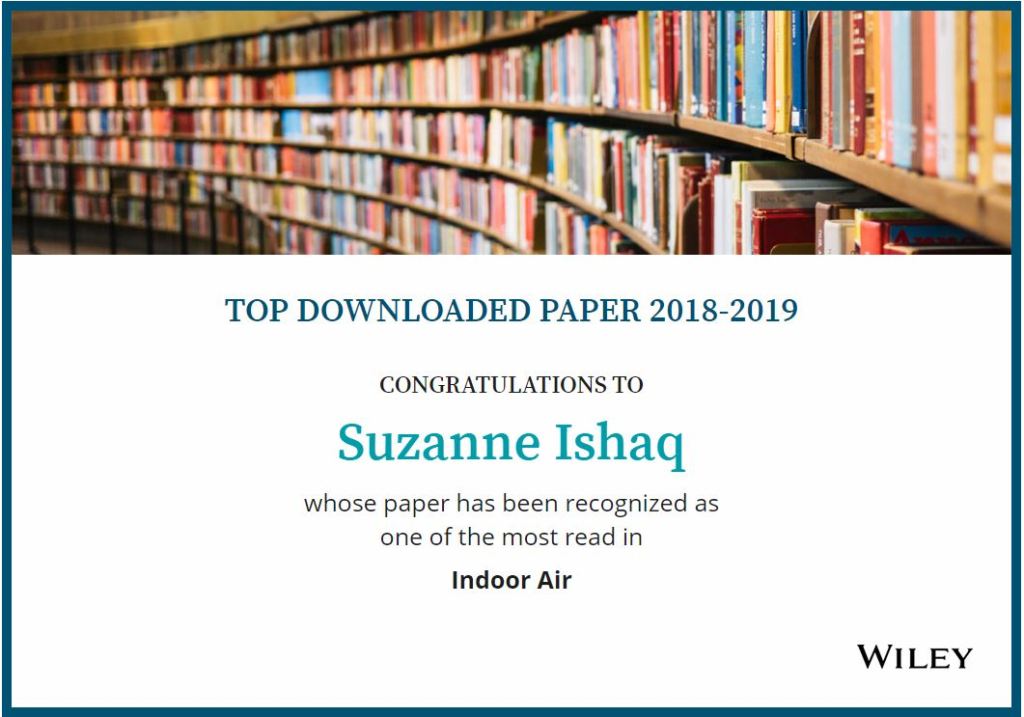
A collaborative review article that I was last author on was listed in the top 10% most downloaded papers of 208/2019 in the journal Indoor Air! Even more impressive, this review was published August 20, 2019, and it was still in the top 10% spanning from January 2019 – December 2019!!
This paper stems from my work on the microbiology of the built environment at BioBE, and reviews the interaction between chemistry, microbiology, and health in the built environment. It was co-authored and led by undergraduate students I was mentoring at the time, as well as research associates and PIs from the BioBE lab, and a variety of fabulous collaborators!
I’m pleased to announce that I have been approved for full Graduate Faculty status in the Ecology and Environmental Sciences Program at the University of Maine! EES is an interdisciplinary program that allows for flexibility of scope in research and graduate study. I am now able to:
advise PhD, MS, and non-thesis MS students in EES
serve on the graduate committees of EES students
design and teach EES-designated grad and undergrad courses
Today a large-scale federal grant proposal was submitted, bringing me to four proposals submitted so far in 2020 (and eight total in the 2019/2020 academic year)! I have one more that is planned for the end of May, and two more that may be submitted this summer depending on the disposition of my pending proposals. Each of these proposals takes weeks to months of planning, writing, and coordination between the research team. The proposal submitted today was 107 pages, and only some of those materials can be re-used between grants, such as descriptions of equipment and research facilities.
So. many. supporting documents.
The success rate for obtaining federal funding for your project varies by agency, year, and category of project/principal investigator, nicely tracked here (updated Dec 2019), and currently ranges from 8 – 30%. For example, “pilot” project (small projects to “seed” your long-term research), student-specific, or “new investigator” grants may have a higher rate of success because their applicant pool is restricted by eligibility. Competition is fierce, especially when federal agency budgets are cut or re appropriated.
If projects are not funded, they are returned with reviews from typically 2 – 4 experts in the field who provide comments and recommendations for strengthening the experimental design, or the presentation of the project itself. You might think that proposals are judged on the merit of the science alone, but the ability of the team to manage the project, and the research team, is also being evaluated. Principal investigators (researchers like me, leading the project) need to show that we have good ideas and the organizational skills to implement them, especially if the project spans multiple years or institutions.
Submitting a research proposal is worth celebrating – it represents weeks of effort – but especially during this time when we are all trying to keep our head above water, never mind accelerate or productivity. It’s important to take a few minutes to relax, work can wait, because ‘the grind’ will be there waiting for you when you get back.
2020 has … gone in a very different direction than the way we probably all thought that it would back in early January. The emergence of the SARS-CoV-2 (COVID-19) pandemic has dramatically altered the way we live our day-to-day lives, and the way we think about ourselves as a global community. To reduce the transmission of the virus, the University of Maine, and many other schools and institutions, made significant alterations to their operating policies over spring 2020. This included sending students home (where possible), moving classes to online instruction only, asking faculty to work from home, and restricting laboratory and field work. This has resulted in some disruption to my plans, so here’s an attenuated post about updates over the last few months.
Teaching
The courses I am teaching this spring lent themselves well to being taught strictly online, with some modifications. Naturally, the presentations class works better in person where the stress of having an audience present promotes in situ training. The students were able to give an elevator speech, a regular short presentation for a peer-level audience, and a peer-level audience presentation with random technical challenges introduced by me into the slides. The remaining portion of the semester was devoted to giving presentations to a public-level audience, which requires a different presentation style and a good deal of thought into how much info is condensed and what you can and can’t expect your audience to already know. It was going to be too logistically challenging to organize public presentations remotely with short notice, so instead I had students create annotation notes for someone else’s slides, described here.
What was a technical challenge you had during a presentation? I'm teaching a presentation course and one assignment I mess with the students' PPT to introduce tech problems I've encountered before. Like videos don't play, slides in wrong order, screen flickers, PPT won't play…
The data analysis class was easier to adapt, but required adjustment nonetheless. Instead of hosting a three-hour video meeting each week, I recorded the remainder of my lectures and made them available well in advance, so that students could watch and listen when they had time and internet access. During the class period, the class met to collaboratively work through data, which was always the goal, but with the challenge of remote work some re-imagination of the assignments was needed to allow students to opt-in to some of the work at times convenient to them.
To simplify the work, instead of having students independently perform similar analyses on different sets of data, I had them perform similar, somewhat independent, analyses on the same dataset, allowing them to all work collaboratively. As a bonus, this unpublished dataset was one that I have been working on collaboratively over the past year, so the students will be able to opt-in to participating in the publication of this work. This is in addition to the two manuscript which are slated to be submitted for review in the next few months, and two more under development. Because that’s still in development, I won’t share more detail now, but stay tuned to those results, and a more in-depth discussion on integrating student data analysis education with research.
My DNAseq data analysis students had 10 wks to learn R, amplicon seq processing/analysis, re-purposing stats knowledge to microbial data, and manuscript writing. These were new to most students, but I'm blown away by their quality. #IntegratedResearchAndTeaching#SoMuchGrading
Since starting at UMaine in September 2019, I have been working on establishing my lab. Most of that effort thus far has revolved around rearranging my lab spaces and acquiring specialized lab equipment. This aspect hasn’t been negatively impacted, outside of the new logistical challenges of delivering large pieces of equipment to locked buildings without coming into contact with delivery drivers.
However, acquiring supplies has been impacted, as certain materials are suddenly in extremely high demand, while production of others has dramatically reduced for the time being. Although I hadn’t begun any wet lab research which needed to be halted, I was just about to start culture work and training students on laboratory protocols, which has now been delayed for at least two months. Instead, I am in the process of transitioning student projects from benchtop-based to data analysis-based, at least for those students planning on graduating between now and spring 2021.
I am also focusing on trying to get previously completed projects written up and sent out for review, including a study on bacterial communities around window components in hospital rooms with the BioBE lab, a few collaborations on gut microbes in different animal species with the Yeoman Lab, and two more papers on the effect of climate, farming system, weed competition, and plant health on wheat production and wheat-associated soil bacteria with the Menalled/Seipel Lab. You can read the pre-print (meaning it hasn’t been peer-reviewed yet) on the soil microbes one here.
I do have some concrete exciting news, though, two graduate students will be joining my lab this summer/fall to start work on master’s of science degrees! Johanna Holman will be working on diet and gut microbiome in humans, for a master’s in Nutrition and Food Science, and Sarah Hosler will be working on new methods for investigating gut microbial communities in animals, for a master’s in Animal Science.
Looking forward, I’ll be changing my plan for training students on laboratory work, to facilitate social distancing measures while ensuring that students aren’t alone in the lab. Luckily for me, my labs and soon-to-be-office have windows between them so I can hover from a different room entirely.
Outreach
Social distancing has temporarily impacted my outreach activities, particularly in the short term as we try to adjust. A lecture I had planned for the Maine Organic Milk Producers annual meeting was canceled in April, although I’ll now be able to talk about Microbes and Social Equity at the Institute for Health in the Built Environment Industry Consortium annual meeting in May since it has been moved from in-person to online. Similarly, I am participating in a few discussions for other summer events and whether they might be transitioned to online formats. In the mean time, I’ve been practicing coming up with pithy interactions on Twitter.
I know a number of scientists who have gotten tattoos visualizing their science. For me, though, I think the most on brand science tattoo would be a simple line of code with a typo in it.
A number of scientific conferences which I was planning to attend and/or have research presented at have made the decision to postpone, including the American Society for Microbiology’s Microbe 2020, International Society of Microbial Ecology’s ISME18, the Gordon Research Conference’s Microbiology of the Built Environment (MoBE) 2020 meeting, the American Society for Nutrition 2020 meeting. Other scientific conferences are attempting to switch to online formats, such as the Ecological Society of America (ESA) 2020 meeting, but bringing thousands of participants together in an interactive way is an extremely ambitious adaptation in such a short period of time.
Looking forward, I hope that many organizations will adjust and maintain their commitment to online accessibility of conferences, meetings, talks, and other outreach events, as well as making these resources available after the event. Attend a conference or public presentation is important to building you research program and improving the impact of your work, but financial, physical, logistical, or familial considerations often make it impossible to participate. Maintaining remote-accessibility, and making content available after the event, are important steps in making science more inclusive and allowing a broader audience to participate.
As a new assistant professor at the University of Maine, 50% of my appointment is research. To establish my research, I started with curating a space to fulfill the needs of my work — “professional nesting”, if you will. I was allotted two adjacent rooms for my lab work, one as a microbial culturing space, and one for genomics work. I asked for and was granted separate spaces to reduce to likelihood of contamination sourced from my culturing space.
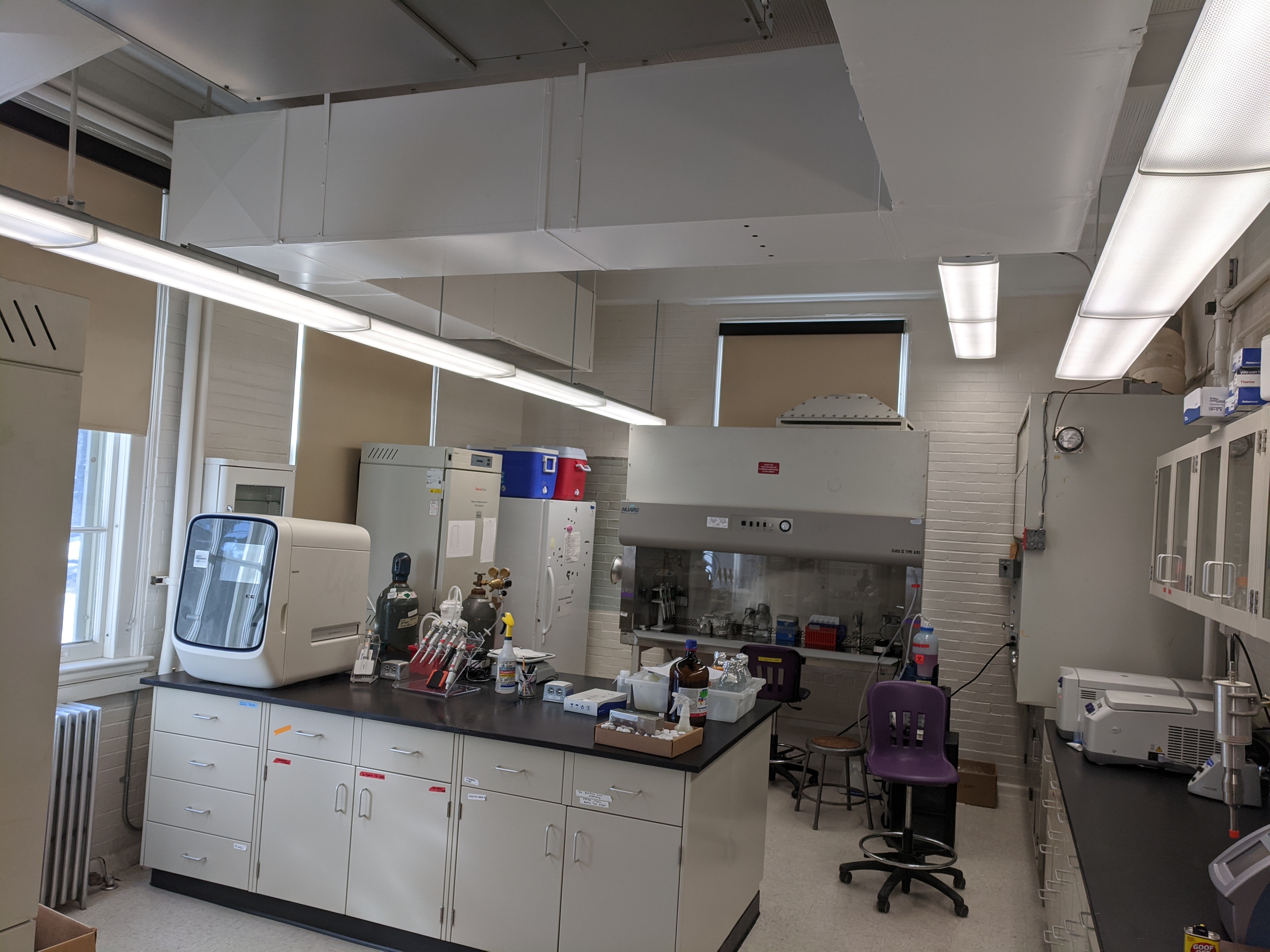
Prior to my arrival at the University of Maine, both lab spaces were set up to perform different research from what I do. This may not seem like it would interfere with my work, but the type of research you do will influence the machinery you need, each of which may have space or utilities requirements, as well as the flow of traffic through the room. To reduce the amount of time you spend moving around the room in search of elusive supplies, it’s best to curate work stations within the room. To that end, the Ishaq lab team spent several days re-arranging the large machinery and the table-top equipment, and then moving the supplies to the cabinets in corresponding locations. This change was most evident in the genomics room, that was previously used for human cell culture and biochemistry, shown below. At this time, I’m still working on updating the microbial culture room, which is larger and contained many more bits and pieces to organize.
Most research labs use extremely specialized equipment and machinery. Some of this was made available to me immediately; when research labs are discontinued, ownership of equipment and consumable materials reverts back to the researcher’s home department. I needed to purchase some of the more research-specific equipment, using some of the funds allotted to me for this purpose. Buying equipment can be stressful, because it can be incredibly expensive, and you want to be sure you selected the machine brand and range of capabilities for what you might want to do over the next 5 – 10 years, at least.
A 230 lb. crate was delivered to my lab, and since I hadn’t seen a shipping notification, it was a surprise!
A temporary solution, but the dPCR machine is ready to use!
Finally, you need to stock your lab with reagents and researchers, but both of these have been temporarily put on hold as of March 2020, as we do our part to reduce the transmission of the Covid-19 virus. Whenever it is safe to do so, I look forward to completing the updates to my spaces and opening them up for collaborative work.
I’m delighted to officially announce that the Ishaq Lab is welcoming two new graduate students this year, Johanna Holman and Sarah Hosler! Both of them will be working on dynamics of the gut microbiome, and starting a master’s of science this summer/fall. Johanna and Sarah are wonderful additions to our current, enthusiastic team, and the Ishaq Lab can’t wait to see what you achieve!
Johanna Holman
Fall 2020 Masters of Science, Human Nutrition and Food Sciences
Johanna is joining the lab in Fall 2020 to investigate the effects of diet on the gut microbiome, and on host-microbial interactions.
Sarah Hosler
Fall 2020 Masters of Science, Animal Science
Sarah is from Newton, NJ and has lived in NJ her whole life until she started college at Albright College in PN. Her undergraduate research was on protein classification. Sarah is joining the lab in Fall 2020 to create new methods for studying host-microbial interactions.
“I am excited to see how much I grow through my graduate experience at the University of Maine. I’m also a little bit nervous about the cold, but I’m sure I will get used to it.”
I’m pleased to announce that a small grant proposal I am part of was just funded by the Northeastern Integrated Pest Management (IPM) Center! The proposal, “A Working Group on Tarping and Soil Solarization”, brings together researchers and food production professionals from across New England to identify the current use of tarping and soil solarization to prevent weed growth without the use of chemcials, as well as identify barriers to adoption of this practice, and develop research proposals to fill any knowledge gaps related to the use of these methods and their effect on crop production, weed suppression, soil microbiota, and the local ecosystem.
Led by Dr. Sonja Birthisel (UM), the working group team is comprised of Dr. Alicyn Smart (UM), myself, Master Nathalie Lounsbury (UNH), and Eva Kinnebrew (UVM). We will be joined by over a dozen other researchers across New England who perform agricultural research, along with dozens of ‘stakeholders’: producers and other food production professionals who have an interest in the group findings and would make use of any knowledge we generate.
Now that I’m an assistant professor, a significant amount of my time is spent writing grant proposals to fund projects I’d like to do in the future.
Many large federal or foundational grants take up to a year from submission to funds distribution, and the success rate, especially for newly-established researches, can be quite low. It’s prudent to start writing well in advance of the due date, and to start small, with “pilot projects”.
To that end, I’m pleased to announce that Dr. Lily Calderwood and I just received word that the Wild Blueberry Commission of Maine is funding a pilot project of ours; “Exploration of Soil Microbiota in Wild Blueberry Soils“. We’ll be recruiting 1 – 2 UMaine students for summer/fall 2020 to participate in the research for their Capstone senior research projects.
Dr. Calderwood is an Extension Wild Blueberry Specialist, and Assistant Professor of Horticulture in the School of Food and Agriculture at UMaine. She and I developed this project when meeting for the first time, over coffee. We realized we’d both been at the University of Vermont doing our PhD’s concurrently, and in neighboring buildings! We got to chatting about my work in wheat soil microbial communities, and her work on blueberry production, and the untapped research potential between the two.
This pilot will generate some preliminary data to help us get a first look at the soil microbiota associated with blueberries, and in response to management practices and environmental conditions. From this seed funding, Lily and I hope to cultivate fruitful research projects for years to come!
One of the biggest challenges faced by STEMM (science, technology, engineering, math, medicine) advocacy groups is finding the time and resources to propose and execute initiatives, as well as find the time for social media engagement to grow the group. There are a number of groups already established in Maine which seek to promote STEMM advocacy/education, accessibility, diversity/equity/inclusion, campus community members, and the general public.
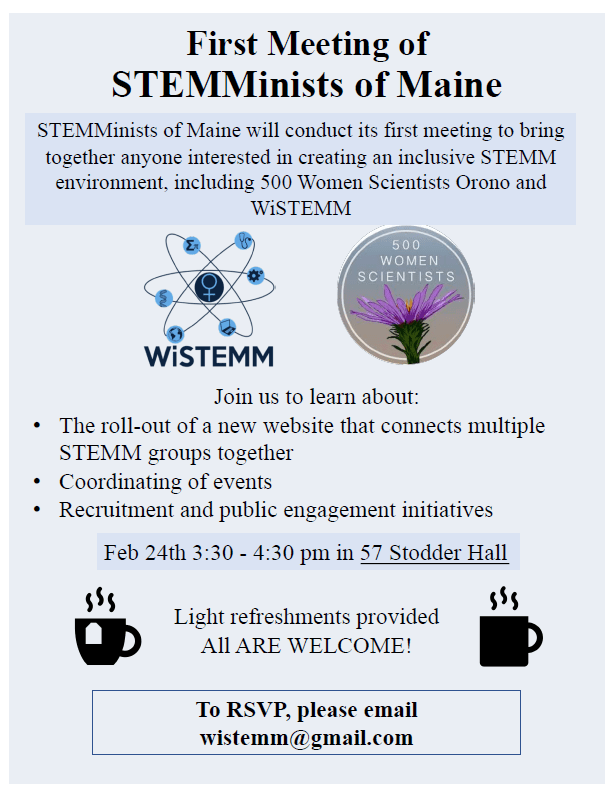
STEMMinists of Maine is a newly-formed STEMM advocacy group, which seeks to bring together these various groups. Our goal is to act as an umbrella organization, to create a cohesive social media presence that makes it easier for people interested in STEMM advocacy and inclusion to find resources, coordinate events, and get the message out. All participating groups will remain autonomous, but participation (which is free) will hopefully allow us all to reach a broader audience and have a greater impact in both campus and state-wide initiatives.
Our inaugural meeting will be held at the University of Maine campus, 57 Stodder Hall, to introduce STEMMinists and invite others to be part of our work to promote a better STEMM community. All are welcome!
Shortly after, our website and social media will be finalized and launched!
The Ishaq lab has been quietly growing, and we had our first official meeting today! I can’t wait to see what we accomplish together.
We are all such rock stars, we needed to meet virtually to keep up with our busy schedules!
Top left: Adwoa, a PhD student in Dr. Jen Perry’s lab, working on kombucha microbes. Top right: in the office with me, Alexandria, an MPS student working on research techniques for gut microbes. Bottom left: senior member Tindall, a MS student at Montana State University in the Menalled/Seipel lab working on soil microbes. Bottom left: Johanna, incoming MS student in nutrition who will be working on diet and gut microbes. Undergrad Emily couldn’t make it, and we have a few more pending members and affiliates joining us in 2020.