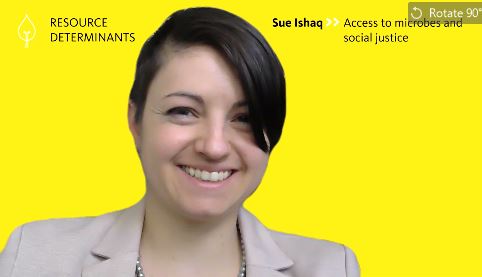
This fall, my speaking engagements will all be held virtually, to aid in ongoing infectious-disease-prevention protocols. While in place to reduce the spread of SARS-CoV-2, these same protocols will also help me avoid the annual fall respiratory infection that I otherwise inevitably encounter while working with overly-stressed students.
But, staying away from others doesn’t mean I can’t stay connected! Virtual events might not feel as fun, but they have allowed me to reach a wider audience, because recorded talks are made available after the live event. And, annotated or subtitled recordings make my talks more accessible!
This fall, I have several public talks and scientific presentations lined up:
University of Maine Cooperative Extension Oxford County 4-H Teen Science Cafe (virtual), “Gut microbes on the farm”, Oct 15, 2020. For teens, this event is free but does require registration to obtain the link.
Genomes to Phenomes (G2P) group, University of Maine. Co-hosting a session with grad student Alice Hotopp, on gut microbes and survival of reintroduced animals. Oct 30, 2020. Link available to University of Maine community members.
University of Maine Medicine seminar series (virtual), “A crash course in the gut microbiome” , Nov 6, 2020. This event is open to the public and free, but does require registration to obtain the link.
Hotopp, A., Silverbrand, S., Ishaq, S.L., MacRae, J., Stock, S.P., Groden, E. “Can a necromenic nematode serve as a biological Trojan horse for an invasive ant?” Entomological Society of America 2020 (virtual). Nov 15-18, 2020. This pre-recorded seminar requires paid event registration.
Yeoman (presenter), C., Lachman, M., Ishaq, S., Olivo, S., Swartz, J., Herrygers, M., Berarddinelli, J. “Development of Climactic Oral and Rectal Microbiomes Corresponds to Peak Immunoglobin Titers in Lambs.” Conference of Research Workers in Animal Diseases (CRWAD) 2020. (Virtual) Dec 5, 2020. This seminar requires paid event registration.
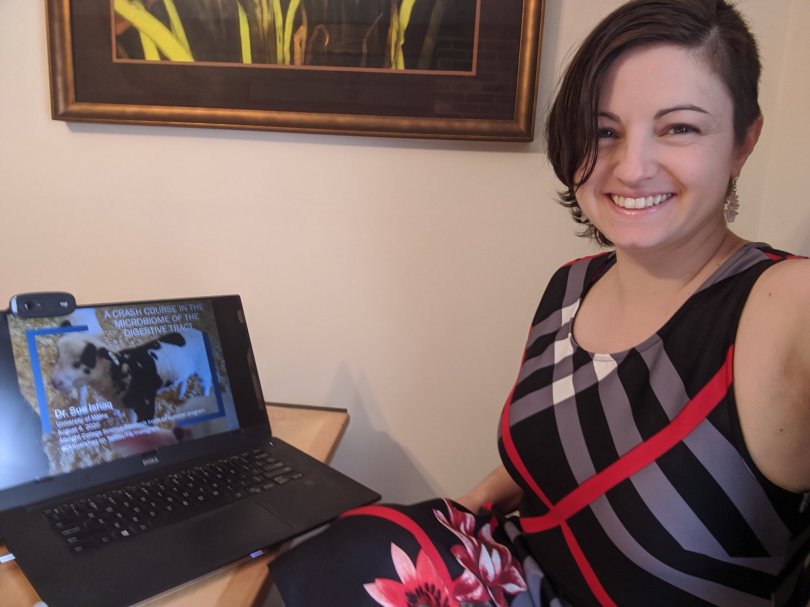
Almost ready for my "Microbes on the farm" presentation to the Oxford County 4H kids! And I finally had to chance to use this photo from my 2015 lamb study. pic.twitter.com/cq43EctXWZ
Fall 2020 is the beginning of my second year as an assistant professor at the University of Maine, but in some aspects, it feels like my first year.
The most prominent visual which evokes this feeling is the new office I just moved into last week. My new office space overlooks my two renovated lab spaces and allows me to witness the first official Ishaq Lab research take shape. My first office was in a building across the street from the two labs, all of which I was inheriting from a previous lab. This reduced our output for several reasons, in particular because undergraduates could not access or be left alone in the lab early on in their training. For several months, when students were in the lab, I was there, too, trying to maintain productivity while on my laptop. And, I needed to be present for several deliveries, meaning I would have to wait around. For the better part of the last year, several students and I have redesigned the space to fit our needs, and it was only over this summer that the microbiology space finally was sorted. Now, I can be close by to answer questions, sign for packages, and sort out problems.
Before (as a nutritional biochemistry lab) and after (as a microbiology lab). Anaerobic chamber is not in the photo frame.
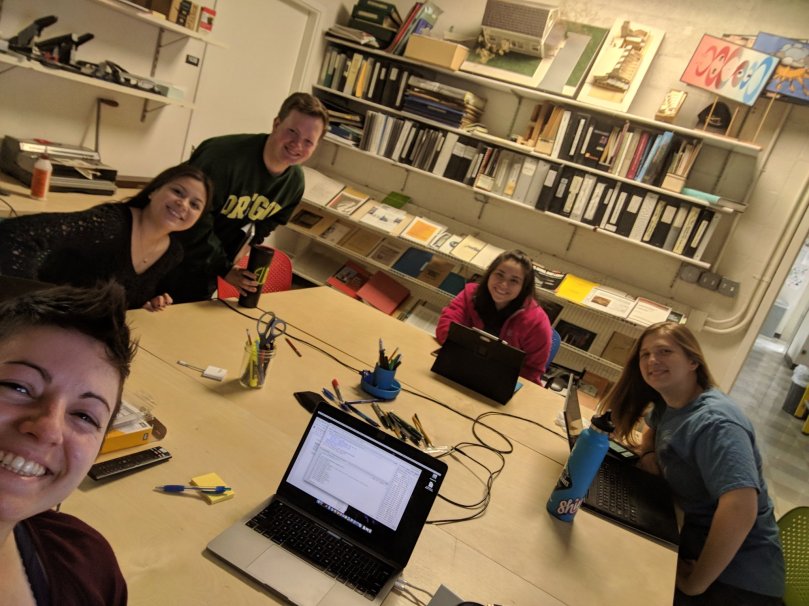
Not only do I have spaces ready for my research, but this year I am also starting with students to perform it. It takes time to recruit students to your lab, and graduate students take particularly long because of application submission or funding start dates. Over the past year, I have been joined by two thesis master’s students, one non-thesis master’s student, 3 graduate students from other labs who do collaborative work with mine, 6 undergraduate researchers, and a handful more partial time undergraduate researchers through the Animal Science Capstone class (more on that further on). The projects range from gut microbes and health, soil microbes in blueberry fields, the use of leaves for home silage, lobster microbes and water temperature, and more! The team is dynamic, curious, and a delight to work with.
To ensure that we stay safe, we manage our lab occupancy with a shared lab calendar (and several of the students are performing partial or fully-online projects). Both spaces are designated for Biosafety Level II work, which means we are already wiping down surfaces with disinfectant before and after use, wearing gloves and a lab coat, and washing our hands before and after work. The air exchange systems stay on to prevent moisture or fume buildup, and they also remove particles from the air, but I have added HEPA filtration units in each lab and my office to remove additional particles (including viruses) from the air. A robotic vacuum in each space cleans dust and settled microbes off the floor each night. In addition, we now limit occupancy, wear masks when multiple people are in the room, and check in/out of the space to facilitate contact tracing.
This semester also feels like my first because I am teaching official courses for the first time. Between the two courses, I am teaching over 50 students! I expect that to increase next fall as my new course becomes more well-known, and as recruitment and retention continue to rise in Animal and Veterinary Studies.
I’m also teaching one on undergraduate research which is a long-standing class that I generated some new materials for. I will teach part of this each fall, and part each spring. Over the academic year they participate in research, then write proposals and reports.
Students generated a word cloud of descriptors for ‘scientist’. At the end, we’ll make a new cloud to see if their impressions change after participating in science.
Over the fall, I have a number of research projects to wrap up from the spring, such as data analysis projects which arose from my DNA sequencing data analysis course, one of which on ants I was invited to present at the virtual Entomological Society of America scientific conference in November! I’m also wrapping up a few small projects which originated over the summer, such as the blueberry soil pilot or the lobster microbes data analysis performed by my REU student-turned-direct-hire. I’ll also be starting several new projects on the interaction between gut microbes and the host, led by my graduate students and a number of undergraduates, which will form the core of the research in our lab.
In addition, my Microbes and Social Equity working group is gaining traction! At over 40 participants, the MSE group has been met with interest and enthusiasm from different research and professional fields, and levels of career stage. We are planning to collaborate on a journal special collection, as well as organize a mini meeting sometime in 2021. I look forward to bringing attention to important and timely work on microbes, health, and public policy!
From their main page, you can find descriptions of each virtual session, including subject material, presenter, and recommended age group (k-12). You can register for as many or as few sessions as you like, which will be delivered over Zoom.
Registration is free! But if you are able to donate to support the program, those are welcome through the 4H site.
I’ll be presenting on Thursday, August 13th, 2020 at 3 pm EST.
Learn about different digestive tracts in livestock, and the community of microbes living there that help animals digest food, or stay healthy. This presentation will give some background on different digestive tract anatomy, the factors which influence microbes in the gut, and how we can care for animals by caring for their microbes. This presentation will also feature a short presentation on Dr. Ishaq’s journey into science and a Q&A session where attendees can ask questions about gut microbes, life as a scientist, or how to get involved in this time of career. Register by August 12.
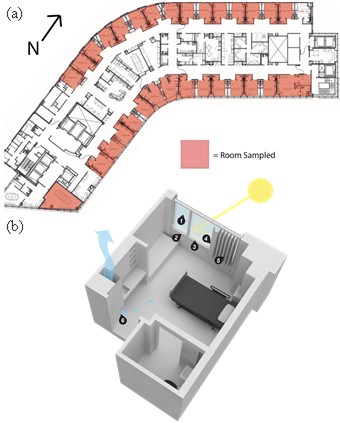
In a 2019 collaboration between the Biology and the Built Environment Center at the University of Oregon and the Oregon Health & Sciences University, we sampled various window surfaces from patient rooms in a hospital ward. We characterized the viable bacterial community located on these surfaces, and investigated the association of relative light exposure of the surface (in direct light or not), the cardinal direction of the room (and roughly the amount of total light exposure in a day), and proximity of the patient room to the nurses’ station (which has higher occupancy and traffic).
Figure 1. Floor plan and rendering of a typical patient room at the Oregon Health and Science University hospital. (a) Floor plan of the 13th floor of Kohler Pavilion (13K) at Oregon Health and Science University (OHSU). Red shading indicates the rooms that were sampled between 10:00 a.m. and 11:00 a.m. on June 7, 2019 (b) Digital rendering of a typical patient room on OHSU (13K) with the sampling locations indicated by the numbers. The sampled locations were (1) window glass surface, (2) the window frame surface facing into the room at the sill, (3) glazing-side of the window frame at the sill, (4) window-side of the curtain, (5) patient-side of the curtain and, (6) wood-covered air return grille.
The microbial community found in buildings is primarily a reflection of the occupants, and in the case of hospitals, the microbiota may be sourced from patients, staff, or visitors. In addition to leaving microbiota behind, occupants may pick up microorganisms from building surfaces. Most of the time, this continuous exchange of microorganisms between a person and their surroundings is unremarkable and does not raise concerns. But in a hospital setting with immunocompromised patients, these microbial reservoirs may pose a risk. Window glass, sills, and the surfaces around windows are often forgotten during hospital disinfection protocols, and the microbial communities found there have not previously been examined.
This paper is the first first-authored research paper from a former undergraduate mentee of mine at the University of Oregon; Patrick Horve.
Horve, P.F., Dietz, L., Ishaq, S.L., Kline, J., Fretz, M., Van Den Wymelenberg, K. 2020. Viable bacterial communities on hospital window components in patient rooms. PeerJ 8: e9580. Impact 2.353. Article.
I’m pleased to announce that an article was published today on soil microbes, climate change, and agriculture! As local climates continue to shift, the dynamics of above- and below-ground associated bio-diversity will also shift, which will impact food production and the need for more sustainable practices.
This publication is part of a series, from data collected from a long-term farming experiment in Bozeman, MT, led by researchers at Montana State University with whom I have published several times, including:
Weed communities and wheat yield are modified by cropping systems and climate conditions. In review.
In this study, cropping system (such as organic or conventional), soil temperature, soil moisture, the diversity and biomass of weed communities, and treatment with Wheat streak mosaic virus were compared as related to the bacterial community in the soil associated with wheat plant roots.
This paper is open-access, which means anyone can read the full paper.
Little knowledge exists on how soil bacteria in agricultural settings are impacted by management practices and environmental conditions under current and predicted climate scenarios. We assessed the impact of soil moisture, soil temperature, weed communities, and disease status on soil bacterial communities between three cropping systems: conventional no-till (CNT) utilizing synthetic pesticides and herbicides, 2) USDA-certified tilled organic (OT), and 3) USDA-certified organic with sheep grazing (OG). Sampling date within the growing season, and associated soil temperature and moisture, exerted the greatest effect on bacterial communities, followed by cropping system, Wheat streak mosaic virus (WSMV) infection status, and weed community. Soil temperature was negatively correlated with bacterial richness and evenness, while soil moisture was positively correlated with bacterial richness and evenness. Soil temperature and soil moisture independently altered soil bacterial community similarity between treatments. Inoculation of wheat with WSMV altered the associated soil bacteria, and there were interactions between disease status and cropping system, sampling date, and climate conditions, indicating the effect of multiple stressors on bacterial communities in soil. . In May and July, cropping system altered the effect of climate change on the bacterial community composition in hotter, and hotter and drier conditions as compared to ambient conditions, in samples not treated with WSMV. Overall, this study indicates that predicted climate modifications as well as biological stressors play a fundamental role in the impact of cropping systems on soil bacterial communities.
Congratulations to all three University of Maine undergrads in the Ishaq Lab for making the Dean’s List in Spring 2020: Jade Chin (AVS), Nicholas Hershbine (EES), and Emily Pierce (AVS)!!
Note, the Bowdoin Dean’s List is announced annually in the fall.
Summer 2020 is…. here. This year has been unpredictable at best, but some things have stayed the same. For example, summer is one of my favorite seasons in which to work in science, because things calm down when the university is not in full session and I’m not facing a deluge of emails, meetings, and myriad small interactions that accumulate to eat up the day. I’ve been taking the time to prepare my laboratory, dive deep into scientific writing, and prepare for the increased teaching load I will have starting this fall.
Manuscripts
You might think that the pandemic causing months of delayed or reduced labwork would have lightened my research load, but I’ve had more than enough to keep me occupied over this spring. Not only have I been submitting a few manuscripts for peer review at scientific journals from my time at the University of Oregon and Montana State University, but I have been working on some unanticipated manuscripts that coalesced this spring. This has included a project with a previous collaborator on diet and health, another based on soil microbial ecology led by master’s student Tindall Ouverson at MSU, and three more which were generated during my DNA sequence data analysis course that I taught this spring! Of these, I am lead author on two and contributing to the others at a variety of depths. Some require a great deal of my time, while others require only editing and review.
I am working on a manuscript compiled from 3 documents: the seq data manuscript from the class I taught, and 2 unpublished honors theses. Taking only what I wanted from each, the unedited compilation was 100+ pages. After weeks of effort we are down to *checks notes* 88.
And then there were 10! I now have three University of Maine master’s students and 4 undergraduate students performing research in my lab, as well as three other graduate students from other labs who are affiliated with us (as in, I am on their committee). In addition to training them on scientific research theory, laboratory protocols, and data management and analysis, they are getting general training in scientific literature review and critique, scientific writing and presentation, and laboratory management.
I am preparing the second of two laboratory spaces for my research, and this space hasn’t been fully renovated in years. While still very functional, there have been a number of remodeling, refinishing, and reorganization steps which needed to be taken to get it in line for biosafety level II microbiology work.
I have been doing much of this work personally, because it’s cheaper, and I have experience in basic home renovations. And, I enjoy the opportunity to put my email inbox away and let my thoughts wander to scientific theory while I use power tools.
When it is ready, I’ll be starting the wet-lab research into gut microbiology and doing more culture work to supplement the genomics work. To aid in that research, I’ve been acquiring more nifty bits of equipment.
Over the spring, I piloted a new course as a special topics version, and I have just been approved to teach that as an official course starting in spring 2021! This summer, I have and will continue to revise my teaching materials from the spring version to prepare them for AVS 454-554 next year.
I’ll be teaching two courses starting in fall 2020, one on animal microbiomes and one on undergraduate research for animal science students. AVS 254, on animal microbiomes, is material I have taught at other institutions with a different course focus. For that course, I will be updating the course material, adding new lectures from scratch, and revising the formatting of powerpoints. I’ll also need to make some of it more accessible for asynchronous online learning, depending on how the semester is organized this fall. This means pre-recording the lectures, and putting more effort into the online learning software I have available.
The other course I am teaching is new to me, AVS 401 (and 402 each spring), the AVS Capstone experience. I’ll be teaching students how to write scientific proposals, research papers, and give scientific presentations, as well as guiding them through participation in research along with faculty mentors. For many students, it’ll be their first experience participating in research. This year, since many students are unable to participate in in-person research and labs have been closed, it’ll be extra challenging to come up with projects, but I have some creative ideas in mind.
Works in development
In addition the above objectives, I have a number of things in development which are not yet ready to be shared in detail. These includes new research collaborations, leading a team to organize a journal special collection, and leading a team to organize and host a (virtual) mini conference meeting in the fall!
Faculty positions and summer work
Now, as an assistant professor at the University of Maine, I’m on a 9-month contract. During the academic year, I devote 50% of my time to research-related activities, and 50% to teaching/advising/mentoring– related activities. I have the option of working in the summer, or taking it off unpaid. However, my summer salary is contingent on me being awarded research funds which will pay for the work, something which is not guaranteed in this funding climate. It is generally not advisable for pre-tenure faculty to spend summers idle, and in any case, I would inevitably have to perform work of some kind over the summer to keep pace with my workload.
I am lucky enough to have start-up funding which can pay up to 2 months of summer salary per year during my first 3 years; however, I am expensive: one month of my summer salary is the equivalent of 1 full-time undergraduate researcher for 3 months, or a sizable chunk of a research project. On the one hand, I want to value my time and effort, and being paid for summer research helps close the gender pay gap for salary and retirement contributions. On the other hand, I am also forced to consider how to get work done on a reduced budget, should federal funding not come through. After all, being awarded tenure is contingent on productivity.
In May, I was adamant about taking the entire month of July off, as 2019 and 2020 have been incredulously busy and stressful and I haven’t had a vacation since Feb 2019. Now, at the end of June, I’m not sure I could take off a full summer month and still output all of the above, plus be prepared for the challenges of teaching this fall. At least my working-from-home view is more or less a vacation-scape, and some surprise home renovations will at least keep me away from electronic screens for some of it.
Not only is the ongoing ‘COVID-19’ pandemic a collective experience and historical event, it has changed the way we interact with each other and with our infrastructure. It’s pertinent to incorporate these events into teaching curricula, not only to study these changes in real time, but to help us make sense of what is happening during these difficult days. A number of faculty at the University of Maine have been and will be integrating various aspects of the pandemic into their teaching. For my part, I’ll be guiding students on research projects related to how COVID-19 and public policy has affected agriculture and veterinary practice.
“COVID has very suddenly and dramatically changed the way we interact with each other, and has had repercussions for food, agriculture and animal care industries,” Ishaq says. “Students need to understand these changes to build more resilient and sustainable food and health care systems.”
“Faculty incorporate COVID-19 content into curricula”, Marcus Wolf, June 23, 2020
A second course that I developed was accepted at the University of Maine! AVS 454-554 DNA Sequencing Data Analysis will be offered to undergraduate and graduate students starting Spring 2021.
AVS 454-554 teaches bioinformatics using DNA data. Starting with raw DNA sequencing data, students go through the process of quality assurance, statistical analysis, graphics design, as well as drafting a scientific manuscript. The course integrates research into teaching by using unpublished data, ideally data the students bring from their own research projects. Not only do students learn highly sought-after analytical and scientific writing skills, but it makes them active participants in research and their own learning. Most of the course time and skillset are focused on amplicon sequencing data, but we’ll also dabble with whole-genome, metagenomics, and metatranscriptomics.
Along with my Introduction to Animal Microbiomes course, I hope to get students interested in microbial ecology earlier in their studies, such that they have time to get involved with microbial ecology research in Maine in time for them to develop a Capstone research experience around it in their senior year. And what a coincidence, I’ll be teaching the Capstone courses for AVS (401 and 402) starting in fall 2020, as well.
This course is based on the precursor version, AVS 590, which I taught as a small, special topics version in the 2020 spring semester. And, even that is conceptually based on a lab section I taught at Montana State University in 2015 and 2016. DNA data analysis and I go way back.
Photo credit: Tom Rayner, Tenure Chasers
It can take several months to get course proposals approved, especially if you are proposing they meet general education requirements, are listed as required for a major degree, or have other levels to them. I started Sept 1, and the AVS faculty curriculum committee, the first step in the approval process, was meeting in early October. I didn’t have time to develop two course proposals in time, so I first proposed my data analysis course as a “special topics” version. These versions are offered selectively and are not counted the same way as an approved course. But, it gave me time to shore up my teaching materials, and teach several students who were graduating and couldn’t wait another year to learn these skills.
DNA sequencing data analysis is challenging to teach as well as to learn, but once over the learning curve, it can be extremely fun and rewarding. I’ve previously taught bioinformatics to undergraduates, and have or continue to publish with a number of them. In AVS 590 in the 2020 semester, there were 4 datasets being analyzed, and 3 of those led to manuscripts which are anticipated to be submitted to for review in scientific journals sometime this year!
IHBE meeting organizers did a fantastic job at facilitating a remote meeting with a dozen speakers across multiple time zones. This included creating formatted slide decks for speakers to populate, coordinating sections by colors and symbols and providing respective virtual backgrounds for section speakers to use, and use of breakout rooms for smaller discussion groups.
I presented “Framing the discussion of microorganisms as a facet of social equity in human health“, and you can find a recorded version of the presentation here. There are no closed captions, but you can read the audio as annotations here:
The concept of “microbes and social equity” is one I’ve been playing with for a little over a year, and has developed into a colloquium course at the University of Oregon in 2019, an essay in PLoS Biology in 2019, and a consortium of researchers participating in “microbes and social equity part 2”. The Part 2 group has been developing some exciting research events planned for later in 2020, and those details will be forthcoming!