I’ve got quite a busy summer ahead! You’ll be able to find me at:
June 22, 2018: The HOMEChem Open House at the UT Austin Test House , University of Texas at Austin’s J.J. Pickle Research Campus. I’ll be meeting with BioBE collaborators to discuss pilot projects exploring the link between indoor chemistry and indoor microbiology.
July 15 – 20, 2018: The Microbiology of the Built Environment (MoBE) Gordon Research Conference, University of New England in Biddeford, ME. BioBE’s Dr. Jessica Green is meeting Vice Chair.
July 22 – 28, 2018: Indoor Air 2018 Conference in Philadelphia, PA. I’ll be presenting some of the work I’ve been part of, exploring the effect of weatherization on bacteria indoors.
In 2016, I was a post-doc in the Menalled Lab, which studies plant and weed ecology in the context of agricultural production and sustainability. There, I assessed soil bacterial communities under different farming management practices and climate scenarios. I also helped to develop a grant proposal, which was just accepted by the USDA AFRI NIFA Agricultural Production Systems! Leading this project is Dr. Fabian Menalled (as Principal Investigator, or PI), along with a number of other PIs; Dr. Amy Trowbridge, Dr. David Weaver, Dr. Tim Seipel, Dr. Maryse Bourgault, and Dr. Carl Yeoman, and collaborators Dr. Darrin Boss, Dr. Kate Fuller, Dr. Ylva Lekberg, and myself as a subaward PI. I will again be providing microbial community analysis for this project, and collectively the project investigators will bring expertise in plant ecology, agronomy, economics, soil and plant chemistry, microbial ecology, agroecosystems, and more.
This research and extension project focuses on the needs of dryland agricultural stakeholders and it was designed in close collaboration with the NARC Advisory Board. While I was only able to attend one meeting, other team members regularly meet with Montana producers to discuss current issues and identify locally-sourced needs for agricultural research. During this project, we will continue to meet with the NARC Advisory Board to share our results, evaluate implications, and better serve the producer community.
Diversifying cropping systems through cover crops and targeted grazing: impacts on plant-microbe-insect interactions, yield and economic returns.
Project summary
The semi-arid section of the Northern Great Plains is one of the
largest expanses of small grain agriculture and low-intensity livestock
production. However, extreme landscape simplification, excessive reliance on
off-farms inputs, and warmer and drier conditions hinder its agricultural
sustainability. This project evaluates the potential of diversifying this region
through the integration of cover crops and targeted grazing. We will complement
field and greenhouse studies to appraise the impact of system diversity,
temperature, and precipitation on key multi-trophic interactions, yields, and
economic outputs. Specifically, we will 1) Assess ecological drivers as well as
agronomic and economic consequences of integrating cover crops and livestock
grazing in semi-arid systems, 2) Evaluate how climate variability modify the
impacts of cover crops and livestock grazing on agricultural outputs. Specifically,
we will 2.1) Compare the effect of increased temperature and reduced moisture
on agronomic and economic performance of simplified and diversified systems,
2.2.) Assess the impact of climate and system diversity on associated biodiversity
(weeds, insect, and soil microbial communities) and above- and belowground
volatile organic (VOC) compound emissions, and 2.3) Evaluate how changes in
microbially induced VOCs influence multitrophic plant-insect interactions.
Objectives
Assess key ecological drivers as well as agronomic and economic consequences of integrating cover crops and livestock grazing in semi-arid production systems
Compare the agronomic and economic performance of simplified and diversified systems
Assess the impact of cover crops and livestock grazing on the associated biodiversity (weeds, insects, and the soil microbiota)
Evaluate how climate conditions modify the impacts of cover crops and livestock grazing on semi-arid production systems
Compare the effect of temperature and soil moisture on agronomic and economic performance of simplified and diversified systems
Assess the impact of climate and system diversity on associated biodiversity and above- and belowground volatile organic compound (VOC) emissions
Evaluate how changes in VOCs emissions influence important multitrophic interactions such as resistance to wheat stem sawfly and natural enemy host location cues
Integrate the knowledge generated into an outreach program aimed at improving producers’ adoption of sustainable diversified crop-livestock systems
It’s been a really busy spring so far, so much so that I haven’t had much chance to write about it! Here is a brief overview of what I’ve been up to.
Research
This past year has easily produced the largest number of research topics I have been working on concurrently. In addition to publishing a paper on the rumen in cattle last September, I have been working on a paper on the rumen of yearling rams which is currently in preparation and due to be submitted to a scientific journal for review soon. I still have several small projects in development from my post-doc in the Yeoman lab, as well as a number of grad-student-led papers that are still pending, and was invited to contribute to a scientific review which is also in preparation.
I’ve been working through the large dataset of soil samples from my post-doc in the Menalled lab. That large project has blossomed into four papers thus far, two of which I’m writing on the soil bacteria, and one of which I am co-authoring on the legacy effects of climate change. Those four are also due for submission to scientific journals for review soon. The Menalled lab just received a grant award from USDA AFRI NIFA, on which I am a (subaward) PI and to which I will be contributing soil bacterial community analysis.
The rumen and soil work over the past year has been entirely in my spare time, however, as my position in the Biology and the Built Environment Center has kept me delightful busy. I have been collaboratively processing a large and complex dataset on weatherization, home operation and lifestyle, indoor air quality, and microorganisms in dust, which I will be presenting at two (possibly three) conferences this summer. I have also been collaboratively writing grant proposals, and while those are still in development or pending review, they span everything from light, to chemistry, to plants and living machines, to hospitals, to social networks in buildings. I hope to further develop some of these collaborations with a short trip at the end of June to the University of Austin, Texas’ Test House.
In addition, I have been assisting in the planning, development, and launch of the University of Oregon’s Institute for Health in the Built Environment. The Institute will facilitate collaboration and information sharing between researchers and industry professionals, with the goal of researching, building, and promoting healthier built environments. The Institute just hosted its #BuildHealth2018 Consortium meeting in Portland, OR, at which I presented some of the results from that large weatherization study regarding indoor plants. The meeting was fantastic, and spurred in-depth discussion on problems facing industry professionals, innovative research goals, and a wealth of new possibilities.
Outreach
In the past few months, I’ve spent a lot of my spare time helping to develop the Eugene Pod of 500 Women Scientists, an organization created to promote diversity, equity, and inclusion in science, and to promote education and interactive between scientists and the general public. We have focused on hosting monthly Science Salon events, four to date, to do just that. I presented at the first one, and have helped organize and MC the others. The Eugene Pod’s activities were just featured on the central 500 WS page, as Pod of the Week, and you can also follow our updates and events on our Facebook page.
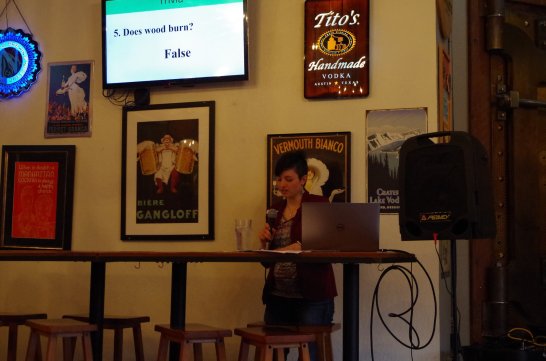
Running trivia on fire and fungi.
While it has been a struggle to maintain regular contributions, I still maintain Give Me the Short Version, along with a few intrepid contributors, which summarizes scientific articles for easier consumption. This spring, I spent several days judging STEM and robotics competitions for several local Eugene middle and high schools, which has been a lot of fun. The student projects are enthusiastic and creative, and I appreciate the chance to assist in these programs in some small way.
Today I'm judging a middle school #Robotics competition, for their #STEM research award. I'm so excited to see what these kids created! #sciencesaturday
I have continued to mentor UO students. The post-bac student from the BioBE lab that was learning bioinformatics with me, Mitch Rezzonico, was accepted to the University of Oregon’s Bioinformatics and Genomics Master’s Program! Mitch wrapped up his work this spring to prepare for the intensive program, and with his interest in health research, BioBE hopes to work with him again in the future. BioBE recently hired an undergraduate student for science communication, Mira Zimmerman. Mira has been making some upgrades to the BioBE and ESBL websites which will continue to be rolled out over the next few months. In addition, she will be helping me develop informative blog posts on the built environment, and helping to grow our information dissemination capabilities. Hiring a student as a science communicator was something I had been hoping to test out, and so far it’s been a smashing success.
Teaching
My course proposal for “Introduction to Mammalian Microbiomes” was accepted by the University of Oregon Clark Honor’s College for the fall term!
In April, I gave a guest lecture to Mark Fretz’s Design the Unseen course at the University of Oregon, on the Indoor Microbiome. The class was populated by architecture students, who were learning about integrating health considerations into design strategies. As a final project, students design a brief field experiment or intervention strategy for a design assistance project with Portland firms. I assisted one group in designing a small experiment on natural daylighting in an office and the effect on E. coli growth on culture plates – more on those results soon!
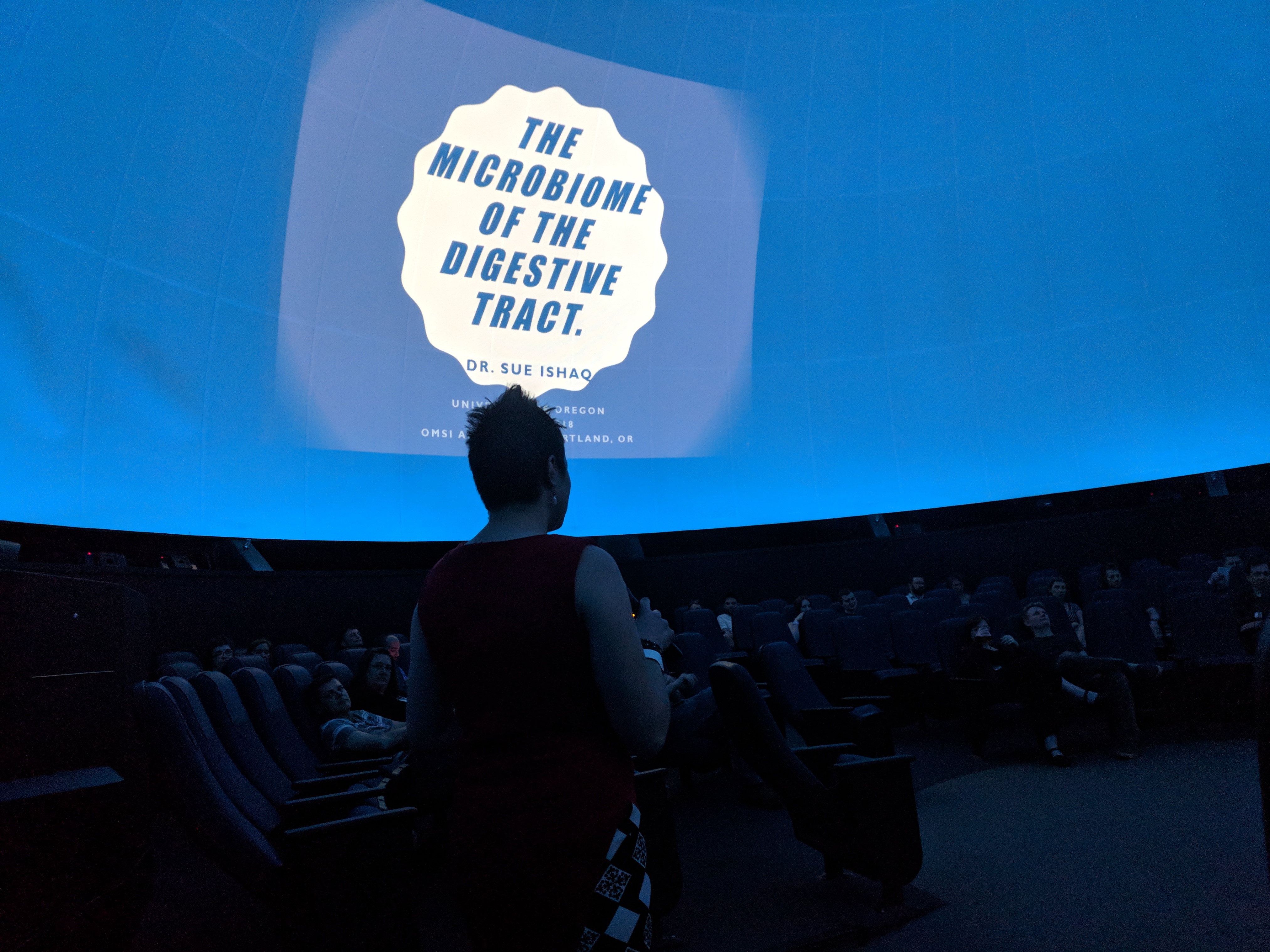
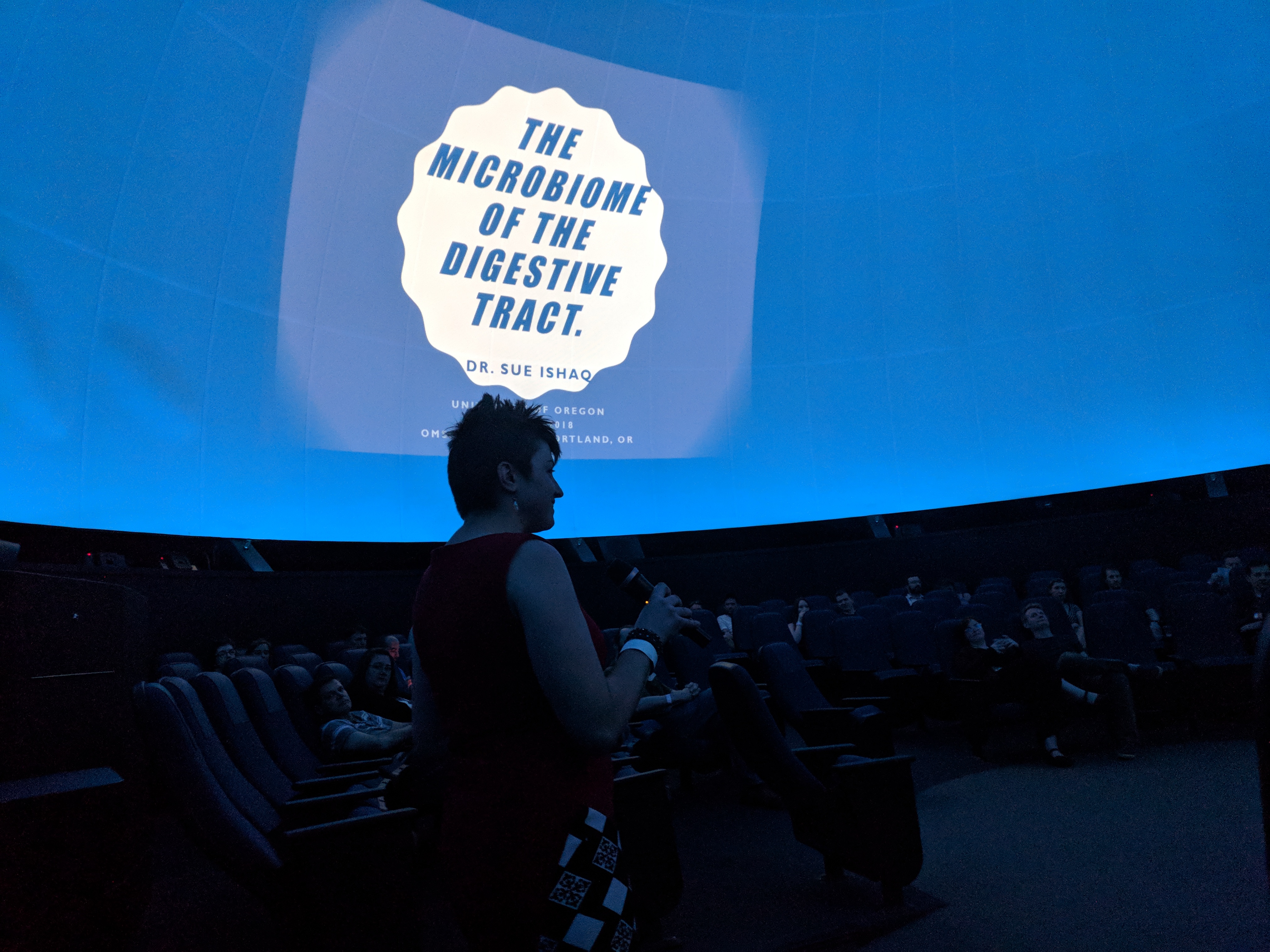
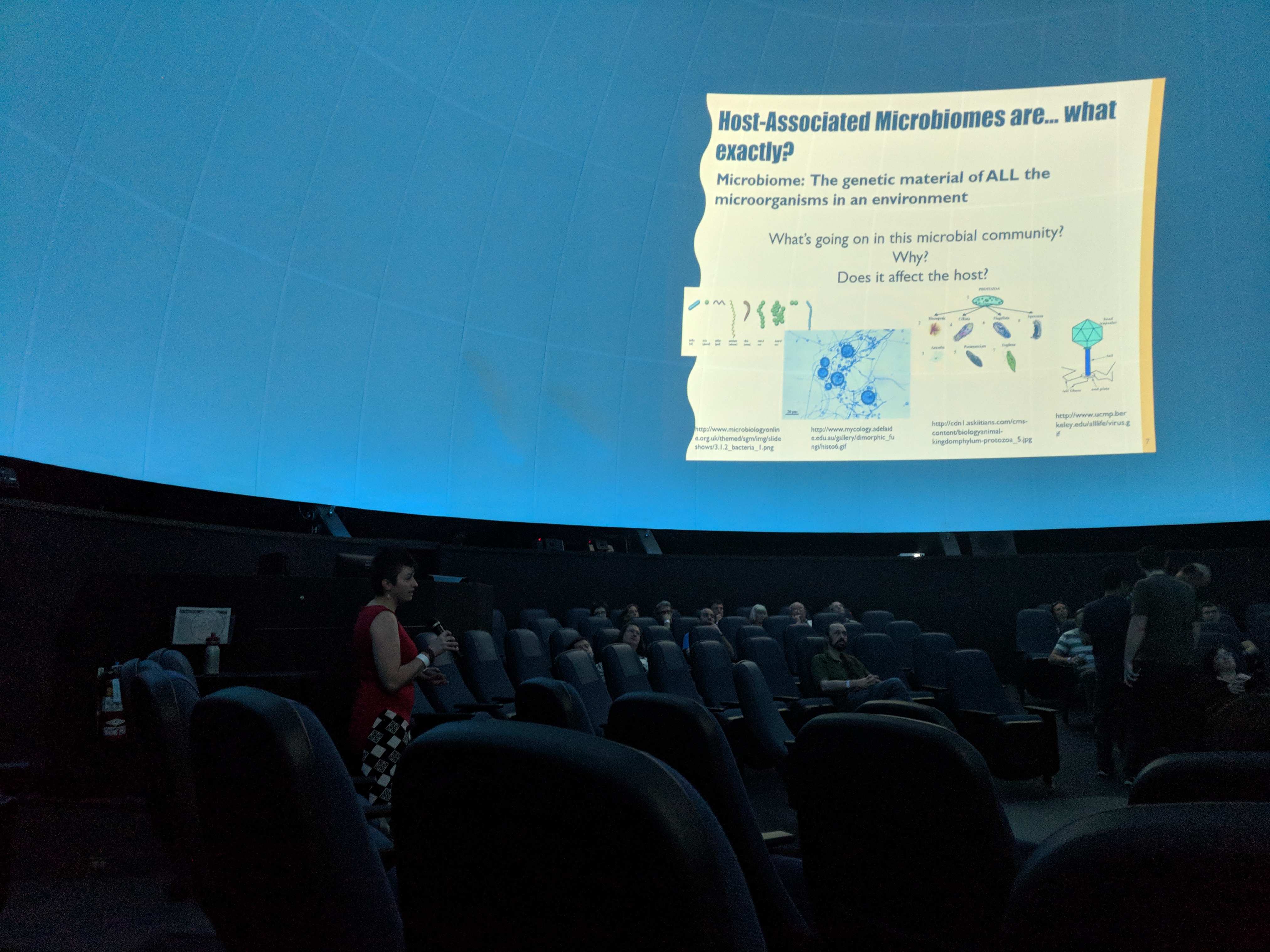
Later that same day, I have a lecture at the Oregon Museum of Science and Industry in Portland, as part of their OMSI After Dark series which opens the museum after-hours to adults for hands-on activities and lectures. The lecture was on the gut microbiome, and I was able to present in the Planetarium!
Last night I participated in the Oregon Museum of Science and Industry (OMSI) After Dark event: “It’s Alive! (Mind and Body)”. OMSI regularly puts on After Dark events, where adults can check out the museum, listen to lectures in the planetarium, and engage in interactive science experiments and activities, all while enjoying an open bar. Last night, I had a great time giving a short presentation on “Ishaq OMSI After Dark 20180425“!
I’m very pleased to announce that I’ll be teaching a course this fall on “Introduction to Mammalian Microbiomes”, with the University of Oregon Clark Honors College. I hope that this will be the first of many courses taught at UO, beginning with my background in “host-associated”, and expanding out into “house-associated”.
Course Description: Introduction to mammalian microbiomes.
The learning objectives of this course are to introduce students to basic concepts in host-associated microbiomes. Some background in microbial ecology, genetics, anatomy, bioinformatics, or immunology would be helpful, but is not required. While difficult concepts will be discussed, the course is intended to teach students about the basic principles: what is a microbiome? How does host anatomy drive microbial ecology? How does that community develop over time? How does it change? How does technology inform our understanding of these systems, and what limitations does that technology introduce? When we read about host-associated microbiomes in the news, especially regarding health, how can we assess if the study is rigorous and how should be interpret the scope of the findings? The skill-set objectives include learning to review complicated journal articles, distilling their findings while understanding their limitations, and developing science communication skills in a variety of formats.
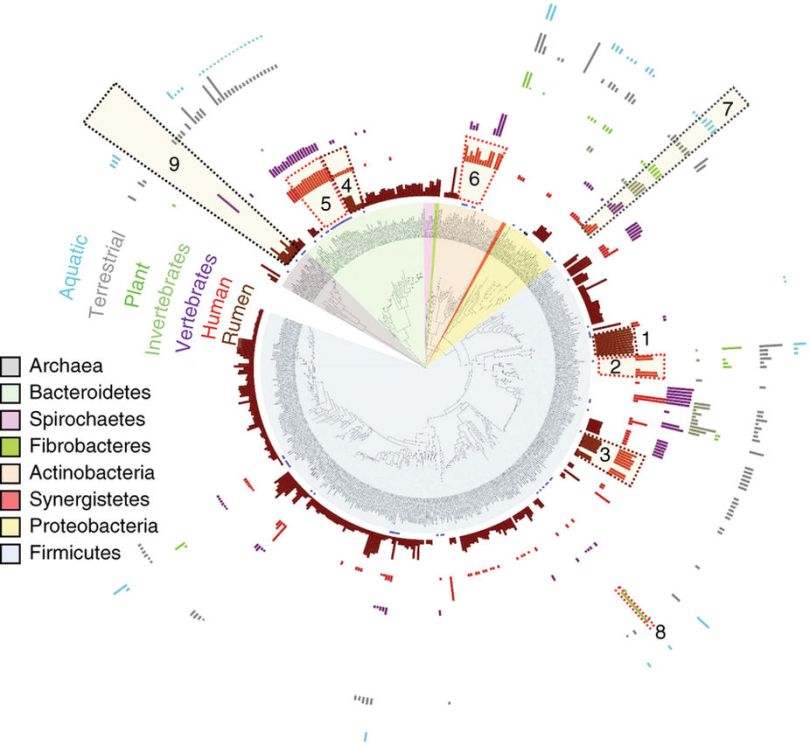
The Hungate 1000 Project was a massive undertaking: namely, sequencing the genome of 1000 microorganisms cultured from ruminant animals all over the world, and was both coordinated and led by the Rumen Microbial Genomics Network. After years of hard work by some incredible researchers, the Hungate 1000 has just been published in the Nature Biotechnology Journal! The […]
For the past two months, I’ve been spending quite a bit of time writing grant proposals. In particular; those which expand our understanding of indoor lighting on human health and behavior, the indoor microbiome, and energy usage in buildings. These project proposals are collaborative efforts between several University of Oregon research labs: Biology and the Built Environment Center, Energy Studies and Buildings Laboratory, and the Baker Lighting Lab. I’ll have more updates in the next few months as those are reviewed.
Siobhan “Shevy” Rockcastle, Chair of the Baker Lighting Lab, and I have been brainstorming ideas, and today I went over to the Baker Lab to check it out in person. The Lab is decorated with concept-design lighting projects from previous students, which are not only beautiful, but extremely creative. Here are a few of my favorites!
Most studies that examine the microbial diversity of the gastrointestinal tract only look at one or two sample sites, usually the mouth, the rumen in ruminant animals, or the feces. It can be difficult, expensive, invasive, or fatal to get samples from deep inside the intestinal tract; however many studies have pointed out that anatomical location and local environmental factors (like temperature, pH, host cells, nutrient availability, and exposure to UV light) can dramatically change a microbial community. Thus, the microbes that we find in feces aren’t always what we would find in the stomach or along the intestines. On top of that, certain microorganisms have been shown to closely associate with or attach to host cells, and the diversity of microbes next to host tissues can be different from what’s at the center of the intestines (the digesta).
This large, collaborative project took samples from nine different sites along the digestive tract of calves over the first 21 days of life to determine how body sites differed from each other, how sites changed over time as the calf matured, and how the lumen-associated bacteria would differ from the digesta-associated bacteria. Samples from the mothers were also taken to understand how maternal microbial influence would affect body sites over time.
This paper was just published in Scientific Reports, and was something I had previously presented on at the Joint Annual Meeting of the American Society for Animal Science, the American Dairy Science Association, and the Canadian Society for Animal Science in Salt Lake City, UT in 2016.
The impact of maternal microbial influences on the early choreography of the neonatal calf microbiome were investigated. Luminal content and mucosal scraping samples were collected from ten locations in the calf gastrointestinal tract (GIT) over the first 21 days of life, along with postpartum maternal colostrum, udder skin, and vaginal scrapings. Microbiota were found to vary by anatomical location, between the lumen and mucosa at each GIT location, and differentially enriched for maternal vaginal, skin, and colostral microbiota. Most calf sample sites exhibited a gradual increase in α-diversity over the 21 days beginning the first few days after birth. The relative abundance of Firmicutes was greater in the proximal GIT, while Bacteroidetes were greater in the distal GIT. Proteobacteria exhibited greater relative abundances in mucosal scrapings relative to luminal content. Forty-six percent of calf luminal microbes and 41% of mucosal microbes were observed in at-least one maternal source, with the majority being shared with microbes on the skin of the udder. The vaginal microbiota were found to harbor and uniquely share many common and well-described fibrolytic rumen bacteria, as well as methanogenic archaea, potentially indicating a role for the vagina in populating the developing rumen and reticulum with microbes important to the nutrition of the adult animal.