The Interviewing Game

Interviewing for research positions is challenging, and when it’s for a job at a university, the process can be lengthy and the competition fierce.  Some jobs for which I applied reported receiving 60 to 160 applications for a single opening.  When it comes to highly coveted positions, like tenure-track faculty jobs, the slow reduction in research funding and ever-increasing pool of PhDs can result in up to 400 applications per opening.  One faculty member eloquently provided stats on their job search, which involved more than 100 applications over two years.  I applied to a mere 22 jobs over a period of seven months (just counting the 2016-2017 season), but the lengthy process generated plenty of questions from family and friends who were dismayed by the slow trickle of news.

The Search Committee

The job posting needs to be carefully crafted.  While most academic positions are looking for candidates with specific skills or research backgrounds, many faculty positions are open-ended so that a wide variety of candidates may apply.  Any required elements of the job, such as teaching specific courses, advising, or extension activities, are often explicitly stated in the posting.  Once funding for a job position and a post has been approved, the search officially opens.  A search committee is formed, which is comprised of several members of the department, and perhaps members of other, closely related departments at the university.  They may aid in the drafting of a job posting, but will be in charge of reviewing every application, selecting candidates for and performing preliminary and full interviews, following up on references, and making final recommendations.

The Application

Applications require a Curriculum Vitae, which lists your education and other professional training, all the positions you have held, professional memberships you belong to, certifications, awards, publications, public presentations, courses taught, career development activities, students you have mentored, and any other skills that might be relevant.  Some applications require official transcripts, and all require letters of reference.  These may need to be provided at the time of the application, or may be requested later by the committee when you have been added to the short-list of potential candidates.  Your letters of reference not only confirm the skills you have claimed in your application, but they provide a glimpse into what it is like to work with you, so it’s best to pick someone who knows you well.

The brunt of the academic application is several essays that detail your experience, philosophy, and vision for each aspect of the job in question.  Some universities limit these to one to three pages each, but others allow you the freedom of word count.  Typically, you must provide a Statement of Research and a Statement of Teaching, and some may request Statements of Mentoring, or Diversity.

The Statement of Research asks you to detail previous work, the skills you have acquired, and important contributions your research has made.  Here, you outline your experience in obtaining grants, or your plan to obtain them in the future, as well as describe the work you would like to perform at the university and the lab members you would like to bring in (undergraduates, graduates, technicians, postdocs).  Outlining your proposed research can be tricky,  as you want to add your expertise to the ongoing departmental research, but without being redundant or too novel.  That might seem counter-intuitive, but if a department doesn’t have the equipment or funding to support your research, or similar researchers that can provide a research support network, it may be difficult for you to perform your work there.

Similarly, the Statement of Teaching asks you to explain in detail your previous teaching experience, and your philosophy of how courses should be developed to improve student learning, incorporate current research or hands-on experience into the curriculum, and use technology to increase student engagement.  Here you can suggest courses that you would like to develop or take over teaching, based on your knowledge base, if the position involves teaching.

Additional Statements may be requested to provide specific information on your philosophy of mentoring students, especially your Statement of Diversity for training new graduate students, or recruiting minority students to science and providing career development opportunities to underrepresented demographics.  The cherry on top is the cover letter that summarizes why you want the job and why you are the best choice.

The Wait

Applications may be solicited for several weeks or months, and some accept applications on a rolling basis until the position is filled.  You will receive a notification, usually automatic, that your application has been received by the system, and perhaps another one to notify you that the review has begun.  Otherwise, you have little communication unless you are selected for the short-list or the position has been filled.  I have waited more than 6 months to hear back about an application before.

It’s time to meet our first three eligible candidates…

The short-list is a subset of applicants, several or several dozen perhaps, that the committee would like to have a phone or video interview with, typically lasting 15 to 60 minutes.  Depending on the number of applications received and when the job posting  closed in relation to the end of the semester, you may not hear about a preliminary interview until several months after you have applied.  Questions requiring detailed answers are often provided in advance, but otherwise, preliminary interview questions usually ask you to reiterate what you might have put in your application: why you want the job, whether you have experience working collaboratively, where you see yourself in five years, etc.  These questions may probe your interpersonal skills, such as whether have you managed others, or whether you have dealt with academic conflicts.  Having been through a number of tele-interviews, I can say that they are more difficult than they seem.  You have a brief time in which to make an impression, and it can be difficult to read a room which you can’t see.

Round 2

From the short-list, two to four candidates are selected for full, in-person interviews, which are scheduled as soon after the phone interviews as possible.  These are complicated to schedule, as they are one to two full days for which the candidate and most members of the department need to be available.  You are required to present a seminar of your research, both past and future.  Depending on the position, you may be required to present a teaching seminar as an example of your style, or perhaps a “chalk-talk” where the committee can ask you questions on potential grants or experimental designs.  You will also have one-on-one interviews with university faculty and staff that you may be working with, tours of the research facilities, and a chance to tour the university.  From experience, even when the interview goes perfectly, they are exhausting. For two days straight you are talking about yourself, your work, your ideas, other people’s work, and potential collaborations.  You are listening attentively, trying to give the best impression possible, and eating meals as quickly as possible while still talking about yourself and hoping you don’t have food stuck in your teeth.

Only once all the selected candidates have been interviewed will the search committee deliberate.  They solicit impressions and opinions from everyone you met- faculty, staff, graduate students, technicians, as well as from your professional references.  They will decide if a candidate is ineligible for an offer for any reason, and rank the eligible candidates.  They will then make recommendations to the department chair or administrator, who will decide whether to extend an offer.

Negotiations

When a job offer is first made, it is a non-binding offer.  Negotiations then take place until both parties are satisfied, and a written, contractual offer will be offered.  University positions have salary ranges by hiring level and experience, and a certain, somewhat unknown, amount of additional funding available for other benefits like relocation, computers, or basic research materials.  Tenure-track or other high-level research positions in the STEM fields typically come with start-up funds, which provide initial funding to buy equipment and lab materials, or fund lab personnel to get you started on pilot studies that can be leveraged for grant funding.

Screen Shot 2017-06-27 at 9.33.02 PM
http://www.glasbergen.com

This is the most delicate phase because this is your best chance to determine your salary, your title, and the specifics of your job requirements.  For example, you can use this opportunity to discuss when and how much you will be asked to teach, what your start date is, whether the department will reserve a teaching or research assistantship so that you may offer it to a new graduate student, and other non-specific benefits.  If you have multiple offers, you might ask one to meet the benefits proffered by another.  On the other hand, universities only have so much they can offer you, regardless of how much they like you.  Remember, you aren’t out to “win”, you are out to satisfactorily arrange a contract with the people you will soon be working with- both parties need to be pleased with the offer.  If an agreement can’t be reached, or if you accept a different offer, the second-ranked candidate will be offered the job, and so on.

Nothing is finalized until both parties have agreed to terms, a background check has been completed, and the contract is signed.  From application to contract, the process may take 6 to 12 months, and it may be a further several months before you officially begin, which is a long time to provide vague answers to eager questions from friends and family.  On top of that, most interviews are semi-confidential: you are not supposed to know who the other candidates are, so it is bad form to ask about them or for the department to discuss them with you, even after you have accepted the job.  And, most applicants keep their interviews quiet until they have a job offer.  For one thing, it’s not worth getting everyone’s hopes up for every application.  For another, you don’t want a prospective job to pass you over because it looks like you are going to accept another offer, as candidate searches are expensive to conduct and occasionally don’t lead to a hire (failed search).  There is also the potential for an uncomfortable situation to arise at your current job when they know you are leaving, although the pervasive search for job security and work-life balance in academia means most people sympathize with your search for the right job.

I choose… Candidate #3!

In the end, much of it comes down to luck: the right department needs to be looking for a candidate like you and have their hiring line approved, you need to find their posting, you need to craft an application that appeals to them while representing your interests and goals, and you have little to no idea who else might be applying.  Often jobs will be posted at an open hiring level to attract a wider variety of candidates, so you might be applying at the lower hiring end but are competing with people who have years more experience than you do.  And it’s important to remember that everyone in science has a large amount of technical training – we are all fantastic candidates and that makes it difficult to choose only one of us.

Since departments or fields don’t relist open positions predictably, most research job hunters will apply to jobs in their field to cover your bases, as well as several closely related fields (for me, it was animal science, microbiology, molecular genetics, microbiomes, bioinformatics, and any combination of those words); you are afraid to lose a whole year because you didn’t apply to enough postings.  This increases the applicant pool size, and provides departments with interesting research directions to take the potential hire in; sometimes you don’t know what kind of candidate you want until you meet them.  Moreover, you don’t really know if you will fit with a university, department, or research team until you have had some time to interact with them during the interview.  Really, applying for a job in academia is a lot like dating.  Some people go on many first date interviews, some on very few, in order to find the right match.  Either way, it’s fun to play the game, but to win you need to ‘make a start date’.

Featured Image modified from The Dating Game show logo.

If at first you don’t succeed… you’ve got the makings of a thesis.

In a recent post on The Rare Knowledgesphere, I mentioned that I when I tell people that I went to graduate school or explain what I do now, the replies can be overly modest or self-deprecating.  Sometimes, people tell me that they don’t feel smart enough to make it through grad school or to do what I do.  Graduate school or other professional schools aren’t for everyone, but there is a big difference between not wanting to go and not feeling good enough to go.  In my experience, people who think they can’t do it aren’t so much incapable as incapacitated by Imposter Syndrome.  In my 9 total years of acquiring higher education, plus 2 years and counting of post-doctoral training, I find that when it comes to academic success, academic achievement frequently takes a backseat to having the right personality.  In this post, I thought it would be helpful to describe some of those qualities that help set the most successful researchers apart.

Learning is a skill

Don’t get me wrong, you need to pass the graduate record examinations (GREs- general and subject) in order to be accepted, be able to understand the material once you are there, do well on exams, and maintain a certain grade point average (GPA).  While grades and exam performance can be good metrics for intelligence, there are a lot of circumstances that could preclude someone from doing well, thus they aren’t the only metrics.  Certainly you need a solid knowledge base in any subject in order to participate in it.  But I don’t usually get asked by people I pass on the sidewalk to explain how 20 different enzymes react instantaneously when you consume a meal in order to alter your metabolism to maintain homeostasis.  I am asked on a daily basis to assimilate new information, process it, and then apply it to my work.  Whether it is learning a new skill (like learning to perform a laboratory technique or how to analyze data I have not worked with before), whether it is evaluating a proposed experiment and looking for flaws in the experimental design, or whether it is reviewing someone’s manuscript for validity and publish-ability, I need to be able to learn new things efficiently.

Learning is a skill, just like wood-working or weight-lifting: you need to start small and practice regularly.  Learning a new skill, language, or activity challenges us.  Not only can it broaden our view of the world, but continuing to learn throughout your adult life can improve health and cognitive function: essentially, the more you learn the better you become at learning.  In addition to physically performing new tasks, reading is a great way to inform yourself while improving your reading comprehension skills, verbal IQ, and  critical thinking so that you can assess the accuracy of the information.  Scientific texts, even for those who are trained to read them, can be extremely difficult to fully comprehend.  Articles are full of very technical language, explain new concepts, and often rely on a certain amount of knowledge inherent to the field.  It’s tempting to read quickly, but in order to do this you efficiently it can help to be systematic and thorough.

study cards

You may not feel you are ready for graduate school, that you belong in grad school, or that you are ready to leave, but grad school isn’t the end point- it’s a learning experience to become a good researcher.  Even once you leave, you never stop learning.  Good graduate students don’t have to know everything, but they do need to know how to learn and how to search for answers.

Put on a happy face

You don’t need to love grad school, your work, or the process of research every second of every day, and you don’t need to pretend to, either.  It can be difficult, and like with any job, there are good days and bad days.  A hardy personality falls a close second to being able to learn new skills.  The road through graduate school is arduous and different for everyone, and it takes a tough person to make it out of the labyrinth of Academia.  Moreover, you are truly surrounded by your peers; everyone in graduate school has already maintained a high GPA, passed the GREs, gotten into grad school, etc.  You are probably never going to be the smartest or most accomplished person in the room again, certainly not for a long time.

You need to be able to take criticism, and not just the constructive kind: not everyone maintains polite professionalization and at some point, someone will bluntly tell you that you don’t belong in graduate school.  For me, this occurred about two years in, when I submitted my first manuscript.  A reviewer mistook my statement that a certain type of photosynthetic, water-based bacteria were present in the rumen of moose (who acquire them by drinking swamp water) for saying that those bacteria normally lived in the rumen of the moose, and commented that the latter was incorrect, that I did not know what I was doing, and that I did not belong in science.  To be sure, being able to deliver information in journal articles in an accurate manner is critical, and if a reviewer mistakes what you say in a manuscript, then you need to clarify your statements.  If a journal article is found to be unsuitable for publication, the reviewer can recommend it be rejected and offer commentary on how to improve re-submissions. However, it is widely accepted to be inappropriate and unprofessional to make personal comments in a review.  I was taken aback at how one misinterpreted sentence in a 5,000 word article could lead someone who had never met me to determine that I wasn’t suited for science.

In the end, I clarified that sentence, resubmitted, and the paper got accepted.  Four years later, that article has been viewed over 6,500 times and several other papers have come out identifying bacteria of that type living in the gastrointestinal tract of animals.  Research is a competitive field, and by its nature requires repetition and trouble-shooting.  You need to be able to fail on a daily basis and still find the enthusiasm to learn from the results and try it again tomorrow.

Two heads are better than one

Working well with others is extremely important in graduate school (and really any work environment).  In graduate school, other people can challenge you, help you reason through problems, identify holes in your logic, or add a perspective based on their personal experiences.  In science, you can never be an expert in everything, and to be able to really answer a research question you need to be able to look at it from different angles, methods, or fields.  Collaborations with other scientists allow you to bring a breadth of expertise and techniques to bear in projects, and can improve the quality of your research (1, 2, 3).

However, it can be difficult to wrangle so many researchers, especially when everyone is so busy and projects may span years.  Emotional intelligence, the ability to empathize, has been found to contribute to academic intelligence and can foster interpersonal relationships and collaborations.  When money, prestige, and ideas are on the line, the drive to be recognized for your work needs to be balanced with empathy in service to completing the experiments and disseminating the results.  At some point in academia, personal conflict will jeopardize a project.  As much as you have a right to recognition and reward for your hard work, you need to remember that other project members are due the same.  That being said, as a graduate student you don’t always feel in a position to negotiate and may feel pressured to minimize your contribution or the thanks to which you are due.  Settling on an order for authorship, or credit for contributions, is a conversation that needs to happen early, often throughout the project, and inclusively to acknowledge that you all worked hard for this.

Organization

Being able to juggle taking classes, teaching and grading, performing research, attending meetings, and all the other hundred things one must do in an academic day, takes a high degree of coordination.  Your calendar is your friend: schedule everything from meetings to reminders about tasks.  And using shared calendars really helps to schedule meetings or remind others.  There are plenty of apps that are specific to laboratory scheduling needs to help coordinate meetings or assign tasks across multiple parties.

30-rock-school-supplies-liz-lemon.jpg
30 Rock

Even more important these days is digital organization: whether it be your email or your hard drive.  You need to be able to confidently curate and store data or electronic materials so that you or someone else can find them, even years later.  You never know when you will need to resurrect an old project or check on a method you once used, and without a solid paper trail you may not be able to locate or understand your digital breadcrumbs.  Lab notebooks, protocols, data files, and knowledge need to be accessible to future members, and it is your responsibility to make them available and intelligible.  There is nothing more frustrating than finding an unlabelled box of samples in a freezer and being unable to identify their owner or contents.  While the Intellectual Property might be yours, if that research or your salary was paid by a university or governmental agency, you have a responsibility to make that information public at some point.

A high degree of organization can help you manage your time, keep track of your results, coordinate with others, and maintain a project schedule.

A spoonful of extra-curricular helps the biochemistry go down

Work-week expectations, course load, teaching load, research load, and financial compensation of graduate students vary by the nature of their appointment, by university policy, or even by department within a university.

Graduate Teaching Assistants are paid a stipend for providing undergraduate teaching and other miscellaneous help to the department (typically 20 hours per week), and may receive tuition compensation for the classes they take.  Depending on the nature of the program, they may do research as well in order to write a thesis (masters) or dissertation (doctorate), or not do any research for their degree (non-thesis major). Graduate Research Assistants (GRAs) are hired strictly to perform research (again, usually 20 hours per week), for which they receive a stipend and/or tuition compensation, and also take classes.  Most programs require GRAs to teach for one semester to gain the experience, and GRAs are almost exclusively performing research for a thesis/dissertation-based degree.  Regardless of the type of appointment, there are a certain number of classes and hours of research which must be logged before a degree may be obtained.  Between courses, teaching, and research, there is enormous pressure on graduate students to work more than 40 hours per week.

It might seem that immersing yourself in graduate school is the best way to be a good student.  Or, maybe you are overwhelmed by the amount of work you are being asked to accomplish and feel pressured to spend 12 – 18 hours a day at it just to meet deadlines. Firstly, you are not lab equipment and should not be treated as such.  As a student, as an employee, and as a person, you have rights in the workplace.  It’s worth looking into university policy to see exactly what it required of you.  Secondly, over-working yourself is a terrible way to be more productive, as I discussed in a previous post on work-life balance.  To summarize that post, over-working yourself negatively affects your health, your cognitive function, and the quality of your work.  On the other hand, taking regular breaks and vacation can help keep you focused and solve abstract problems.

In addition to helping you manage stress, having an active life outside of your program helps give you other experiences from which you can draw upon to aid your graduate work. For example, I worked for several years at a small-animal veterinary hospital before going to graduate school, at which I trained employees and had extensive interactions with customers.  There, I gained the skills to manage others, simplify technical information, be very specific in my instructions, or maintain a professional demeanor in the face of emotional or chaotic events.  My interests in painting and photography have improved the quality and presentation of graphical results, or visually document my experiments.

Learn to Type

Seriously.  I spend most of my time at a computer: reading, writing, cut/pasting.  If you can type as quickly as you can gather your thoughts,you’ll find that you are much more productive.

phd022410s.gif

Draft twice, submit once: the grant writing process

Today, the research team that I am a part of submitted a grant which I co-wrote with Dr. Tim Seipel, along with Dr. Fabian Menalled, Dr. Pat Carr, and Dr. Zach Miller. We submitted to the Organic Transitions Program (ORG) through the US Department of Agriculture’s (USDA) National Institute of Food and Agriculture (NIFA).  The culmination of months of work, and some 12+ hour days this past week to meet today’s deadline, this grant will hopefully fund some very exciting work in agriculture!

Research relies on grant money to fund projects, regardless of the type of institution performing the research, though commercial research centers may partially self-fund projects.  Most new research hires to universities will receive a “start-up package” which includes some funding for a few years to buy equipment, pay for a small, preliminary project, or temporarily hire a technician. Start-up funds are designed to hold a researcher over for a year or two until they may apply for and receive grant funding of their own.  Sooner or later, everyone in academia writes a grant.

startup
Cartoon Credit

Grants may be available for application on a regular basis throughout the year, but some grant calls are specific to a topic and are made annually.  These have one submission date during the year, and a large number of federal grants are due during in the first quarter of the year, a.k.a. Grant Season.  University researchers find themselves incredibly pressed for time from January to March and will hole up in their office for days at a time to write complex grants.  Despite the intention of starting your writing early, and taking the time to thoroughly discuss your project design with all your co-PDs well before you start writing to avoid having to rewrite it all again, most researchers can attest that these 20-30 pages grants can get written over from scratch 2 or 3 times, even before going through a dozen rounds of group editing.

The Bright Idea

Most large grants, providing several hundred thousand to over a million in funding over several years, require project teams with multiple primary researchers (called Principal Investigators or Project Directors) to oversee various aspects of research, in addition to other personnel (students, technicians, subcontractors).  One researcher may conceptualize the project and approach other researchers (usually people they have worked with in the past, or new hires) to join the project.  Project ideas may get mulled over for several years before they mature into full grant submissions, or go through multiple versions and submissions before they are perfected.

The grant I just co-wrote investigates the use of cover crops in Montana grain production.  Briefly, cover crops are plant species which improve the soil quality but which you aren’t necessarily intending to eat or sell.  They are grown in fields before or after the cash crop (ex. wheat) has been grown and harvested.  Legumes like peas, beans, or alfalfa, are a popular choice because they fix nitrogen from its gaseous form in the atmosphere into a solid form in soil which other plants (like wheat) can use.  Other popular cover crop plants are great at bio-remediation of contaminated soils, like those in the mustard family (1, 2, 3). Planting cover crops in an otherwise empty (fallow) field can out-compete weeds that may grow up later in the year, and they can prevent soil erosion from being blown or washed away (taking the nutrients with it).  For our project, we wanted to know how different cover crop species affect the soil microbial diversity, reduce weeds, put nutrients back into soil, and improve the production of our crop.

We designed this project in conjunction with the Montana Organic Association, the Organic Advisory and Research Council, and Montana organic wheat farmers who wanted research done on specific cover crops that they might use, in order to create a portfolio of cover crops that each farmer could use in specific situations.  As these organizations comprise producers from across the state, our research team was able to get perspective on which cover crops are being used already, what growing conditions they will and won’t work in (as much of Montana is extremely dry), and what production challenges growers face inherent to planting, managing, and harvesting different plant types.

Drafting Your Team

When you assemble a research team, you want to choose Project Directors who have different experiences and focuses and who will oversee different parts of the project.  A well-crafted research team can bring their respective expertise to bear in designing a large and multi-faceted project.  For our grant, I am the co-PD representing the microbial ecology and plant-microbe interaction facet, about a third of the scope of the grant.  We will also be investigating these interactions under field settings, which requires a crop production and agroecology background, as well as expanding the MSU field days to include organic-specific workshops and webinars, which requires an extension specialty.

Because grant project teams are made up of researchers with their own projects and goals, in addition to providing valuable perspective they may also change the scope or design of your project.  This can be extremely beneficial early on in the grant-writing phase, especially as you may not have considered the limitations of your study, or your goals are too unambitious or too lofty.  For example, the cover crop species you want to test may not grow well under dry Montana conditions, do you have a back-up plan?  However, as the submission deadline looms larger, changing the focus of your study can cost you precious writing time.  Working in a research team requires a high degree of organization, a flair for communication, and an ability to work flexibly with others.

Identifying the research question

scienceeducation
Image Credit

All grants center around a Project Narrative, and funding agencies will provide detailed instructions on how to format your project grant.  Pay strict attention- in very competitive pools your grant can be flagged or rejected for not having the appropriate file names or section headers.  The Narrative gives introductory background on your topic that details the research that has previously been published.  Ideally, it also includes related studies that you and your team have published, and/or preliminary data from projects you are still working on.  The aim is to provide a reasoned argument that you have correctly identified a problem, and that your project will fill in the knowledge gaps to work towards a solution.  Grant panels are made up of researchers in a related field, but they may not be intimately aware of your type of research.  So, you need to be very specific in explaining  your reasoning for doing this study.  If your justification seems weak, your project may be designated as “low priority” work and won’t get funded.

In our case, cover crops have been used by farmers already, but not much basic research has been done on the impacts of picking one species over another to plant.  Thus, when cover crops fail, it may be unclear if it was because of unfavorable weather, because the previous crop influenced the soil in ways which were detrimental to your new crop, because you seeded your crop too sparsely and weeds were able to sneak in and out-compete, because you seeded too densely and your crop was competing with itself, or something else entirely.

You also need to identify the specific benefits of your project.  Will you answer questions? Will you create a new product for research or commercial use?  Will organic producers be able to use what you have learned to improve their farm production?  Will you teach students?  When you are identifying a need for knowledge and describing who or what will benefit from this study, you need to identify “stakeholders”.  These are people who are interested in your work, not people who are directly financially invested.  For us, our stakeholders are organic wheat farmers in Montana and the Northern Great Plains who want to integrate cover crops into their farming as an organic and sustainable way to improve crops and reduce environmental impact.  Not only did our stakeholders directly inform our project design, but we will be working closely with them to host Field Day workshops, film informative webinars, and disseminate our results and recommendations to producers.

Crafting Your Experimental Plan

Once you have identified a problem or research question, you need to explain exactly how you will answer it.  For experiments in the laboratory or field, you need to be incredibly specific about your design.  How many samples will you take and when?  Will you have biological replicates?  Biological replicates are identical treatments on multiple individual organisms (like growing a single cover crop species in four different pots) to help you differentiate if the results you see are because of variation in how the individual grows or because of the treatment you used.  Do you have technical replicates?  Technical replication is when you analyze the same sample multiple times, like sequencing it twice to make sure that your technology creates reproducible results.  Will you collect samples which will provide the right type of information to answer your question?  Do your collection methods prevent sample deterioration, and how long will you keep your samples in case you need to repeat a test?

In addition to describing exactly what you will do, you need to explain what might go wrong and how you will deal with that.  This is called the Pitfalls and Limitations section.  Because basic research needs to be done in controlled environments, your study may be limited by a “laboratory effect”: plants grown in a greenhouse will develop differently than they will in a field.  Or, you might not be able to afford the gold-standard of data analysis (RNA sequencing of the transcriptome still costs hundreds of dollars per sample and we anticipate over 1,200 samples from this project) so you need to justify how other methods will still answer the question.

Supporting Documents

Even after explaining your research question in the Narrative and your design in the Methods sections, your grant-writing work is still far from complete.  You will need to list all of the Equipment and research Facilities currently available to you to prove that your team can physically perform the experiment.  If you will have graduate students, you need a Mentoring Plan to describe how the research team will train and develop the career of said student.  If you will be working with people outside of the research team, you will need Letters of Support to show that your collaborators are aware of the project and have agreed to work with you, or that you have involved your stakeholders and they support your work.  I was delighted by the enthusiasm shown towards this project by Montana organic producers and their willingness to write us letters of support with only a few days’ notice!  You’ll also need a detailed timeline and plan for disseminating your results to make sure that you can meet project goals and inform your stakeholders.

0619160801
Poster presentation at ASM 2016.

Perhaps the most difficult accessory document is the Budget, for which you must price out almost all the items you will be spending money on.  Salary, benefits (ex. health insurance), tuition assistance, travel to scientific conferences, journal publication costs, travel to your research locations, research materials (ex. seeds, collection tubes, gloves, etc.), cost to analyze samples (ex. cost of sequencing or soil nutrient chemical analysis) cost to produce webinars, and every other large item must be priced out for each year of the grant.  The Budget Narrative goes along with that, where you explain why you are requesting the dollar amount for each category and show that you have priced them out properly.  For large pieces of equipment, you may need to include quotes from companies, or for travel to scientific conferences you may need airline and hotel prices to justify the costs.

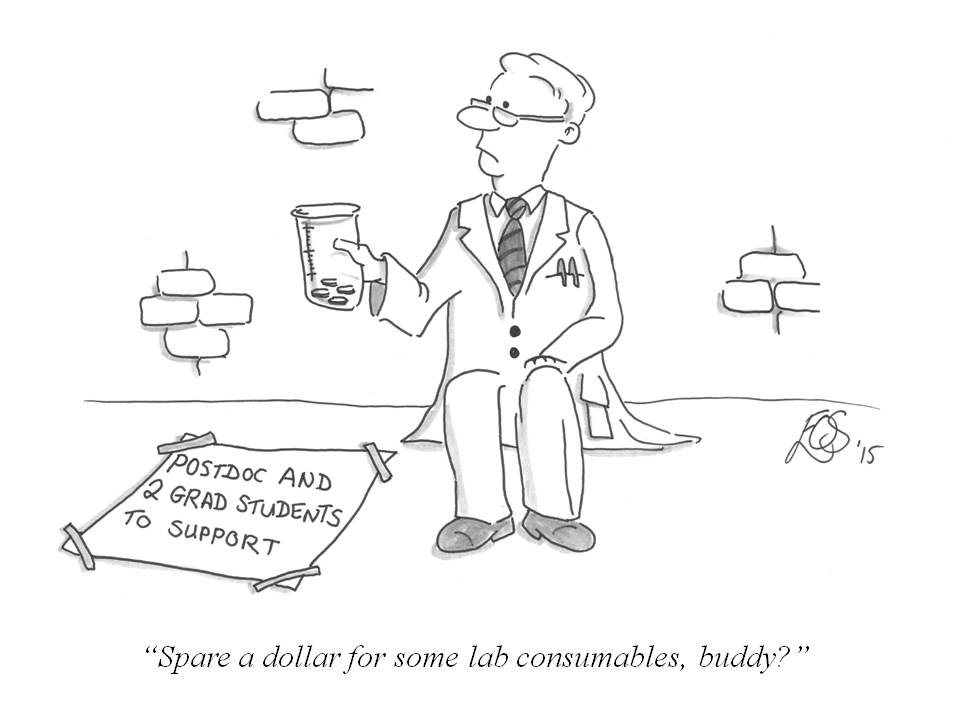
Begging
Cartoon Credit

On top of what you need to complete the study, called Direct Costs, you also need to request money for Indirect Costs.  This is overhead that is paid to the institution that you will be working at to pay for the electricity, water, heating, building space, building security, or other utilities that you will use, as well as for the administrative support staff at the institution. Since nearly all grants are submitted through an organization (like universities), instead of as an individual, the university will handle the money and do all the accounting for you. Indirect costs pay for vital research support, but they run between 10-44% of the dollar amount that you ask for depending on the type of grant and institution, potentially creating a hefty financial burden that dramatically reduces the available funding for the project.  On a $100,000 grant, you may find yourself paying $44,000 of that directly to the university.

comicnov9_2014_overhead
Cartoon Credit

Draft Twice, Submit Once

The Budget is by far the most difficult piece to put together, because the amount of money you have available for different experiments will determine how many, how large, and how intensive they are.  Often, specific methods or whole experiments are redesigned multiple times to fit within the financial constraints you have.  If you factor in the experimental design changes that all your co-PDs are making on the fly, having to balance the budget and reconstruct your narrative on an hourly basis to reflect these changes, and the knowledge that some grants only fund 6-8 projects a year and if you miss this opportunity you may not have future salary to continue working at your job, it’s easy to see why so many researchers find Grant Season to be extremely stressful.

Review_panel.JPG
Cartoon Credit

Featured Image Credit

Anyone can Science, step 2: join the team

Great news: you can participate in science without going through a decade of higher education (sorry grad students, but thanks for your service!). There are two ways to do this: either you can volunteer to collect samples for a project, or you can volunteer to be the sample for a project.  You can volunteer through the National Institutes of Health,  third-party match sites that help recruit volunteers for large projects, independent research centers (that are usually under contract to run a study), and most universities and colleges have volunteer-recruiting websites.

Get out there and collect

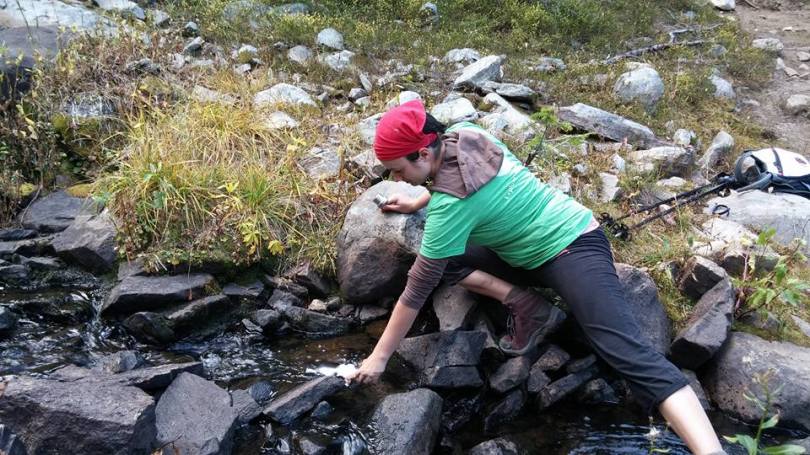
There is a myriad of environmental science studies that rely on volunteers to collect samples, which may take place in very specific areas, or globally.  Some are simple  wildlife surveys, often through conservation societies like the Audubon Society, which use volunteers’ bird sightings to estimate populations.  Humanitarian volunteer agencies may recruit volunteers for global research studies, as well.  Some projects require more technical sampling, or require participants to travel to distant or difficult to reach places, and thus rely on outdoors-people with the gear and ability to safely retrieve water, soil, plants, animal hair or feces, you name it!  There are some excellent examples of global projects which can be found through Adventure Scientists.  AS recruits and trains volunteers for more difficult environmental sampling, and I am currently participating in their Gallatin Microplastics Initiative (year 1 and 2) along with my sampling team: Lee and Izzy.

This slideshow requires JavaScript.

‘Host’ your own research

Volunteering to be the sample also allows you to participate on a sliding scale of involvement.  For example, observational studies only collect information on what is already happening.  These might be sociology (human behavior) studies which only require you to fill out surveys (often online) on your personal history or normal routines. You can also donate biological samples (hair, breathe, blood, urine, feces, skin scrapings, etc.) which are minimally invasive but don’t necessarily require any experimental treatments that you have to participate in.  A study that I analyzed data for asked participants to use a breathalyzer and submit a fecal sample in a jar.  That’s all, and they were financially compensated for their time.  The study was trying to correlate microorganisms in the gut with how much hydrogen or methane was in the breath, and whether a breathalyzer test could be used as a rough measure of how many methanogenic archaea lived in your gut.  Often, research centers which are focused on medical treatment for a specific disease will collect specific biological samples.

Studies which require actual treatments or testing are clinical medical studies that rely on human volunteers upon whom to test products.  At a certain point in drug or vaccine testing, animal or computer models can no longer serve as a proxy and you need to test things in humans.  Thanks to HIPPA (Health Insurance Portability and Accountability Act of 1996) and other safety regulations, both at the federal and institutional level, there is a lot of transparency in these studies.  You are told exactly what you will be required to do, what data will be collected and who will have access to it, and any possible health concerns that may arise from this study.  Any release of tissue “ownership” will require you to sign consent.

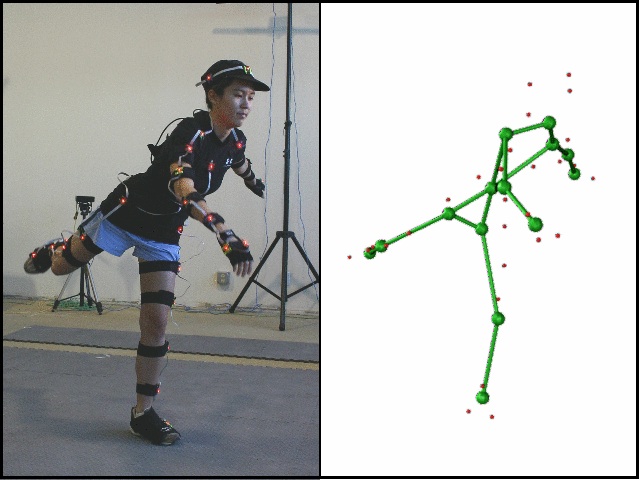
I have participated in antibacterial product testing, a diet study investigating dairy fats during which I could only eat the prescribed diet for two solid months (boy, did I miss chocolate and Thai food!), and a study on chronic back pain (I was in the control group). For the back pain study, I had an EEG net put on my head to measure brainwaves and motion capture balls(examples below) attached all over my body to track my muscle movements as I performed simple tasks that required me to use my lower back muscles.  I even had a functional MRI brain scan to measure how muscle pain might change brain function, unfortunately, I was not able to get a photocopy of my brain scan for posterity.  The more invasive, time consuming, or risky a study may be, the higher the compensation (some vaccine studies compensate several thousand dollars).

Pay it forward

You can participate in science in other ways, too.  Try getting involved with science education!  There are workshops, summer programs, or school events which encourage kids to learn about science and consider a career in it.  Even if you aren’t a scientist yourself and can’t be a presenter, many programs still need people to chaperone, coordinate or market the event, and cater.  Many science museums and educational centers have programs, as do many colleges.  You can also find opportunities through local government to help clean natural sites or educate the public.

While you are out there collecting water samples from Arctic ice, counting wolves, or surveying land for public use, you are also perfectly situated to help with a little environmental restoration.  The Global Microplastics Initiative looks for plastic in water sources from some very remote locations, and this study wouldn’t have been conducted if plastic in the environment wasn’t a concern.  So while you are out there, try to leave the area a little cleaner than how you found it.  You can volunteer for clean-up events to target specific locations that need help, but you don’t even need to organize for this one, just go out and start picking up trash!

wp-1456094725093.jpeg
I took it upon myself to clean a stream near my house in Bozeman one day last year.

Finally, most agricultural research studies rely on farmers, ranchers, growers, and producers as a source of project resources (like seeds, land, or cows) and project motivation.  After all, federally and state-funded agricultural science exist to help local and national agriculture.  You can participate in science by identifying problems that need to be solved and providing objectives for our studies, or by allowing research projects to use your land, animals, or facilities.

So far, you’ve educated yourself on science, and now you can go out and participate.  Stay tuned in the next for weeks for Anyone can Science, Step 3: be supportive.

Anyone can Science, step 1: get your education on

Co-written by Dr. Irene Grimberg, Affiliate Associate Research Professor at Montana State University.


Science may seem like an exclusive club, what with the complicated technical jargon, quirky inside jokes that only seem funny to science people, daunting entrance and exit exams, and years of study and self-improvement.  And it doesn’t help that many scientists would rather hole up in their lab than give a public presentation or figure that “social media thing” out.  But we scientists get coffee stains on our lab coats and use spell-check just like everyone else.  And as with ice cream, science comes in a tremendous variety of flavors and sizes of commitment.  So, let’s talk about some ways that you can involved today!

Education

Getting acquainted with the vast field of science seems daunting, but it’s actually easy and fun.  There are hundreds of museums out there that are eagerly waiting to broaden your perspective on science, technology, engineering, and mathematics (STEM), and will let you give it a try with hands-on activities.  Wikipedia has conveniently made some lists on science museums in the US and around the world.  In fact, there are organizations like the American Alliance of Museums and the Association of Science-Technology Centers that can help to get you connected to the museum that catches your eye.  Many US National Parks also have strong science education programs and information in the visitor centers or around the park (at least, as of January 19th, 2017 they did).

All colleges and universities host daily talks (seminars) on current research and they are open to the public, they just aren’t advertised widely in local media.  If you search online for your local university and “seminar”, you can find public presentations for nearly every department or subject, not just the STEM ones.  Some presentations are available as webinars and can be found online to watch remotely in real-time so that you can ask questions, or can be replayed later at your leisure.  There are many outreach STEM programs sponsored by non-profit organizations, sometimes in collaboration with universities.  For example, Farm Days or Field Days are public presentations at university research facilities on issues related to local and national agriculture, food production, and food safety.  In fact, most university farms and greenhouses are open to the public and offer free tours and other events on a regular basis.  There are also “ask an expert” shows on local public radio and TV in which viewers can call in and ask questions to university researchers.  Or you can simply email your questions and get connected to someone in a relevant field.  Even NASA has a program in which you can ask questions to an astrophysicist!

Other educational options include science festivals, robotic competitions and shows, Science Olympiads, The National Chemistry Week, and programs that specifically aim to recruit girls to science, such as Expanding Your Horizons and Girls for a Change.  As an undergraduate at the University of Vermont, I participated in a service-learning course in spring of 2008 in which we designed a public presentation at the ECHO Center in Burlington, VT.  The purpose of the all-day workshop was to educate kids and adults on wolf ecology and potential reintroduction into New England.  Our Wolfwise presentation was incredibly fun to host, and it was a huge hit: we were invited to come back and present again the next weekend!


If leaving the house isn’t your thing, there are an overwhelming amount of resources available online.  An increasing number of scientific and research journals are available free of charge online, known as open access.  Over 26 million journal articles are available through PubMed, a database for medically-relevant research studies which is curated by the National Center for Biotechnology Information (NCBI).  Science News hosts a huge variety of STEM articles compiled from the most prestigious science journals, as well.  And any subject under the sun (or inside the sun) has an educational video out there somewhere.  There are science shows on TV, a dedicated cable channel, and documentaries including several outstanding educational series with high-definition video footage from around the globe (Plant Earth, Life, and The Blue Planet).  There are podcasts, such as Science, Star Talk Radio, and many others that allow you to listen to recorded audio shows on your own time.  You can find interactive websites to learn a variety of things, both academic and practical.  Or teach yourself computer coding in C++, Java, Ruby, Python, or Perl.

Just be sure that you are getting your information from a credible source.  Many online bloggers or websites sound great, but they often have no formal training in what they peddle, or are heavily sponsored by companies to promote an unsubstantiated lifestyle or discredit scientific work.  A good rule of thumb is to look for qualifications, citations, and motivations.  Does this person or organization have formal education or training?  Do they cite their sources for information?  And what is their reason for doing this?  Here are my qualifications, you’ve seen how much I enjoy citing sources, and since I am (and have always been thus far) federally-funded through different grants, I consider it part of my job to share my work and my experiences free of charge.

Featured Image Source.

The Rare Knowledgesphere

I sometimes get a self-depreciating response when I tell people what I do: “oh I could never do that,” “I wouldn’t even know where to begin,” or my least favorite; “I’m not smart enough to do that myself.”  Sure, I’m intelligent, but more importantly I am interested in my work and I put a lot of time and effort into practicing it.  I didn’t become a microbiologist overnight.  And more than that, in my career path I discovered a lot of people and opportunities that helped me get here.  I firmly believe that most people could do my job, given the right amount of education, determination, and support (and a heavy dose of enthusiasm for spread sheets).  As I move up the ladder, I’m increasingly in a position to educate, help others network, and bring students closer to their career goals.  One day I’ll be able to take on graduate and undergraduate researchers of my own, and I find myself asking, how will I find and recruit those students that just need an opportunity to become amazing scientists?  The ones that weren’t told by their teachers that they should be microbiologists but still have an aptitude for it, the ones that think they aren’t “smart enough” when really they just aren’t confident enough?

Lessons from the rare biosphere

One of the emergent theories in microbial ecology over the last few decades is that of the “rare biosphere.”  It’s the idea that microbial ecosystems are much more intricate than we realized, and there are a great many microorganisms present in any given environment that have very low populations.  We just couldn’t see them under a microscope or grow them in culture because their presence was washed out by more abundant microorganisms.  It wasn’t until the emergence of DNA-based technologies that we could really understand the depth of that diversity because this technology was able to sequence all or nearly all the DNA in the entire sample.

sue_23_smallg
An anaerobic chamber allows microbes to be grown in an oxygen-free environment, and the different color plates represent different media recipes.  Credit: Kristina Bond.

When culturing bacteria in the lab, one must try to mimic the original environment as closely as possible in order to get that microbe to grow.  It is incredibly difficult to please “everyone” on just one or even dozens of different culture media types, so you end up getting a biased idea of “who” lives in a natural environment based on what species are able to survive in the mock environment you’ve created.  DNA-based technologies don’t require live microorganisms; you can extract DNA or RNA strands directly from your environment and sequence them, although you will need a reference database of previously cultured and sequenced microorganisms to make the identification.  Sequencing has its own problems, of course, namely being able to discern between a rare microorganism whose DNA represents a very small percentage of your data, and a random sequencing error inherent to your technology that turns a known sequence into a fake novel one.  One way bioinformaticians tackle this is by removing rare sequences altogether, but as Sogin et al. argue, you might be getting rid of significant contributors to your ecosystem.

This is just one example of a major theme in science: how do we detect something if we don’t know it’s there?  How to do we differentiate what is real (but rare) from the technological errors and background noise?  We constantly improve our technology and revise our understanding of the physical world as we get better at investigating it.  But as we rely more and more on technology that we have created (which may operate on the biases we have designed into it), and we want to collect more information with less human effort, we need to remember that it’s our intuition and reasoning skills that make humans so good at data analysis and investigation in the first place. This led me to wonder if we weren’t making the same mistakes in education.

One of the most common errors we commit is to mistake education for intelligence.  Intelligence is partially a natural ability for learning and understanding, and partially cultivated by an atmosphere of curiosity and interest in learning.  Education, on the other hand, has to be earned.  While public schools and other learning resources in the United States exist to give all children an equal chance at education, in practice there are significant biases in quality and quantity in education.

The disparity between education and ability

Student to teacher ratio is correlated with student performance, and can vary widely by type of school (public, private, elementary or secondary), geographic location, urban or rural demographics, etc.  Because of that, the national trend for student to teacher ratios in public schools appears to have only slightly increased (more students per teacher) from where it was in 2002, with that increase only since 2008.  However, much of the increase in student to teacher ratios is localized, specifically in low-income districts, so there is a disproportionate affect by economic status.  Many teachers in low-income school districts cite budget cuts that result in overwhelmingly large class sizes to be the main reason they quit education (discussed here).  And a poor school budget does more than just crowd students, it depletes the school of educational resources which reduces the quality of the education and student performance.

Therefore, just because someone appears uneducated does not mean they are not intelligent.   For example, Linus Pauling, who was competing with Britain’s Watson and Crick to discover the structure of DNA, didn’t obtain his high school diploma until after he won two Nobel Prizes simply because he didn’t finish some required high school history courses.  A recent study looked at grade point average (GPA), SATs (previously the Scholastic Aptitude Test), graduate record examinations (GREs- the standardized tests that most schools use as a graduate entrance qualifier), and whether test scores predicted how well someone performed as a graduate student.  Like undergraduate study, most graduate programs require a minimum GPA and GRE score even to be considered.  However, the study found that students with higher test scores didn’t actually perform better as graduate students.  In fact, here’s a whole website about geniuses that failed IQ or other aptitude tests that went on to change the world.  Here’s another about artists, politicians, and business tycoons who failed repeatedly before becoming household names.

Another problem is our biased view of the quality of an education based on the country of origin.  Indian mathematician and genius Srinivasa Ramanujan was born in a small village in the late 1880s.  He started performing advanced geometry and arithmetic at just 13 years old, and began focusing on mathematics in secondary school and at a local college.  At 26, he wrote to British mathematicians looking to discuss his ideas, and was dismissed out of hand by almost all of them.  G.H. Hardy, however, wrote back, and began a collaboration of ideas that led to an incredible body of work between the two of them.

The Rare Knowledgesphere- The one that almost got away

This idea of overlooking greatness is important to keep in mind when ranking people by their resume or test scores instead of by an interview.  After all, just because you attended Yale doesn’t mean you went to all your classes.  This concerns me, because we may be passing over potential undergraduate or graduate students who appear less educated on paper, but aren’t less intelligent or less apt.

So, how do we as educators and mentors get beyond this bias and find the students and researchers-to-be that slip through the cracks?  The ones that are out there that aren’t even on our radar.  I’ll let you know once I’ve figured it out.  But from my experience, it comes down to taking the time to interview and really get to know someone before accepting them as a graduate student, not just selecting the best looking resume. It especially means letting go of your ideas about the quality of someone’s education based on the type or location of their school, as well as stereotypes about their abilities.

And it means being creative about marketing your positions, to make sure you are reaching the individuals that aren’t actively looking for you.  This may sound counter-intuitive; why try to recruit someone to graduate study if they aren’t interested?  Again, I can speak from experience.  My undergraduate degree is in Animal Science, and my interests in graduate study at the time centered vaguely around wildlife conservation.  Instead, I entered a graduate program where my primary research and laboratory work were focused on microbiology, genetics, microbial ecology, and bioinformatics.  I had no formal academic or practical training in these areas.  But I joined, and I excelled, all because my mentor-to-be told me that I was capable.  And here I am today, in love with my science.

With all this in mind, stay tuned for my post in the next few weeks on what makes a person a good graduate student, if it isn’t test scores.

Featured Image Credit

Imposter Syndrome

There’s been a lot of attention paid online lately to “Imposter Syndrome”. It’s that sneaking doubt that makes you feel like you don’t belong somewhere because you aren’t qualified, and eventually someone will realize the mistake and fire you.  In short: that you are an Imposter.  It’s extremely common among graduate students and young faculty.  In fact, I haven’t met a graduate student that didn’t doubt themselves and whether they deserved their place in a research program at some point in their studies.  Most studies on this phenomenon have been relatively small and in specific populations of people, thus estimates of affected individuals range from 40 to 70%, at some point in one’s life.

cat-imposterFrom my experience, in academia, Imposter Syndrome stems from feeling overwhelmed by the amount of information that you need to learn, or the amount that you need to accomplish.  The interdisciplinary approach to graduate studies has increased the number of scientific fields you now need to be familiar with, and compounds the amount of material that you have to memorize.  This seems to leave many students feeling inadequate and dumb, because they are unable to perfectly recall every fact they learned in two or three years worth of graduate courses.  For post-doctoral researchers and assistant professors, your To-Do list only grows longer by the day, as the reduction in federal funding increases the competition for fewer and fewer job postings and more pressure to distinguish yourself.  These tasks seem insurmountable, and that you simply aren’t up to them.  You start to doubt your abilities, and think that there has been some mistake.  You think, someone will realize how dumb I am, and that I don’t deserve to be here.

At best, Imposter Syndrome makes you nervous, at worst, it can lead to a lot of work-place stress and low self esteem.  It can also prevent you from taking risks in your research, or being ambitious in the positions you apply for, or make you feel guilty about taking time off when you feel that you should be using the time for career development.


screen-shot-2016-10-13-at-3-03-33-pm

Imposter Syndrome, or more clinically, Imposter Phenomenon, has been studied for several decades, and is reviewed thoroughly here.  Originally it was thought to be a symptom found only in professional women who weren’t emotionally strong enough to deal with the stress of the workplace.  Later, after it was described by Dr. Pauline Clance in 1985, and observed in many different careers and both genders, we came to understand that this sexist stereotype was in fact common to high-achievers, “perfectionists”, and those with anxiety and the motivation to succeed.

Correlations have also been found between feeling like an imposter and low or conflicting family member support, low self-esteem or general self-doubt, neurotic behaviors, or when there are negative consequences to achieving success.  For example, if a person is ostracized by friends or family for working hard, studying, getting an education, or generally wanting a “better life” than the cohort has.   This can also occur when there is jealousy or competition between coworkers, where a promotion or other success would alienate you.

Own your success

goddess.jpg

When graduate students express feelings of self-doubt to me, I remind them that they already got into grad school.  Their graduate program was satisfied by their application, their PI or advisor chose them for their accomplishments.  I remind them that in academia, you can’t compare yourself to anyone else.  Everyone has come from different backgrounds, has different work experience, took different classes, read different papers, and has different research and career goals.  Maybe you got PhD but you don’t want to do research, only teach.  Maybe you only want to do research.  Maybe you want to publish ten papers a year, or maybe you only want to publish once a year because that is more consistent with the pace of your research and the type of work that you do.  Maybe you have more post-docs who work on complicated questions, or maybe you have undergraduates and your projects are smaller.  Some research fields (especially literal fields) can’t be rushed, and it’s unrealistic to expect prolific publications from everyone.  Cognitive behavior therapy guidelines for dealing with Imposter Syndrome recommend distancing yourself from the need for validation from others, to improve your self-awareness about your own abilities and needs, and to lessen the feeling that you need to hide the real you.

There is no litmus test for whether you are a “good graduate student”, or a “successful researcher”, except for your own demanding self-assessment.  All you can do is try to set realistic goals for yourself.  And not vague, large ones, such as “I want to publish 5 papers this year”.  Be more specific, and more short-term: “This week, I want to finish the Methods section of this paper, and hopefully have a working draft of this manuscript by the end of the month”.  I also find it helpful to keep a written record of what I’ve done.  Maybe keep a running To-Do list, and at the end of the week, month, or year, look back and see all of the things you have crossed off.  This is most helpful to me when I find that projects are getting delayed, or analyses need to be redone, or I generally feel like I am spinning my wheels.  Or, when I write a number of grants but some of them don’t even get submitted.  I still did all that work, but if I don’t have that item crossed off my list, I don’t have a visual reminder that I accomplished something.

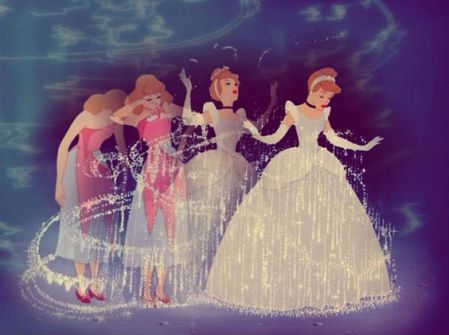
And keeping a tally of everything you’ve done- not just the things that get published, can help you prove your worth and your effort when it comes time for job assessment.  Whether it’s a weekly meeting with your PI where you need to account for how you’ve spent your time, an annual performance review, or the tenure process.  If you have a written record of all the things you have done, all the little things that you spent your time on, you have proof that you have been productive.  Remember that success and failure are often out of your hands- especially in research.  Sometimes all you can do is try your best and hope that your fairy grant-mother rates your proposal wish as “outstanding”.

cinderella.jpg
Cinderella, 1950

Work-life balance: the unicorn that is the 40 hour academic work week

In the first installment of the work-life balance discussion, I discussed the different levels of employment for university faculty and gave general information on the different functions they performed on a daily basis.  I also talked about how many of them work longer than 40 hours a week, including nights and weekends, and may even work summers without compensation.  For example, in a 1994 report, the American Association of University Professors reported that professors worked 48-52 hours per week, and this had increased to  53 hours by 2005.  Other sources over the past five years have reported more: 57 hours per week at a Canadian research institution, 50-60 hours per week in the UK.  But like with anything, work quantity does not equate to quality.

All work and no play makes Jack a dull boy

For one thing, working long hours without sufficient weekly time off, or vacations, can significantly increase stress.  And this stress can lead to all sorts of different mental and physical problems.  Working long hours can interfere with our normal circadian rhythm– it can disrupt our sleep cycles, throw off our eating times and appetite, and make it difficult to exercise regularly.  Longer hours have been directly correlated with incidence of hypertension and other cardiovascular problems (also reviewed here).

Moreover, long work hours and work stress can negatively impact mental health (12, 3, 4), and increase the use of legal and illegal substances (reviewed here).  A study of work hours on over 330,000 participants in 61 countries found that working more than 48 hours a week was associated with heavy drinking in both men and women.  Stress, lack of sleep, and a subsequent difficulty paying attention can also increase the frequency of injury at work, and this injury rate directly relates to the increase in hours.  Jobs with overtime hours have been associated with as much as 61% more work-related injuries than those without.  In fact, there is so much research on stress, health, and occupation, that there are numerous journals solely dedicated to reporting on those findings: The International Journal of Stress Management, Occupational and Environmental Medicine, The Journal of Occupational and Organizational Psychology, just to name a few.

Having a life makes us better employees

But for all that personal sacrifice, mounting evidence shows that a reduction in work hours is what promotes productivity, not a 24-hour work day.  Reducing weekly hours increased productivity as employees were less likely to be absent from work due to poor health (reviewed here).  Taking scheduled breaks instead of skipping them was also responsible for improving cognitive function in students.  Even brief diversions were shown to improve focus and cognitive function. Besides giving us a rest from our current task, or engaging our attention with something novel, taking a break allows us to daydream.  While this may seem like a waste of time, letting our minds wander activates different parts of our brain- including those involved in problem solving and creative thinking.  If you’ve ever come up with a brilliant solution while doing mundane tasks, then you’ve experienced this.  For my part, I tend to think of great ideas when I’m washing dishes or biking home.  Daydreaming, or taking a break, also helps release dopamine, a chemical neurotransmitter involved in movement, emotions, motivation, and rewards.  It’s very helpful in the creative process, as explained in a discussion of creativity in the shower.  Restful thinking also seems to be involved with promoting divergent thinking, emotional connectivity, and reading comprehension.

Going on regular annual vacations was correlated with a lower risk for coronary heart disease: not only are vacations great for reducing stress, but they also provide opportunities for more exercise, mental downtime, and creative outlets.  Mandatory time-off during nights and weekends for consultants resulted in a reported increase job performance, mental health, and attitude, though many said it was a struggle to enforce “time outs” from work in the beginning because they felt guilty about not working during their personal time.  This was seen again in a study of Staples managers who did not take scheduled breaks out of guilt.

It’s this persistent feeling that you should be working at home, and that you could be doing more, which is largely reported by “driven” employees and workaholics.  This feeling has lately been coined “tele-pressure“.  It’s particularly invasive these days as you have access to work emails and other communications via smart phones, laptops, or tablets.  In fact, by syncing many of these devices, your attention is compelled by multiple simultaneous electronic signals and vibrations whenever someone contacts you.  It’s no wonder we can’t shut off at the end of the day. (And for the record, I wrote this on a Sunday evening.)

More important than knowing that taking regular breaks and vacations will help manage your stress and improve your productivity, is remembering that you are entitled to it.  We have labor laws for a reason, and you are entitled to your nights, weekends, and your X number of weeks a year.  You are entitled to stay home when you are sick, or whenever you feel like it.  It’s your personal time, take it.

So, if you’re in academia, what do you do to unwind?  Leave me some comments!

Work-life balance: what do professors do?

Outside the academic world, there is a lot of misconception about what faculty and university personnel actually do and when.  While this varies by position, university faculty have a variable mix of teaching, research, advising students, grant writing, administration of grant budgets and workloads for persons working in the lab, being on institutional committees (curriculum planning, graduate student committees, candidate search committees), and community outreach (presentations, generating informative publications for the general public, etc.).  As universities have sought to increase student populations while decreasing faculty, this has led to an ever-increasing number of hours spent working.

The Academic Ladder

To understand the problem with workloads, we must first understand the positions generally available.  It’s taken for granted that graduate students will work more than 40 hours per week.  Graduate teaching assistants are paid a stipend to teach a certain number of credits per semester, and generally their tuition is covered by the department they are teaching for, although this does not always include university fees and health insurance.  At the University of Vermont as a GTA, I still paid around $1,200 per semester, despite having my tuition and some of my student health insurance comped.  As a graduate research assistant, a research grant pays your stipend and, potentially, your tuition.  Either way, you are taking classes and expected to do your own research, and it is very difficult to excel at all aspects while try to only work 40 hours per week.

Post-doctoral researchers have attained their Ph.D., and are specializing in an area of research.  Often, PhDs go from post-doc position to post-doc position waiting for a professorship in their field to open up.  Depending on the positions, post-docs also have to write their own grants, and may have to teach, although this is often unpaid.  In 2005, post-docs in the US reported working an average of 51 hours per week, diluting their salary until their effective hourly pay was lower than Harvard janitorial staff.  As reported in the study, average post-doctoral salary ($38k/year) was also less than the average salary of someone working outside of academia with only a bachelor’s degree ($45k/year), and much less than those with professional degrees ($72k/year).

From there, a variety of academic positions available, but these generally fall into three tiers: assistant, associate, and (full) professor.  For example, if you are a research professor, you do not have to teach and often do not mentor students outside of your graduate students, and you can be at the level of assistant-, associate-, or (full) research professor depending on your years of experience.  These are almost always non-tenured positions, meaning you work by contract, and you often have to fund your own salary through grants.  There are also adjunct professors, as well as lecturers or instructors.  Like research professors, they perform fewer functions (generally just teaching and advising), and have short-term contracts.  Adjunct positions are part-time with no benefits, while lecturers are full-time and come with benefits, and their prevalence in research universities is increasing.

Traditional faculty positions, on the other hand, have salaries paired through the department, and are contracted for longer periods of time.  You can also be at the level of assistant, associate, or (full) professor, and you may also apply for tenure.  Tenure is a permanent contract with the university, and it is a grueling review in which all of your career moves are carefully examined by a panel of your peers.  The idea behind tenure is that once it is awarded, you cannot be fired except under special circumstances, allowing you to pursue less trendy and more daring research topics.  Tenure is not awarded lightly, and assistant (or associate) faculty spend years trying to accomplish as much as possible, such that they are driven to work longer hours. Faculty without tenure reported working an average of 56 hours per week, which is likely driven by assistant professors that reported working 56 hours per week.

All of these positions may be offered as 9 (September to May) or 12 month appointments, meaning you are only paid for working that many months.  There is a perception that faculty don’t work in the summer, and that’s because those 9 month appointments are not required to work.  However, most take the opportunity to catch up on research or generating teaching materials, and many academics report working longer hours in the summer.  While you might be awarded grant money to pay salary for the three months of summer that you spend catching up on research, many academics will end up working uncompensated just to keep up.

Responsibilities

1470706987609657018716

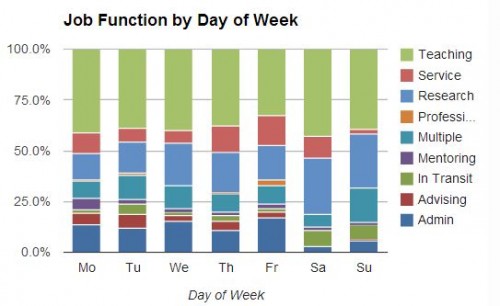
In a preliminary study by anthropologist Dr. John Ziker, called Time Allocation Workload Knowledge Study (TAWKS), 30 professors from Boise State University were asked to recall everything they had done over the past 24 hours.  Participants reported an average of 61 hours per week spent working, including about 10 hours on the weekend.  The breakdown of their job functions is below:

1b
TAWKS preliminary data, Dr. John Ziker


Other studies report similar findings, with an average 53 hours per week spent on all activities, and a breakdown as such:

Screen Shot 2016-08-09 at 9.07.18 AM.png
Link et al. 2008, Economics of Education Review

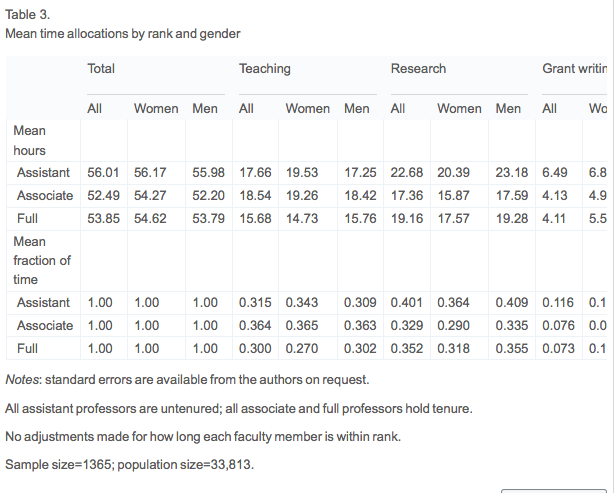
This seems to be skewed towards assistant professors:

Screen Shot 2016-08-09 at 9.09.59 AM.png
Link et al. 2008, Economics of Education Review

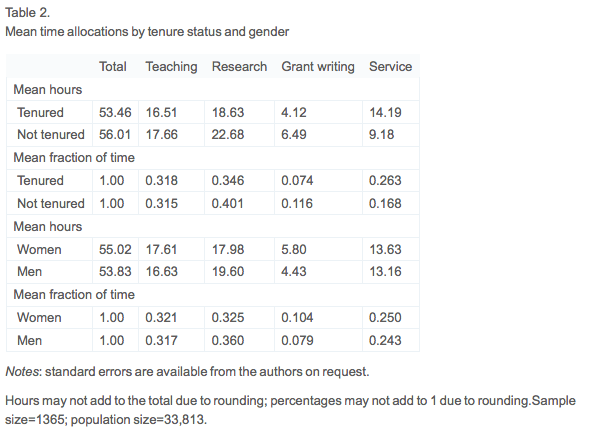
as well as non-tenured faculty:

Screen Shot 2016-08-09 at 9.14.14 AM.png
Link et al. 2008, Economics of Education Review


As I mentioned, professors are responsible for teaching, research, advising students, grant writing, administration of grant budgets and workloads for persons working in the lab, institutional committees (curriculum planning, graduate student committees, candidate search committees), and community outreach (presentations, generating informative publications for the general public, etc.).  Here is a very long list that one professor made of their responsibilities.  Enrollment in college has increased over the past few decades, but faculty hires have not kept pace: there are an average of 16 fewer staff members per 1,000 full-time students in 2012 than there was in 2000.  While the number of faculty positions in the US has increased numerically, this growth has been overwhelmingly in part-time hires, with a 121% increase from 1990 to 2012 as compared to a 41% increase in full-time hires.  The increasing number of students, expansion of faculty responsibilities, and the rise in part-time employees who often travel to multiple universities in a day for work have pushed staff and faculty to work longer hours, yet this does not always translate into better quality of work, as some work functions take priority over others over time.

In the follow-up segment, I’ll discuss the importance of time off and finding a work-life balance (as I write this on evenings and weekends), and how this contributes to reduced stress, as well as improved health, productivity, quality of work, and quality of life.

If you’re in academia, what do you do on a daily basis?  Leave me some comments!

Intellectual property and the tug of war between confidentiality and transparency

Intellectual property (IP) is anything that you conceptualize or create: whether it is written, played, sung, viewed, or synthesized in a lab. Different countries, universities, and companies have legislation regarding intellectual property.

In academia, the IP usually belongs to the researcher, with approval of the university, and thanks to the 1980 Bayh-Dole Act, universities can patent and sell IP. Since you are an employee, and the university owns the building, arranges for the electricity bill to be paid, manages your grant funds so you don’t run into accounting problems, and technically owns the equipment that you buy with grant funds, they have a stake in your work even though they don’t outright own it. This means you are free to publish anything that is true and verifiable, and both governmental funding agencies and college policy generally dictate that you have to honestly publish your results no matter the outcome. The best you can do is not publish a project, but you can’t keep anyone else from replicating your work and then publishing it.

In fact, that is where a lot of confidentiality concerns surrounding IP come into play. For example, if you are working on something, and another group publishes a similar project first, you’ve been scooped and your work is no longer novel. In the rare cases that someone stole your work, and you can prove it, the university will back you on IP rights. While competition can be fierce in many fields or work settings, outright theft of data is not common despite the widespread fear of it.

Confidentiality is a large part of academic work, but in most cases is a temporary part. You might not be able to publish a commercial lab’s proprietary procedure, but you can and are encouraged to make publicly available all your methods and all your raw data. Once you publish it in some way, your name is now tied to it, and you will have a citation credit. The availability of raw and processed data is hugely important to most fields today. Not only does it allow you to analyze your work in reference to someone else’s results, but it provides the opportunity for large-scale data mining. There are quite a few studies that downloaded and reanalyzed a large number of similar data sets in order to better compare them and gain new insights into trends, as well as drug-prediction studies that use DNA or protein sequences from other projects as models against their drug to test its ability to bind and work effectively before trying it out in the lab.

Personally, I try to be transparent about what I work on at the local scale, and a bit vague on social media until the experiment is concluded and results published. For my thesis, I opted to wait six months after the University of Vermont had accepted it to make it open access. Print copies could be ordered, but it would not yet appear online. This was because several chapters were manuscripts which had not yet been published, and once it appears in print online that is considered “published” and some journals would not want to publish it again in an identical format. I tend to be very descriptive in how I present my bioinformatic workflows, because when I was learning the trade, a methods section that played things close to the chest made it very difficult for me to understand how others had analyzed their data. Once published, though, I think it’s very important to disseminate and publicize your work as much as possible; it doesn’t do the scientific community or the general public any good if they never see it.


Featured image: https://fbombmedia.com/patent-patent-mobile-apps-intellectual-property/