
Advocating for science on Capitol Hill
Last week, while I was in D.C. for a Board of Directors’ meeting for the American Society of Microbiology, I had the opportunity to attend an ASM Hill Day. Led by the ASM Public Policy and Advocacy Team, Hill Days bring scientists to Capitol Hill to advocate for science by sharing our lived experience of federal funding functions. This time, several members of the ASM Board spoke with U.S. legislators’ offices about the health, environmental sustainability, and economic development priorities of the microbial scientific community, scientific funding in the next fiscal year, and how microbiologists around the world are eager to provide scientific evidence to inform public policy. On a more somber note, we brought personal stories about the effects of disruptions to research and education last year; the disruptions to education funding and loss of students who can’t afford to continue their academic and professional training; the effect of stalled payments on funding projects this year; and more.
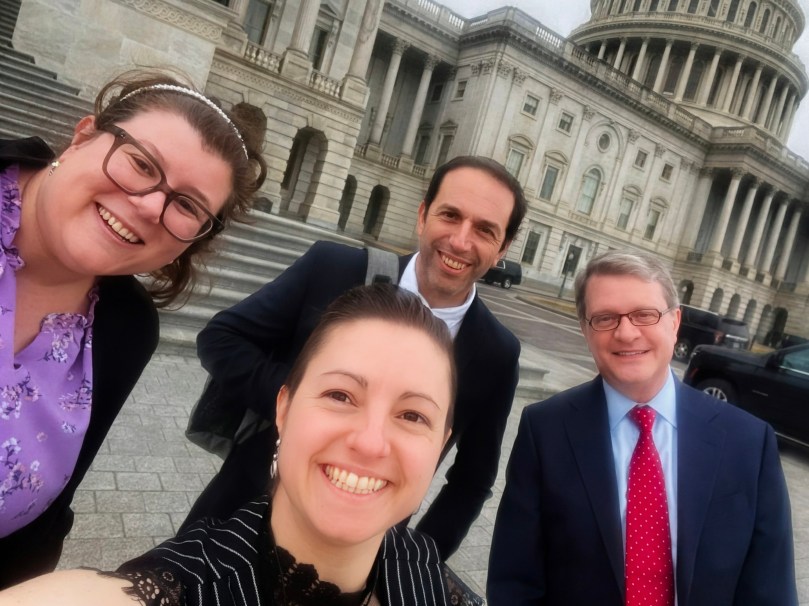
I was on a team led by Senior Federal Affairs Officer Nicole Zimmerman from the ASM Policy Team, along with incoming ASM President-Elect Dr. Federico Sisti, and current ASM President Dr. Alexander McAdam.
ASM is always looking for members who would like to learn how to advocate for science, share their stories with lawmakers, and help shape the future of science policy. You can find out more about recent advocacy from the ASM Policy Action Center, and specifically hear about ways to get involved iin the Action Network. Earlier in my career, I never thought I would be interested in getting involved in policy, or confident enough to advocate on behalf of 38,000 microbiologists, but the ASM Policy Training made it really easy for me to identify needs or concerns from my colleagues and students, collect data to demonstrate the impact of policies on our industry, and specify steps that legislators could take to seize opportunities or provide resolutions. With the global social, political, and economic turmoil we have all been facing for years– to put it mildly – having the opportunity to be a small part of building the future has been a meaningful part of my career. I highly recommend it!
Offering expertise and building trust
One of the messages that we were keen to share with US (and all) policymakers, articulated by incoming ASM President-Elect Dr. Federico Sisti, is that ASM members around the world have an incredible breadth and depth of expertise in all topics related to microbiology, and that we are here to help. ASM has always had a strong initiative for providing scientific information and policy support, including ASM policy staff and our thousands of members.
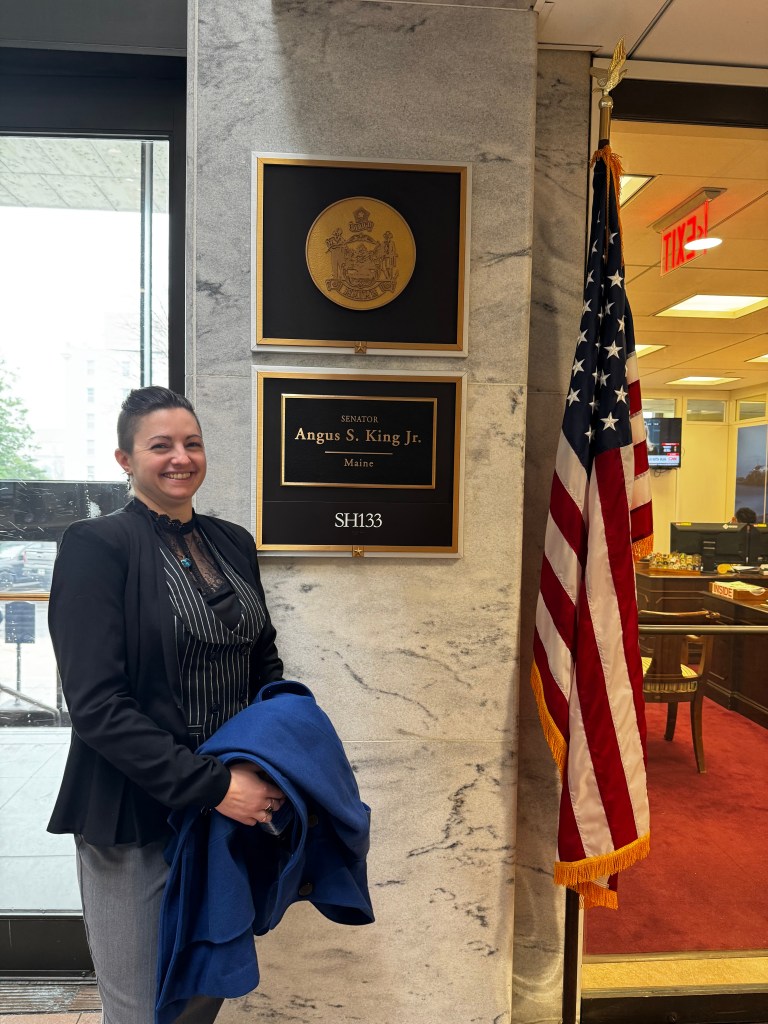
But, to create the collaborations between scientists and policy makers requires time to build trust and establish regular communication. Here, I had an advantage in that 3 of my meetings were with Maine lawmakers (Senators Angus King and Susan Collins, and Representative Jared Golden), and being a voting constituent lends weight to my voice as I spoke about how reduction in funding for education, and disruptions to research funding which also impacted student research opportunities, impacted students and communities in Maine.
From the classroom to Congress
Serendipitously, I know one of the staff members in Senator Susan Collins’ office, and it was a delightful surprise to run into Michael DeLorge, co-Valedictorian at UMaine in 2024 and student in my Intro to Animal Microbiomes class. My microbiomes class talks about the need for science in policymaking, as well as the need for diverse and far-reaching collaborations in order to solve global challenges, such as those set out by the United Nations Sustainable Development Goals.
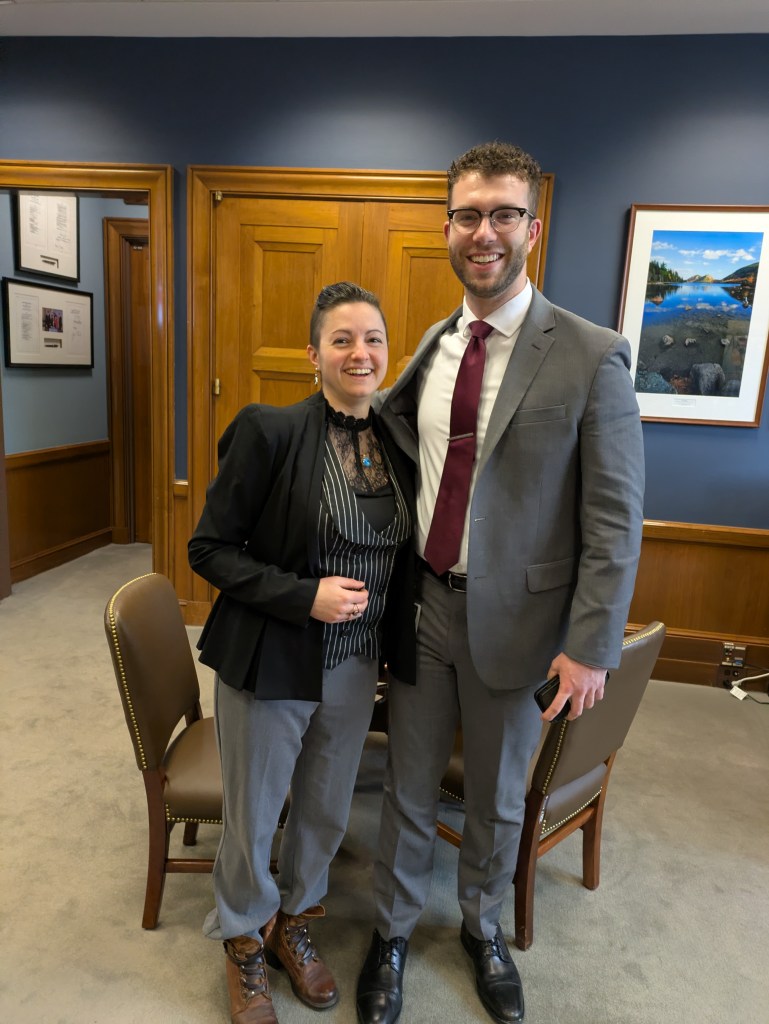
I got even further into the connection between research and public policy, as well as federal funding, in my Capstone In Animal Science course, nicknamed “How To Be A Researcher”. I have a whole lecture about the federal funding process in the US, historic funding levels, and how agencies had been trying to improve equity in the distribution of funds (including to rural areas, primarily undergraduate institutions, and other universities which had received less research and education funding).
I also teach my students about designing impactful research by identifying problems to solve and the relevant impacted communities (humans, animals, plants, other organisms, ecosystems). Over the semester, students design research projects and detail them in funding proposals, but we write them backwards by first identifying who/what the students want to help, then identifying the problem or what they could help with, and then outlining the strategy for finding information so we could make a positive change.
And, I’m sure my Capstone students will be happy to hear that I put into practice what I make them do in the classroom: all of my meetings on Capitol Hill were essentially “Elevator Speeches”, short pitches which identify a problem and a possible solution in a succinct format that allows the listener to engage in a discussion with you. I’m happy to report that I kept all my speeches under the meeting time limit 😊
The views expressed in this post and in my meetings were my own and did not represent the institutions I am affiliated with.
 The Ishaq Lab