

We are have mixed news about one of Tolu’s paper’s from her dissertation – it was stolen by a predatory journal, Functional Foods in Health and Disease. While we stand by the version of our work that we submitted for review to this journal, we do not endorse this journal and we did not authorize them to publish this. We submitted our manuscript for review to them on March 30, 2025, and were told that the 5000 word limit also included references (not mentioned on their submission guidelines), but that they would accept it if we would agree to pay twice the article fee. We agreed to this, after a month it was accepted with minor feedback in the single review, and the requirement to add some citations from other publications within the journal. We were told to pay the article fee within 7 days (which is the first it had mentioned of that deadline), and when the initial payment could not be processed by the journal’s bank, the journal added a 5% late fee (first we had heard of this policy) and threatened to add another 20%. The editor in chief, Danik Martirosyan, also suggested we could pay to his personal account. We rescinded our permission to print our manuscript on June 16, after which we continued to receive harassing emails and phone calls. The journal removed our article in summer 2025, and then put it back online without our permission or knowledge.
Tolu defended her dissertation in summer 2024, and she recently visited Maine for her graduation and hooding ceremony, so we were able to celebrate in person.


We’ve been researching the benefits of cruciferous vegetables on health, some of which are available directly from the plants, and some of which require the participation of certain bacteria that live in our gut. Cruciferous vegetables are loaded with fiber, vitamins, minerals, and – what we are most interested in – the plant’s secondary compounds called glucosinolates which can be transformed into antioxidants and anti-inflammatories. Depending on the type of vegetable, and the way that it is cooked/prepared, you can end up with different types and quantities of these beneficial compounds.
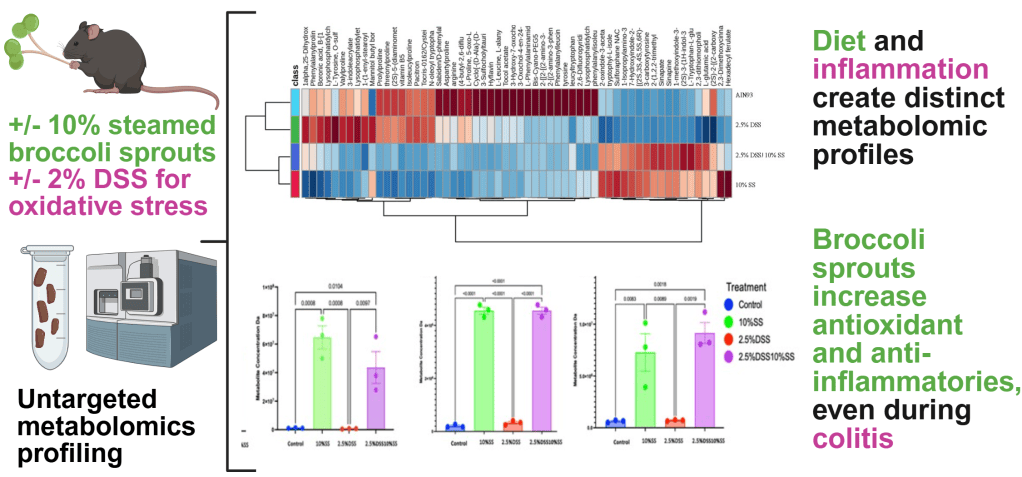
This project focuses on an analysis of fecal metabolome – all the metabolites sourced from the diet, made by or modified by gut microbiota, and made by or modified by the host (in this case, mice). The feces were sourced from a previous study on whether a 10% steamed broccoli sprout diet could be used to resolve ulcerative colitis using mice. The diet was effect at modifying bacterial communities in the gut, and reducing inflammation, to promote health in mice experiencing a flare-up induced by a high dose of a salt laxative, and results from that portion of the study can be found here. The metabolome profiles of these mice showed which benefitical metabolites were increased by the sprout diet, and which detrimental (pro-inflammatory or oxidative) were decreased by the diet.
Alaba, Tolu .E., Zhang, Tao, Li, Yanyan, Ishaq, Suzanne L. 2025. Steamed broccoli sprouts diet alleviates inflammatory bowel disease by increasing anti-inflammatory, antioxidant and gut protective metabolites in an ulcerative colitis mouse model. Functional Foods in Health and Disease 15(5): 272-295.
Abstract
Background
Broccoli is a cruciferous vegetable rich in bioactive compounds that may be beneficial against inflammatory bowel disease. However, an in-depth annotation and understanding of the metabolites and microbial interactions associated with the broccoli sprouts diet is needed.
Methods
Specific pathogen-free C57BL/6 mice (male, 6 weeks old) were divided into four treatments: control diet; control diet with 2.5% DSS in water to induce symptoms of ulcerative colitis; 90% control diet plus 10% steamed broccoli sprouts; and 90% control diet/ 10% steamed broccoli sprouts plus 2.5% DSS in drinking water to induce symptoms. DSS treatment was cycled three times, with five days of DSS then a recovery period of five days. Mice remained on their diets for the duration of the study. Fecal samples were collected on day 30 and frozen at -80℃ until metabolomics analysis. Liquid chromatography with a high-resolution mass spectrometry (LC-HRMS) data acquisition was performed using Waters Synapt G2, time-of-flight (TOF) XEVO. We processed the LCMS metadata in MassLynx, Progenesis QI, mzMine, and Sirius tools with built-in search engines to obtain the retention time, mass charge ratio, molecular weight, peak intensity, metabolites name, and formula using several libraries.
Results
Ove 3,000 fecal metabolites were differentially abundant in feces of mice based on diet (+/- steamed broccoli sprouts) and ulcerative colitis (+/- 2.5% DSS) treatments. The steamed broccoli sprouts intervention significantly increased the concentrations of beneficial metabolites, such as sulforaphane, short-chain fatty acids, tryptophan, indoles, glutamic and polyphenolic metabolites, with positive correlations with commensal bacteria, Bacteroides spp., Intestinimonas, Oscillibacter and Lachnospiraceae in the colon, cecal and jejunum regions of the gut.
Novelty
This study used untargeted metabolomic approaches to identify novel dietary and microbial anti-inflammatory, antioxidant, prebiotic, and gut-protective metabolites associated with a steamed broccoli sprouts diet that are effective against ulcerative colitis in mice.
Conclusions
These data suggest that as a nutritional intervention, broccoli sprouts may confer metabolites and microbial interactions for antioxidants, anti-inflammatory, and gut-protective benefits during inflammatory bowel diseases.

