

Some of the lab are lucky enough to be able to travel to Cape Town, South Africa this August for the 19th International Symposium on Microbial Ecology (ISME)!!! This conference is held in different host cities, and brings together microbiologists from around the world to celebrate our work and foster our scientific community.
Session: Integrating equity into microbiome science from crops to communities

Convenors
Sue Ishaq, University of Maine, USA
Adolphe Zeze, Institut National Polytechnique Félix Houphouët-Boigny, Côte d’Ivoire
Date: 20-Aug-2024, session from 11:00 to 13:00. Location: Meeting Room 2.6 (2.61 – 2.64) of CTICC1 in Cape Town.
About the session: Microorganisms are critical to many aspects of biological life, and the collective microbial community, or microbiome, can be impacted by environmental factors which may be driven by social, economic, medical, or political constraints that restrict available choices and may impact our health. This session explores the way that microbes connect to social disparities, and how microbial ecology can be used to benefit public health and vulnerable populations.
Photo credit Johanna Holman.

Characterizing Gut Bacteria Associated with Sulforaphane Production

Alexis Kirkendall 1, Johanna Holman 1, Marissa Kinney 1, Aakriti Sharma 2, Lilian Nowak 2, Gloria Adjapong 2, Yanyan Li 3, Suzanne Ishaq2
Date: 19-Aug-2024, live session from 16:30 to 17:30. Poster number: PS1.02.050. Section: Understanding microbiome dynamics to improve human health
Affiliations: 1 Molecular and Biomedical Sciences, University of Maine, Orono, Maine, USA; 2 School of Food and Agriculture, University of Maine, Orono, Maine, USA; 2 Graduate School of Biomedical Sciences and Engineering, University of Maine, Orono, Maine, USA; 3School of Pharmacy and Pharmaceutical Sciences, SUNY Binghamton University, Johnson City, New York, USA.
Abstract: Broccoli sprouts contain glucosinolates which can be converted into sulforaphane, an anti-inflammatory compound. Mammals do not produce the essential digestive enzymes to perform this conversion, fortunately, some gut bacteria do, and this results in high sulforaphane in the colon and systemically. Sulforaphane production has implications in treating inflammatory bowel diseases such as ulcerative colitis. Bacterial samples were collected from 40 all-male SPF C57BL/6 mice. Divided into four groups, mice received a combination, or lack thereof, of 2.5% dextran sodium sulfate in drinking water to induce ulcerative colitis and/or steamed broccoli sprouts at 10% of the diet. Following the trial, bacteria were isolated from jejunum and colon digesta- and mucosal-associated contents. Bacteria were grown on bacto-tryptone yeast broth media in anaerobic conditions. Collected bacteria were analyzed based on morphological data. Following initial culturing bacteria were placed in 96-well plates amongst bacto-tryptone yeast broth in four groups: with glucose, without glucose, with glucoraphanin, and with sinigrin. Plates were incubated anaerobically for 24 hours followed by growth being measured via spectrophotometry, to assess potential as a probiotic. Over four hundred bacteria were assessed, multiple of which showed signs of glucosinolate conversion. Across gram stains, approximately 80% of all analyzed showed to be gram +.

Funding Sources: This work was funded by the NIH, Crohn’s and Colitis Foundation, and NSF NRT.
Steamed broccoli sprouts alleviate gut inflammation and retain gut microbiota against DSS-induced dysbiosis.

Johanna M. Holman1, Lola Holcomb2, Louisa Colucci3, Dorien Baudewyns4, Joe Balkan5, Grace Chen6, Peter L. Moses7,8, Gary M. Mawe7, Tao Zhang9, Yanyan Li1*, Suzanne L. Ishaq1*
Date: 19-Aug-2024, live session from 10:00 to 11:00 Poster number: PS1.02.007 Section: Understanding microbiome dynamics to improve human health
Affiliations: 1 School of Food and Agriculture, University of Maine, Orono, Maine, USA; 2 Graduate School of Biomedical Sciences and Engineering, University of Maine, Orono, Maine, USA; 3 Department of Biology, Husson University, Bangor, Maine, USA; 4 Department of Psychology, University of Maine, Orono, USA; 5 Department of Chemical and Biological Engineering, Tufts University, Medford, Massachusetts, USA; 6 Department of Internal Medicine, University of Michigan Medical School, Ann Arbor, Michigan, USA; 7 Departments of Neurological Sciences and of Medicine, Larner College of Medicine, University of Vermont, Burlington, Vermont, USA: 8 Finch Therapeutics, Somerville, Massachusetts, USA; 9 School of Pharmacy and Pharmaceutical Sciences, SUNY Binghamton University, Johnson City, New York, USA.
Abstract: Inflammatory bowel diseases are devastating conditions of the gastrointestinal tract with limited treatments, and dietary intervention may be effective, affordable, and safe for managing symptoms. Research has identified inactive compounds in broccoli sprouts that may be metabolized by the gut microbiota into key anti-inflammatories. Our research set out to identify biogeographic locations of participating microbiota and correlate that to health outcomes. We fed specific pathogen free C57BL/6 mice either a control diet or a 10% steamed broccoli sprout diet, and gave a three-cycle regimen of 2.5% dextran sulfate sodium in drinking water over 40 days to simulate ulcerative colitis. We monitored body weight, fecal characteristics and lipocalin, and sequenced bacterial communities from the contents and mucosa of the jejunum, cecum, and colon. Mice fed the broccoli sprout diet while receiving dextran sulfate sodium performed better than mice fed control diet for all disease parameters, including increased weight gain (2-way ANOVA, p < 0.05), lower Disease Activity Index scores (2-way ANOVA, p < 0.001), and higher bacterial richness (linear regression model, p < 0.01). Bacterial communities were assorted by gut location except in the mice receiving the control diet and colitis-inducing treatment (Beta-diversity, ANOVA, p < 0.05). Importantly, our results suggest that broccoli sprouts abrogated the effects of dextran sulfate sodium on the gut microbiota, that colitis erases biogeographical patterns of bacterial communities, and that the cecum is not likely to be a contributor to colonic bacteria of interest, in a mouse model of ulcerative colitis.
Funding Sources: This work was funded by the NIH, USDA, NSF NRT, and UMaine GSBSE.

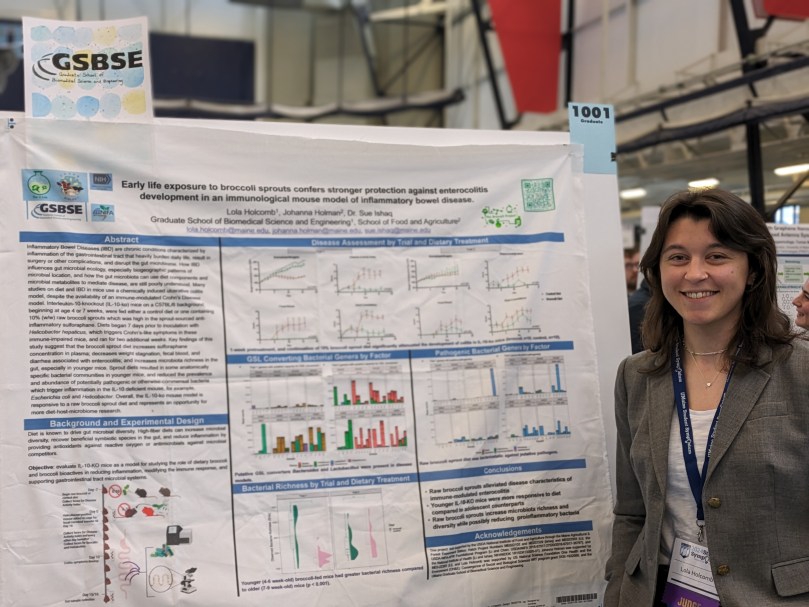
Early life exposure to broccoli sprouts confers stronger protection against enterocolitis development in an immunological mouse model of inflammatory bowel disease.

Lola Holcomb1, Johanna Holman2, Molly Hurd3, Brigitte Lavoie3, Louisa Colucci4, Gary M. Mawe3, Peter L. Moses3,5, Emma Perry6, Allesandra Stratigakis7, Tao Zhang7, Grace Chen8, Suzanne L. Ishaq1*, Yanyan Li7*
Date: 19-Aug-2024, live session from 16:30 to 17:30 Poster number: PS1.02.002 Section: Understanding microbiome dynamics to improve human health
1 Graduate School of Biomedical Sciences and Engineering, University of Maine, Orono, Maine 2 School of Food and Agriculture, University of Maine, Orono, Maine 3 Larner College of Medicine, University of Vermont, Burlington, Vermont 4 Department of Biology, Husson University, Bangor, Maine, 5 Finch Therapeutics, Somerville, Massachusetts, 6 Electron Microscopy Laboratory, University of Maine, Orono, Maine 7 School of Pharmacy and Pharmaceutical Sciences, SUNY Binghamton University, Johnson City, New York, 8 Department of Internal Medicine, University of Michigan Medical School, Ann Arbor, Michigan
Inflammatory Bowel Diseases (IBD) are chronic conditions characterized by inflammation of the gastrointestinal (GI) tract that burden daily life, result in complications, and disrupt the gut microbiome. Many studies on diet and IBD in mice use an ulcerative colitis model, despite the availability of an immune-modulated Crohn’s Disease model. The objective of this study was to establish IL-10 deficient mice as a model for studying the role of dietary broccoli and broccoli bioactives in reducing inflammation, modifying the immune response, and supporting GI tract microbial systems. Interleukin-10-knockout (IL-10-ko) mice on a C57BL/6 background, beginning at age 4 or 7 weeks, were fed either a control diet or one containing 10% raw broccoli sprouts. Diets began 7 days prior to inoculation with Helicobacter hepaticus, which triggers Crohn’s-like symptoms in these immune-impaired mice, and ran for 2 additional weeks. Broccoli sprouts decreased (p < 0.05), fecal lipocalin (LCN2), a biomarker for intestinal inflammation, and fecal blood, diarrhea, and overall Disease Activity Index. Sprouts increased gut microbiota richness, especially in younger mice (p < 0.004), and recruited different communities in the gut (B-diversity, ANOVA, p < 0.001), especially in the colon (B-diversity, ANOVA, p = 0.03). The control group had greater prevalence and abundance of otherwise commensal bacteria which trigger inflammation in the IL-10-ko mice. Helicobacter was within the top-5 most prevalent core genera for the control group, but was not within the top-5 for the broccoli group. Disease parameters and microbiota changes were more significant in younger mice receiving broccoli. A diet containing 10% raw broccoli sprouts may be protective against negative disease characteristics of Helicobacter-induced enterocolitis in IL-10-ko mice, and younger age is the most significant factor (relative to diet and anatomical location) in driving gut bacterial community richness and similarity. The broccoli diet contributes to prevalence and abundance of bacterial genera that potentially metabolize dietary compounds to anti-inflammatory metabolites in the gut, are bacteriostatic against pathogens, and may ease disease severity.
Funding Sources: This work was funded by the NIH, USDA, NSF NRT, and UMaine GSBSE.
 The Ishaq Lab