
Over the past few months, a large team of undergraduate, graduate, and postdoctoral researchers, and I, have been processing hundreds of samples from our scallop hatchery microbiome project. As 2022 winds down, so does the first phase of our lab work, and we are taking a well-deserved break over the holidays before we launch additional lab work, data analysis, and manuscript writing in 2023.
In 2021, the Ishaq Lab, collaborators at UMaine, and collaborators at the Downeast Institute ran a pilot project to investigate the bacteria that associate with sea scallop larvae in hatcheries, and how this is develops in relation to bacteria in hatchery tanks over time. For that project, we collected hundreds of culture plates with a specialized media that selects for certain species of bacteria.
When tanks are drained and cleaned every two days, cotton swabs are rolled across part of the bottom or side of the tank and used to inoculate bacteria onto these culture plates. This is part of a routine screening for pathogens, and don’t worry, we aren’t finding bacteria that causes disease in humans. But, these screening plates creates a useful starting point for our research on bacterial community dynamics.

We received over 200 of these TCBS culture plates, and from them we isolated 140 bacteria in 2021 and early 2022 which we archived at -80 degrees Celsius. This was part of Sarah Hosler’s master’s of science thesis in August of 2022, and has since been passed to Ayodeji Olaniyi for part of his master’s of science thesis.
This fall, we were able to recover 115 of these isolates from the deep freeze, and tested them on 12 different media in duplicate, which created >1800 cultures plates and tubes, and 230 microscope slides!
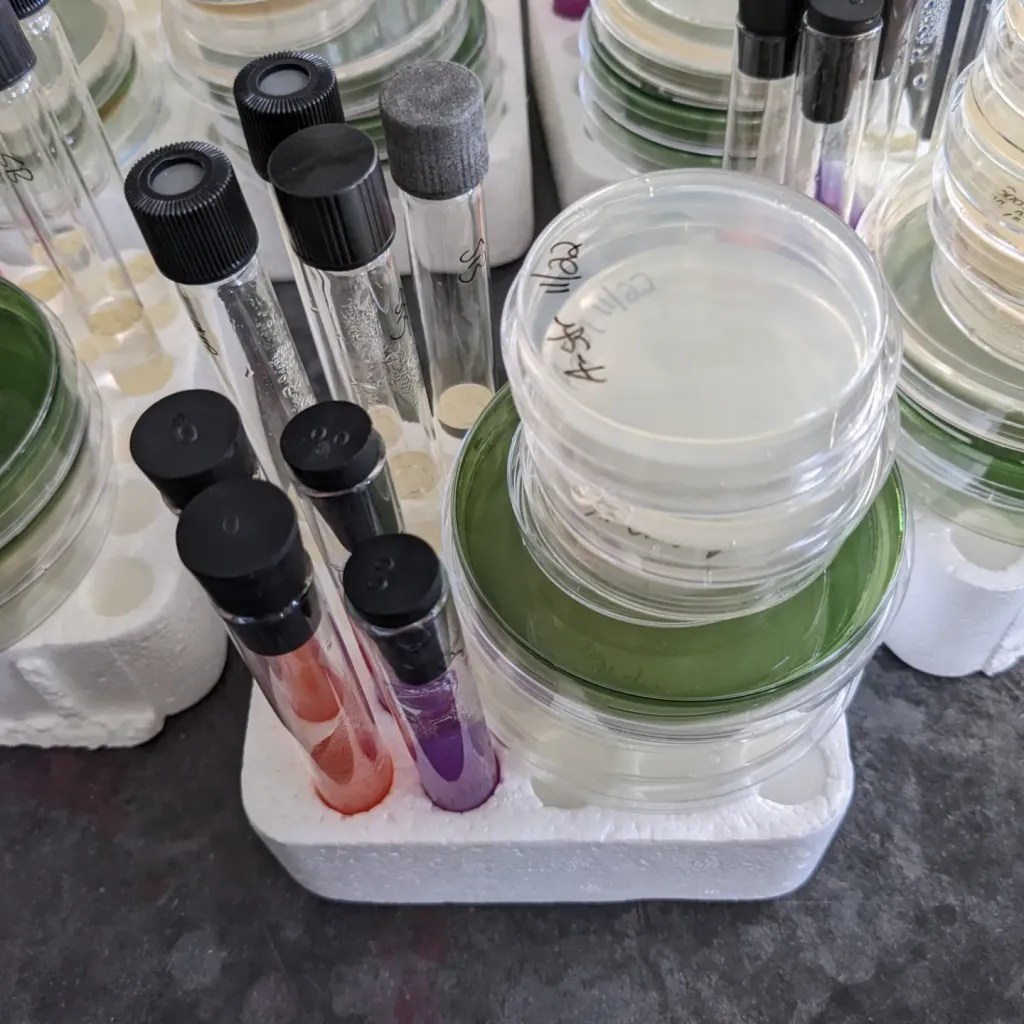


This massive undertaking would not have been possible without a large team helping with the lab work, including rockstars Ayodeji Olaniyi, Sydney Shair, Keagan Rice, and Lacy Mayo who put in hours and hours leading the efforts on this. We are also grateful to Alaa Rabee, Aaron Williams, Lily Robbins, Ash VanNorwick, and Rebecca Kreeger who provided assistance with media making, inoculating, and the large amount of cleanup (we used glass or autoclavable plastic where possible, and sterilized some single-use plastics to be used as training tools for student education). We were also assisted by Bryanna Dube, who is working on creating outreach/education materials based on our results.


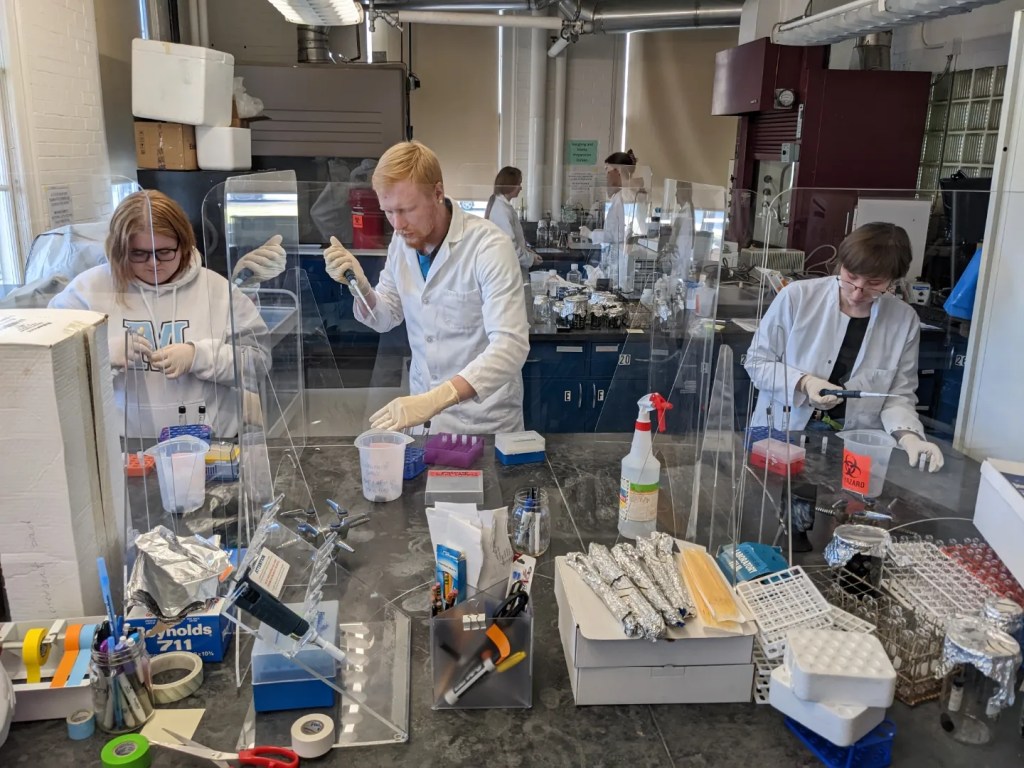
Now, our team will focus on analyzing the results of all these microbiology tests and look for trends. Some will also be heading to the Perry Lab to learn how to perform quantitative polymerase chain reactions (qPCR), in which we use a modified version of DNA replication to count the copies of specific genes. We will use this to look for genes which confirm the identity of our bacteria.

Beginning in summer 2022, the Ishaq Lab has also been part of a state-wide research and commercial collaboration to understand and improve sea scallop production in hatcheries and farms. As part of that project, we received 1500 DNA samples from different hatchery tanks or larvae over the summer/fall rearing season.
Gloria Adjapong is a Postdoctoral Fellow at the UMaine Cooperative Extension Veterinary Diagnostics Lab, and she has been graciously extracting these samples as part of her cross-training in the Ishaq Lab. We will use the extracted DNA to sequence the bacterial communities to identify which bacteria are present, and when, to understand microbial community dynamics over time and in relation to scallop health.

 The Ishaq Lab