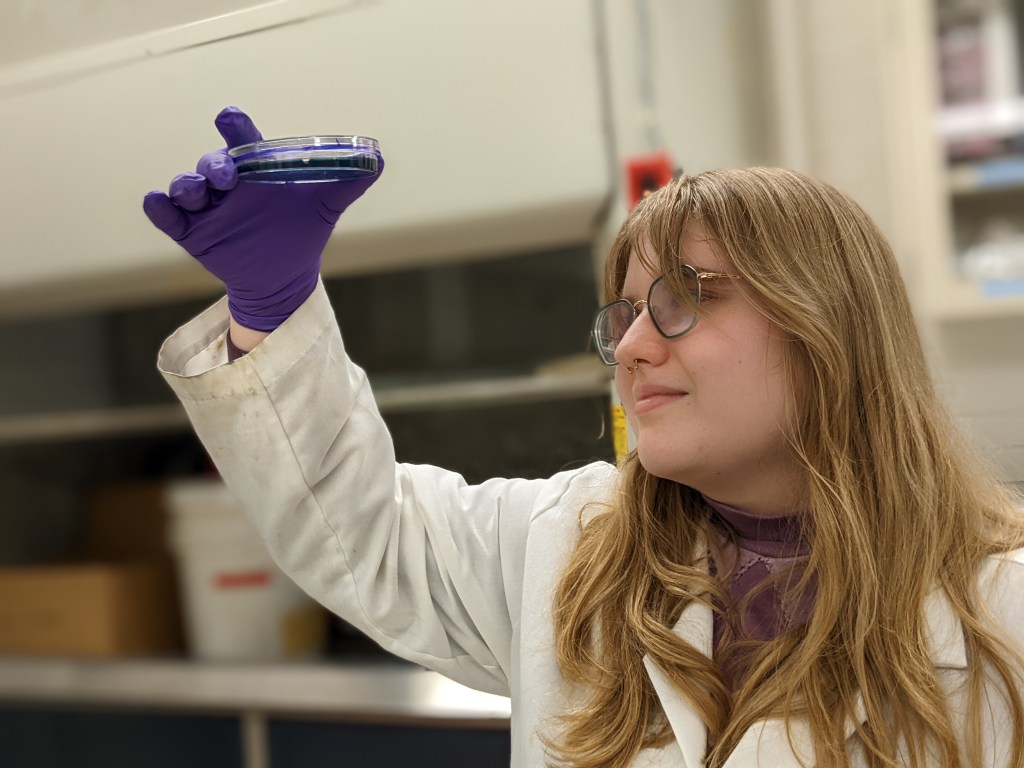
The Ishaq Lab is pleased to welcome Marissa Kinney as a Master’s of Science student in Microbiology, beginning in January 2023! She’ll be joining ‘Team Broccoli‘ to investigate the 806 bacteria we isolated from the digestive tracts of mice eating a broccoli sprout diet, in a previous experiment on broccoli sprouts, microbes, and resolving colitis.
Master of Science student, Microbiology and Animal and Veterinary Sciences
Blurb: Marissa is a Masters student who loves learning and bench microbiology. She completed her undergraduate at the University of Maine in 2021, earning a BS in Microbiology and a BS in Cellular/Molecular Biology. She devoted a large portion of her time in undergrad to research in the laboratories of Dr. Julie Gosse and Dr. Edward Bernard. Since graduating, she worked in the field of public health at UMaine’s Margaret Chase Smith Policy Center, collecting and processing data about violent and drug-related deaths in Maine. While her role at the Center was one she loved dearly, she feels a big pull towards laboratory work and academic research. She recently joined the Ishaq lab and is excited by the new opportunities this position brings.
A massive literature review led by Johanna Holman, and featuring our collaborative team of broccoli sprout and microbes researchers, was accepted for publication!
As part of her master’s of science thesis, Johanna Holman reviewed hundreds of journal articles on anti-inflammatory, health-promoting dietary compounds in broccoli and other vegetables or fruits, and how microbes in the digestive tract can transform inactive precursors from foods into those beneficial compounds. This is part of a broader research collaboration on how glucoraphanin in broccoli sprouts can be made into sulforaphane, which acts as an anti-inflammatory in humans. Humans are unable to convert glucoraphanin to sulforaphane, and a small amount of this occurs naturally thanks to enzymes in the broccoli sprouts. But, certain gut microbes can make the conversion and this has helped resolve colitis and other symptoms in mice in laboratory trials (manuscripts in preparation).
Inflammatory Bowel Diseases (IBD) are chronic, reoccurring, and debilitating conditions characterized by inflammation in the gastrointestinal tract, some of which can lead to more systemic complications and can include autoimmune dysfunction, a change in the taxonomic and functional structure of microbial communities in the gut, and complicated burdens in a person’s daily life. Like many diseases based in chronic inflammation, research on IBD has pointed towards a multifactorial origin involving factors of the host’s lifestyle, immune system, associated microbial communities, and environmental conditions. Treatment currently exists only as palliative care, and seeks to disrupt the feedback loop of symptoms by reducing inflammation and allowing as much of a return to homeostasis as possible. Various anti-inflammatory options have been explored, and this review focuses on the use of diet as an alternative means of improving gut health. Specifically, we highlight the connection between the role of sulforaphane from cruciferous vegetables in regulating inflammation and in modifying microbial communities, and to break down the role they play in IBD.
Yanyan Li and I sat down yesterday with Carly D’Eon, a reporter with News Center Maine, to talk about our ongoing research into broccoli sprouts, gut microbes, and Inflammatory Bowel Disease!
It’s been a few years in the making, but our draft manuscript on lobster shell microbes, epizootic shell disease, and climate change is available online as a preprint (not yet peer reviewed)! You can read the preprint here, and the summary is below.
I joined this project back in the summer of 2020, when I was given a large 16S rRNA gene sequence dataset of bacterial communities from the shells of lobsters by a research group at UMaine who had been studying lobster health for some time. My first point of contact on the project was Jean MacRae, an Associate Professor of Civil and Environmental Engineering at UMaine, who had been working on bacterial community sequencing on other projects which I’ve been involved in, and who has been involved with MSE, and this will be our fourth publication together!
Jean introduced me to the original research team, including Debbie Bouchard, who is the Director of the Aquaculture Research Institute and was researching epizootic shell disease in lobsters for her PhD dissertation; Heather Hamlin, Professor and Director of the School of Marine Sciences; Scarlett Tudor, the Education and Outreach Coordinator at the ARI; and Sarah Turner, Scientific Research Specialist at ARI.
I used the data as a training opportunity for Grace Lee, who at the time was an undergraduate at Bowdoin College participating in the abruptly cancelled summer Research Experience for Undergrads program at UMaine in summer 2020. Instead, Grace joined my lab as a remote research assistant and we worked through the data analysis over the summer and fall. Grace has since graduated with her Bachelor’s of Science in Neuroscience, obtained a Master’s of Science at Bowdoin, and is currently a researcher at Boston Children’s Hospital while she is applying to medical school.
Earlier this year, the research team, along with social science Masters student Joelle Kilchenmann, published a perspective/hypothesis piece which explored unanswered questions about how the movement of microbes, lobsters, and climate could affect the spread of epizootic shell disease in lobsters off the coast of Maine.
Suzanne L. Ishaq1,2,, Sarah M. Turner2,3, Grace Lee4,5,M. Scarlett Tudor2,3, Jean D. MacRae6, Heather Hamlin2,7, Deborah Bouchard2,3
1 School of Food and Agriculture; University of Maine; Orono, Maine, 04469; USA.
2 Aquaculture Research Institute; University of Maine; Orono, Maine, 04469; USA.
3 Cooperative Extension; University of Maine; Orono, Maine, 04469; USA.
4 Department of Neuroscience, Bowdoin College, Brunswick, ME 04011; USA.
5 Boston Children’s Hospital, Boston, MA 02115; USA.
6 Department of Civil and Environmental Engineering; University of Maine; Orono, Maine, 04469; USA.
7 School of Marine Sciences; University of Maine; Orono, Maine, 04469; USA.
Summary
The American lobster, Homarus americanus, is an economically valuable and ecologically important crustacean along the North Atlantic coast of North America. Populations in southern locations have declined in recent decades due to increasing ocean temperatures and disease, and these circumstances are progressing northward. We monitored 57 adult female lobsters, healthy and shell-diseased, under three seasonal temperature cycles for a year, to track shell bacterial communities using culturing and 16S rRNA gene sequencing, progression of ESD using visual assessment, and antimicrobial activity of hemolymph. The richness of bacterial taxa present, evenness of abundance, and community similarity between lobsters was affected by water temperature at the time of sampling, water temperature over time based on seasonal temperature regimes, shell disease severity, and molt stage. Several bacteria were prevalent on healthy lobster shells but missing or less abundant on diseased shells, although putative pathogens were found on all shells regardless of health status.
The second paper from Tindall’s master’s work at Montana State University in the Menalled Lab has been accepted for publication! Tindall defended her master’s in August 2021, and has been working at a plant production company in Bozeman since then.
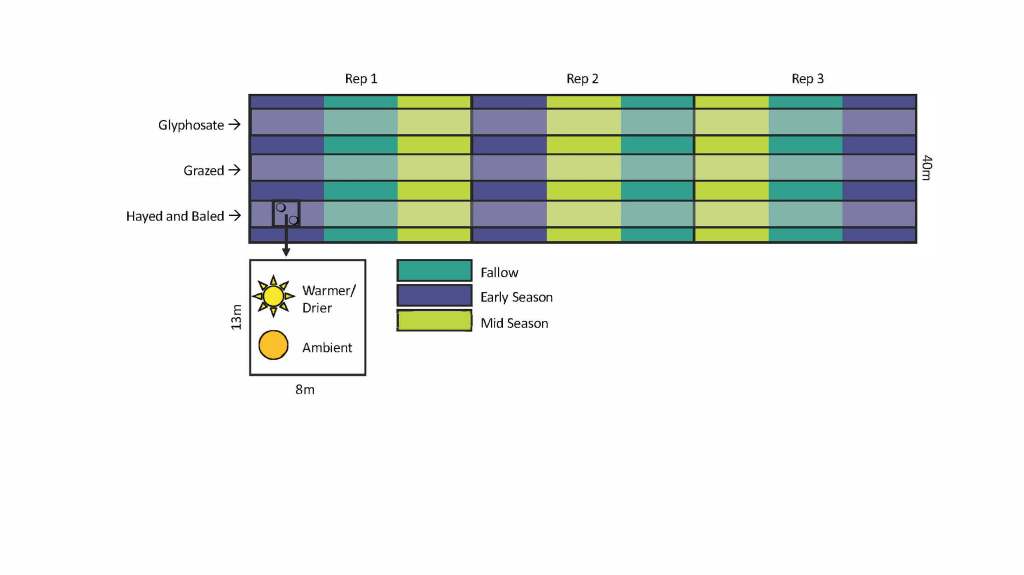
Soil microbial communities are integral to highly complex soil environments, responding to changes in aboveground plant biodiversity, influencing physical soil structure, driving nutrient cycling, and promoting both plant growth and disease suppression. Cover crops can improve soil health, but little is known about their effects on soil microbial community composition in semiarid cropping systems, which are rapidly becoming warmer and drier due to climate change. This study focused on a wheat-cover crop rotation near Havre, Montana that tested two cover crop mixtures (five species planted early season and seven species planted mid-season) with three different termination methods (chemical, grazed, or hayed and baled) against a fallow control under ambient or induced warmer/drier conditions. Soil samples from the 2018 and 2019 cover crop/fallow phases were collected for bacterial community 16S rRNA gene sequencing. The presence and composition of cover crops affected evenness and community composition. Bacterial communities in the 2018 ambient mid-season cover crops, warmer/drier mid-season cover crops, and ambient early season cover crops had greater richness and diversity than those in the warmer/drier early season cover crops. Soil microbial communities from mid-season cover crops were distinct from the early season cover crops and fallow. No treatments affected bacterial alpha or beta diversity in 2019, which could be attributed to high rainfall. Results indicate that cover crop mixtures including species tolerant to warmer and drier conditions can foster diverse soil bacterial communities compared to fallow soils.
Figure 1, showing a schematic of the fields and experimental design.
This award will complement other projects/awards led by our team, which has been investigating inflammatory bowel diseases, anti-inflammatories, gut microbes, and nutrition, separately for decades and collaboratively for over two years.
Dr. Yanyan Li, PhD (lead PI), Assistant Professor at the University of Maine with expertise in nutrition and food science, particularly dietary bioactives and colitis;
myself (co-PI), with expertise in host-associated microbiology, especially GI tract;
Dr. Grace Chen, MD, PhD (co-I), Associate Professor at the University of Michigan, expertise in mouse models for gut microbiome and colonic host immune responses;
Dr. Tao Zhang, PhD (consultant), Assistant professor at Binghamton University, with expertise in metabolism, kinetics, and bioanalysis of natural products;
Dr. Gary Mawe, PhD (consultant), Professor at the University of Vermont, with expertise in translational research on GI tract regulation, inflammation, and IBD;
Dr. Peter Moses, MD (consultant), Professor Emeritus at the University of Vermont College of Medicine and Senior Researcher at GSK, with expertise in IBD and functional gastrointestinal disorders.
R15 Research Enhancement Awards are designated for projects which involve a large number of student researchers. Between the Li and Ishaq labs, there are three current graduate students, and two former undergrads who have contributed to this research, and we anticipate bringing in 1-2 additional graduate students and almost a dozen undergrads in the next year! That will include undergrads in Honors, Top Scholars, and Capstone programs at UMaine. We’ve also been assisted by the work of students, postdocs, technicians, and investigators through our collaborators, and we are ecstatic about the opportunity to continue to grow our team across institutions. And, this project will generate research that will feed back into education at UMaine through the courses that we teach, such as my microbiomes and DNA sequence analysis courses.
“Harnessing gut microbiota to reduce inflammation using broccoli-sprout diets.”
Project Summary:
Inflammatory bowel disease (IBD) is a poorly understood gastrointestinal (GI) condition characterized by inflammation. The prevailing theory is that combined genetic and environmental factors disrupt the host immune system’s interaction with gut microbiota. Our central hypothesis is that consumption of specific broccoli sprout preparations elicits changes in the gut microbiota that not only improve the production of anti-inflammatory bioactives, but also promote intestinal homeostasis. Our labs have shown there is an anatomical pattern along the GI tract where broccoli sprout-derived bioactive levels are high which correspond to diet-induced changes in gut microbial communities. We showed that gut microbiota contribute to the transformation of inactive precursors to bioactives, and that specific broccoli sprout preparations alter their capacity for biotransformation, and the susceptibility of mice to colitis. However, a significant knowledge gap remains regarding the mechanisms by which dietary bioactives modify disease risk and the role of gut microbiota. Our immediate goal is to identify the mechanisms by which broccoli sprout diets affect susceptibility to IBD in mice. Our long-term goal is to develop a dietary preparation of broccoli sprouts which has therapeutic effects against IBD in humans. Our innovative approach uses different preparations of broccoli sprouts to help differentiate gut microbiota versus plant-derived enzymatic activities. We employ a combination of “omics” approaches to spatially-map the microbial community and metabolite profile changes along the GI tract, to better assess changes induced by broccoli sprout diets. We complement “omics” approaches with culturing, and validate our study design using two complementary models for strategic research.
Created by Johanna Holman.
Aim 1 tests the hypothesis of an anatomical pattern where the GI tract microbiota transform broccoli compounds into bioactives, and helps us determine whether this microbial biotransformation is sensitive to dose of broccoli compounds. We will use our established DSS-mouse-model of ulcerative colitis to investigate the effects of different broccoli sprout preparations and concentrations on the microbiota along the GI tract; on the resulting concentration of bioactives in gut tissues; and on the development of colitis in mice.
Created by Sue Ishaq, made with Biorender
Aim 2 tests the benefits of using an immunosuppressed mouse model in the dietary prevention study to provide a stronger translational strategy for the use of broccoli sprouts for IBD prevention. When exposed to a specific bacterial pathogen, the immunosuppressed mice develop chronic enterocolitis resembling Crohn’s disease. This diet-based approach provides critical information for developing accessible and equitable strategies for improving health of IBD patients.
The Allen Foundation awarded Dr. Yanyan Li, Assistant Professor of Food Science and Human Nutrition, and myself funding for a pilot project in people on broccoli sprouts, the gut microbiome, anti inflammatory compounds, and health! Dr. Li and I, as well as a team of other researchers, have been collaborating over the last three years to understand how certain gut microbes create an anti-inflammatory compound using a compound in broccoli sprouts, and how we can use this action to calm colitis. Over the next 18 months, we will be recruiting a small group of people to participate in a diet trial. This will form the first part of the PhD work for Johanna Holman, who recently defended her master’s of science at UMaine.
Project Summary:
There is increasing evidence that diet and the gut microbiota have significant impact on human health and thus impact susceptibility to disease such as inflammatory bowel disease. Indeed, a Westernized diet has been associated with higher risk for developing inflammatory bowel disease, primarily as ulcerative colitis and Crohn’s disease, while a diet rich in fruits and vegetables tends to reduce risk. Our preliminary data suggests that a specific whole-food preparation of broccoli sprouts protects against the development of colitis in a chemically-induced mouse model as well as in a transgenic mouse model of Crohn’s disease. Furthermore, the gut microbiome contributes to the generation of the active anti-inflammatory component, sulforaphane, from broccoli sprouts, and the microbiome, in turn, is altered by exposure to broccoli sprouts or its metabolites. Thus, our long-term goal is to understand the interactions between anti-inflammatory bioactives of broccoli sprouts and the gut microbiome. The current proposal aims to increase our understanding of the nutrigenomics of the human microbiome and a broccoli sprout diet in healthy subjects. Our goal is to determine the feasibility of incorporating a specific broccoli sprout preparation into whole-food diets to increase levels of anti-inflammatory bioactives from broccoli sprouts in healthy humans. These directly address the foundation’s priority of “bringing the promise of nutrigenomics or nutritional genomics to realization”. Results from this study will help determine the feasibility and potential efficacy of a whole food approach in promoting intestinal homeostasis and mitigating risk of developing inflammatory bowel disease.
Figure from Holman et . in review, artwork by Johanna Holman. Glucoraphanin hydrolysis. A. GLR hydrolysis in the presence of myrosinase upon damage to the broccoli plant. Epithiospecifier protein preferentially converts GLR to SFN-nitrile. B. GLR hydrolysis has been demonstrated by gut bacteria in the colon of mammals. Low pH environments favor conversion to SFN-nitrile.
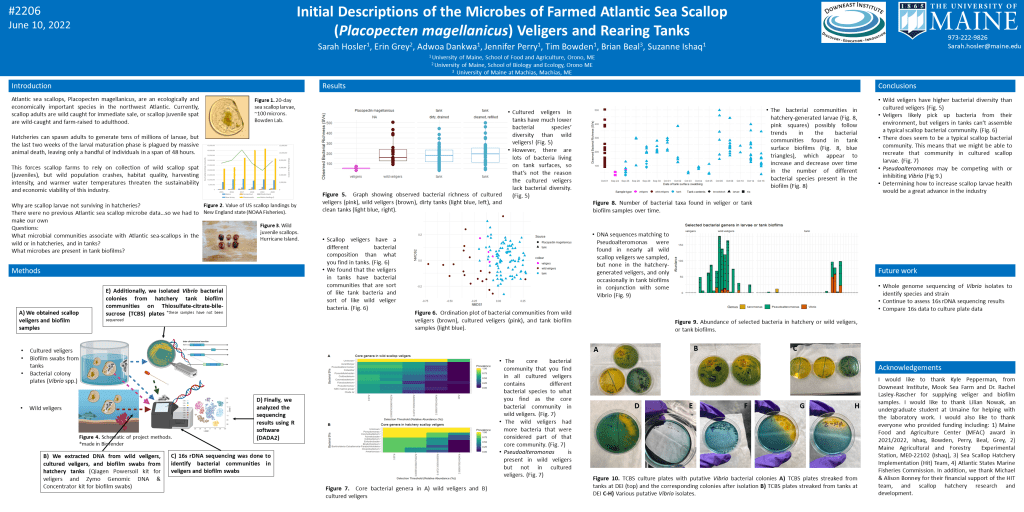
Last week, undergraduate Alexis Kirkendall concluded her 10-week Research Experience for Undergraduates (REU) program at the University of Maine. Over that time, she has been an integral member of the Ishaq lab, and had assisted with lab work for multiple projects, comparing microscopy staining protocols, training students, assisting with laboratory management and safety regulation checks, and more. She picked up skills in animal sample collection, microscopy and staining, parasitology, culture media preparation, DNA extraction, and data visualization in R. Alexis also helped create some of the marketing materials for the Microbes and Social Equity Symposium in July, and facilitated group discussions as a note taker.
At the end of the program, REU students create posters and short presentations of their efforts over the summer. The presentations were last week, but you can check out the poster below.
Alexis is heading back to Ohio for her next year at Heidelberg College where, in addition to studying science, she is leading initiatives to make the campus more accessible and inclusive. But, we hope to see her back in Maine sometime in the future!
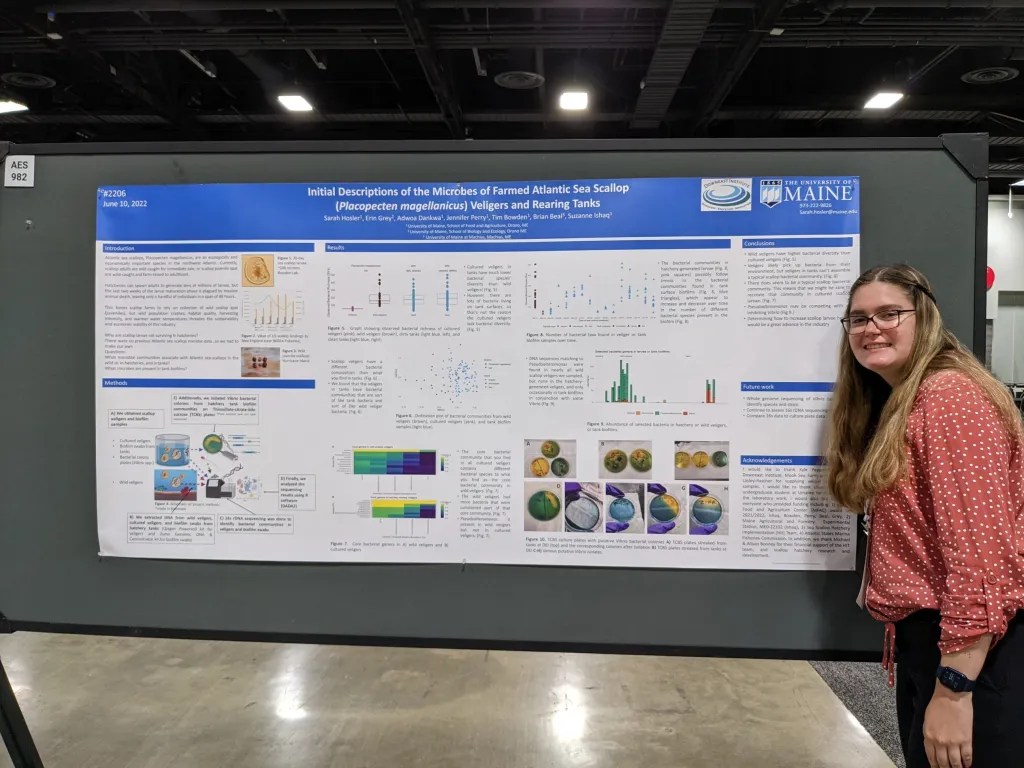
Sarah Hosler passed her Master’s of Science these defense (we knew she would succeed)!! Sarah has worked incredibly hard over the last two years to broaden her research skills and conduct four completely different pilot projects. Her defense presentation focused on the two main projects, but was a wonderful way to see that progression all at once and to reflect on her growth as a lab manager and researcher. She has also earned the designation of “second Ishaq Lab grad student to defend”.
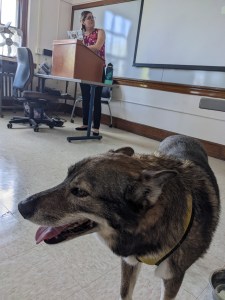
The defense was attended by her thesis committee, students in the Ishaq lab, collaborators on this project, friends and family, and Izzy the dog (pictured, and yes, Sarah preferred this picture of her at her defense to a portrait of herself. Sarah will officially pass after a few revisions to her thesis and a formal acceptance by the committee members, which is standard for graduate defenses.
After wrapping up a few things in Maine, Sarah will be heading to Pennsylvania to take a position as Student Program Coordinator for middle and high school aged students at Albright College, where she obtained her Bachelor’s of Science. Congrats on the defense and on the next stage of your career!
“Weaving An Interdisciplinary Microbiome Career Using Threads From Different Ecosystems”.
Johanna Holman passed her Master’s of Science these defense (we knew she would succeed)!! Johanna has worked incredibly hard over the last two years to broaden her research skills and conduct several experiments, and her defense presentation was a wonderful way to see that progression all at once. She has also earned the designation of “first Ishaq Lab grad student to defend”. The defense was attended by her thesis committee, students in the Ishaq lab, collaborators on this project, and friends and family (who brought her a flower and broccoli bouquet that can be seen in the picture below). She will officially pass after a few revisions to her thesis and a formal acceptance by the committee members, which is standard for graduate defenses.
Johanna Holman beginning her master’s defense presentation.
Johanna has been accepted to the Nutrition PhD program at UMaine, and will continue working with Dr. Li and I, as well as the full research team. Based on those preliminary results, Johanna’s doctoral work will focus on developing that new mouse model, synthesizing information from both models, and using those results to develop diet intervention trials in human patients. After her PhD, Johanna intends to conduct research at an institution here in Maine, and to continue her work connecting the biochemistry of nutrition with gut microbiology and human health.
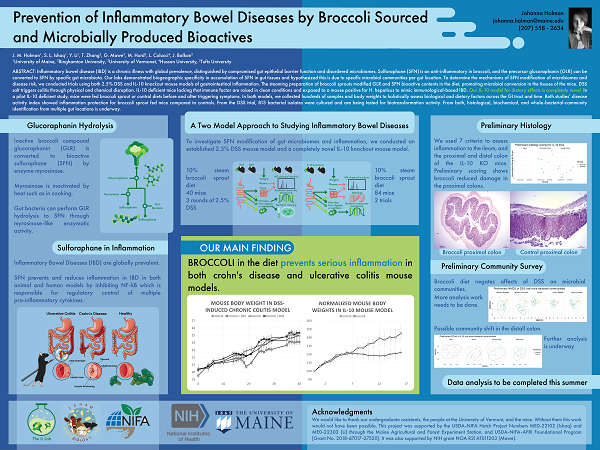
Prevention of Inflammatory Bowel Diseases by Broccoli Sourced and Microbially Produced Bioactives.
Johanna Holman at her ASM Microbe 2022 poster
Johanna Holman, graduate researcher in the Ishaq Lab