Show Me the (Grant) Money!

Every political season brings about uncertainty regarding the future of policy, funding, and cultural beliefs, and the field of science is no exception. The surprising results this November have led many scientists and other academics to fear for their jobs and research in the coming years.

Part of this stems from a growing trend of members of the public distrusting scientists (discussed here), or the rise of false information regarding serious issues such as climate change, genetically modified organisms (GMOs), vaccinations, etc., that is leading to a disparity between what scientists accept as true and what the public accepts as true.  Regardless of which side of an issue you fall on, the consensus seems to be that the public is lacking scientific literacy and scientists are lacking in public outreach (hence the basis for my website).


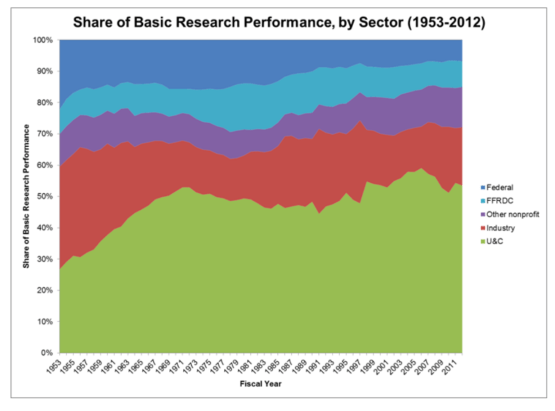
Some of this disparity develops from public opinion and governmental policy, which can affect what research is deemed important enough to be funded.  For example, if an administration denies the existence and causes of climate change, it sends a message to the public that this research and this theory are invalid or unimportant.  Not only can this influence state and federal policy (1, 2), but usually means that the field is unlikely to receive state or federal research grant funding.  Not only does this prevent a better understanding of scientific issues, like climate change, but it prevents technological advances which improve quality of life and the economy, especially since a good deal of commercial technology companies utilize basic research from academic institutions as publications and raw date are typically publicly available.
Screen Shot 2016-12-07 at 4.54.54 PM.png
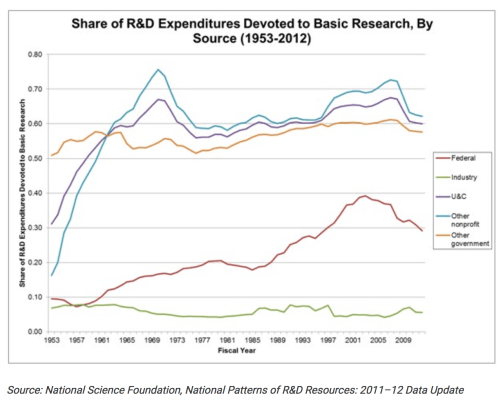
“The Changing Nature of U.S. Basic research: Trends in Performance”, SSTI.  U&C = universities and colleges.

It also means that people relying on research grants for salary (like myself, and most other post-doctoral researchers, research associates, graduate and undergraduate researchers, technicians, and some extension outreach personnel) find themselves without jobs.  Research-based salary also means that you are limited to a short contract based on the project, anywhere from a month to several years.  From experience, a short-term funded position (a year or less) means that you spend a significant amount of time applying to other jobs (a lengthy process) or writing more research grants (an incredibly lengthy process that I’ll discuss in a few months- which take at least 6 – 8 weeks just to write).  This can impede on your other job or social responsibilities.

Prior to the jump in federal funding during the Cold War, research was funded by universities themselves and smaller organizations. Most large-scale research grants in the last 50 years, however, have been federally funded.  Organizations such as the United States Department of Agriculture (USDA), the National Science Foundation (NSF), the National Institutes of Health (NIH), the National Aeronautics and Space Administration (NASA), the US Department of Defense (DoD), the US Department of Energy (DoE), and others release funding calls on a regular basis.  Some funding calls are general and will accept any project type, but many are specific to a particular field or research question (e.g. climate change, cancer, etc.).  There are many other organizations or companies which will fund research in a very specific field (such as Sustainable Agriculture Research and Education (SARE), which funds organic and sustainable agriculture), or provide small fellowships.  Philanthropic organizations also fund research, usually targeted towards a specific disease or special interest, and tend to be small but which can help bring funding to obscure fields.

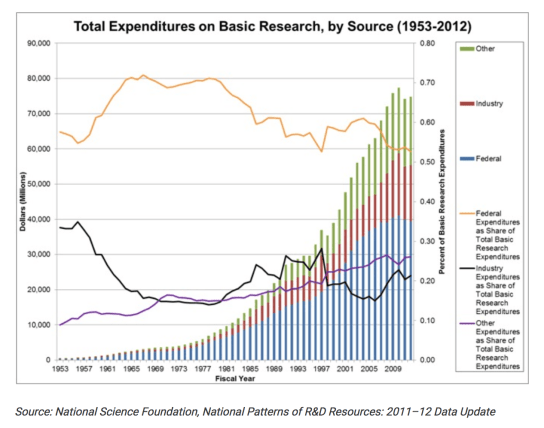
While the total dollar amount of money put into research and development (R & D) in the US has dramatically increased over the last 50 years, the amount the federal government has been putting in has remained relatively stable over the last 10 years.  Some cite the availability of other funding sources, such as universities themselves, as making up more of the costs.  However, this also comes with a price, as the reduction in state funding has been cited as the cause for rising tuition, and universities are unwilling to reduce tuition even after funding has been reinstated.
Screen Shot 2016-12-07 at 4.49.43 PM.png

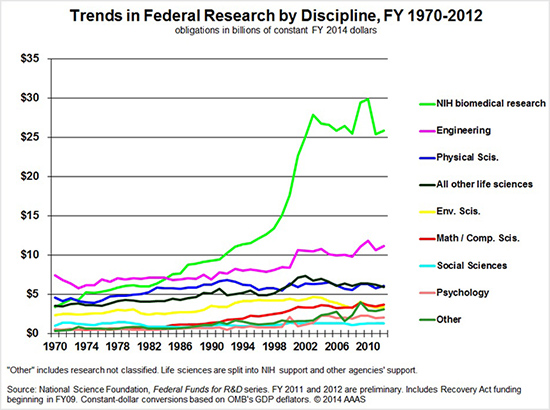
The increase in funding has largely been in biomedical and engineering fields, with other areas of research remaining relatively stable.
fundingbydiscipline550.jpg

It’s also important to remember that there are more people going into research jobs now,  although this number has been largely stagnant over the last 10 years, and even with the increases in working researchers, only 5.9% of the US workforce was in a STEM field in 2015.  Long-term, without a concurrent increase in funding this increase in working researchers can increase job competition and stress.

Laboratory equipment and technology is much more complex and expensive than it was even a decade ago.  The percentage of funding going into basic research, from multiple funding sources, has also declined over the last 10 years, which means research projects have to focus on short-term goals instead of long-term, complex projects that gather more data.  Basic research aims to understand a system, rather than manipulate it or develop a product, and is the necessary first step which opens up decades of further, more applied, research.
Screen Shot 2016-12-07 at 4.49.10 PM.png


The increase in number of researchers and projects/researcher, coupled with funding stagnation, can massively increase grant competition.  Over the past few years, it has been holding steady at 22% for NSF, and 18-25% for NIH, although their data is more complicated because they saw an increase in budget and an increase in total number of PIs funded, yet a reduction in percent of projects funded (indicating that more many more grants were submitted overall).  The USDA is also more complicated to track because of the number of grant programs within the USDA, each of which put forward different targeted grant funding calls each year.  In 2013, USDA AFRI had a 10% funding success rate.  Manually checking grant funding calls reveals grant-specific success rates, upwards of 30% funding success; however, many of these grants with a higher rate of success also require you to match their funding with funding from another source.  So if you have a 1/3 chance of getting that USDA grant, and a 1/5 chance of getting a matching NIH grant, your actual chances of getting all that funding are 1/3 x 1/5 = 1/15.


Taken altogether, the clearest trend regarding research in the US is that it’s an integral part to our  way of life and it’s not going anywhere.  Whatever your political views, it’s important that scientists, citizens, and politicians come together across the aisle to do what’s best for the future of the US, and that’s going to necessitate a strong support of scientific work.


End of the fall semester is in sight!

Finals are upon us and that can only mean that I’ve committed myself to reading a stack of manuscripts that students wrote as the final project for the bioinformatics lab I am teaching!  This semester we took raw 16S rRNA sequencing data, analyzed it, interpreted it, and here are the results. Many of my students had never used command line based programs at the beginning of the semester, and now they can discuss the merits of different clustering techniques- I am so proud of them!

Just My Enterotype

A review chapter that I put together last year is now available online or by purchasing the textbook!  The chapter explores the current breadth of knowledge about methanogenic archaea that live in the human digestive tract and their involvement in human gut diseases. These archaea produce methane using hydrogen and carbon products that bacteria create during fermentation, and it’s unclear how the interaction of host immune system, bacterial diversity, and archaeal diversity can trigger disease or convalescence.

It’s based on a preliminary study I did with my Ph.D. advisor https://acbs.cals.arizona.edu/people/andre-denis-wright and gastroenterologist https://www.uvm.edu/medicine/medicine/gastro/?Page=profile.php&bioID=22563 on the connection between methanogen diversity in the intestines and exhaled breath methane.


A collaborative study on virulent Streptococcus got published!

Dr. Benfang Lei is an associate professor here at Montana State University in the Department of Microbiology and Immunology, who has previously collaborated with my previous post-doc advisor, Dr. Carl Yeoman.  As a lab member at the time, I consulted with Dr. Lei about the whole-genome shotgun sequencing that his lab group had performed on several Streptococcus pyogenes isolates.  S. pyogenes is pathogenic in humans and, among other symptoms, causes fever for which it is named.  Some of Dr. Lei’s isolates were much more virulent than others, and his study was to identify differences in the genome that would account for this.  I helped perform some of the genome processing and analysis, and am happy to be a small part of such an interesting study.

Wenchao, Feng, Dylan Minor, Mengyao Liu, Jinquan Li, Suzanne Ishaq, Carl Yeoman, and Benfang Lei. 2016. Null Mutations of Group A Streptococcus Orphan Kinase RocA: Selection in Mouse Infection and Comparison with CovS Mutations in Alteration of in vitro and in vivo Protease SpeB Expression and Virulence. Infection and Immunity.

My first soil microbial ecology paper was just published!

After a long year of data analysis and interpretation, my first paper on soil microbial ecology was just published in Microbial Ecology, found here.  Previously, I presented the data at a poster at this summer’s ASM conference in Boston.  The project led to further collaborations and, of course, led to my current post-doc position!


 “Impact of Cropping Systems, Soil Inoculum, and Plant Species Identity on Soil Bacterial Community Structure”

Suzanne L. Ishaq, Stephen P. Johnson,Zach J. Miller, Erik A. Lehnhoff, Sarah Olivo, Carl J. Yeoman, Fabian D. Menalled. 2016. Microbial Ecology: 1-18.

Abstract

Farming practices affect the soil microbial community, which in turn impacts crop growth and crop-weed interactions. This study assessed the modification of soil bacterial community structure by organic or conventional cropping systems, weed species identity [Amaranthusretroflexus L. (redroot pigweed) or Avena fatua L. (wild oat)], and living or sterilized inoculum. Soil from eight paired USDA-certified organic and conventional farms in north-central Montana was used as living or autoclave-sterilized inoculant into steam-pasteurized potting soil, planted with Am. retroflexus or Av. fatua and grown for two consecutive 8-week periods to condition soil nutrients and biota. Subsequently, the V3-V4 regions of the microbial 16S rRNA gene were sequenced by Illumina MiSeq. Treatments clustered significantly, with living or sterilized inoculum being the strongest delineating factor, followed by organic or conventional cropping system, then individual farm. Living inoculum-treated soil had greater species richness and was more diverse than sterile inoculum-treated soil (observed OTUs, Chao, inverse Simpson, Shannon, P  < 0.001) and had more discriminant taxa delineating groups (linear discriminant analysis). Living inoculum soil contained more Chloroflexi and Acidobacteria, while the sterile inoculum soil had more Bacteroidetes, Firmicutes, Gemmatimonadetes, and Verrucomicrobia. Organically farmed inoculum-treated soil had greater species richness, more diversity (observed OTUs, Chao, Shannon, P  < 0.05), and more discriminant taxa than conventionally farmed inoculum-treated soil. Cyanobacteria were higher in pots growing Am. retroflexus, regardless of inoculum type, for three of the four organic farms. Results highlight the potential of cropping systems and species identity to modify soil bacterial communities, subsequently modifying plant growth and crop-weed competition.

Keywords

16S rRNA, Avena fatua, Amaranthus retroflexus, Conventional farming, Illumina MiSeq, Organic farming, Soil microbial diversity

Preparing for my first greenhouse trial

As the 2016 growing season comes to a close in Montana, here in the lab we aren’t preparing to overwinter just yet.  In the last few weeks, I have been setting up my first greenhouse trial to expand upon the work we were doing in the field.  My ongoing project is to look at changes in microbial diversity in response to climate change.  The greenhouse trial will expand on that by looking at the potential legacy effects of soil diversity following climate change, as well as other agricultural factors.

First, though, we had to prep all of our materials, and since we are looking at microbial diversity, we wanted to minimize the potential for microbial influences.  This meant that the entire greenhouse bay needed to be cleaned and decontaminated.  To mitigate the environmental impact of our research, we washed and reused nearly 700 plant pots and tags in order to reduce the amount of plastic that will end up in the Bozeman landfill.

We also needed to autoclave all our soil before we could use it, to make sure we are starting with only the microorganisms we are intentionally putting in.  These came directly from my plots in the field study, and are being used as an inoculum, or probiotic, into soil as we grow a new crop of wheat.

This is trial one of three, each of which has three phases, so by the end of 2016 I’ll have cleaned and put soil into 648 pots with 648 tags; planted, harvested, dried and weighed 11,664 plants; and sampled, extracted DNA from, sequenced, and analyzed 330 soil and environmental samples!

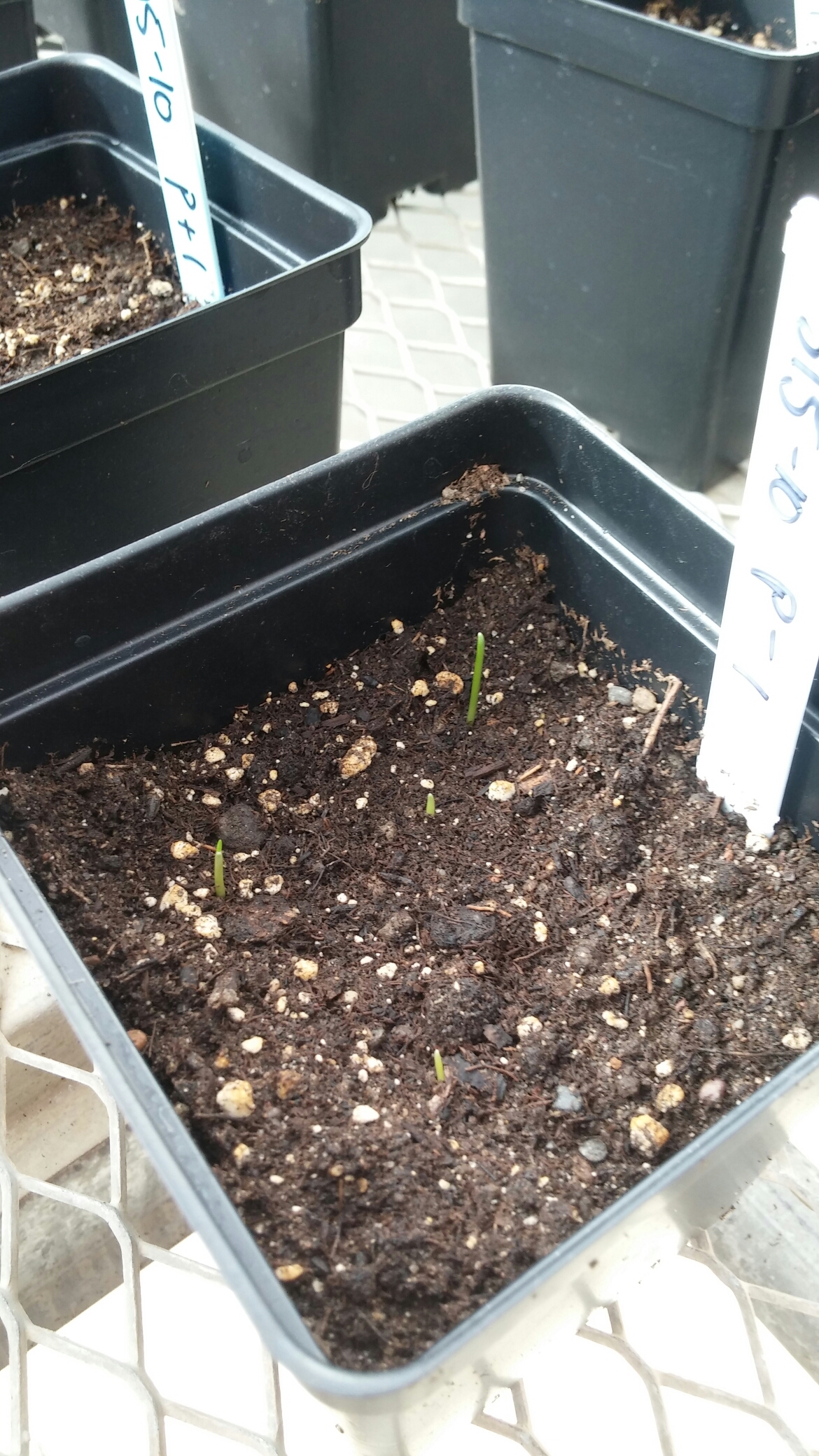
After only a few days, seedlings are beginning to emerge.

 Stay tuned for more updates and results (eventually) from this and my field study!

Citizen Science: year 2 of the Gallatin Microplastic Initiative

The Gallatin Microplastics Initiative is beginning its second year of sample collection along the Gallatin river in Montana.  Volunteers organized by Adventurers and Scientists for Conservation gathered this weekend for our training and first sampling of the year.  ASC brings together local adventurers to help collect difficult animal or environmental samples for large-scale research projects.  While some of their projects are location-specific, some like the Global Microplastics Initiative are open for anyone to participate.

Last year, Lee and I went to Deer Creek in September, December, March, and June to collect water samples to look for microplastics.  This year, we are collecting samples from Storm Castle.  New year, new location, let’s begin a new adventure!

This slideshow requires JavaScript.


What I do for a living Part 4: Teaching

In addition to my post-doctoral research, I also do a small amount of teaching.  Last fall, I taught the laboratory section of a course on Host-Associated Microbiomes at Montana State University.  I redesigned the lab to focus on teaching students how to process and analyze sequencing data, which they had no previous experience in.  Starting with raw data from mock samples, students had to assemble sequences into contigs, pass them through quality assurance steps, align and classify them based on a reference database of their choosing, and statistically compare diversity between samples.  This culminated in a final scientific manuscript, which presented the student’s findings and gave them experience with scientific writing.

This fall, in addition to teaching the lab section, I’m very pleased to announce that I’ll also be teaching some of the class lecture portion.  Most of that will be presenting an introduction to microbial ecology, theory, terminology, and technology.  This will give a base of knowledge for the rest of the course on microbiomes.  Scientific discovery is inextricably linked to the ability and accuracy of the technology available at the time.  To understand how we went from discovering there were microscopic organisms living in water to being able to sequence the entire genome of that organism to understand how it interacts with medications in the human body, we need to understand the technological steps in between.  That way, we can better understand how scientists worked through microbial theories of the past (like disproving Spontaneous Generation), so that we can learn how to work through the microbial theories of the present (like Hygiene Theory).

BIOM405class_9-12_SpeciesDivergence

Summary of JAM conference

The Joint Annual Meeting brings together the American Society of Animal Science, the American Dairy Science Association, the Canadian Society of Animal Science, and this year, the Western Section of ASAS.  Or I should say, JAM did bring these together, as this was the last year that all the societies would be meeting jointly for some time.  The meetings bring together researchers, students, educators, animal producers, and animal feeds and industry together to discuss issues facing animal production and how to best solve them.

After patiently waiting for the recordings of my presentations to be made available, I find that they are not available to the public for a year!  So, here are links to the written abstracts for my presentations, and I’ll upload the videos next year.  By that time, hopefully both these projects will already have published manuscripts!

Abstract 1768.  Ground redberry juniper and urea in DDGS-based supplements do not adversely affect ewe lamb rumen microbial communities.

S.L. Ishaq, C.J. Yeoman, and T.R. Whitney. 2016.


Abstract 1522.  Influence of colostrum on the microbiological diversity of the developing bovine intestinal tract.

S.L. Ishaq, E. Bichi, S.K. Olivo, J. Lowe, C.J. Yeoman, and B.M. Aldridge. 2016.