
Two weeks ago I participated in a BioBE Design Champs webinar on Daylight and Microbes. Find out more here.
Tag: Updates

Where does the time go?
As we rapidly approach the end of both the fall semester and 2017, it’s a great time to reflect about the year’s accomplishments (update your C.V.) and look forward to what 2018 will bring (panic about all the things you haven’t finished yet that need to be completed by the end of the year).
Time management is a reoccurring theme in academia, and with so many items on one’s to-do list, it’s not hard to see why. Everyone has their own advice about how to be more effective; which was the very first meeting in this year’s Faculty Organizing for Success professional development workshop series, which I attended in October. I compiled some of the suggestions made there, along with advice I’ve picked up over the years, and strategies I use which I’ve found to be effective.
One of the major questions that came up at the FOS meeting was time management in the face of academic duties, namely service. Academics have a requirement to provide service or outreach to their university, the community, and their field, and as I’ve previously discussed, these amorphous responsibilities can be time-consuming and under-appreciated. Sometimes, turning off your ringer, closing your email application, or saying “no” isn’t enough or isn’t possible. So, how can you make the most of your time while navigating the constraints of a fractured schedule?
Lists
- I find lists to be extremely helpful in keeping track of everything I need to do, and it really helps me focus on what I need to get done TODAY.
- Lists help me organize my thoughts
- by adding notes for each particular item
- and ordering the steps I need to take to finish each item.
- Being able to
cross tasks off a physical listis also a great visual reminder that you are, in fact, being productive.
- And, at the end of the day, the remaining items form a new list, so I know where to begin tomorrow. This saves me a lot of time which would otherwise be spent trying to remember where and how I left off.
Calendars
Don’t like lists? I also heavily rely on my calendar and will schedule appointments for everything, especially the little things that I’m liable to forget, including catching up on emails, lunch, reading articles, writing posts, etc. I utilize color-coding and multiple calendars within a calendar, like shared calendars from research labs or online applications. I have learned to schedule small blocks of time after meetings, especially project development or brainstorming meetings, during which I can write notes, look up deadlines, send emails, or any other action items that came up during the meeting while it’s still fresh in my mind. I even schedule appointments for my personal events, like hiking, movies, or buying cheese at the farmer’s market. Having them in my calendar keeps me from scheduling work-related things into my personal time. Academics, myself included, have a habit of working more than 40 hours a week: “Let me just send this email real quick” can easily transform into “Well, there went my Saturday”.
I’ve been known to schedule reminders months or a year in advance, perhaps to catch up with someone about a project, to have a certain portion of a project completed by a soft deadline, or look up a grant RFA that will be made available approximately three months from now. Making good use of my calendar has been particularly important for tracking my time for reporting (or billing) purposes. BioBE and ESBL use the Intervals tracking program, and it’s much easier to report my time if I have a detailed account of it in my calendar. Even better- it’s great for retrospective reports:
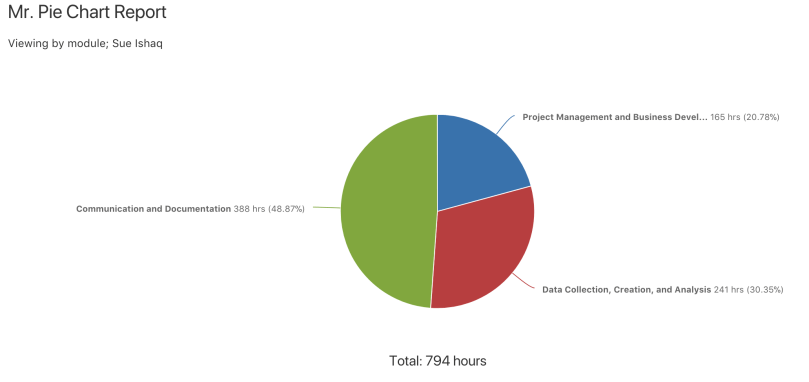

Perhaps the best use of my calendar has been to schedule themed time-blocks spanning several hours, such as “catching up on projects” or “data analysis”, specifically on a shared or public calendar to prevent time fractionation. These events are marked as tentative, so I can be scheduled during those times as needed, but I find that I get fewer requests for my time when I don’t have unclaimed space on the calendar. And, I can focus on a specific project for several hours, which I prefer to a “30 min here, 60 min there” approach. If possible, I also try to concatenate meetings, seminars, training and workshops, or other short but disruptive events. One or two stand-alone events can be a nice way to break up the day, but too many can fracture my time into small blocks and make it very difficult to effectively perform the research portion of my work which is best accomplished when I can puzzle out problems at my own pace. So, I categorize the day as “administrative”, “social media“, or “project management”, and spend the day taking care of all the other responsibilities I have that are tangential (but important) to my research.
Emails
Prioritizing my emails with flags is also really helpful, especially if you can color-code by importance. I get dozens of emails every day, from six different email accounts, but I keep my inboxes to less than 10 items each, almost every day. I spend a few minutes to prioritize them for later, I archive old emails into other folders for future reference, and I dedicate time to deal with my emails on a daily basis. I also liberally use the “unsubscribe” link.

Caution: Work Zone Ahead

Academics love to work outside the office- most often because the office is where everyone goes to find you for some reason. Coffee shops, parks, airports, and homes are popular locations for “writing caves” (I’m writing this from home right now). Being in a distraction-free, or distraction-specific (i.e. white noise of cafe chatter) location helps me focus on things without interruption. When I’m analyzing data or writing up results, I have multiple computer application windows open and am collating information from multiple sources, so I need to focus or else I waste a lot of time trying to pick up where I left off after every interruption.

When I’m stuck on something, sometimes I’ll take a walk- usually to go get coffee. Ok, always to go get coffee. Exercise stimulates blood flow and lattes are full of glucose, so it’s a perfect way for me to recharge. Often, that change of pace is all I need to accomplish in 2 min what I was struggling to put together earlier. My best ideas often coalesce while hiking or biking home, so I started taking pens and notepaper with me so I can write them down on the fly before I forget.
When possible, I also try not to force myself to work to continue working on specific things past the point where I can make progress on it (you know, for all those times I’m not up against a deadline- haha). Of course, this flexibility in my schedule during business hours is a privilege that most people don’t enjoy. It also takes a great deal of self-motivation to enforce, but it can be very effective for me. Instead, I set that project aside and focus on something else entirely. Often, this leads to procrastinating work with other work, but it’s productive nonetheless. But for me, it also leads to more effective work-life balance. Late afternoons are not a particularly productive time for me; it’s better if I leave early and go grocery shopping, and then work for a few hours in the evening or on Saturday mornings, when I can get an extremely productive hour or two in after I’ve had time to mull things over. Having down time built into your day has been shown to improve productivity.
Conversely, when I get new data, start writing a new grant, or acquire a novel task, my interest and enthusiasm are high and I’m tempted to drop everything else to start working on it. Following that passion for a day or a week gives me a great start in which to outline what I’ll do for the next few weeks or months. Then, as my enthusiasm ebbs, my thoughts wander, and other deadlines become more pressing, I can set it aside and pick that outline up later after I’ve thought it over. Collectively, these strategies allow me to be productive without reallocating time that I would otherwise use for sleeping, and without racing against the clock to submit something.
Find a system you like and stick to it
Everyone uses different technology and productivity applications, and everyone has a different style of organization, so you may have to try different things to find a method you like. But once you find something that works for you, stick with it. Too often I see people abandon a time management strategy because they don’t have time to invest in adapting to it. Maybe you have several hundred unread emails you don’t want to sort, maybe you are having syncing issues across multiple device operating systems, or maybe you keep forgetting to use your strategy because it hasn’t become habit. I encourage you to devote time to becoming comfortable with some time management strategy, as I can personally attest that it will pay off later.
A study to which I contributed got published!
I’m pleased to announce that one of my collaborators, Dr. Huawei Zeng of the USDA Agricultural Research Service, recently published another study of his, to which I contributed some analysis of bacterial communities from mice. Several years ago, during my Ph.D. at the University of Vermont, I provided wet-lab and DNA sequence analysis work for a previous project of Dr. Zeng, investigating the health effects of a low or high fat diet on mice, which can be found here.
Colonic aberrant crypt formation accompanies an increase of opportunistic pathogenic bacteria in C57BL/6 mice fed a high-fat diet.
Zeng, H., Ishaq, S.L., Liu, Z., Bukowski, M.R. 2017. Journal of Nutritional Biochemistry. In press, doi.org/10.1016/j.jnutbio.2017.11.001.
Abstract
The increasing worldwide incidence of colon cancer has been linked to obesity and consumption of a high-fat western diet. To test the hypothesis that a high fat diet (HFD) promotes colonic aberrant crypt (AC) formation in a manner associated with gut bacterial dysbiosis, we examined the susceptibility to azoxymethane (AOM)-induced colonic AC and microbiome composition in C57/BL6 mice fed a modified AIN93G diet (AIN, 16% fat, energy) or a HFD (45% fat, energy) for 14 weeks. Mice receiving the HFD exhibited increased plasma leptin, body weight, body fat composition and inflammatory cell infiltration in the ileum compared with those in the AIN group. Consistent with the gut inflammatory phenotype, we observed an increase in colonic AC, plasma interleukin 6 (IL6), tumor necrosis factor α (TNF α), monocyte chemoattractant protein 1 (MCP1), and inducible nitric oxide synthase (iNOS) in the ileum of the HFD-AOM group compared with the AIN-AOM group. Although the HFD and AIN groups did not differ in bacterial species number, the HFD and AIN diets resulted in different bacterial community structures in the colon. The abundance of certain short chain fatty acid (SCFA) producing bacteria (e.g., Barnesiella) and fecal SCFA (e.g., acetic acid) content were lower in the HFD-AOM group compared with the AIN and AIN-AOM groups. Furthermore, we identified a high abundance of Anaeroplasma bacteria, an opportunistic pathogen in the HFD-AOM group. Collectively, we demonstrate that a HFD promotes AC formation concurrent with an increase of opportunistic pathogenic bacteria in the colon of C57BL/6 mice.

What is academic Outreach/Extension?
Service can be a vaguely defined expectation in academia, but it’s an expectation to give back to our community; this can be accomplished in different ways and is valued differently by institutions and departments. Outreach is an easily neglected part of science, because so often it is considered non-essential to your research. It can be difficult to measure the effectiveness or direct benefit of outreach as a deliverable, and when you are trying to hoard merit badges to make tenure and your time is dominated by other responsibilities, you often need to prioritize research, teaching, advising, or grant writing over extension and service activities. Nevertheless, public outreach is a vital part to fulfilling our roles as researchers. Academic work is supported by public funding in one way or another, and much of our research is determined by the needs of stakeholders, who in this sense are anyone who has a direct interest in the problem you are trying to solve.
Depending on your research field, you may work very closely with stakeholders (especially with applied research), or not at all (with theoretical or basic research). If you are anywhere in agriculture, having a relationship with your community is vital. More importantly, working closely with the public can bring your results directly to the people out in the real world who will benefit from it.
A common way to fulfill your outreach requirement is to give public presentations. These can be general presentations that educate on a broad subject, or can be specifically to present your work. Many departments have extension specialists, who might do some research or teaching but whose primary function is to connect researchers at the institution with members of the public. In addition to presentations, extension agents generate newsletters or other short publications which summarize one or more studies on a specific subject. They are also a great resource for networking if you are looking for resources or collaborations, for example if you are specifically looking for farms in Montana that grow wheat organically and are infested with field bindweed.
For my new job, I’m shifting gears from agricultural extension to building science and health extension. In fact, the ESBL and BioBE teams at the University of Oregon have recently created a Health + Energy Research Consortium to bring university researchers and industry professionals together to foster collaborations and better disseminate information. The goals of the group at large are to improve building sustainability for energy and materials, building design to serve human use better, and building microbiology and its impact on human health. I have a few public presentations coming up on my work, including one on campus at UO on Halloween, and one in February for the Oregon Museum of Science and Industry Science Pub series in February. Be sure to check my events section in the side bar for details.
Even when outreach or extension is not specified in your job title, most academics have some level of engagement with the public. Many use social media outlets to openly share their current work, what their day-to-day is like, and how often silly things go wrong in science. Not only does this make us more approachable, but it’s humanizing. As hard as scientists work to reach out to the public, we need you to reach back. So go ahead, email us (please don’t call because the stereotype is true: we really do hate talking on the phone), tweet, post, ping, comment, and engage with us!!
A collaborative paper on how rumen acidosis affects fungi and protozoa got published!
Ruminal acidosis is a condition in which the pH of the rumen is considerably lower than normal, and if severe enough can cause damage to the stomach and localized symptoms, or systemic illness in cows. Often, these symptoms result from the low pH reducing the ability of microorganisms to ferment fiber, or by killing them outright. Since the cow can’t break down most of its plant-based diet without these microorganisms, this disruption can cause all sorts of downstream health problems. Negative health effects can also occur when the pH is somewhat lowered, or is lowered briefly but repeatedly, even if the cow isn’t showing outward clinical symptoms. This is known as sub-acute ruminal acidosis (SARA), and can also cause serious side effects for cows and an economic loss for producers.
In livestock, acidosis usually occurs when ruminants are abruptly switched to a highly-fermentable diet- something with a lot of grain/starch that causes a dramatic increase in bacterial fermentation and a buildup of lactate in the rumen. To prevent this, animals are transitioned incrementally from one diet to the next over a period of days or weeks. Another strategy is to add something to the diet to help buffer rumen pH, such as a probiotic. One of the most common species used to help treat or prevent acidosis is a yeast; Saccharomyces cerevisiae.
This paper was part of a larger study on S. cerevisiae use in cattle to treat SARA, the effects of which on animal production as well as bacterial diversity and functionality have already been published by an old friend and colleague of mine, Dr. Ousama AlZahal, and several others. In total, very little work has been done on the effect of SARA or S. cerevisiae treatment on the fungal or protozoal diversity in the rumen, which is what I added to this study. I was very pleased to be invited to analyze and interpret some of the data, as well as to present the results at a conference in Chicago earlier this year. The article itself has just been published in Frontiers in Microbiology!
An investigation into rumen fungal and protozoal diversity in three rumen fractions, during high-fiber or grain-induced sub-acute ruminal acidosis conditions, with or without active dry yeast supplementation.
Authors: Suzanne L. Ishaq, Ousama AlZahal, Nicola Walker, Brian McBride
Sub-acute ruminal acidosis (SARA) is a gastrointestinal functional disorder in livestock characterized by low rumen pH, which reduces rumen function, microbial diversity, host performance, and host immune function. Dietary management is used to prevent SARA, often with yeast supplementation as a pH buffer. Almost nothing is known about the effect of SARA or yeast supplementation on ruminal protozoal and fungal diversity, despite their roles in fiber degradation. Dairy cows were switched from a high-fiber to high-grain diet abruptly to induce SARA, with and without active dry yeast (ADY, Saccharomyces cerevisiae) supplementation, and sampled from the rumen fluid, solids, and epimural fractions to determine microbial diversity using the protozoal 18S rRNA and the fungal ITS1 genes via Illumina MiSeq sequencing. Diet-induced SARA dramatically increased the number and abundance of rare fungal taxa, even in fluid fractions where total reads were very low, and reduced protozoal diversity. SARA selected for more lactic-acid utilizing taxa, and fewer fiber-degrading taxa. ADY treatment increased fungal richness (OTUs) but not diversity (Inverse Simpson, Shannon), but increased protozoal richness and diversity in some fractions. ADY treatment itself significantly (P < 0.05) affected the abundance of numerous fungal genera as seen in the high-fiber diet: Lewia, Neocallimastix, and Phoma were increased, while Alternaria, Candida Orpinomyces, and Piromyces spp. were decreased. Likewise, for protozoa, ADY itself increased Isotricha intestinalis but decreased Entodinium furca spp. Multivariate analyses showed diet type was most significant in driving diversity, followed by yeast treatment, for AMOVA, ANOSIM, and weighted UniFrac. Diet, ADY, and location were all significant factors for fungi (PERMANOVA, P = 0.0001, P = 0.0452, P = 0.0068, Monte Carlo correction, respectively, and location was a significant factor (P = 0.001, Monte Carlo correction) for protozoa. Diet-induced SARA shifts diversity of rumen fungi and protozoa and selects against fiber-degrading species. Supplementation with ADY mitigated this reduction in protozoa, presumptively by triggering microbial diversity shifts (as seen even in the high-fiber diet) that resulted in pH stabilization. ADY did not recover the initial community structure that was seen in pre-SARA conditions.
A collaborative project on juniper diets in lambs was published!
In 2015, while working in the Yeoman Lab, I was invited to perform the sequence analysis on some samples from a previously-run diet study. The study was part of ongoing research by Dr. Travis Whitney at Texas A & M on the use of juniper as a feed additive for sheep. The three main juniper species in Texas can pose a problem- while they are native, they have significantly increased the number of acres they occupy due to changes in climate, water availability, and human-related land use. And, juniper can out-compete other rangeland species, which can make forage less palatable, less nutritious, or unhealthy for livestock. Juniper contains essential oils and compounds which can affect some microorganisms living in their gut. We wanted to know how the bacterial community in the rumen might restructure while on different concentrations of juniper and urea.
Coupled with the animal health and physiology aspect led by Travis, we published two companion papers in the Journal of Animal Science. We had also previously presented these results at the Joint Annual Meeting of the American Society for Animal Science, the American Dairy Science Association, and the Canadian Society for Animal Science in Salt Lake City, UT in 2016. Travis’ presentation can be found here, and mine can be found here. The article can be found here.
Ground redberry juniper and urea in supplements fed to Rambouillet ewe lambs.
Part 1: Growth, blood serum and fecal characteristics, T.R. Whitney
Part 2: Ewe lamb rumen microbial communities, S. L. Ishaq, C. J. Yeoman, and T. R. Whitney
This study evaluated effects of ground redberry juniper (Juniperus pinchotii) and urea in dried distillers grains with solubles-based supplements fed to Rambouillet ewe lambs (n = 48) on rumen physiological parameters and bacterial diversity. In a randomized study (40 d), individually-penned lambs were fed ad libitum ground sorghum-sudangrass hay and of 1 of 8 supplements (6 lambs/treatment; 533 g/d; as-fed basis) in a 4 × 2 factorial design with 4 concentrations of ground juniper (15%, 30%, 45%, or 60% of DM) and 2 levels of urea (1% or 3% of DM). Increasing juniper resulted in minor changes in microbial β-diversity (PERMANOVA, pseudo F = 1.33, P = 0.04); however, concentrations of urea did not show detectable broad-scale differences at phylum, family, or genus levels according to ANOSIM (P> 0.05), AMOVA (P > 0.10), and PERMANOVA (P > 0.05). Linear discriminant analysis indicated some genera were specific to certain dietary treatments (P < 0.05), though none of these genera were present in high abundance; high concentrations of juniper were associated with Moraxella and Streptococcus, low concentrations of urea were associated with Fretibacterium, and high concentrations of urea were associated with Oribacterium and Pyramidobacter. Prevotella were decreased by juniper and urea. Ruminococcus, Butyrivibrio, and Succiniclasticum increased with juniper and were positively correlated (Spearman’s, P < 0.05) with each other but not to rumen factors, suggesting a symbiotic interaction. Overall, there was not a juniper × urea interaction for total VFA, VFA by concentration or percent total, pH, or ammonia (P > 0.29). When considering only percent inclusion of juniper, ruminal pH and proportion of acetic acid linearly increased (P < 0.001) and percentage of butyric acid linearly decreased (P = 0.009). Lamb ADG and G:F were positively correlated with Prevotella(Spearman’s, P < 0.05) and negatively correlated with Synergistaceae, the BS5 group, and Lentisphaerae. Firmicutes were negatively correlated with serum urea nitrogen, ammonia, total VFA, total acetate, and total propionate. Overall, modest differences in bacterial diversity among treatments occurred in the abundance or evenness of several OTUs, but there was not a significant difference in OTU richness. As diversity was largely unchanged, the reduction in ADG and lower-end BW was likely due to reduced DMI rather than a reduction in microbial fermentative ability.
‘Round up of ESA conference’ reblog
Check out my round-up post about the Biology and the Built Environment Center crew at the Ecological Society of America meeting in August:
Source: Round up of ESA conference

Field notes from my first ESA meeting
![IMG_20170808_083850[4637].jpg](https://sueishaqlab.org/wp-content/uploads/2017/08/img_20170808_0838504637.jpg?w=162&h=218)
In particular, it was intriguing to attend talks on the ecology of the human microbiome. Due to the complexity of host-associated microbial communities, and the limitations of technology, the majority of studies to date have been somewhat observational. We have mapped what is present in different animals, in different areas of the body, under different diet conditions, in different parts of the world, and in comparison between healthy and disease states. But given the complexity of the day-to-day life of people, and ethics or technical difficulty of doing experimental studies in humans, many of the broader ecological questions have yet to be answered.
For example, how quickly do microbial communities assemble in humans? When you disturb them or change something (like adding a medication or removing a food from your diet) how quickly does this manifest in the community structure and do those changes last? How does dysbiosis or dysfunction in the body specifically contribute to changes in the microbial community, or do seemingly harmless events trigger a change in the microbial community which then causes disease in humans? Some of the presentations I attended have begun teasing out these problems with a combination of observational in situ biological studies, in vitro laboratory studies, and in silico mathematical modeling. The abstracts from all the meeting presentations can be found on the meeting website under Program. I have also summarized several of the talks I went to on Give Me The Short Version.
One of my favorite parts was attending an open lunch with 500 Women Scientists, a recently-formed organization which promotes diversity and equality in science, and supports local activists to help change policy and preconceived notions about diversity in STEM. The lunch meeting introduced the organization to the conference participants in attendance, asked us to voice our concerns or difficulties we had faced, encouraged us to reach out to others in our work network to seek advice and provide mentoring, and walked us through exercises designed to educate on how to build a more inclusive society.

My poster presentation was on Wednesday, halfway through the meeting week, which gave me plenty of time to prepare. You never know who might show up at your poster and what questions they’ll have. In the past, I’ve always had a steady stream of people to chat with at my poster which has led to a number of scientific friendships and networking, and this year was no different. The rather large (but detailed) poster file can be found here: Ishaq et al ESA 2017 poster . Keep in mind that this is preliminary work, and many statistical tests have not yet been applied or verified. I’ve been working to complete the analysis on the large study, which also encompasses a great deal of environmental data. We hope to have manuscript drafted by this fall on this part of the project, and several more over the next year from the research team as this is part of a larger study; stay tuned!
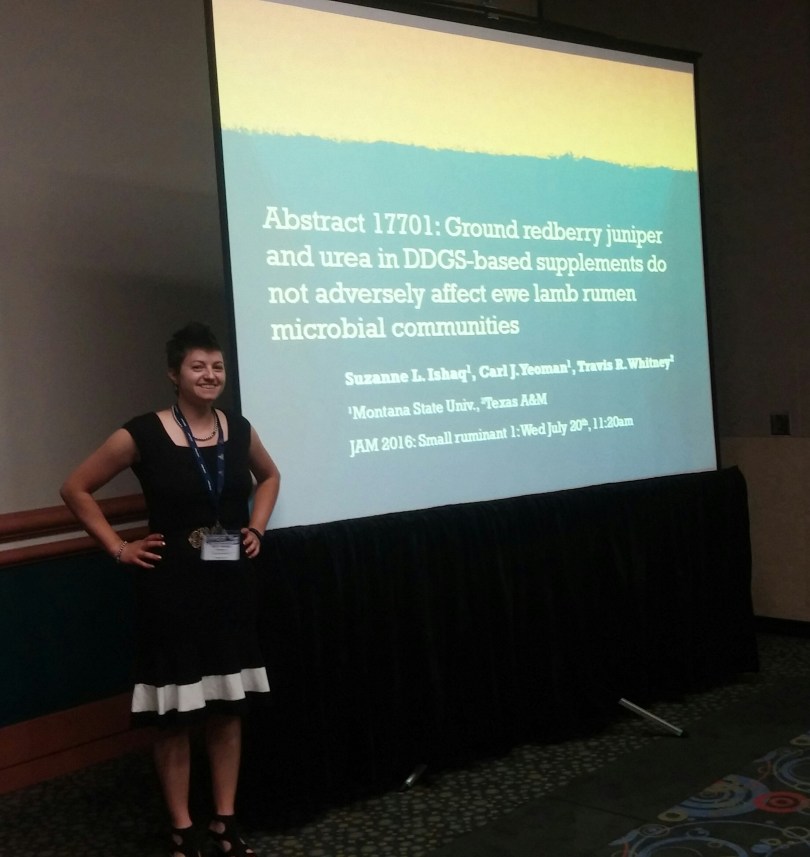
Presentation on juniper diets and rumen bacteria from JAM 2016 available!
The video presentation of my work on the effects of juniper diets on rumen bacteria is finally available for public use! I apologize for any side comments in the audio, the projector in the room kept flicking off! Stay tuned, our publication was just accepted and will be in press soon…
Abstract 1768. Ground redberry juniper and urea in DDGS-based supplements do not adversely affect ewe lamb rumen microbial communities.
S.L. Ishaq, C.J. Yeoman, and T.R. Whitney. 2016.
Presentation on maternal influences on the calf digestive tract from JAM 2016 available!
The video presentation of my work on the effects of maternal biotic influences on the developing calf digestive tract bacteria is finally available for public use!
Abstract 1522: Influence of colostrum on the microbiological diversity of the developing bovine intestinal tract
 The Ishaq Lab