The first look at Atlantic deep sea scallop bacterial communities in new publication

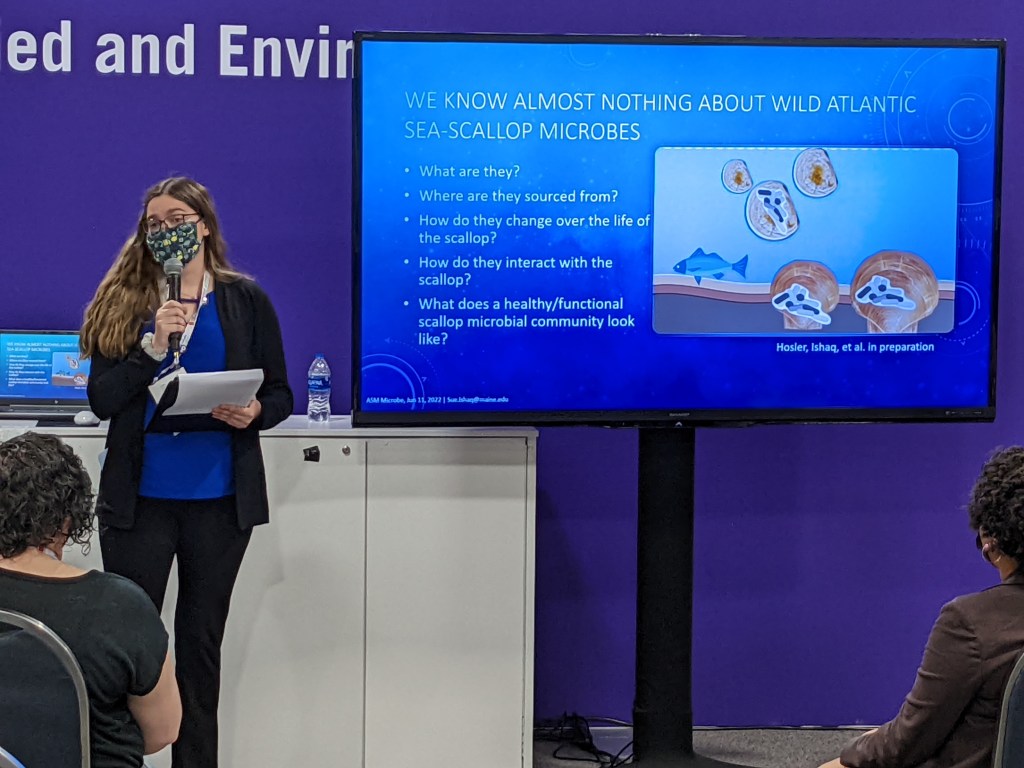
Our paper was published in Aquaculture Reports, on identifying the bacteria associated with wild and hatchery-raised Atlantic sea scallop larvae, and the biofilms in larval tanks in a hatchery! For the past few years, I’ve been part of a state-wide collaboration between researchers, industry professionals, and educators all working together to understand and improve Atlantic sea scallop hatchery production. To our knowledge, this is the first study to identify bacteria in Atlantic sea scallops, and even though it was a very small project we hope it will lead to a much larger, mult-year project to investigate this in more detail.

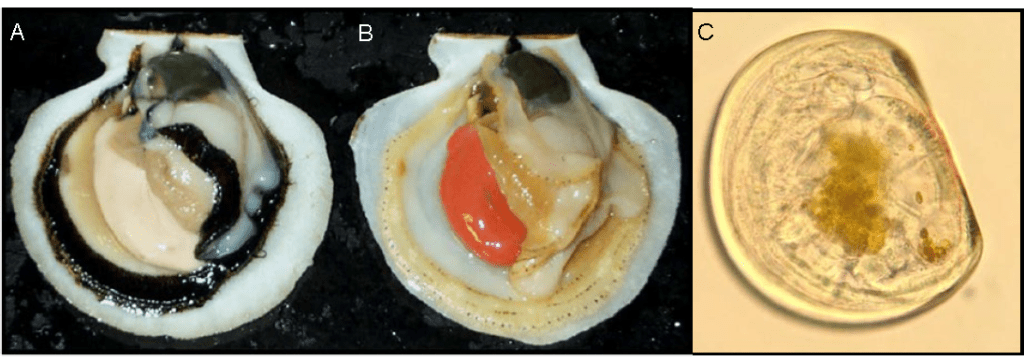
Scallops are a diverse animal group of marine bivalve mollusks (family Pectinidae) with global distribution in coastal waters, and Atlantic deep-sea scallops, Placopecten magellanicus, are found along the eastern coast of the United States and Canada. Scallops’ reproductive potential and industry demand make them a prime target for hatchery- and farm-based production, and this has been successfully achieved in bay scallops, but not in sea scallops. Currently, hatcheries collect wild sea scallop adults, or maintain cultured broodstocks, and spawn them in their facilities with the intention of forming a plentiful population to grow to adulthood, spawn, and sell to create a sustainable production cycle while also reducing disruption to the scallops’ natural habitat.
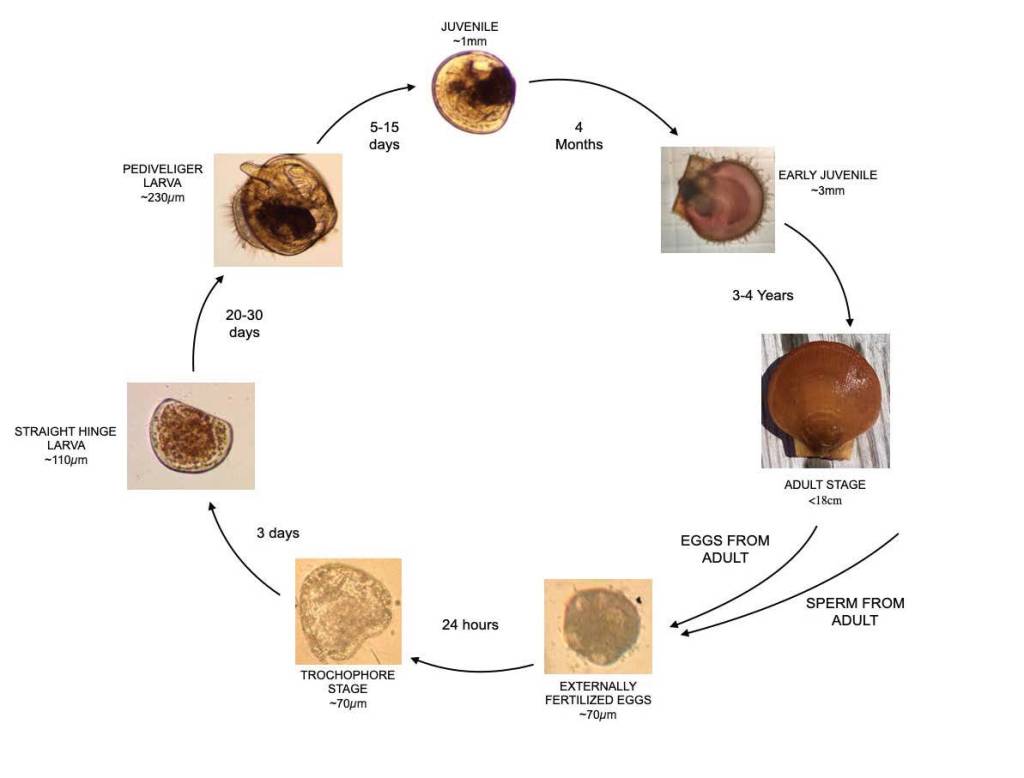
Unfortunately, in sea scallop hatcheries the last two weeks of the larval maturation phase, the veliger-stage, is plagued by large mortality events, going from 60 million sea scallop larvae down to several thousand individuals in a span of 48 hours. Survival of clutches to maturity remains very low, with an industry-standard rate around 1%. This drastic winnowing of larvae reduces the availability of cultured sea scallop spat for farmers, forcing sea scallop farms to rely almost exclusively on sea scallop spat collected from wild populations for stock and is seen as a bottleneck for growth of the industry and achieving sustainable harvests. Hatchery larval die-off is well-demonstrated not to be caused by inadequate diet, lighting, temperature, or atmospheric pressure in aquaculture facilities compared to wild conditions.

This project wanted to know if there was any clue in the bacteria that associate with larvae, or with the tanks they are in. In particular, hactcheries are worried about certain species of bacteria in the genus Vibrio, as they can cause disease to scallops and/or people, but it is tricky to study them because there are many species which do nothing at all. This project is part of another experiment to examine some of the Vibrio we found in tanks.

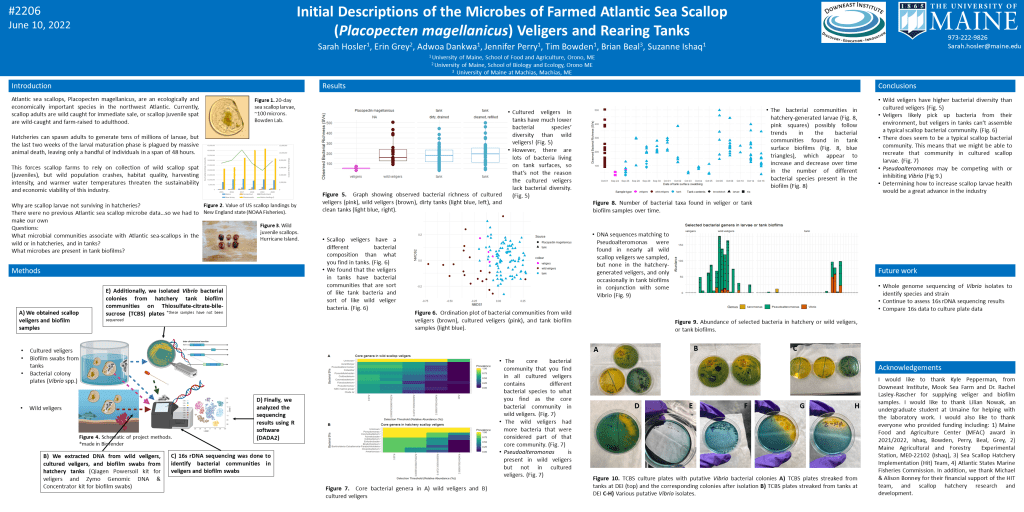
We sampled from some wild larvae, hatchery larvae, and from tank biofilms to indentify what was there. There were two styles of tank setup, and we collected from used tanks as well as tanks after they had been cleaned and refilled with filtered seawater.

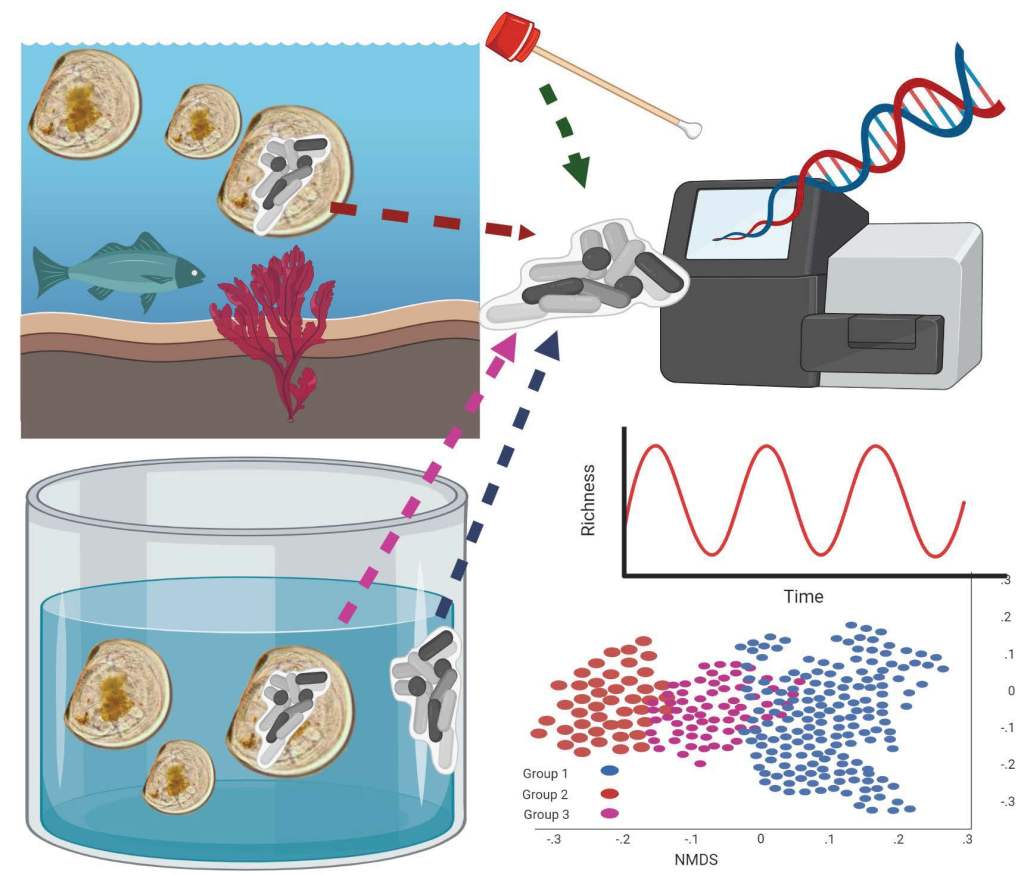
One of the surprising things we found, was that the bacterial communities in biofilms along the sides of larvae tank were more similar to each other (clustering) when samples were collected during the same phase of the lunar cycle. Bacterial richness and community similarity between tank samples fluctuated over the trial in repeated patterns of rise and fall, which showed some correlation to lunar cycle  where richness is high when the moon is about 50% and richness is low during new and full moon phases. This may be a proxy for the effects of spring tides and trends in seawater bacteria and phages which are propagated into hatchery tanks. The number of days since the full moon was significantly correlated with bacterial community richness in tanks: low during the full moon, peaking ~ 21 days after the full moon, and decreasing again at the next full moon.  

Fig. 7. Constrained ordination of bacterial communities in tank samples. Each point represents the bacterial community from one sample. Similarity between samples was calculated using Distance-based Redundancy Analysis (dbDRA), and significant model factors (anova, p < 0.01) are displayed with arrow lengths relative to their importance in the model (f value). The shape of points indicates whether swabbing was either immediately after filtered seawater has been used to fill the tank (cleaned, refilled) or 48 hours after (dirty, drained). Tank setup indicates if water was static, constantly filtered and recirculated in a flow-through system, or setup information was not available (n/a).

These results along with future work, will inform hatcheries on methods that will increase larval survival in these facilities, for example, implementing additional filtering or avoiding seawater collection during spring tides, to reduce certain bacterial taxa of concern or promoting a more diverse microbial community which would compete against pathogens.

Bacterial community trends associated with sea scallop, Placopecten magellanicus, larvae in a hatchery system.

Authors: Suzanne L. Ishaq1*, Sarah Hosler1, Adwoa Dankwa1, Phoebe Jekielek2, Damian C. Brady3, Erin Grey4,5, Hannah Haskell6, Rachel Lasley-Rasher6, Kyle Pepperman7, Jennifer Perry1, Brian Beal8, Timothy J. Bowden1

Affiliations:1 School of Food & Agriculture, University of Maine, Orono ME 044692 Ecology and Environmental Sciences, University of Maine, Orono ME 044733 School of Marine Sciences, Darling Marine Center, University of Maine, Walpole ME 045734 School of Biology and Ecology, University of Maine, Orono ME 044695 Maine Center for Genetics in the Environment, University of Maine, Orono ME 044696 Department of Biological Sciences, University of Southern Maine, Portland ME 041037 Downeast Institute, Beals, ME 046118 Division of Environmental & Biological Sciences, University of Maine at Machias, Machias, ME 04654

Abstract

Atlantic sea scallops, Placopecten magellanicus, are the most economically important marine bivalves along the northeastern coast of North America. Wild harvest landings generate hundreds of millions of dollars, and wild-caught adults and juvenile spat are increasingly being cultured in aquaculture facilities and coastal farms. However, the last two weeks of the larval maturation phase in hatcheries are often plagued by large mortality events. Research into other scallop- and aquacultured-species point to bacterial infections or altered functionality of microbial communities which associate with the host. Despite intense filtering and sterilization of seawater, and changing tank water every 48 hours, harmful microbes can still persist in biofilms and mortality is still high. There are no previous studies of the bacterial communities associated with the biofilms growing in scallop hatchery tanks, nor studies with wild or hatchery sea scallops. We characterized the bacterial communities in veliger-stage wild or hatchery larvae, and tank biofilms using the 16S rDNA gene V3-V4 region sequenced on the Illumina MiSeq platform. Hatchery larvae had lower bacterial richness (number of bacteria taxa present) than the wild larvae and tank biofilms, and hatchery larvae had a similar bacterial community (which taxa were present) to both wild larvae and tank biofilms. Bacterial richness and community similarity between tank samples fluctuated over the trial in repeated patterns of rise and fall, which showed some correlation to lunar cycle that may be a proxy for the effects of spring tides and trends in seawater bacteria and phages which are propagated into hatchery tanks. These results along with future work, will inform hatcheries on methods that will increase larval survival in these facilities, for example, implementing additional filtering or avoiding seawater collection during spring tides, to reduce bacterial taxa of concern or promote a more diverse microbial community which would compete against pathogens.

Acknowledgements

The authors would like to thank the staff at the Downeast Institute for supporting the development and implementation of this project, as well as for financially supporting the DNA sequencing; Meredith White of Mook Sea Farm for sharing her expertise and collecting biofilm samples; the Darling Marine Center for sharing their expertise and collecting biofilm samples; and the Sea Scallop Hatchery Implementation (Hit) Team for their expertise, review of this work, and funding support, who are financially supported by the Atlantic States Marine Fisheries Commission and Michael & Alison Bonney. The authors thank Lilian Nowak for assistance with related lab work to this project, and the Map Top Scholars Program for related financial support. The authors also thank Nate Perry for helping us collect wild scallop larvae. All authors have read and approved the final manuscript. This project was supported by the USDA National Institute of Food and Agriculture through the Maine Agricultural & Forest Experiment Station, Hatch Project Numbers: ME0-22102 (Ishaq), ME0-22309 (Bowden), and ME0-21915 (Perry); as well through NSF #OIA-1849227 to Maine EPSCoR at the University of Maine (Grey). This project was supported by an Integrated Research and Extension Grant from the Maine Food and Agriculture Center, with funding from the Maine Economic Improvement Fund.

Interview with WeTalkScience: animal microbiome

A few weeks ago, I sat down with Sheba A-J, one of the producers of the WeTalkScience podcast, to talk about one of my recent publications in the research journal iScience, at which Sheba is also an editor. Listen to find out how lobsters are like humans, how I got involved on a project working with ants and nematodes, and how you can help make science a more welcoming place.

The full publication is:

Ishaq, S.L., A. Hotopp, S. Silverbrand, J.E. Dumont, A. Michaud, J. MacRae, S. P. Stock, E. Groden. 2021. Bacterial transfer from Pristionchus entomophagus nematodes to the invasive ant Myrmica rubra and the potential for colony mortality in coastal Maine. iScience 24(6):102663. Article.

Pilot project funded to study Vibrio bacteria in scallop farming

A collaborative pilot project was funded by the Maine Food and Agriculture Center (MFAC) to investigate Vibrio bacteria in scallop hatcheries in Maine! This will support some ongoing work by a collaborative research team at UMaine and the Downeast Institute, as we develop a long-term, larger-scale project investigating scallop health and survival in hatcheries, something which will be critical to supporting sustainable and economically viable aquaculture productions.

“Investigating microbial biofilms in Maine hatchery production of sea scallop, Placopecten magellanicus.”

Principal Investigator: Sue Ishaq

Co-Investigators:

  • Dr. Tim Bowden, Associate Professor of Aquaculture, University of Maine
  • Dr. Jennifer Perry, Assistant Professor of Food Microbiology, University of Maine
  • Dr. Brian Beal, Professor of Marine Ecology, University of Maine at Machias; and Research Director/Professor, Downeast Institute
  • Dr. Erin Grey, Assistant Professor of Aquatic Genetics, University of Maine

Project Summary: Atlantic deep-sea scallops, Placopecten magellanicus, are an economically important species, generating up to $9 million in Maine alone. Despite their potential to the aquaculture industry, hatchery-based sea scallop production cannot rely on the generation of larvae to produce animals for harvest. In hatcheries, the last two weeks of the larval maturation phase is plagued by massive animal death, going from 60 million scallop larvae down to a handful of individuals in a span of 48 hours. This forces farmed scallop productions to rely on collection of wild scallop spat (juveniles), but wild population crashes, habitat quality, harvesting intensity, and warmer water temperatures threaten the sustainability and economic viability of this industry. The reasons for sea scallop larvae death remain unknown, but other cultured scallop species are known to suffer animal loss from bacterial infections, including from several bacterial species of  Vibrio and Aeromonas. At the Downeast Institute in Beals, Maine, biofilms appear on tank surfaces within 24 hours. Routine screening for the presence of Vibrio sp. in tanks at DEI reveals no obvious signs of colonies in scallop tanks. Preliminary culturing and genetic identification from these biofilms suggests a species of Pseudoalteromonas, known biofilm formers which outcompete or inhibit other microorganisms. Our goal is to investigate the dynamics of tank surface biofilms in bivalve aquaculture facilities. Our long-term goals are to understand microbial community assembly and animal health during scallop hatchery production, and to standardize management practices to enhance the success of cultured scallop production.  

Experimental design schematic for this project. Our objectives are to 1) Identify the microbial community members involved in tank biofilms, and if it is a repeated or novel community assembly, and 2) Test for biofilm antagonism in vitro, using competing microorganisms, chemical treatments, and environmental conditions. 

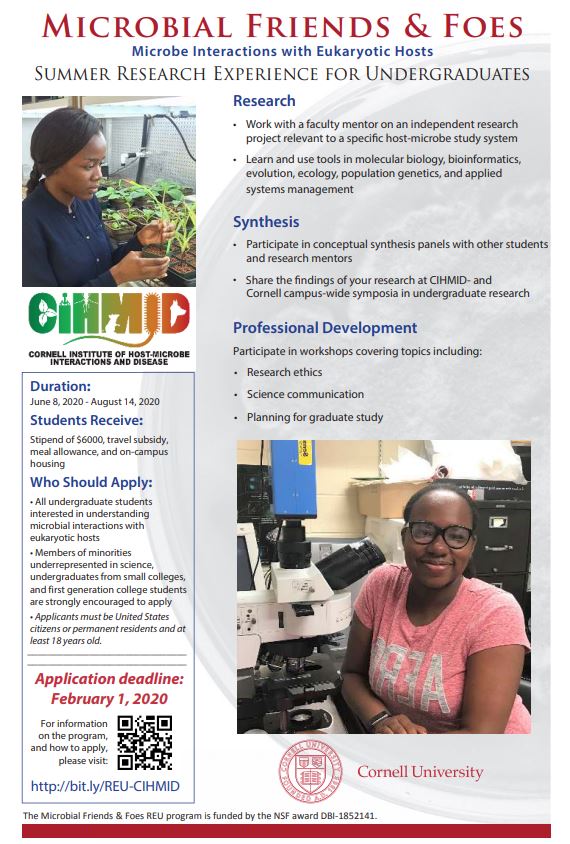
Application open for the Microbial Friends & Foes Research Experience for Undergraduates (REU) Summer Program at Cornell.

Poster describing The Cornell Institute of Host-Microbe Interactions and Disease (CIHMID) program for Microbial Friends and Foes Summer Program.

“The Cornell Institute of Host-Microbe Interactions and Disease (CIHMID) is accepting applications for the NSF-funded Microbial Friends & Foes Research Experience for Undergraduates (REU) Summer Program (bit.ly/REU-CIHMID).  Applications are due February 1, 2020.

The Microbial Friends & Foes Program will take place from June 8 to August 14, 2020.  The program will provide training in the concepts and experimental approaches central to understanding microbial interactions with eukaryotic hosts.  Students will learn about broad diversity of microbe-eukaryote interactions through conducting independent research projects, participation in weekly research group meetings, seminars presented by CIHMID faculty, Microbial Friends & Foes Synthesis Panels, CIHMID Summer Symposium, and Microbial Friends & Foes Poster Session. Emphasis will be placed on appreciation of the scientific method and developing effective strategies for conducting research as well as on the synthesis of concepts important to interspecific interactions across diverse systems.  In addition, workshops in electronic database literacy, science citation software, research ethics, science communication, and planning for graduate study will be offered to the Microbial Friends & Foes program participants. Students will receive a stipend of $6000, travel subsidy, meal allowance and on-campus housing.  Applicants will be asked to identify 3 laboratories of interest, and will be selected in a two-step review process by the program organizers and potential mentors. A flyer describing the program is attached and more information can be found at bit.ly/REU-CIHMID.

WHO SHOULD APPLY

*All undergraduate students interested in understanding microbial interactions with eukaryotic hosts.

*Members of minorities underrepresented in science, undergraduates from small colleges, and first-generation college students.

*Applicants must be United Stated citizens or permanent residents and at least 18 years old.”

Lessons learned: a retrospective on a newly developed course

This fall, I developed and taught a course called Introduction to Mammalian Microbiomes for the University of Oregon Clark Honors College.  The course objectives were to:

  1. introduce students to basic concepts, laboratory techniques, historical background, terminology, and technology related to microbial ecology in or on mammals,
  2. familiarize students with online resources, including sequence repositories, scientific databases, and analysis tools,
  3. discuss how host-associated microbiomes are shaped by the anatomy and lifestyle of the host, and how the microbiome can reflect onto the health and performance of the host, and
  4. review current literature on host-associated microbial ecology.
As always, include plenty of humor.

Keeping it fresh

While I’ve taught similar material at Montana State University, and have plenty of teaching experience from my graduate teaching assistant days at the University of Vermont, I’ve learned that each student population is different, with a unique core knowledge base and interests.  Thus, I developed this course from scratch, and constantly revised it during the semester to adjust to the pace and learning style of my students.  A draft syllabus, as well as an example of a student’s final project, can be found on my GitHub.

To improve engagement, I tried to make the course (which did not have a lab section) more interactive. I offered a tour of the molecular biology lab I work in, I brought agar plates to class so students could try culturing their own microbiota, and I dressed up like a dead cat.

These students were not science majors, and had had very little science since high school. Even if they had been science majors, I wanted to give a broader look at the field of science than just giving an overview of current knowledge.  At the end of some lectures, I facilitated class discussions on various topics in science: the role of scientists in communicating science and whether we should report only or have an obligation to convince the public; elitism, recognition, and credit for intellectual property in a highly-collaborative working environment; the transfer of maternal microbiota and health status to offspring and how we approach prenatal care and parental leave; air quality (and air microbiota), residential zoning in urban areas, and income inequality; should we eat dirt?, etc.  The students enthusiastically participated in class discussions, and — to my surprise — requested more (see below).

Phone a friend

I wanted to highlight current research in host-associated microbiomes, and hosted three mini-lectures from guest researchers; Deepika Sundarraman, a graduate students in UO physics, Dr. Candace Williams, a postdoctoral researcher who Skyped in from Vienna, and Dr. Edward Pajarillo, a postdoctoral researcher who Skyped in from Florida.

Feedback

I really enjoyed teaching this group of students, and I got regular feedback from them about how the course was going and what was working.  More formally, I volunteered the class to participate in a pilot evaluation for my midterm and end of term review, which asked more probing questions of students than typical teaching evaluations.  For the midterm, only 4 of 15 students responded, but for the final, 13 of 15 responded.

Students wanted more in-class discussions, and more group-based work, which was surprising to me as science students tend to prefer fewer of these, or at least the option to opt out. I am already considering additional topics for discussion next year. While there was an option on the final to submit a group project, no one chose to pursue that.  Similarly, students were able to work collaboratively on journal article summaries to improve their comprehension, provided each student submitted a unique response.  Perhaps this option simply needs to be reiterated.

What surprised me most about the evaluations was that several students replied that (the second half of) the course was not challenging enough.  The course content was entirely new to them, and while the assignments drew on skills from their core competency as humanities students (reading and writing), they were required to distill large amounts of scientific information and be able to explain it back to me.  It’s a challenge to serve the learning speed and style of all students in a class, and I try to manage this by varying the format of assignments, as well as to teach skills in the first part of the class which can be refined with successive assignments. 

An example of this was the final project, for which the students needed to create a public outreach presentation in the format of their choice (essay, poster, pamphlet, presentation), which covered a particular topic or discussion point on host-associated microbial communities. Students were able to draw from scientific article summaries they had previously written, or even material from their exams (take-home essays), provided it was more developed and presented in a new and creative way. This flexibility allowed students to choose topics that they were passionate about, and to focus on the message rather the format. I felt this would help them find their voice, and judging by the final projects I received, it was effective.

That being said, if humanities students thought the material too easy, I take credit for communicating it well. I’m pleased with how the course turned out, as well as with the feedback I received from students.  I’ve already begun implementing upgrades to my curricula, and have proposed this course again to the Honors College. Pending approval, I’ll be back at it next year!

Introduction to Mammalian Microbiomes

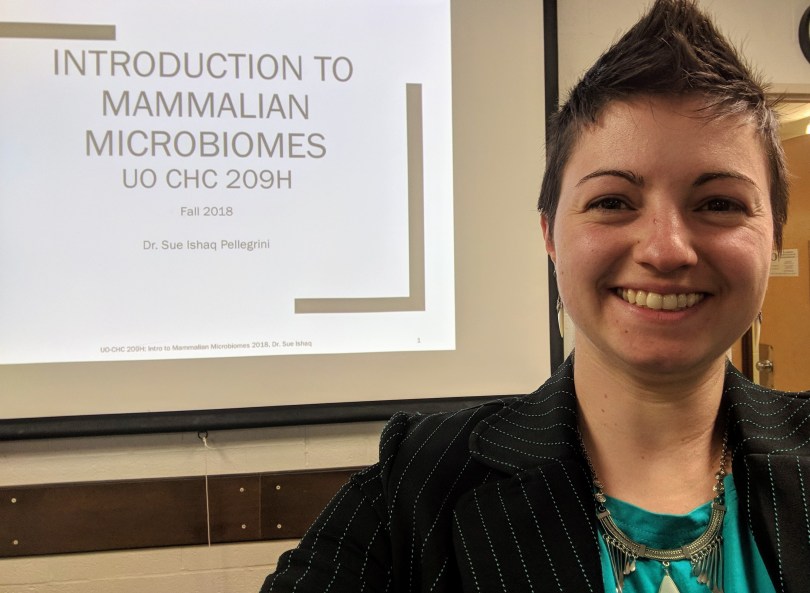
Since the end of September, I’ve been teaching a course for the UO Clark Honors College; Introduction to Mammalian Microbiomes.   And in a novel challenge for me – I’m teaching the idea of complex, dynamic microbial ecosystems and their interaction with animal hosts … to non-majors.  My undergraduate students almost entirely hail from the humanities and liberal arts, and I couldn’t be more pleased. So far, it’s been a wonderful opportunity for me to pilot a newly developed course, improve my teaching skills, and flex my creativity, both in how I explain concepts and how I design course objectives.

I enthusiastically support efforts towards science communication, especially in making science more accessible to a wider audience.  My students likely won’t be scientific researchers themselves, but some will be reporting on science publications, or considering funding bills, and all of them are exposed to information about human-associated microbial communities from a variety of sources. To navigate the complicated and occasionally conflicting deluge of information online about the human microbiome, my students will need to build skills in scientific article reading comprehension, critical thinking, and discussion.  To that end, many of my assignments are designed to engage students in these skills.

I feel that it’s important to teach not only what we know about the microbial community living in the mouth or the skin, but to teach the technologies that provide that knowledge, and how that technology has informed our working theories and understanding of microbiology over centuries.  Importantly, I hope to teach them that science, and health sciences, are not static fields, we are learning new things every day.  I don’t just teach about what science has done right, but I try to put our accomplishments in the context of the number of years and personnel to achieve publications, or the counter-theories that were posited and disproved along the way.

And most of, I want the course to be engaging, interesting, and thought provoking.  I encouraged class discussions and student questions as they puzzle through complex theories, and I’ve included a few surprise additions to the syllabus along the way.  Yesterday, University of Oregon physics Ph.D. student Deepika Sundarraman taught us about her research in Dr. Parthasarathy’s lab on using light sheet fluorescence microscopy to visualize bacterial communities in the digestive tract of larval zebra fish! Stay tuned for more fun in #IntroMammalianMicrobiomes!


OMSI presentation: A crash course on the microbiome of the digestive tract

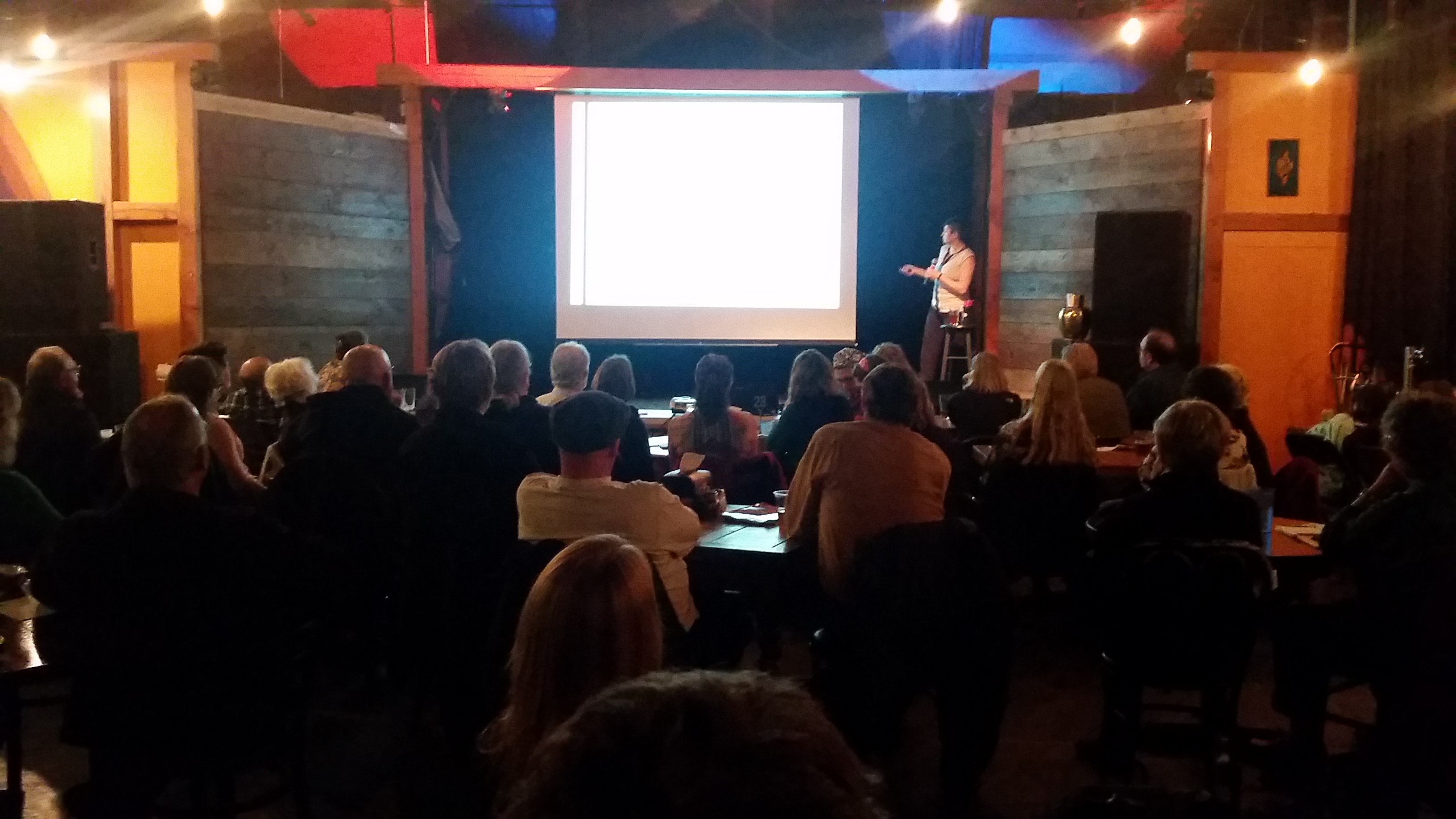
Last night, I gave my first “science stand-up” as part of the Oregon Museum of Science and Industry (OMSI) Science Pub series at Whirled Pies in Eugene, OR.  I really enjoy giving public presentations of my work, and while I’ve been on stage with a microphone before, it was the first time I got a stool to put my drink on.

I gave a talk which encompassed much of my previous work on host-associated microbiomes in moose and other ruminants, as well as more current research from others on the human gut.  It’s difficult enough to fit the field of host-associated microbiomes into a semester-long class, nevermind an hour (I digress), so I kept it to the highlights: “A crash course on the microbiome of the digestive tract“.   You can find the slides here: Ishaq OMSI SciPub 20180208, although there is no video presentation at this time. I was honored to have such a well-attended lecture (about 120 people!) with an engaged audience, who had some really on-track questions about the intersection of microbial diversity and health.

20180208_185804.jpg
Photo Credit: Al Lebovitz

As I’ve discussed here before, academic outreach is a sometimes overlooked, yet nevertheless extremely important, aspect of science.  The members of the general public are a large portion of our stakeholder audience, and outreach helps disseminate that research knowledge, facilitate transparency of the research process, and engage people who might benefit from or be interested in our work.  As I told the audience last night, scientists do like when people ask us about our work, but “we’re more scared of you than you are of us”.  I encourage everyone to add science to their life by getting informed, getting involved, and getting out to vote.

Thanks again to OMSI for inviting me to participate, and to Whirled Pies for hosting!


Featured Photo Credit: Al Lebovitz