Plowing Forward: Montana Agriculture in a Changing Climate

Agriculture is consistently Montana’s largest economic sector, but as an arid state we need to prepare for the challenges brought on by changing weather patterns.  Yesterday, agricultural producers, scientists, special interest groups, lawmakers, and the general public came together at the Bozeman Public Library to talk about the future of climate change and what it means for people in the agricultural industry and research sector.  The event was organized by Plowing Forward, a collaborative group to coordinate local Ag. education efforts.

“If you’ve eaten today, then you’re involved in agriculture.”  -Chris Christiaens at the Plowing Forward meeting in Bozeman, MT, Feb 10, 2017

Opening remarks were led by Chris Christiaens, lobbyist and Project Specialist for the Montana Farmers Union, based in Great Falls, MT. Chris gave us some perspective on how Montana farming and ranching has changed over time, especially over the last 10 years,including changes to the growing season, harvest times, water usage, the types of plants which are able to survive here.  He reminded us that the effect of climate on agriculture affects all of us.

0210171341.jpg
Chris Christiaens, Project Specialist for Montana Farmers Union.

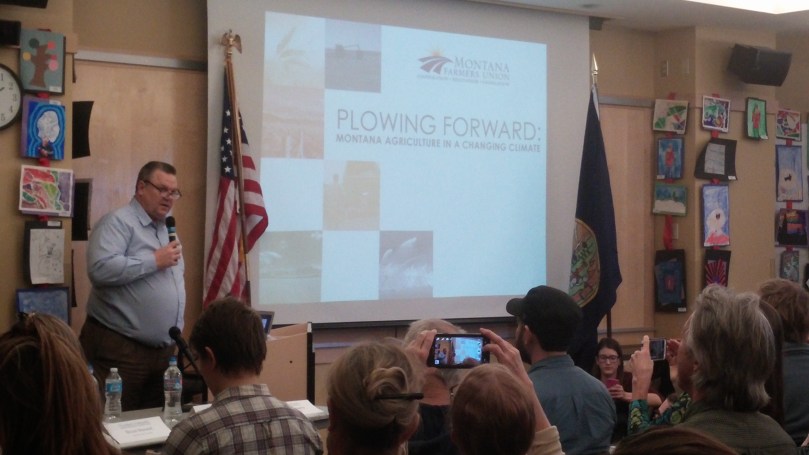
Next, we heard from Montana’s Senator Jon Tester, who runs a farm in northern Montana that has been in his family since 1912.  The Senator spoke to his personal experiences with farming and how his management practices had adapted over the years to deal with changing temperature and water conditions.  Importantly, he spoke about how agriculture is a central industry to the United States in ways that will become even more apparent in the coming years as the negative effects of climate change affect more and more areas.  Food security, a peaceful way of life, and economic vitality (not just in Montana or the United States, but globally), were contingent upon supporting agricultural production under adverse events.  He assured agricultural stakeholders that he continues to support production, research, and education, including the work we do in the laboratory as well as out in the field to promote agriculture.
0210171347.jpg
Montana Senator Jon Tester

Next, we heard from three professors from Montana State University.  Dr. Cathy Whitlock, a Professor of Earth Sciences, who is also the Director for the MSU Institute on Ecosystems, and a Lead Coordinator for the Montana Climate Assessment.  The Montana Climate Assessment seeks to assemble past and current research on Montana climate in order to assess trends, make predictions about the future, and help both researchers and producers to tailor their efforts based on what is happening at the regional level.  The Assessment is scheduled for release in August, 2017, and will allow for faster dissemination of research information online.

Dr. Whitlock’s introduction to the MCA was continued by  Dr. Bruce Maxwell, a Professor of Agroecology, as well as the Agriculture Sector Lead for the Montana Climate Assessment.  He summarized current research on the present water availability in Montana, as well as what we might see in the future.  He warned that drier summers were likely, and while winters may get wetter, if they continue to get warmer that snow runoff will flow into rivers before the ground has thawed.  This means snow melt will flow out of the region more quickly and not be added to local ground water sources for use here.  To paraphrase Bruce, a longer growing season does you no good if you don’t have any water.

0210171404.jpg
Dr. Bruce Maxwell, Montana State University

We also heard from my current post-doctoral advisor, Dr. Fabian Menalled, Professor of Weed Ecology Management and Cropland Weed Specialist (Extension).  He presented some of the results from our ongoing project at Fort Ellis on the interactions between climate change (hot and dry conditions), farm management system (conventional or organic), disease status, and weed competition on wheat production.  Increased temperatures and decreased moisture reduced wheat production but increased the amount of cheatgrass (downy brome), a weed which competes with wheat and can reduce wheat growth.  My work on the soil bacterial diversity under these conditions didn’t make it into the final presentation, though.  I have only just begun the data analysis, which will take me several months due to the complexity of our treatments, but here is a teaser: we know very little about soil bacteria, and the effects we are seeing are not exactly what we predicted!

Here is the video of Dr. Menalled’s presentation (just under 9 minutes):

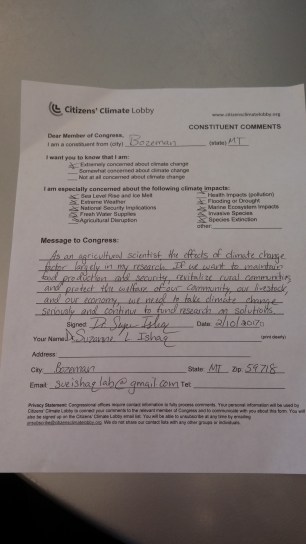
Lastly, we heard from a local producer who spoke to his experience with ranching on a farm that had been run continuously for well over 100 years.  His talk reflected the prevailing sentiment of the presentations: that farm practices had changed over the last few decades and people in agriculture were already responding to climate change, even if previously they wouldn’t put a name to it.  The presentations concluded with a question and answer session with the entire panel, as well as a reminder that we all have the right and the obligation to be invested in our food system.  Whether we grow produce or raise livestock for ourselves or others, whether we research these biological interactions, whether we set the policy that affects an entire industry, or whether we are just a consumer, we owe it to ourselves to get involved and make sure our voice is heard.  To that end, I wrote a letter to my legislators (pictured below), and in the next few weeks I’ll be writing posts about how I participate in science (and agriculture) on the local and national level.
0210171504
Make your voice heard.

2016 Year In Review

Looking back

2016 started with a bang when I launched this site and joined Twitter for the first time!  For the first quarter of the year, I was a post-doctoral researcher in the Yeoman Lab in the Department of Animal and Range Sciences at Montana State University.  I was working on a total of eight grants, ranging from small fellowships to million dollar projects, both as a principal investigator and as a co-PI.  I was also doing the bioinformatic analysis for multiple projects, totaling nearly 1,000 samples, as well as consulting with several graduate students about their own bioinformatic analyses.

In late spring, my position in the Yeoman lab concluded, and I began a post-doctoral position in the Menalled Lab in the Department of Land Resources and Environmental Sciences at MSU.  This position gave me the opportunity to dramatically increase my skill-set and learn about plant-microbe interactions in agricultural fields.  My main project over the summer was studying the effect of climate and other stresses on wheat production and soil microbial diversity, and this fall I have been investigating the legacy effects of these stressors on new plant growth and microbial communities.  I have extracted the DNA from all of my Fort Ellis summer trial soil samples, and look forward to having new microbial data to work with in the new year.  Based on the preliminary data, we are going to see some cool treatment effects!

Over the summer, I attended the American Society for Microbiology in Boston, MA in June, where I presented a poster on the microbial diversity in organic and conventional farm soil, and the Joint Annual Meeting for three different animal science professional societies in Salt Lake City, UT in July, where I gave my first two oral conference presentations. One was on the effect of a juniper-based diet on rumen bacteria in lambs, and the other was on the biogeography of the calf digestive system and how location-specific bacteria correlate to immune-factor expression.

Thanks to a lot of hard work from myself and many collaborators, a number of research projects were accepted for publication in scientific journals, including the microbial diversity of agricultural soils, in reindeer on a lichen diet, and in relation to high-fat diets in mice, it also included work on virulent strains of Streptococcus pyogenes, and a review chapter on the role of methanogens in human gastrointestinal disease.

This slideshow requires JavaScript.


Looking forward

A whopping thirteen manuscripts are still in review at scientific journals or are in preparation waiting to be submitted! Some of those are primarily my projects, and for others I added my skills to the work of other researchers.  Editing all those is going to keep me plenty busy for the next few months. I’ll also be writing several more grants in early 2017, and writing a blog post about the Herculean task that can be.

I’ll be concluding my greenhouse study by March of 2017, just in time to prepare for another field season at Fort Ellis, on the aforementioned climate change study that is my main focus. In January, I’ll be spending time in the lab helping to process and sequence DNA from my 270 soil samples, and begin the long task of data quality assurance, processing, and analysis.  I’m not worried, though, 270 samples isn’t the most I’ve worked with and bioinformatic analysis is my favorite part of the project!

This year, I am hoping to attend two conferences that I have never previously attended, and present data at both of them.  The first will be the 2017 Congress on Gut Function in Chicago, IL in April, and the second will be the Ecological Society of America’s Annual Meeting in Portland, OR in August.  Both conferences will give me the opportunity to showcase my work, network with researchers, and catch up with old friends.

If 2017 is anything like the past few years, it’s going to be full of new projects, new collaborators, new skills, and new opportunities for me, and I can’t wait!  So much of what I’ve accomplished over the last year has been possible because of the hard work, enthusiasm, and creativity of my colleagues, students, friends, and family, and I continue to be grateful for their support.  I’d also like to thank anyone who has been kind enough to read my posts throughout the last year; it’s been a pleasure putting my experiences into words for you and I appreciate the time and interest you put in.  I look forward to sharing more science with you next year!

ASM Microbe 2016 was a blast!

For the last four days I was in Boston for the American Society for Microbiology (ASM) Microbe 2016 meeting.  The meeting is held in Boston on even years, and New Orleans on odd. 
image

The conference brings together all sorts of microbiologists: from earth sciences, to host-associated, to clinical pathologists and epidemiologists, to educators.  This year, there were reportedly over 11,000 participants! Because of the wide variety of topics, there is always an interesting lecture going on related to your topic, and it was a wonderful experience to be able to talk directly to other researchers to learn about the clever techniques they are using.  I posted about a tiny fraction of those interesting projects on Give Me The Short Version.

On Sunday, I presented a poster on “Farming Systems Modify The Impact Of Inoculum On Soil Microbial Diversity.”  I analyzed the data from this project for the Menalled Lab last year, and it has developed into a manuscript in review, as well as several additional projects in development.

Ishaq et al ASM 2016 poster

One of the best parts of ASM meetings is that you never know who you are going to run into, and I was able to meet up with several friends and colleagues, including Dr. Benoit St-Pierre, who was a post-doc in the Wright lab at the University of Vermont while I was a student, and Laura Cersosimo, the other Ph.D. candidate from the UVM Wright lab who will be defending in just a few months!  I also ran into Ph.D. candidate Robert Mugabi, who is hoping to defend by March and in the Barlow lab at UVM while I was there.  Most unexpectedly, I ran into a A Lost Microbiologist who had wandered in from Norway: Dr. Nicole Podnecky, who I met at UVM back when we were undergraduates!

This slideshow requires JavaScript.

Of course, no conference would be complete without vendor swag.

Conference Proceedings

Scientific conferences are a great place to get your name out there, discuss research with colleagues, and meet other researchers with whom you might one day collaborate.  It can be difficult to get noticed as a graduate student or post-doctoral researcher, especially if it’s your first time at a certain conference, if your poster time conflicts with more interesting events, or if you find yourself way at the back of a 1,000 poster hall.  You need to be ready to introduce yourself and get your point across, and to do it in a memorable and concise way.  There may be hundreds or even thousands of people in attendance, so you need to make a fast impression.

0531161802.jpg
Too much info on your card? A black background is slimming.

Though a bit outdated these days, I find business cards really handy.  Not only can you quickly hand out all your information, but you can write notes on the back about what you discussed with someone so you can follow up with them later.  It’s easy to leave a bag of them at your poster for people to take, too.

Not only is your poster or presentation’s content important, its visual appeal will help draw in people who are “browsing”.  Make sure your font is large enough to read from 5-8 ft away, and that you have some color, but not enough to make text illegible.  Bolding or bulleting take-home messages can also be really helpful.  Make sure you can describe your poster in a variety of ways: in under 60 seconds to the person with a mild passing interest, and in-depth with the person that is curious about your methods or your other projects.

The most important thing to prepare, though, is yourself.  You are representing yourself, your institution, and your science.  Cleanliness, organization, and confidence make a huge difference when meeting new people, and will make you more approachable.  Make eye contact, try to avoid filler words, and smile!  I have watched posters get overwhelmingly passed by because the presenter was on their phone, or looked bored or annoyed.  Making eye contact and saying hello to someone as they walk by is often enough to get them to slow down and ask you about your work.

JAM 2015 poster
If nothing else, a brightly colored shirt will attract attention to you and your poster.

When asking questions at other presentations, be sure to be polite; being demanding or rude is guaranteed to be met with disapproval from the rest of the audience.  And go ahead and introduce yourself to other researchers, just be sure to keep it brief and don’t interrupt another meeting.

One more thing to consider at a conference is your behavior outside of your presentation.  You are at a gathering of intellectuals who may one day be your boss, your colleague, your grant reviewer, or otherwise influential in your career.  They may remember that they saw you talking loudly to a friend during a presentation, or that you got too drunk at the opening session.  Conferences are often used as an excuse to take a concurrent vacation, especially for those in academia who generally can’t take a week off during the semester.  But you should remember why you are there and act professionally, especially as a graduate student or post-doc, because you never know who’ll remember you in the future.

Abstract Accepted!

Great news!  I’ll be presenting a poster this year at the American Society for Microbiology’s (ASM) Microbe Conference in Boston, MA this June 16th-20th.  I’ll have a date and time later this month, and will of course post the full abstract and poster after the presentation.

“Farming Systems Modify The Impact Of Inoculum On Soil Microbial Diversity”

Suzanne L. Ishaq¹, Stephen P. Johnson², Zach J. Miller³, Erik A. Lehnhoff4, Carl J. Yeoman¹, Fabian D. Menalled²

1 Montana State University, Department of Animal and Range Science, Bozeman, MT 2 Montana State University, Department of Land Resources & Environmental Sciences, Bozeman, MT 3 Montana State University, Western Agriculture Research Center, Bozeman, MT 4 New Mexico State University, Department of Entomology, Plant Pathology and Weed Science, Las Cruces, NM