
I’m delighted to share the data article, “16S rRNA metabarcoding dataset of seawater from three public beaches in La Jolla, CA” published in Data in Brief. Led by Dr. Callen Hyland, this publication is a succinct description and basic interpretation of bacterial communities found in seawater samples from three locations along the coat of La Jolla, California.
These samples were collected by Callen who has been a Senior Researcher and, more recently, a Biology Teaching Fellow, at the University of San Diego. I met Callen a few years ago when she took my AVS 554 DNA Sequencing Data Analysis course during her Professional Masters in Bioinformatics. During that class, she began processing these microbial community samples, and we kept in touch to develop the analysis into a data publication.
You can read the publication and access the dataset here.
16S rRNA metabarcoding dataset of seawater from three public beaches in La Jolla, CA.
Authors: Callen Hyland1, Suzanne L. Ishaq2
Affiliations: 1Department of Biology, University of San Diego, San Diego, CA; 2School of Food and Agriculture, University of Maine, Orono, ME
Published in: Data in Brief
Abstract: We report a 16S rRNA gene sequencing dataset from bacteria collected at three public beaches in La Jolla, California. One-liter seawater samples were collected in triplicate from the surf zone in three locations, once per month for five months. Seawater was filtered to collect micro-organisms, DNA was extracted from filters, and the 16S gene was amplified and sequenced following Earth Microbiome Project protocols. Raw fastq files are available in the Dryad data repository. Filtered and trimmed sequences are provided on our GitHub repository, along with Phyloseq objects documenting intermediate analysis steps. Of an initial 3,308,033 reads, 137,678 reads assigned to 8,827 bacterial SVs in 41 seawater samples remained after quality filtering, removal of chimeras and contamination, and rarefaction. Alpha diversity and community composition analysis were used for preliminary characterization of the samples. Proteobacteria and Bacteriodota were the dominant phyla, accounting for 50% of SVs in all samples. Only 21% of SVs were classified at the Genus level. This data set can be reused by scientists studying local variation in bacterial community, including low abundance and unidentified taxa, in coastal waters.
Citation: Hyland, C., and Ishaq, S. 2026. 16S rRNA metabarcoding dataset of seawater from three public beaches in La Jolla, CA. Data in Brief 113437.
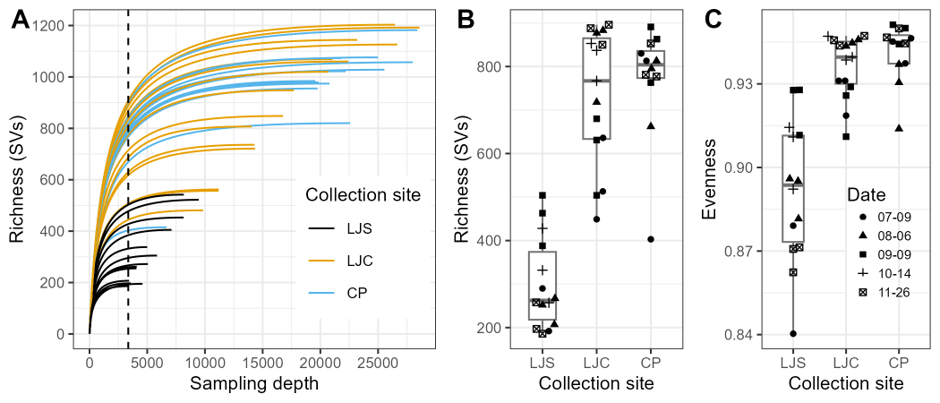
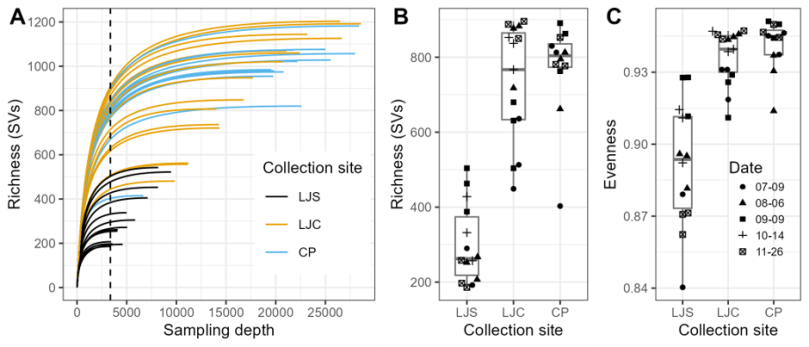
Figure 2. Rarefaction and alpha diversity. A. Rarefaction plot of bacterial sequence variants (SVs) in 41 seawater samples. Vertical line indicates rarefaction level used in diversity analysis. B. SV richness, and C. Evenness of bacteria taxa in seawater grouped by collection site. La Jolla Shores = LJS, La Jolla Cove = LJC, Children’s Pool = CP.

