Last week, I went to Portland, Oregon for the first ever meeting of the Health and Energy Research Consortium (HERC), which brings together researchers, foundations, consultants, and industry leaders from different fields to discuss these research issues and foster interdisciplinary work in the built environment. This includes everything from designing lighting control systems that better integrate human behavior and preferences, to understanding how our human microbiomes interact with building materials to create a unique building microbiome that can feed back onto us in a positive or negative way. More information can be found on the BioBE site, as well as microBEnet. And of course, I’ll be sure to keep you updated right here.
Lee, Izzy, and I have been in Montana for just over two wonderful years, and while we will miss being just 30 min away from great skiing, we are also excited for this next chapter of our life. Is it a coincidence that the next chapter is located in wine country and less than an hour from the beach? Too early to say. One thing is for sure, though, the friendships and collaborations I’ve made here will continue to be cultivated in the years to come.
A few months ago, I was invited to submit an article to the special issue “Plant Probiotic Bacteria: solutions to feed the World” in AIMS Microbiology on the interactions between agricultural plants and microorganisms. As my relevant projects are still being processed, I chose to write a review of the current literature regarding these interactions, and how they may be altered by different farming practices. The review is available as open-access here!
“Plant-microbial interactions in agriculture and the use of farming systems to improve diversity and productivity”
A thorough understanding of the services provided by microorganisms to the agricultural ecosystem is integral to understanding how management systems can improve or deteriorate soil health and production over the long term. Yet it is hampered by the difficulty in measuring the intersection of plant, microbe, and environment, in no small part because of the situational specificity to some plant-microbial interactions, related to soil moisture, nutrient content, climate, and local diversity. Despite this, perspective on soil microbiota in agricultural settings can inform management practices to improve the sustainability of agricultural production.
Citation: Suzanne L. Ishaq. Plant-microbial interactions in agriculture and the use of farming systems to improve diversity and productivity. AIMS Microbiology, 2017, 3(2): 335-353. doi: 10.3934/microbiol.2017.2.335
Today was a big day out in the field at Fort Ellis: virus inoculation day for the project I’ve been part of, on how farming system can alter reactions to adverse growing conditions (like climate change, weed competition, and disease). This is the second year of the project, and the fifth year of the larger crop rotation study, so a lot is riding on being able to keep to the schedule.
Spring has been cool and wet here in Montana, which has presented us from being able to do work in the muddy fields but hasn’t slowed down the wheat or the weeds. If the wheat is too developed when the virus is sprayed, the infection won’t manifest well enough to measure. Thanks to carefully prepared protocols, seasoned personnel, and a stretch of sunny, dry days, we treated our plots and went home early!
My greenhouse trial on the legacy effects of farming systems and climate change has concluded! Over this past fall and winter, I maintained a total of 648 pots across three replicate trials (216 trials per). In the past few weeks, we harvested the plants and took various measurements: all-day affairs that required the help of several dedicated undergraduate researchers.
In case you were wondering why research can be so time and labor intensive, over the course of the trials we hand-washed 648 pot tags twice, 648 plant pots twice, planted 7,776 wheat seeds across two conditioning phases, 1,944 wheat seeds and 1,944 pea seeds for the response phase. We counted seedling emergence for those seeds every day for a week after each of the three planting dates in each of the three trials (9 plantings all together). Of those 11,664 plants, we hand-plucked 7,776 seedlings and grew the other 3,888 until harvesting which required watering nearly every day for over four months. At harvest, we counted wheat tillers or pea flowers, as well as weighed the biomass on those 3,888, and measured the height on 1,296 of them. And this is only a side study to the larger field trial I am helping conduct! All told, we have a massive amount of data to process, but we hope to have a manuscript ready by mid-summer – stay tuned!
Yesterday I participated in the Expanding Your Horizons for Girls workshop at Montana State University! EYH brings almost 300 middle-school aged girls from all over Montana for a one-day conference in STEM fields. Twenty-seven instructors, including myself and other female scientists and educators, ran workshops related to our current research. My presentations were on “Unlocking the Hidden World of Soil Bacteria”, with the help of undergraduate Genna Shaia from the Menalled Lab.
Setting up a soil microbes workshop for Expanding Your Horizons for Girls.
Genna Shaia, undergraduate researcher.
I gave the girls a brief presentation on microbial ecology, and how bacteria and fungi can affect plants in agricultural soil. We talked about beneficial versus pathogenic microorganisms, and how different farming strategies can influence soil microbiota. This was followed by two hands-on activities that they were able to talk home with them. First, the girls made culture plates from living or sterile soil that was growing wheat or peas to see what kind of microbes they could grow. Then, they planted wheat seeds in either living or sterile soil so they could track which soil made the seeds germinate faster.
The girls were enthusiastic to learn, asked lots of insightful questions, and it was awesome being able to share microbiology with kids who hadn’t given it much thought before! If you are a woman in STEM, and have the opportunity to participate in a workshop or mentor a young scientist, it is not only rewarding but can make a huge impact on encouraging women into STEM.
This slideshow requires JavaScript.
Slideshow photos: Genna Shaia, reproduced with student permission.
I’m pleased to announce that a paper that I contributed to was recently accepted for publication in the Journal of Animal Science!
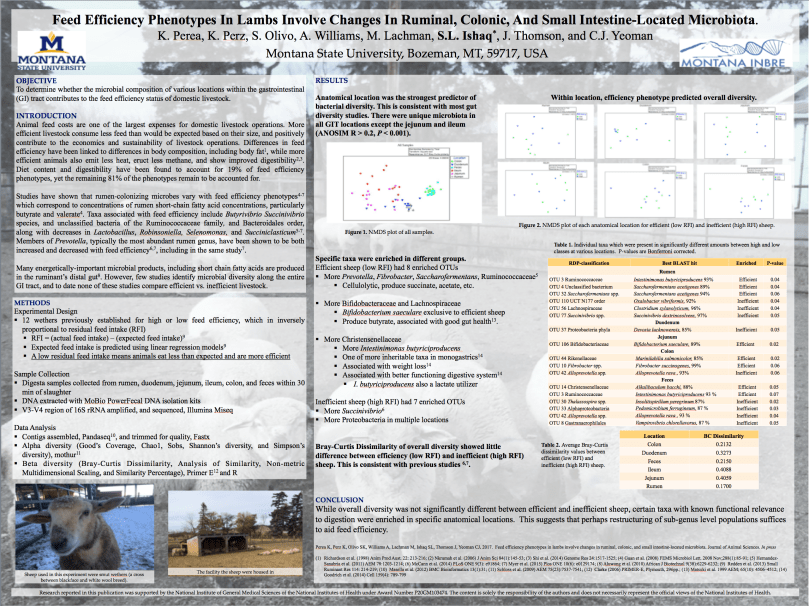
“Feed efficiency phenotypes in lambs involve changes in ruminal, colonic, and small intestine-located microbiota”, Katheryn Perea; Katharine Perz; Sarah Olivo; Andrew Williams; Medora Lachman; Suzanne Ishaq; Jennifer Thomson; Carl Yeoman (article here).
Katheryn is an undergraduate at New Mexico Institute of Mining and Technology who received an INBRE grant to support her as a visiting researcher at Montana State University in Bozeman, MT over summer 2016. Here, she worked with Drs. Carl Yeoman and Jennifer Thomson to perform the diversity analysis on the bacteria in the gastrointestinal tract of sheep from a previous study. These sheep had been designated as efficient or inefficient, based on how much feed was needed for them to grow. Efficient sheep were able to grow more with less feed, and it was thought this might be due to hosting different symbiotic bacteria which were better at fermenting fibrous plant material into usable byproducts for the sheep.
Samples from the sheep were collected as part of a larger study on feed efficiency performed by MSU graduate students Kate Perz and Medora Lachman, as well as technicians Sarah Olivo and Andrew Williams, and Katheryn performed the data and statistical analysis using some of my guidelines. This is Katheryn’s first published article, and one I just presented a poster on at the Congress on Gastrointestinal Function in Chicago, IL!
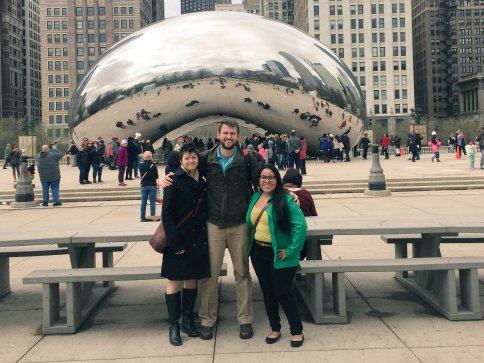
I just got back from my very first Congress on Gastrointestinal Function, a small meeting for researchers with a specific focus on the gastrointestinal tract, which is held every two years in Chicago, Illinois. The special session this year was on “Early Acquisition and Development of the Gut Microbiota: A Comparative Analysis”. The rest of the sessions opened up the broader topics of gut ecosystem surveillance and modulation, as well as new techniques and products with which to study the effect of microorganisms on hosts and vice versa. The research had a strong livestock animal focus, as well as a human health focus, but we also heard about a few studies using wild animals.
As I’ve previously discussed, conferences are a great way to interact with other scientists. Not only can you learn from similar work, but you can often gain insights into new ways to solve research problems inherent to your system by looking at what people in different fields are trying, something that you might otherwise miss just by combing relevant literature online. A meeting or workshop is also a great place to meet other similarly focused scientists to set up collaborators that span academia, government, non-profit, and industry sectors.
It was great to catch up with Dr. Ben Wenner, now at Purdue Agribusiness, and meet Yairy Roman-Garcia, grad student at the Ohio State University.
This year, I was excited for one of my abstracts to be accepted as a poster presentation, and honored to have the other upgraded from poster to talk! Stay tuned for details about both of those projects in the coming weeks, and be sure to check this meeting out in April, 2019.
According to National Day Calendar, it’s National Employee Appreciation Day! Many organizations have an annual Staff Appreciation Day or Week, and rightly so. Research staff in academia, as well as general staff, are often quietly under appreciated. Research staff can be costly, especially because many universities insist that research positions have salary and benefits fully-funded by grants. Many labs thus rely on undergraduate student researchers, who work for minimum wage or might even pay for university “research credits”, to help provide labor.
While many undergraduates find themselves performing unglamorous routine lab maintenance (anything from washing dishes, to pre-weighing commonly used supplies, to dusting, to inventory), as a researcher I can attest to how vital these tasks are. Working in a molecular biology lab, dust and other contaminants had to be minimized and it was extremely helpful to have undergraduates who were able to dust multiple times a day. When culturing bacterial isolates, I would go through hundreds of culturing tubes every week, which all needed to be autoclave sterilized, emptied, washed, and re-sterilized. This was a massive amount of effort unto itself, and I would not have been able to accomplish my culture work without. Perhaps the best example was my study of probiotics in newborn lambs. I had 24 lambs which were only 4 days old, which needed to be fed every 4-5 hours, sometimes by hand, as well as weighed, sampled, and cleaned on a regular basis. Without numerous undergraduate volunteers, I would have found myself sleeping at the barn for two months.
Not only is it polite to appreciate the staff who keep your work moving, but proper gratitude can go a long way towards improving work relationships, job satisfaction, and performance. So get out there and start thanking!
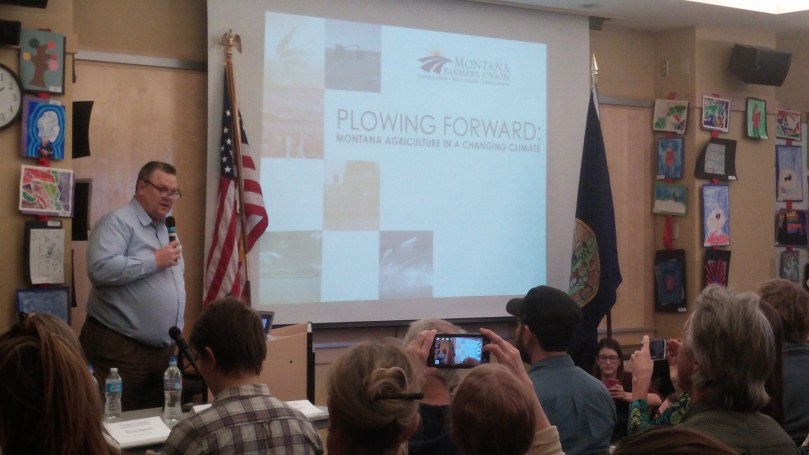
Agriculture is consistently Montana’s largest economic sector, but as an arid state we need to prepare for the challenges brought on by changing weather patterns. Yesterday, agricultural producers, scientists, special interest groups, lawmakers, and the general public came together at the Bozeman Public Library to talk about the future of climate change and what it means for people in the agricultural industry and research sector. The event was organized by Plowing Forward, a collaborative group to coordinate local Ag. education efforts.
“If you’ve eaten today, then you’re involved in agriculture.” -Chris Christiaens at the Plowing Forward meeting in Bozeman, MT, Feb 10, 2017
Opening remarks were led by Chris Christiaens, lobbyist and Project Specialist for the Montana Farmers Union, based in Great Falls, MT. Chris gave us some perspective on how Montana farming and ranching has changed over time, especially over the last 10 years,including changes to the growing season, harvest times, water usage, the types of plants which are able to survive here. He reminded us that the effect of climate on agriculture affects all of us.
Chris Christiaens, Project Specialist for Montana Farmers Union.
Next, we heard from Montana’s Senator Jon Tester, who runs a farm in northern Montana that has been in his family since 1912. The Senator spoke to his personal experiences with farming and how his management practices had adapted over the years to deal with changing temperature and water conditions. Importantly, he spoke about how agriculture is a central industry to the United States in ways that will become even more apparent in the coming years as the negative effects of climate change affect more and more areas. Food security, a peaceful way of life, and economic vitality (not just in Montana or the United States, but globally), were contingent upon supporting agricultural production under adverse events. He assured agricultural stakeholders that he continues to support production, research, and education, including the work we do in the laboratory as well as out in the field to promote agriculture.
Montana Senator Jon Tester
Next, we heard from three professors from Montana State University. Dr. Cathy Whitlock, a Professor of Earth Sciences, who is also the Director for the MSU Institute on Ecosystems, and a Lead Coordinator for the Montana Climate Assessment. The Montana Climate Assessment seeks to assemble past and current research on Montana climate in order to assess trends, make predictions about the future, and help both researchers and producers to tailor their efforts based on what is happening at the regional level. The Assessment is scheduled for release in August, 2017, and will allow for faster dissemination of research information online.
Dr. Whitlock’s introduction to the MCA was continued by Dr. Bruce Maxwell, a Professor of Agroecology, as well as the Agriculture Sector Lead for the Montana Climate Assessment. He summarized current research on the present water availability in Montana, as well as what we might see in the future. He warned that drier summers were likely, and while winters may get wetter, if they continue to get warmer that snow runoff will flow into rivers before the ground has thawed. This means snow melt will flow out of the region more quickly and not be added to local ground water sources for use here. To paraphrase Bruce, a longer growing season does you no good if you don’t have any water.
Dr. Bruce Maxwell, Montana State University
We also heard from my current post-doctoral advisor, Dr. Fabian Menalled, Professor of Weed Ecology Management and Cropland Weed Specialist (Extension). He presented some of the results from our ongoing project at Fort Ellis on the interactions between climate change (hot and dry conditions), farm management system (conventional or organic), disease status, and weed competition on wheat production. Increased temperatures and decreased moisture reduced wheat production but increased the amount of cheatgrass (downy brome), a weed which competes with wheat and can reduce wheat growth. My work on the soil bacterial diversity under these conditions didn’t make it into the final presentation, though. I have only just begun the data analysis, which will take me several months due to the complexity of our treatments, but here is a teaser: we know very little about soil bacteria, and the effects we are seeing are not exactly what we predicted!
Here is the video of Dr. Menalled’s presentation (just under 9 minutes):
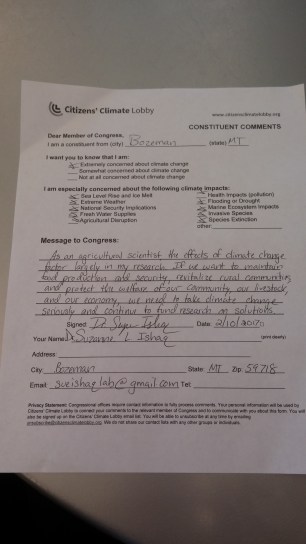
Lastly, we heard from a local producer who spoke to his experience with ranching on a farm that had been run continuously for well over 100 years. His talk reflected the prevailing sentiment of the presentations: that farm practices had changed over the last few decades and people in agriculture were already responding to climate change, even if previously they wouldn’t put a name to it. The presentations concluded with a question and answer session with the entire panel, as well as a reminder that we all have the right and the obligation to be invested in our food system. Whether we grow produce or raise livestock for ourselves or others, whether we research these biological interactions, whether we set the policy that affects an entire industry, or whether we are just a consumer, we owe it to ourselves to get involved and make sure our voice is heard. To that end, I wrote a letter to my legislators (pictured below), and in the next few weeks I’ll be writing posts about how I participate in science (and agriculture) on the local and national level.
2016 started with a bang when I launched this site and joined Twitter for the first time! For the first quarter of the year, I was a post-doctoral researcher in the Yeoman Lab in the Department of Animal and Range Sciences at Montana State University. I was working on a total of eight grants, ranging from small fellowships to million dollar projects, both as a principal investigator and as a co-PI. I was also doing the bioinformatic analysis for multiple projects, totaling nearly 1,000 samples, as well as consulting with several graduate students about their own bioinformatic analyses.
In late spring, my position in the Yeoman lab concluded, and I began a post-doctoral position in the Menalled Lab in the Department of Land Resources and Environmental Sciences at MSU. This position gave me the opportunity to dramatically increase my skill-set and learn about plant-microbe interactions in agricultural fields. My main project over the summer was studying the effect of climate and other stresses on wheat production and soil microbial diversity, and this fall I have been investigating the legacy effects of these stressors on new plant growth and microbial communities. I have extracted the DNA from all of my Fort Ellis summer trial soil samples, and look forward to having new microbial data to work with in the new year. Based on the preliminary data, we are going to see some cool treatment effects!
Over the summer, I attended the American Society for Microbiology in Boston, MA in June, where I presented a poster on the microbial diversity in organic and conventional farm soil, and the Joint Annual Meeting for three different animal science professional societies in Salt Lake City, UT in July, where I gave my first two oral conference presentations. One was on the effect of a juniper-based diet on rumen bacteria in lambs, and the other was on the biogeography of the calf digestive system and how location-specific bacteria correlate to immune-factor expression.
Thanks to a lot of hard work from myself and many collaborators, a number of research projects were accepted for publication in scientific journals, including the microbial diversity of agricultural soils, in reindeer on a lichen diet, and in relation to high-fat diets in mice, it also included work on virulent strains of Streptococcus pyogenes, and a review chapter on the role of methanogens in human gastrointestinal disease.
This slideshow requires JavaScript.
Looking forward
A whopping thirteen manuscripts are still in review at scientific journals or are in preparation waiting to be submitted! Some of those are primarily my projects, and for others I added my skills to the work of other researchers. Editing all those is going to keep me plenty busy for the next few months. I’ll also be writing several more grants in early 2017, and writing a blog post about the Herculean task that can be.
I’ll be concluding my greenhouse study by March of 2017, just in time to prepare for another field season at Fort Ellis, on the aforementioned climate change study that is my main focus. In January, I’ll be spending time in the lab helping to process and sequence DNA from my 270 soil samples, and begin the long task of data quality assurance, processing, and analysis. I’m not worried, though, 270 samples isn’t the most I’ve worked with and bioinformatic analysis is my favorite part of the project!
This year, I am hoping to attend two conferences that I have never previously attended, and present data at both of them. The first will be the 2017 Congress on Gut Function in Chicago, IL in April, and the second will be the Ecological Society of America’s Annual Meeting in Portland, OR in August. Both conferences will give me the opportunity to showcase my work, network with researchers, and catch up with old friends.
If 2017 is anything like the past few years, it’s going to be full of new projects, new collaborators, new skills, and new opportunities for me, and I can’t wait! So much of what I’ve accomplished over the last year has been possible because of the hard work, enthusiasm, and creativity of my colleagues, students, friends, and family, and I continue to be grateful for their support. I’d also like to thank anyone who has been kind enough to read my posts throughout the last year; it’s been a pleasure putting my experiences into words for you and I appreciate the time and interest you put in. I look forward to sharing more science with you next year!




 a small meeting for researchers with a specific focus on the gastrointestinal tract, which is held every two years in Chicago, Illinois. The