
Two weeks ago I participated in a BioBE Design Champs webinar on Daylight and Microbes. Find out more here.
Category: Outreach

What is academic Outreach/Extension?
Service can be a vaguely defined expectation in academia, but it’s an expectation to give back to our community; this can be accomplished in different ways and is valued differently by institutions and departments. Outreach is an easily neglected part of science, because so often it is considered non-essential to your research. It can be difficult to measure the effectiveness or direct benefit of outreach as a deliverable, and when you are trying to hoard merit badges to make tenure and your time is dominated by other responsibilities, you often need to prioritize research, teaching, advising, or grant writing over extension and service activities. Nevertheless, public outreach is a vital part to fulfilling our roles as researchers. Academic work is supported by public funding in one way or another, and much of our research is determined by the needs of stakeholders, who in this sense are anyone who has a direct interest in the problem you are trying to solve.
Depending on your research field, you may work very closely with stakeholders (especially with applied research), or not at all (with theoretical or basic research). If you are anywhere in agriculture, having a relationship with your community is vital. More importantly, working closely with the public can bring your results directly to the people out in the real world who will benefit from it.
A common way to fulfill your outreach requirement is to give public presentations. These can be general presentations that educate on a broad subject, or can be specifically to present your work. Many departments have extension specialists, who might do some research or teaching but whose primary function is to connect researchers at the institution with members of the public. In addition to presentations, extension agents generate newsletters or other short publications which summarize one or more studies on a specific subject. They are also a great resource for networking if you are looking for resources or collaborations, for example if you are specifically looking for farms in Montana that grow wheat organically and are infested with field bindweed.
For my new job, I’m shifting gears from agricultural extension to building science and health extension. In fact, the ESBL and BioBE teams at the University of Oregon have recently created a Health + Energy Research Consortium to bring university researchers and industry professionals together to foster collaborations and better disseminate information. The goals of the group at large are to improve building sustainability for energy and materials, building design to serve human use better, and building microbiology and its impact on human health. I have a few public presentations coming up on my work, including one on campus at UO on Halloween, and one in February for the Oregon Museum of Science and Industry Science Pub series in February. Be sure to check my events section in the side bar for details.
Even when outreach or extension is not specified in your job title, most academics have some level of engagement with the public. Many use social media outlets to openly share their current work, what their day-to-day is like, and how often silly things go wrong in science. Not only does this make us more approachable, but it’s humanizing. As hard as scientists work to reach out to the public, we need you to reach back. So go ahead, email us (please don’t call because the stereotype is true: we really do hate talking on the phone), tweet, post, ping, comment, and engage with us!!

Expanding Your Horizons for Girls workshop, MSU 2017
Yesterday I participated in the Expanding Your Horizons for Girls workshop at Montana State University! EYH brings almost 300 middle-school aged girls from all over Montana for a one-day conference in STEM fields. Twenty-seven instructors, including myself and other female scientists and educators, ran workshops related to our current research. My presentations were on “Unlocking the Hidden World of Soil Bacteria”, with the help of undergraduate Genna Shaia from the Menalled Lab.

Setting up a soil microbes workshop for Expanding Your Horizons for Girls.

Genna Shaia, undergraduate researcher.
I gave the girls a brief presentation on microbial ecology, and how bacteria and fungi can affect plants in agricultural soil. We talked about beneficial versus pathogenic microorganisms, and how different farming strategies can influence soil microbiota. This was followed by two hands-on activities that they were able to talk home with them. First, the girls made culture plates from living or sterile soil that was growing wheat or peas to see what kind of microbes they could grow. Then, they planted wheat seeds in either living or sterile soil so they could track which soil made the seeds germinate faster.


The girls were enthusiastic to learn, asked lots of insightful questions, and it was awesome being able to share microbiology with kids who hadn’t given it much thought before! If you are a woman in STEM, and have the opportunity to participate in a workshop or mentor a young scientist, it is not only rewarding but can make a huge impact on encouraging women into STEM.
Slideshow photos: Genna Shaia, reproduced with student permission.

Anyone can Science, step 3: show your support
The political climate of 2017 has already raised several causes for concern among U.S. scientists: from politicians who reject current scientific theory, to dramatic cuts proposed to federal or state budgets for research (and jobs), to enacting hiring freezes and stopping grant payments, to policy changes which would allow for governmental oversight on which and how results were disseminated (a gag order). Certainly, other administrations have suggested or enacted scientific budget cuts, or called for hiring freezes and gag orders, but never before has a president and White House administration so clearly come out against scientific literacy, education, research, and policy.
This change of political tone has encouraged many scientists to voice their concerns, but we scientists also need the support of the general public. After all, science is largely designed to improve the lives and economies of everyone. According to the U.S. Bureau of Labor Statistics, STEM jobs accounted for 8.6 million US jobs in 2015 in the U.S., but an estimated 26 million jobs (20% of jobs in 2011) require knowledge of a STEM field, a sector that consistently has low rates of unemployment, and expands the US economy. Thus, even without thinking about the politics of science, we can agree that scientific research is a vital part of the U.S. economy. Additionally, 93% of STEM occupations have wages above the national average. If you are a scientist, know a scientist, or generally want to show your support, here are some ways you can get involved.
March for Science
Signing petitions, wearing slogans, and being vocal to legislatures and the public about your support is wonderful, but a show of solidarity can bring people together to effect change.
On Saturday April 22, 2017, people will March for Science in cities across the United States to peacefully show their support for scientific literacy, education, policy, and freedom of speech. Please consider joining them.
You can find a march near you, here. A number of scientific organizations have endorsed the March for Science, including (in no particular order) the Union of Concerned Scientists, the Georgia Academy of Science, the National Science Teachers Association, the American Public Health Association, the American Geophysical Union, the American Chemical Society, the American Association for the Advancement of Science, and others. And if you need inspiration for a sign or an outfit, there are lots of places that are ready to help you out.
Financial Support
As I discussed in a previous post about research grant money, financial support of science is always welcome. There are lots of ways to contribute, whether it’s donating to organizations to fund research for specific medical conditions, participating in a crowd-funding campaign to raise money or get equipment donated, becoming a member or donating to scientific advancement organizations, or even just taking a grad student out to lunch.
Rock the Vote
Support for scientific funding, education, and policy may not be at the top of your list of reasons for supporting political candidates, but it should be on there somewhere. After the first few months of 2017, a number of scientists have decided to hang up their lab coat and run for public office, so you’ll have plenty of options in the coming elections.
I would like to acknowledge Drs. Irene Grimberg and Fabian Menalled for their edits to this post, as well as the ongoing efforts of my editor, Mike Haselton, MA, towards improving my writing.

Plowing Forward: Montana Agriculture in a Changing Climate
Agriculture is consistently Montana’s largest economic sector, but as an arid state we need to prepare for the challenges brought on by changing weather patterns. Yesterday, agricultural producers, scientists, special interest groups, lawmakers, and the general public came together at the Bozeman Public Library to talk about the future of climate change and what it means for people in the agricultural industry and research sector. The event was organized by Plowing Forward, a collaborative group to coordinate local Ag. education efforts.
“If you’ve eaten today, then you’re involved in agriculture.” -Chris Christiaens at the Plowing Forward meeting in Bozeman, MT, Feb 10, 2017
Opening remarks were led by Chris Christiaens, lobbyist and Project Specialist for the Montana Farmers Union, based in Great Falls, MT. Chris gave us some perspective on how Montana farming and ranching has changed over time, especially over the last 10 years,including changes to the growing season, harvest times, water usage, the types of plants which are able to survive here. He reminded us that the effect of climate on agriculture affects all of us.

Next, we heard from Montana’s Senator Jon Tester, who runs a farm in northern Montana that has been in his family since 1912. The Senator spoke to his personal experiences with farming and how his management practices had adapted over the years to deal with changing temperature and water conditions. Importantly, he spoke about how agriculture is a central industry to the United States in ways that will become even more apparent in the coming years as the negative effects of climate change affect more and more areas. Food security, a peaceful way of life, and economic vitality (not just in Montana or the United States, but globally), were contingent upon supporting agricultural production under adverse events. He assured agricultural stakeholders that he continues to support production, research, and education, including the work we do in the laboratory as well as out in the field to promote agriculture.
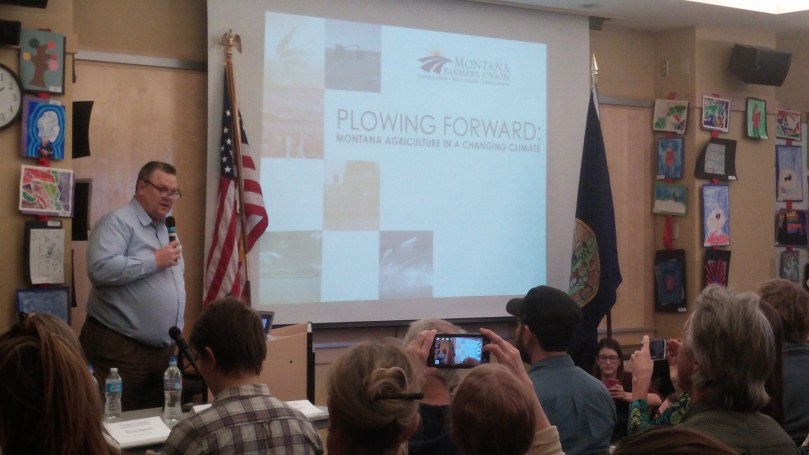
Next, we heard from three professors from Montana State University. Dr. Cathy Whitlock, a Professor of Earth Sciences, who is also the Director for the MSU Institute on Ecosystems, and a Lead Coordinator for the Montana Climate Assessment. The Montana Climate Assessment seeks to assemble past and current research on Montana climate in order to assess trends, make predictions about the future, and help both researchers and producers to tailor their efforts based on what is happening at the regional level. The Assessment is scheduled for release in August, 2017, and will allow for faster dissemination of research information online.
Dr. Whitlock’s introduction to the MCA was continued by Dr. Bruce Maxwell, a Professor of Agroecology, as well as the Agriculture Sector Lead for the Montana Climate Assessment. He summarized current research on the present water availability in Montana, as well as what we might see in the future. He warned that drier summers were likely, and while winters may get wetter, if they continue to get warmer that snow runoff will flow into rivers before the ground has thawed. This means snow melt will flow out of the region more quickly and not be added to local ground water sources for use here. To paraphrase Bruce, a longer growing season does you no good if you don’t have any water.

We also heard from my current post-doctoral advisor, Dr. Fabian Menalled, Professor of Weed Ecology Management and Cropland Weed Specialist (Extension). He presented some of the results from our ongoing project at Fort Ellis on the interactions between climate change (hot and dry conditions), farm management system (conventional or organic), disease status, and weed competition on wheat production. Increased temperatures and decreased moisture reduced wheat production but increased the amount of cheatgrass (downy brome), a weed which competes with wheat and can reduce wheat growth. My work on the soil bacterial diversity under these conditions didn’t make it into the final presentation, though. I have only just begun the data analysis, which will take me several months due to the complexity of our treatments, but here is a teaser: we know very little about soil bacteria, and the effects we are seeing are not exactly what we predicted!
Here is the video of Dr. Menalled’s presentation (just under 9 minutes):
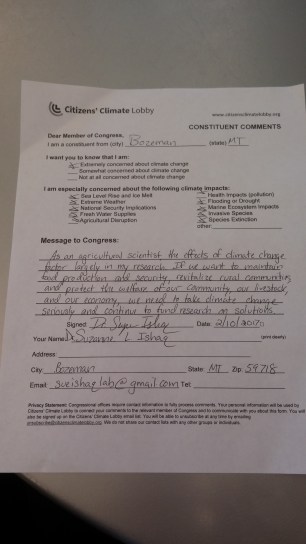
Lastly, we heard from a local producer who spoke to his experience with ranching on a farm that had been run continuously for well over 100 years. His talk reflected the prevailing sentiment of the presentations: that farm practices had changed over the last few decades and people in agriculture were already responding to climate change, even if previously they wouldn’t put a name to it. The presentations concluded with a question and answer session with the entire panel, as well as a reminder that we all have the right and the obligation to be invested in our food system. Whether we grow produce or raise livestock for ourselves or others, whether we research these biological interactions, whether we set the policy that affects an entire industry, or whether we are just a consumer, we owe it to ourselves to get involved and make sure our voice is heard. To that end, I wrote a letter to my legislators (pictured below), and in the next few weeks I’ll be writing posts about how I participate in science (and agriculture) on the local and national level.
I Accepted a New Position in Soil Microbiology and Agroeconomy!
As my current post-doctoral position winds down in the Yeoman Lab in the Department of Animal and Range Sciences, I am pleased to announce that I have accepted a post-doctoral position in the Menalled Lab in the Land Resources and Environmental Sciences Department! Dr. Menalled’s work focuses on agricultural weed ecology and management, particularly with respect to plant-plant interactions, changing climate (water and temperature changes), and now plant-microbe interactions!
I’ll primarily be working on a new two-year project that recently got funded through the USDA, entitled “Assessing the vulnerability and resiliency of integrated crop-livestock organic systems in water-limited environments under current and predicted climate scenarios”, but I’ll also be working collaboratively on several other similar projects in the lab.

My new responsibilities will include comparing agronomic performance and weed-crop-pathogen interactions between organic-tilled and organic-grazed systems, evaluating the impact of management and biophysical variables on soil microbial communities, and collaborating in modeling the long-term consequences of these interactions under current and predicted climate scenarios. It’ll mean a lot more field work, and a lot of new skills to learn! In fact, to help me study for my new job working with agricultural plants, my mentee and her friend made me flash cards:

In addition to my new skills, I’ll be integrating my background in microbial ecology and bioinformatics, in order to study agricultural ecosystems more holistically and measure plant-microbe interactions. In the same way that humans eat probiotics to promote a healthy gut microbiome, plants foster good relationships with specific soil microorganisms. The most exciting part is that I will act as an interdisciplinary bridge between the agroecology of the Menalled lab and the microbial ecology of the Yeoman lab, which will allow for more effective collaborations!
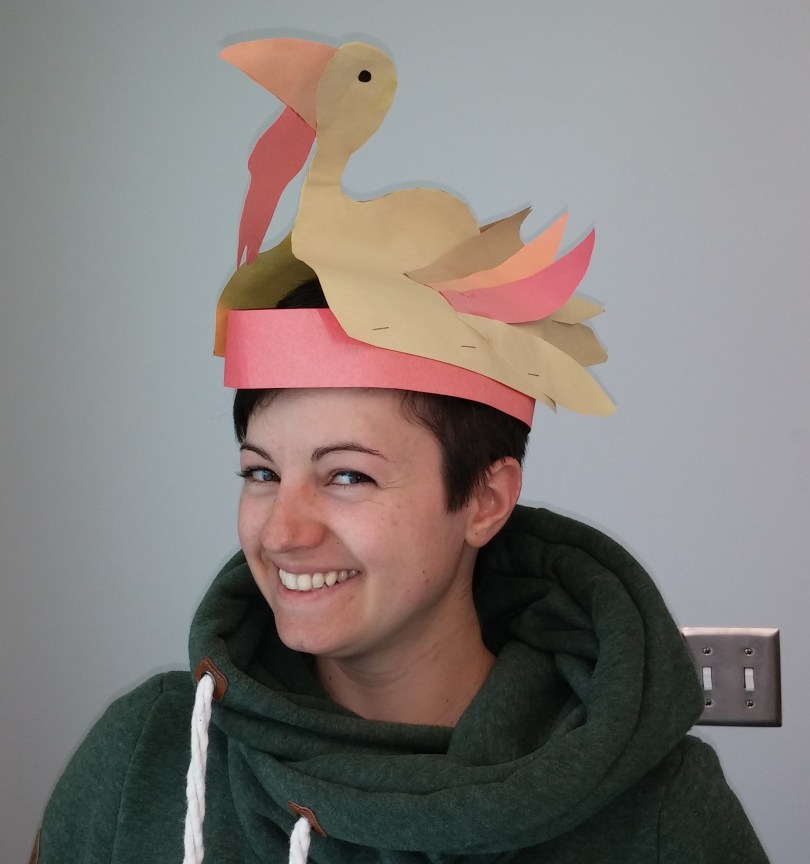
Improving a child’s life is as easy as wearing a paper turkey-hat.
Encouraging girls to go into STEM fields is really important; studies show that female STEM high-school teachers and even online mentors increase the probability of female students following a STEM education. Moreover, any child benefits academically and psychologically from having positive role models in their life, especially when they were role models that they interacted with as opposed to celebrity role models. And the benefits don’t just extend to children, adults benefit from positive role models, too. Certainly I have benefited from strong female role models in my life, from high school art teachers, to undergraduate lecturers, to family (happy birthday, Mom!).
This past fall I started putting my money where my mouth was- I started mentoring an elementary school-aged girl in Bozeman, MT through the Thrive Child Advancement Project (CAP). So far, we have mostly been making art projects and talking about archaeology. But we have been talking about trying to learn the Java programming language together!
There are lots of opportunities to mentor kids, either through CAP programs, Big Brother/Big Sister, Girls and Boy Scouts, etc., just a quick internet search brings up dozens of local options. For less of a time commitment, you can also volunteer for community workshops, like the Girls for a Change summit in Bozeman or the Girls-n-Science in Billings.

Citizen Science- volunteering for the microplastics study
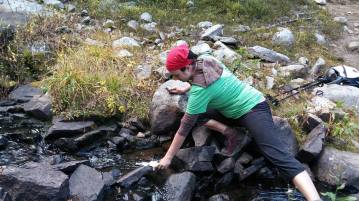
Yesterday was the winter sampling time point for a large research project I’m volunteering for: Adventurers and Scientists for Conservation is managing sample collection for the ASC Gallatin Microplastics Initiative in the Gallatin Valley watershed. The project samples various streams and lakes, both where they converge with the Gallatin River and at their headwaters. The project is part of a much larger project looking at microplastics in water around the world, the ASC Worldwide Microplastics Initiative. ASC recruits volunteers who have the outdoors-man skills (like hiking, tracking, or boating) and enthusiasm to get to hard to reach places to collect samples, then trains them in how to collect water samples and metadata (like weather, temperature, what we’re wearing during collection), coordinates sample collection times, and makes sure to safely send the samples back to a laboratory in Maine.

Digging down through the snow to find the headwaters of Deer Creek.

Our intrepid, fuzzy researcher stuck by our side the whole way.

Lee and I sample Deer Creek, just north of Big Sky, Montana. To do this, we hike 13 miles round trip to Moon Lake, with a 3,288 foot elevation gain up to around 9,000 ft above sea level. This time, the trail was covered in 1-2 feet of undisturbed snow, luckily we had snowshoes that kept us from sinking into all but the most soft of snowdrifts. On the way up it was snowing heavily, though visibility was fine, and on the way down it was raining. In many areas of the trail, drifts meant that the trail was at a 45 degree angle, and we had to break our own trail for nearly all of it. Despite the arduous trek, the views were beautiful, it was wonderful to be out of the office, and it was fun helping a large coordinated study. You can get involved in studies like this through organizations like ASC, or through research universities- volunteers are always needed for all different types of studies.

Lee showing what he was wearing, in case our clothing contaminated the sample.

The trail was very steep and uneven thatnks to snow drifts.

Not in my backyard!
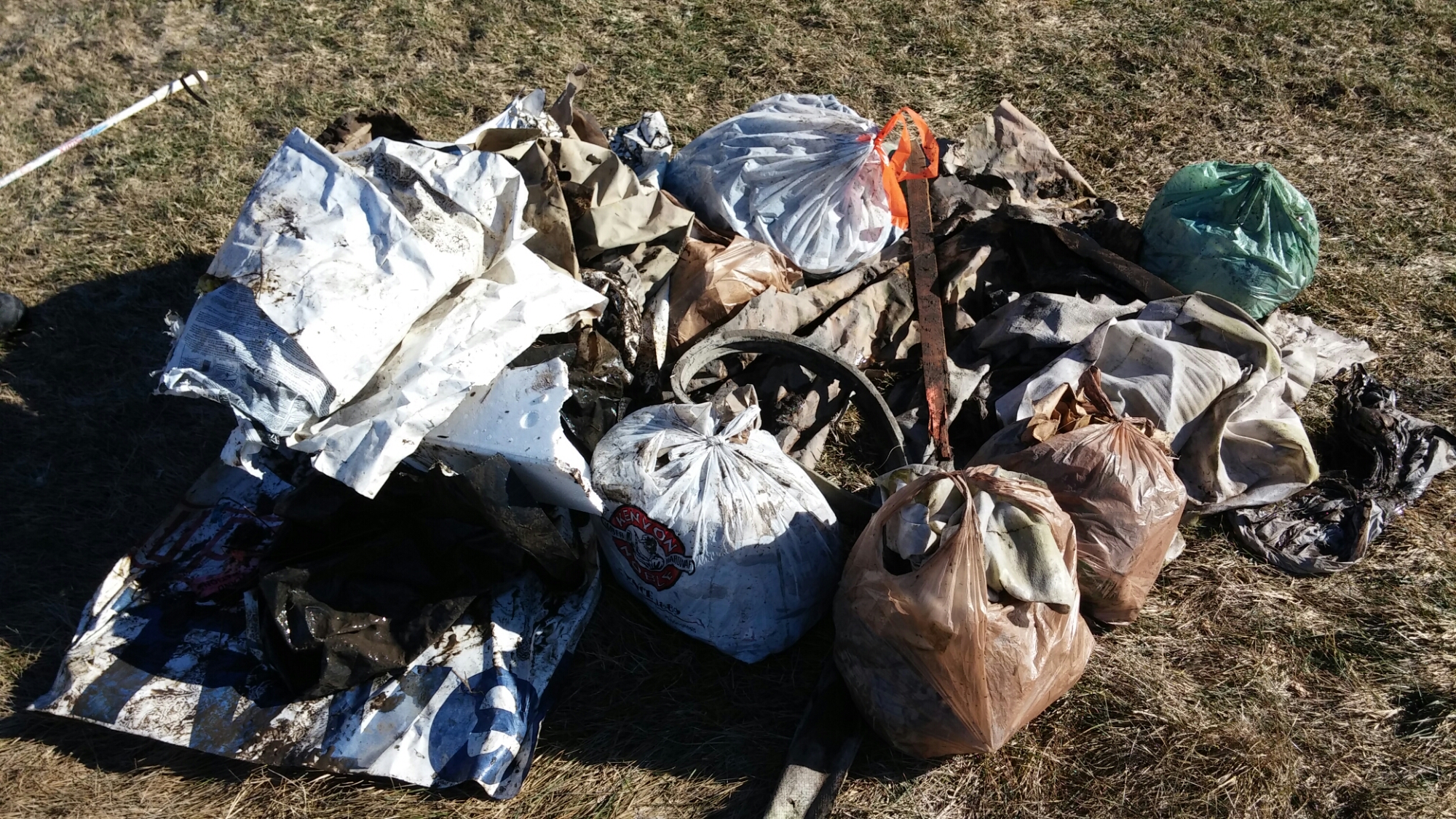
Today I spent a few hours picking trash out of some steams bordering my housing development. It’s very windy on the plains of Montana, and wind storms contribute to pollution by spreading trash. These steams are home to ducks, fish, musk rats, snakes, and frogs, and they link to larger water systems which run through local farms and provide water to cattle. Since the water table isn’t very deep here, any pollution can have far reaching effects. In just two and a half hours, I managed to pull all this out using only a ski pole, proving that one person can make a difference. As an environmental scientist, it’s important to me to give back. Next time you’re looking for something to do, why not try some green up?
 The Ishaq Lab