I recently sat down with Ashley Hagen, who hosts the Meet the Microbiologist podcast at the American Society for Microbiology, to talk about my collaborative research on broccoli sprouts, anti-inflammatories, and gut microbes!

I recently sat down with Ashley Hagen, who hosts the Meet the Microbiologist podcast at the American Society for Microbiology, to talk about my collaborative research on broccoli sprouts, anti-inflammatories, and gut microbes!

The Microbes and Social Equity Working Group was featured in on the American Society for Microbiology (ASM) blog in a piece today: “Microbes and social equity“. The blog post describes the global rise of research, education, and policy surrounding microbiomes and how social policy can influence our exposure to them – for better or worse.
You can read more using the link below to the growing list of contributions to the special collections featured by the scientific journal mSystems; “Special Series: Social Equity as a Means of Resolving Disparities in Microbial Exposure.”
“Variation in microbial exposure at the human-animal interface and its risks for health“, by Sahana Kuthyar and Aspen T. Reese
“Teaching with Microbes: Lessons from Fermentation during a Pandemic“, by Megan A. Carney
“Introducing the Microbes and Social Equity Working Group: Considering the Microbial Components of Social, Environmental, and Health Justice“, Ishaq et al.
A few weeks ago, I sat down with Sheba A-J, one of the producers of the WeTalkScience podcast, to talk about one of my recent publications in the research journal iScience, at which Sheba is also an editor. Listen to find out how lobsters are like humans, how I got involved on a project working with ants and nematodes, and how you can help make science a more welcoming place.
The full publication is:
Ishaq, S.L., A. Hotopp, S. Silverbrand, J.E. Dumont, A. Michaud, J. MacRae, S. P. Stock, E. Groden. 2021. Bacterial transfer from Pristionchus entomophagus nematodes to the invasive ant Myrmica rubra and the potential for colony mortality in coastal Maine. iScience 24(6):102663. Article.
The Microbes and Social Equity working group and The University of Maine Institute of Medicine present an inaugural symposium on:

June 14 – 18th, 2021
Format: virtual meeting, Zoom platform.

Friday, June 18th, 13:00 ~ 16:30 EST. Registration for this session is closed.
Section leader: Emily Wissel
Access to healthcare, including treatment and preventative care, is critical to moderate beneficial host-microbe interactions and mitigate host-pathogen interactions, yet healthcare is inequitably distributed and often curbed by social policy. For instance, maternity care is well-demonstrated to improve health outcomes and facilitate the transfer of beneficial maternal microbes to newborns. Policies which support breastfeeding likewise promote this transfer of maternal microbes. Similarly, newborns and infants with access to care in their first five years of life have better outcomes overall than those with limited access. This difference in care during early life can impact lifelong differences in outcomes, reinforcing inequalities present at birth. This session will cover topics from the vaginal microbiome during pregnancy to the infant gut microbiome after birth, with perspectives from a clinician, public health researchers, and a biological scientist.
Registration, a full speaker list and program, and details of each day can be found here.
Registration will occur for each (day) section individually, so participants can select which topics to participate in, or all of them.
Registration is free and open to the public.
Microorganisms are critical to many aspects of biological life, including human health. The human body is a veritable universe for microorganisms: some pass through but once, some are frequent tourists, and some spend their entire existence in the confines of our body tissues. The collective microbial community, our microbiome, can be impacted by the details of our lifestyle, including diet, hygiene, health status, and more, but many are driven by social, economic, medical, or political constraints that restrict available choices that may impact our health.
Many human clinical conditions or diseases have been established as being related to the state of the human microbiome. It is known that collective social inequity can drive the prevalence, morbidity, and mortality of some of these diseases or conditions. When access to a nutritious diet and healthcare are impeded by social inequity, these disparities can also affect the human microbiome; this can further contribute to reduced or poorly functioning microbiomes.
Access to resources is the basis for creating and resolving social equity—access to healthcare, healthy foods, a suitable living environment, and to beneficial microorganisms, but also access to personal and occupational protection to avoid exposure to infectious disease. The emergence of the SARS-CoV2 (COVID-19) pandemic has dramatically altered our daily lives and the availability and ability to access essential resources, which has been worsened by pre-existing social inequity. Yet, the pandemic has also highlighted the inherent social disparity among those more likely to be exposed to infectious diseases.
This meeting highlights recent investigations into beneficial and detrimental instances of microbial exposure, in the context of how social policy may mediate or deepen disparities between and within populations. In addition to invited presentations on thematic sections, each section will involve a discussion session using smaller breakout groups, to facilitate conversations and brainstorming between attendees. These groups will be arranged around smaller themes or research questions, and group members will identify knowledge gaps for future research, as well as list actionable steps that can be taken using existing research to promote equitable social policy. Ideally, meeting attendees will gain knowledge, collaborators and connections, and a path forward for turning their research into evidence-based policy to support public health.
Unlike traditional symposium formats, this meeting will present some plenary-style talks by experts in the field, including biological scientists, social scientists, practitioners or policy makers, as well as facilitate discussion among participants. Each thematic section will feature 90 minutes of talks, which will be recorded and made publicly available after the live session. After each plenary session, there will be 90 minutes of discussion in groups led by speakers and MSE group members, and assisted by notetakers, with ~10 participants per breakout room. Participants will be encouraged to “problem solve” a suggested topic or one of their own choosing. The goal is to create action items that are meaningful for group participants, such as ideas for curricula development, identifying research needs or best practices, suggestions for engaging research in policy, and more.
The Microbes and Social Equity working group and The University of Maine Institute of Medicine present an inaugural symposium on:

June 14 – 18th, 2021
Format: virtual meeting, Zoom platform.

Thursday, June 17th, 13:00 ~ 16:30 EST. Registration for this session is closed.
Section leader: Patricia Wolf
While it has been established that human behavior may impact microbiome structure, it has become evident that this is only part of the story. Historically racist housing policies may lead to inequitable exposure of those living in segregated neighborhoods to environmental pollutants. Additionally, life-long exposure to social and environmental stress faced by minority groups within the US may increase risk to disease through the alteration of host and bacterial metabolites. These inequities were compounded during the COVID-19 pandemic, during which neighborhood structural environments led to differing access to healthcare and treatment for the disease. Notably, those with the least access often were subject to higher exposure to the disease due to having “essential” employment. This session will explore the social and environmental factors that can impact human microbiomes, and will discuss measures that investigators should incorporate into research in order to fully understand microbial mechanisms of disease.
Registration, a full speaker list and program, and details of each day can be found here.
Registration will occur for each (day) section individually, so participants can select which topics to participate in, or all of them.
Registration is free and open to the public.
Microorganisms are critical to many aspects of biological life, including human health. The human body is a veritable universe for microorganisms: some pass through but once, some are frequent tourists, and some spend their entire existence in the confines of our body tissues. The collective microbial community, our microbiome, can be impacted by the details of our lifestyle, including diet, hygiene, health status, and more, but many are driven by social, economic, medical, or political constraints that restrict available choices that may impact our health.
Many human clinical conditions or diseases have been established as being related to the state of the human microbiome. It is known that collective social inequity can drive the prevalence, morbidity, and mortality of some of these diseases or conditions. When access to a nutritious diet and healthcare are impeded by social inequity, these disparities can also affect the human microbiome; this can further contribute to reduced or poorly functioning microbiomes.
Access to resources is the basis for creating and resolving social equity—access to healthcare, healthy foods, a suitable living environment, and to beneficial microorganisms, but also access to personal and occupational protection to avoid exposure to infectious disease. The emergence of the SARS-CoV2 (COVID-19) pandemic has dramatically altered our daily lives and the availability and ability to access essential resources, which has been worsened by pre-existing social inequity. Yet, the pandemic has also highlighted the inherent social disparity among those more likely to be exposed to infectious diseases.
This meeting highlights recent investigations into beneficial and detrimental instances of microbial exposure, in the context of how social policy may mediate or deepen disparities between and within populations. In addition to invited presentations on thematic sections, each section will involve a discussion session using smaller breakout groups, to facilitate conversations and brainstorming between attendees. These groups will be arranged around smaller themes or research questions, and group members will identify knowledge gaps for future research, as well as list actionable steps that can be taken using existing research to promote equitable social policy. Ideally, meeting attendees will gain knowledge, collaborators and connections, and a path forward for turning their research into evidence-based policy to support public health.
Unlike traditional symposium formats, this meeting will present some plenary-style talks by experts in the field, including biological scientists, social scientists, practitioners or policy makers, as well as facilitate discussion among participants. Each thematic section will feature 90 minutes of talks, which will be recorded and made publicly available after the live session. After each plenary session, there will be 90 minutes of discussion in groups led by speakers and MSE group members, and assisted by notetakers, with ~10 participants per breakout room. Participants will be encouraged to “problem solve” a suggested topic or one of their own choosing. The goal is to create action items that are meaningful for group participants, such as ideas for curricula development, identifying research needs or best practices, suggestions for engaging research in policy, and more.
The Microbes and Social Equity working group and The University of Maine Institute of Medicine present an inaugural symposium on:

June 14 – 18th, 2021
Format: virtual meeting, Zoom platform.

Wednesday, June 16th, 13:00 ~ 16:00 EST. Registration for this session is closed.
Section leader: Gwynne Mhuireach
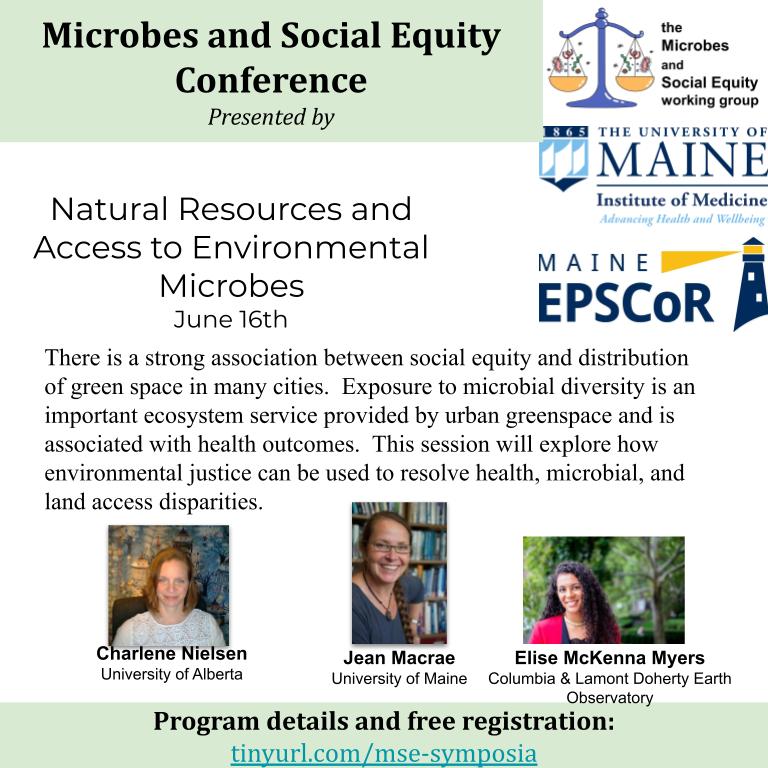
The relationship between health and greenspace is well-established. There is also a recognized association between social equity and distribution of greenspace in many cities—parks are often larger, higher quality, and more prevalent in higher-income, upper-class neighborhoods; private yards and gardens are a luxury sometimes inaccessible to lower-income households; even street trees tend to be older, larger, and more numerous in higher income neighborhoods. New evidence shows that exposure to microbial diversity may be an important ecosystem service provided by urban greenspace, as exposure to greater microbial diversity early in life is related to lower prevalence of autoimmune disorders, such as allergies and asthma. This session will explore how environmental justice can be used to resolve health, microbial, and land access disparities.
Registration, a full speaker list and program, and details of each day can be found here.
Registration will occur for each (day) section individually, so participants can select which topics to participate in, or all of them.
Registration is free and open to the public.
Microorganisms are critical to many aspects of biological life, including human health. The human body is a veritable universe for microorganisms: some pass through but once, some are frequent tourists, and some spend their entire existence in the confines of our body tissues. The collective microbial community, our microbiome, can be impacted by the details of our lifestyle, including diet, hygiene, health status, and more, but many are driven by social, economic, medical, or political constraints that restrict available choices that may impact our health.
Many human clinical conditions or diseases have been established as being related to the state of the human microbiome. It is known that collective social inequity can drive the prevalence, morbidity, and mortality of some of these diseases or conditions. When access to a nutritious diet and healthcare are impeded by social inequity, these disparities can also affect the human microbiome; this can further contribute to reduced or poorly functioning microbiomes.
Access to resources is the basis for creating and resolving social equity—access to healthcare, healthy foods, a suitable living environment, and to beneficial microorganisms, but also access to personal and occupational protection to avoid exposure to infectious disease. The emergence of the SARS-CoV2 (COVID-19) pandemic has dramatically altered our daily lives and the availability and ability to access essential resources, which has been worsened by pre-existing social inequity. Yet, the pandemic has also highlighted the inherent social disparity among those more likely to be exposed to infectious diseases.
This meeting highlights recent investigations into beneficial and detrimental instances of microbial exposure, in the context of how social policy may mediate or deepen disparities between and within populations. In addition to invited presentations on thematic sections, each section will involve a discussion session using smaller breakout groups, to facilitate conversations and brainstorming between attendees. These groups will be arranged around smaller themes or research questions, and group members will identify knowledge gaps for future research, as well as list actionable steps that can be taken using existing research to promote equitable social policy. Ideally, meeting attendees will gain knowledge, collaborators and connections, and a path forward for turning their research into evidence-based policy to support public health.
Unlike traditional symposium formats, this meeting will present some plenary-style talks by experts in the field, including biological scientists, social scientists, practitioners or policy makers, as well as facilitate discussion among participants. Each thematic section will feature 90 minutes of talks, which will be recorded and made publicly available after the live session. After each plenary session, there will be 90 minutes of discussion in groups led by speakers and MSE group members, and assisted by notetakers, with ~10 participants per breakout room. Participants will be encouraged to “problem solve” a suggested topic or one of their own choosing. The goal is to create action items that are meaningful for group participants, such as ideas for curricula development, identifying research needs or best practices, suggestions for engaging research in policy, and more.
The Microbes and Social Equity working group and The University of Maine Institute of Medicine present an inaugural symposium on:

June 14 – 18th, 2021
Format: virtual meeting, Zoom platform.

Tuesday, June 15th, 13:00 ~ 16:00 EST. Registration for this session is closed.
Session leader: Laura Grieneisen
Access to fresh foods, and especially fruits, vegetables, and other products high in fiber, is well demonstrated to be affected by social inequity. The lack of fiber and nutritious food can dramatically hamper a functional gut microbiome. With the effects of COVID-19 being felt, the loss of income/loss of SNAP benefits and disruption to our food and transport systems will make it more difficult for many individuals to obtain a nutritious diet and reap the benefit of a healthy gut microbiome. This effect will be disproportionately felt by lower-income individuals. This session explores the effects of diet on the gut microbiome and health, food insecurity, policy to support food access, and how to use existing resources to create community-based food systems.
A full speaker list and program, and details of each day can be found here.
Registration will occur for each (day) section individually, so participants can select which topics to participate in, or all of them.
Registration is free and open to the public.
Microorganisms are critical to many aspects of biological life, including human health. The human body is a veritable universe for microorganisms: some pass through but once, some are frequent tourists, and some spend their entire existence in the confines of our body tissues. The collective microbial community, our microbiome, can be impacted by the details of our lifestyle, including diet, hygiene, health status, and more, but many are driven by social, economic, medical, or political constraints that restrict available choices that may impact our health.
Many human clinical conditions or diseases have been established as being related to the state of the human microbiome. It is known that collective social inequity can drive the prevalence, morbidity, and mortality of some of these diseases or conditions. When access to a nutritious diet and healthcare are impeded by social inequity, these disparities can also affect the human microbiome; this can further contribute to reduced or poorly functioning microbiomes.
Access to resources is the basis for creating and resolving social equity—access to healthcare, healthy foods, a suitable living environment, and to beneficial microorganisms, but also access to personal and occupational protection to avoid exposure to infectious disease. The emergence of the SARS-CoV2 (COVID-19) pandemic has dramatically altered our daily lives and the availability and ability to access essential resources, which has been worsened by pre-existing social inequity. Yet, the pandemic has also highlighted the inherent social disparity among those more likely to be exposed to infectious diseases.
This meeting highlights recent investigations into beneficial and detrimental instances of microbial exposure, in the context of how social policy may mediate or deepen disparities between and within populations. In addition to invited presentations on thematic sections, each section will involve a discussion session using smaller breakout groups, to facilitate conversations and brainstorming between attendees. These groups will be arranged around smaller themes or research questions, and group members will identify knowledge gaps for future research, as well as list actionable steps that can be taken using existing research to promote equitable social policy. Ideally, meeting attendees will gain knowledge, collaborators and connections, and a path forward for turning their research into evidence-based policy to support public health.
Unlike traditional symposium formats, this meeting will present some plenary-style talks by experts in the field, including biological scientists, social scientists, practitioners or policy makers, as well as facilitate discussion among participants. Each thematic section will feature 90 minutes of talks, which will be recorded and made publicly available after the live session. After each plenary session, there will be 90 minutes of discussion in groups led by speakers and MSE group members, and assisted by notetakers, with ~10 participants per breakout room. Participants will be encouraged to “problem solve” a suggested topic or one of their own choosing. The goal is to create action items that are meaningful for group participants, such as ideas for curricula development, identifying research needs or best practices, suggestions for engaging research in policy, and more.
The Microbes and Social Equity working group and The University of Maine Institute of Medicine present an inaugural symposium on:

June 14 – 18th, 2021
Format: virtual meeting, Zoom platform.

Monday, June 14th, 13:00 ~ 16:30 EST. Registration for this session is closed.
Session leaders: Michael Friedman and Sue Ishaq
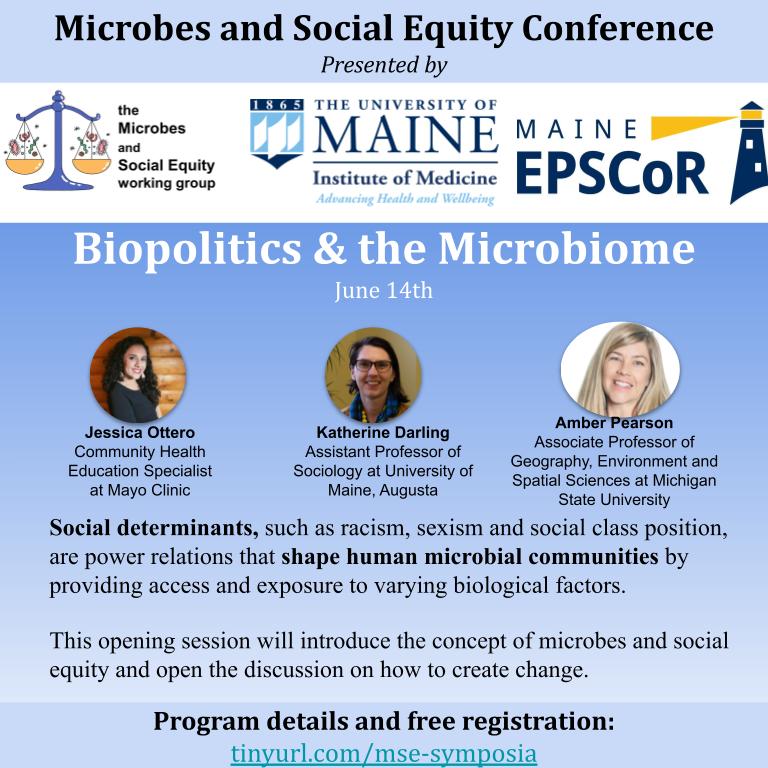
The human microbiota is a mediator between social determinants of health and health outcomes. Social determinants, such as racism, sexism and social class position are power relations that shape human microbial communities by providing access and exposure to varying biological factors. In turn, shifts in such communities are associated with distinct health outcomes. This opening session will introduce the concept of microbes and social equity, and open the discussion on how to create change.
A full speaker list and program, and details of each day can be found here.
Registration will occur for each (day) section individually, so participants can select which topics to participate in, or all of them.
Registration is free and open to the public.
Microorganisms are critical to many aspects of biological life, including human health. The human body is a veritable universe for microorganisms: some pass through but once, some are frequent tourists, and some spend their entire existence in the confines of our body tissues. The collective microbial community, our microbiome, can be impacted by the details of our lifestyle, including diet, hygiene, health status, and more, but many are driven by social, economic, medical, or political constraints that restrict available choices that may impact our health.
Many human clinical conditions or diseases have been established as being related to the state of the human microbiome. It is known that collective social inequity can drive the prevalence, morbidity, and mortality of some of these diseases or conditions. When access to a nutritious diet and healthcare are impeded by social inequity, these disparities can also affect the human microbiome; this can further contribute to reduced or poorly functioning microbiomes.
Access to resources is the basis for creating and resolving social equity—access to healthcare, healthy foods, a suitable living environment, and to beneficial microorganisms, but also access to personal and occupational protection to avoid exposure to infectious disease. The emergence of the SARS-CoV2 (COVID-19) pandemic has dramatically altered our daily lives and the availability and ability to access essential resources, which has been worsened by pre-existing social inequity. Yet, the pandemic has also highlighted the inherent social disparity among those more likely to be exposed to infectious diseases.
This meeting highlights recent investigations into beneficial and detrimental instances of microbial exposure, in the context of how social policy may mediate or deepen disparities between and within populations. In addition to invited presentations on thematic sections, each section will involve a discussion session using smaller breakout groups, to facilitate conversations and brainstorming between attendees. These groups will be arranged around smaller themes or research questions, and group members will identify knowledge gaps for future research, as well as list actionable steps that can be taken using existing research to promote equitable social policy. Ideally, meeting attendees will gain knowledge, collaborators and connections, and a path forward for turning their research into evidence-based policy to support public health.
Unlike traditional symposium formats, this meeting will present some plenary-style talks by experts in the field, including biological scientists, social scientists, practitioners or policy makers, as well as facilitate discussion among participants. Each thematic section will feature 90 minutes of talks, which will be recorded and made publicly available after the live session. After each plenary session, there will be 90 minutes of discussion in groups led by speakers and MSE group members, and assisted by notetakers, with ~10 participants per breakout room. Participants will be encouraged to “problem solve” a suggested topic or one of their own choosing. The goal is to create action items that are meaningful for group participants, such as ideas for curricula development, identifying research needs or best practices, suggestions for engaging research in policy, and more.
Our proposal for a special session on ‘microbes and social equity’ has been approved for the Ecology Society of America scientific conference this summer, August 2 – 6, 2021! This year’s meeting will be entirely virtual, allowing us to host panel speakers from various locations. This session requires registration to the ESA meeting.
09:30 – 12:30 PST/ 12:30 – 15:30 EST
Microbiomes — environmental, human and other organismal symbionts — are increasingly seen as critical physiological, developmental and ecological mediators within and among living things, and between the latter and our abiotic environments. Therefore, it is no surprise that microbial communities may be altered, depleted or disrupted by social and economic determinants. Social inequality entails concrete alterations and differentiation of microbial communities among social groups, by way of such factors as nutritional access, environmental pollutants or green space availability, often to the detriment of human and ecosystem health. This special session will be organized as a panel discussion with break-out groups in order to provide participants the opportunity to discuss the ways in which social inequity interacts with microbiomes, and how we might intervene as scientists and communities to promote favorable microbiomes while advancing social equality. We hope to generate research questions and actionable items.
Panel speakers: Michael Friedman, Naupaka Zimmerman, Justin Stewart, Monica Trujillo, Sue Ishaq, Sierra Jech, Jennifer Bhatnagar, and Ariangela Kozik

About the speaker: Dr. Kishana Taylor is a virologist and Co-founder and president of the Black Microbiologists Association. Dr. Taylor holds a bachelors degree in animal science, a masters of public health in microbiology and emerging infectious disease, and a doctorate in interdisciplinary biomedical science. Dr. Taylor is currently a postdoctoral fellow at Carnegie Mellon University in the lab of Dr. Elizabeth Wayne. Her current NSF funded research focuses on the role of monocytes and macrophages in SARS-CoV2 infection and subsequent development of COVID-19. Dr. Taylor’s research interest include arboviruses, zoonotic viruses and their epidemiology, ecology and evolution.
Twitter: @KYT_ThatsME
About the seminar: Much like previous pandemics, the COVID-19/SARS-CoV-2 pandemic, especially in the U.S., has brought to the forefront pre-existing social and structural inequalities that affect access to quality healthcare and perpetuate viral spread. As we begin to think toward the future and the next inevitable pandemic, it is important to incorporate the lessons learned from this pandemic, and others, in an attempt to mitigate similar patterns of inequity in the future.
About the series: Microorganisms are critical to many aspects of biological life, including human health. The human body is a veritable universe for microorganisms: some pass through but once, some are frequent tourists, and some spend their entire existence in the confines of our body tissues. The collective microbial community, our microbiome, can be impacted by the details of our lifestyle, including diet, hygiene, health status, and more, but many are driven by social, economic, medical, or political constraints that restrict available choices that may impact our health.
Access to resources is the basis for creating and resolving social equity—access to healthcare, healthy foods, a suitable living environment, and to beneficial microorganisms, but also access to personal and occupational protection to avoid exposure to infectious disease. This speaker series explores the way that microbes connect public policy, social disparities, and human health, as well as the ongoing research, education, policy, and innovation in this field. The spring speaker series will pave the way for a symposium on “Microbes, Social Equity, and Rural Health” in summer 2021.