I'm an assistant professor of animal and veterinary studies at the University of Maine, Orono, studying how animals get their microbes. I am also the Founder and Lead of the Microbes and Social Equity working group.
It’s a new school year, and that means new members have joined the Ishaq Lab team – primarily undergraduates in Animal and Veterinary Sciences who are participating in research in fulfillment of their Capstone Experience senior projects. Over the next few months, we’ll be sharing more details about our new team members and their projects.
While UMaine is back on campus, not all of our students are local, so we had a hybrid meeting of in-person and Zoom attendees. We have members at Husson University in Bangor, Maine; Tufts University in Medford, Massachusetts; and Stony Brook University in Stony Brook, New York!
We use collaborative file sharing such as Google Drive, virtual meeting spaces like Zoom, and messaging platforms such as Slack for a few projects to facilitate our research and keep track of information. To help us connect more easily, and especially to help get everyone in my office on screen together, we’ll be adding more virtual conferencing equipment, too.
Most of the Ishaq Lab Fall 2021 team were able to make it to a Welcome Meeting recently.
Microbes are found everywhere, including on our skin or in our digestive tract, and the ones that hang out with us are called “host-associated”. Microbes interact with us in many different of ways, for better or for worse. To describe some common host-microbe interactions, the AVS254 Intro to Animal Microbiomes students collaborated on some playlists! Check them out on Spotify, and please note some songs are rated E for ‘explicit’ language.
Pathobiont: Ever had a microbe that you thought loved you only to have it turn on you? This playlist takes you from besties to bacteriosis.
Symbiont: Sometimes you just can’t live without your microbes. Welcome to your happily ever after, even if it is a tiny one.
Exogenous: Sometimes hosts and microbes are like ships passing in the night. This playlist tells you about the microbe that got away.
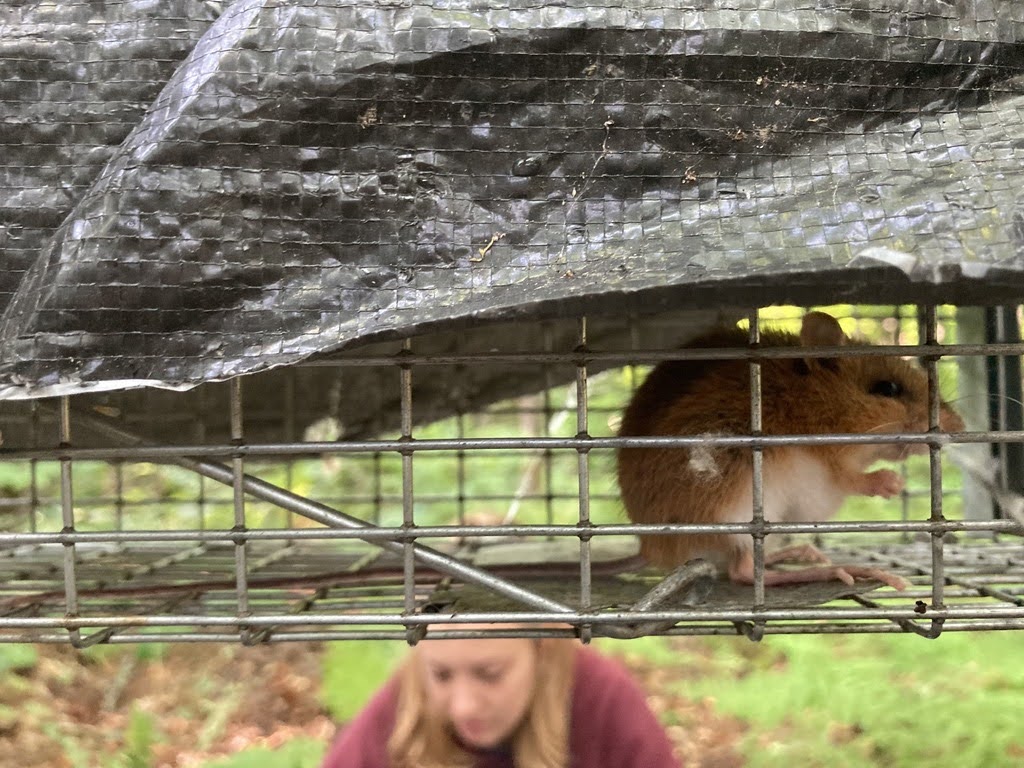
Funded by the University of Maine Rural Health and Wellbeing Grand Challenge Grant Program, this project assesses pathogen carriage by mice and flying squirrels on or near farms in several locations in Maine. We live-capture mice and flying squirrels in traps, collect the poop they’ve left in the trap, and conduct a few other health screening tests in the field before releasing them. To maximize the information we collect while minimizing stress and interference to the animals, information is being collected for other projects in the Levesque Lab at the same time. We will be collecting samples for another few weeks, and then working on the samples we collected in the lab over the fall and winter.
One of the major goals of the funding program, and this project, is to engage students in research. After a few months on the project, some of our students describe their role and their experiences so far…
Marissa Edwards
Undergraduate in Biology
Levesque Lab
Hi! My name is Marissa Edwards and I am an undergraduate research assistant with Danielle Levesque. This summer, my role has been to set traps, handle small mammals, and collect fecal and tissue samples from deer mice.
One of the skills I’ve learned this summer is how to properly ear tag a mouse. To catch mice, we set traps across UMaine’s campus as well as other parts of Maine, including Moosehead Lake, Flagstaff Lake, and Presque Isle.
During our trip to Moosehead Lake, I saw a marten for the first time (it was in one of our traps). I did not know martens existed and initially thought it was a fisher cat. It was both a cool and terrifying experience!
Elise Gudde
Master’s Student of Ecology and Environmental Sciences
Levesque Lab
Hello, my name is Elise Gudde, and I am currently a master’s student at the University of Maine in the Ecology and Environmental Sciences program. I work in Dr. Danielle Levesque’s lab studying small mammal physiology in Maine.
This summer, as a part of the squirrel project, I work to trap small mammal species in Maine, such as white footed mice, deer mice, and flying squirrels in order to determine which species have shifted their range distributions as a result of climate change. Being a part of the research team, this summer has brought me all over Maine! I have been able to travel to Orono, Greenville, New Portland, and Aroostook County to study many interesting mammals. I even got to handle an Eastern chipmunk for the first time! As a member of the animal-handling side of the research team, I also collect fecal and tissue samples from the animals. These samples are then handed off for other members of the team to research in the lab!
Rebecca French
Undergraduate in Animal and Veterinary Sciences
Ishaq Lab
In the beginning of this project, I had no idea what I was getting myself into when I began researching flying squirrels and mice. I came into it with almost no in-person lab experience, so I had a lot to learn.
So far, I have been focusing on making media on petri dishes for culturing bacterial growth and after plating fecal bacteria on said plates; discerning what that growth can be identified as.
We are using media with specific nutrients, and colored dyes, and certain bacteria we are interested in will be able to survive or produce a color change. I have also been performing fecal flotations and viewing possible eggs and parasites under a microscope. What I’ve found most fun about this project is putting into practice what I have learned only in a classroom setting thus far. It is also very satisfying to be a part of every step of the project; from catching mice, to making media, to using that media to yield results and then to be able to have a large cache of information to turn it all into a full fledged project.
Some of the media used to culture bacteria from the feces of mice and squirrels.
Joe Beale
Undergraduate in Animal and Veterinary Sciences
Kamath Lab
Hello! My name is Joseph Beale, and I am an undergraduate at the University of Maine working on the squirrel project as a part of my capstone requirement for graduation. My primary responsibility in this project is the molecular testing of samples obtained from the field. Primarily I will be working with ear punch samples taken from flying squirrels and field mice. DNA extracts from these field samples will be run via qPCR. The results of this qPCR will tell us if these squirrels are carrying any pathogens.
The pathogens we will be testing for are those found in Ixodes ticks. The qPCR panel which we will be running the extracted DNA from the ear punches on tests for Borrelia burgdorferi, the causative agent of Lyme disease, Anaplasma phagocytophilum, the causative agent of anaplasmosis, and Babesia microti, the causative agent of Babesiosis. These pathogens and respective diseases discussed are all transmitted through Ixodes ticks. Deer ticks are the most common and famous of the Ixodes genus. The Ixodes genus encapsulates hard-bodied ticks. Along with deer ticks, Ixodes ticks found in Maine include: woodchuck ticks, squirrel ticks, mouse ticks, seabird ticks, and more. Mice and squirrel are ideal hosts for these Ixodes ticks, therefore becoming prime reservoirs for these diseases. In our research, we are interested in determining the prevalence of these diseases in squirrels and mice as these hosts can spread these diseases to humans and other animals in high tick areas.
qPCR, quantitative polymerase chain reaction, allows for the quantification of amplified DNA in samples. This will help tell us if these pathogens are present in samples and in what capacity. In qPCR provided DNA strands are added to the reaction. These strands match with the genome of the intended pathogens. If the pathogens are present in our samples, the provided DNA strands will bind to the present pathogen DNA. PCR will then work to manufacture billions of copies of this present pathogen DNA.
When not working on this project, I also work in the University of Maine Cooperative Extension Diagnostic Research Laboratory as a part of the Tick Lab. In this position I have honed the molecular biology skills that I will in turn use for the squirrel project.
Hello everyone! My name is Yvonne Booker and I am a rising senior, animal and poultry science major at Tuskegee University in Tuskegee, Alabama. I am interested in animal health research, with a particular focus in veterinary medicine. I’ve always wanted to be a veterinarian, but as I progressed throughout college, I became interested in learning more about animal health and how I might help animals on a much larger and impactful scale–which led me to the REU ANEW program. Currently climate change is causing an increase in global temperatures, putting pressure on animals’ ability to interact and survive within their environment. Consequently, scientists are now attempting to understand not just how to prevent climate change, but how these creatures are adapting to this emerging challenge.
My research experience this summer is geared toward addressing this global issue. I am currently working in Dr. Danielle Levesque’s Lab, which aims to study the evolutionary and ecological physiology of mammals in relation to climate. My project involves conducting a literature review of the microbiome of mammals, to learn more about how their microbial community plays a role in how they adapt in a heat-stressed environment.
Our knowledge of vertebrate-microbe interactions derives partly from research on ectotherms. While this research paves the path for a better understanding of how organisms react to temperature changes, fewer studies have focused on how mammals deal with these extreme temperature shifts—specifically, the abrupt surge in climate change. The ability of endotherms to thermoregulate alters our knowledge of (1) how mammals create heat tolerance against these environmental challenges and (2) how this internal process alters mammals’ adaptability and physiology over time. We suggest that the microbiome plays an essential part in understanding mammals’ heat tolerance and that this microbial community can help researchers further understand the various processes that allow mammals to survive extreme temperatures.
As a student of the REU ANEW program my goal was to go out of my comfort zone and study animals in an applied fashion that would impact animal health on an environmental and ecological scale; and this program was just that! My mentor, Dr. Levesque was wonderful in guiding me through conducting this research, while giving me the independence to create my own voice. The program directors, Dr. Anne Lichtenwalner and Dr. Kristina Cammen, have also been extremely supportive throughout this entire program equipping students with the tools they need to succeed as researchers. Although research was my primary focus this summer, some of my favorite memories involved building community with the students and the staff. From weekly check-ins on zoom to virtual game nights of complete smiles and laughter, this program has been one for the books! The One Health and the Environment approach to this Research Experience for Undergraduate students has encouraged me to build on my curiosity within the field of science, and I’m looking forward to applying what I’ve learned to my career in the future.
The Microbes and Social Equity Working Group was featured in on the American Society for Microbiology (ASM) blog in a piece today: “Microbes and social equity“. The blog post describes the global rise of research, education, and policy surrounding microbiomes and how social policy can influence our exposure to them – for better or worse.
You can read more using the link below to the growing list of contributions to the special collections featured by the scientific journal mSystems; “Special Series: Social Equity as a Means of Resolving Disparities in Microbial Exposure.”
Did you know that camels have three stomach chambers or that they have to throw up their own food in order to digest their food properly? Have you felt excluded from science spaces before? Then this blog post is for you!
Allow me to introduce myself.
My name is Myra, and I am a rising senior at SUNY Stony Brook University, where my major is Ecosystems and Human Impact, with a biology minor. In a nutshell, my major is interdisciplinary with a focus on conservation and ecology within human societies.
If I were to describe my college experience in one word I’d pick “surprises”. I never actually saw myself being a scientist in my middle and high school years. I found it hard to care about abstract concepts or theories that felt so far removed from humanity, particularly minority communities. But, during college I found myself falling in love with environmental studies, and along with it, the beautiful complexities that come with being human in our increasingly anthropogenic world.
At UMaine, we focus on the One Health Initiative, which views the health of humans, animals, and the environment as interconnected. When COVID-19 caused everyone to go into lockdown, I was fortunate to find this farm was looking for crew members, with a focus on food security. While certainly not how I planned to spend the summer of 2020, farming for underserved communities is where I saw how impactful One Health was. Organic farmers commonly use plastic mulch as a popular alternative to pesticides for weed suppression. At my home institution, I lead a project on the impacts of microplastics on earthworm health, an Ecotoxicology lab (students of the lab affectionately gave it the nickname “the Worm lab”). We use earthworm health as an indicator of soil health, which in turn is crucial for crop flourishment. The Worm Lab and farming emboldened me to pursue science and, ergo, look for this REU!
At UMaine, I am a member of the Ishaq Lab where I work on the camel metagenome project. Basically, scientists in Egypt raised camels on different diets, then used samples from their feces to sequence their microbial genome. These microbes live in the camel rumen (part of the camel stomach), and help the camel digest their food. What I do with Dr. Ishaq’s lab is, I perform data analysis on these sequences to see how the microbial gene profile changes with different diets. Camels are essential for transportation and food for the communities that rely on them, so finding the most efficient feed for them is important. Camels also release methane depending on their diet so it’s possible humans could control methane production of camels through their diet.
Being a part of the REU ANEW program for 2021 definitely has been an interesting experience, since it is the first time this program has been conducted virtually. Even though I would have loved to have seen everyone in person and spent time in lovely Orono, Maine, I’m glad for the research opportunity as it has further solidified my love of research and the One Health initiative.
Myra’s poster for the REU Research Symposium, virtual, Aug 13, 2021.
Live discussion date: “Thursday, August 5th, 2021”
Live discussion time: 9:30 AM – 10:30 AM Pacific Time
Microbiomes — environmental, human and other organismal symbionts — are increasingly seen as critical physiological, developmental and ecological mediators within and among living things, and between the latter and our abiotic environments. Therefore, it is no surprise that microbial communities may be altered, depleted or disrupted by social and economic determinants. Social inequality entails concrete alterations and differentiation of microbial communities among social groups, by way of such factors as nutritional access, environmental pollutants or green space availability, often to the detriment of human and ecosystem health. This special session will be organized as a panel discussion with break-out groups in order to provide participants the opportunity to discuss the ways in which social inequity interacts with microbiomes, and how we might intervene as scientists and communities to promote favorable microbiomes while advancing social equality. We hope to generate research questions and actionable items.Panel speakers: Michael Friedman, Naupaka Zimmerman, Justin Stewart, Monica Trujillo, Sue Ishaq, Sierra Jech, Jennifer Bhatnagar, and Ariangela Kozik ESA meeting program: https://www.esa.org/longbeach/
Registration to the ESA meeting is required to attend this event.
Next week kicks off the live events, including with question + answer, discussions, and special sessions being held in real time, for the Ecological Society of America’s annual conference, which is being held virtually this year. Prerecorded presentations are already available on demand.
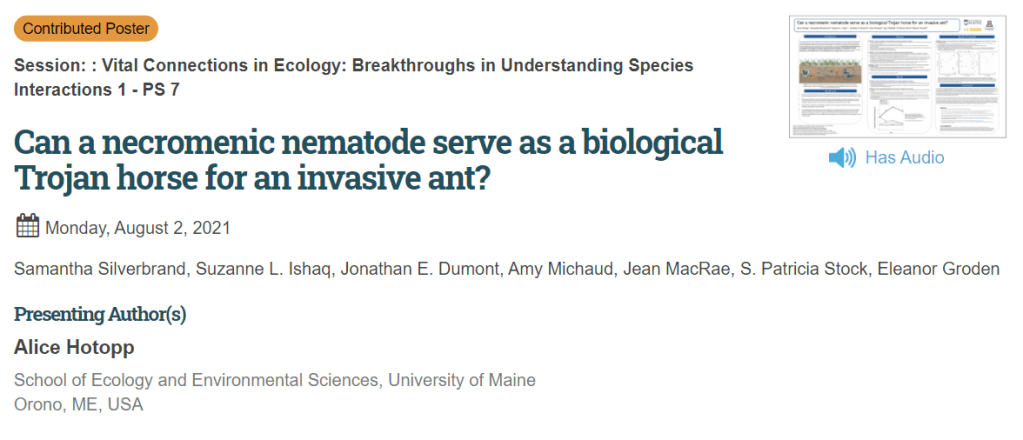
Can a necromenic nematode serve as a biological Trojan horse for an invasive ant?
Session 1-PS7: Vital Connections in Ecology: Breakthroughs in Understanding Species Interactions
Poster and narration available on demand.
Live discussion: Monday, August 2, 2021, 9:30 AM – 10:30 AM Pacific Time
Abstract:
Background/Question/Methods The invasive European fire ant (Myrmica rubra) threatens native ant species and human health along the coast of Maine, United States. M. rubra mortality has been associated with infection by Pristionchus entomophagus, a necromenic nematode that is hypothesized to transfer pathogenic bacteria acquired from the environment to ant colonies. To investigate this hypothesis, we conducted a series of experiments on nematode-infected ants collected from Mount Desert Island. First, we isolated bacteria cultured from nematodes emerging from M. rubra cadavers and assessed the ability of the nematodes to acquire and transfer environmental bacteria to Galleria mellonella waxworm larvae. Second, we identified bacteria which were potentially transferred from nematodes to infected ant nests on MDI using bacterial community similarity and sequence tracking methods.
Results/Conclusions Multiple bacterial species, including Paenibacillus spp., were found in the nematodes’ digestive tract. Serratia marcescens, Serratia nematodiphila, and Pseudomonas fluorescens were collected from the hemolymph of nematode-infected G. mellonella larvae. Variability was observed in insect virulence in relation to the site origin of the nematodes. In vitro assays confirmed uptake of red fluorescence protein (RFP)-labeled Pseudomonas aeruginosa strain PA14 by nematodes. Bacteria were highly concentrated in the digestive tract of adult nematodes, some bacteria were observed in the digestive tract of juveniles with a more significant amount on their cuticle, and none on the cuticle of adults. RFP-labeled P. aeruginosa were not observed in hemolymph of G. mellonella larvae, indicating an apparent lack of bacterial transfer from juvenile nematodes to the insects despite larval mortality.
Host species was the primary factor affecting bacterial community profiles. Spiroplasma sp. and Serratia marcescens sequences were shared across ants, nematodes, and nematode-exposed G. mellonella larvae. Alternative to the idea of transferring bacteria from environment to host, we considered whether nematode-exposure might disorder or depauperate the endobiotic community of an insect host. While total bacterial diversity was not statistically lower in nematode-exposed G. mellonella larvae when compared to controls, 16 bacterial sequence variants were less abundant in nematode-exposed larvae, while three were increased, including Serratia, Pseudomonas, and Proteus. This study suggests that transfer of bacteria from nematodes to ants is feasible, although largely serendipitous, and may contribute to ant mortality in Maine. Hypothetically, the use of an engineered biological control, such as nematodes carrying specifically-seeded bacterial species, may be effective, especially if the pathogenic bacteria are naturally found in soil ecosystems and represent a low risk for biosafety control.
Poster Citation: Hotopp*, A., Silverbrand, S., Ishaq, S.L., Dumont, J., Michaud, A., MacRae, J., Stock, S.P., Groden, E. “Can a necromenic nematode serve as a biological Trojan horse for an invasive ant?” Ecological Society of America 2021. (virtual). Aug 2-6, 2021. (poster)
Ishaq, S.L., A. Hotopp2, S. Silverbrand2, J.E. Dumont, A. Michaud, J. MacRae, S. P. Stock, E. Groden. 2021. Assessment of pathogenic bacteria transfer from Pristionchus entomophagus (Nematoda: Diplogasteridae) to the invasive fire ant (Myrmica rubra) and its potential role in colony mortality in coastal Maine. iScience 24(6):102663. Article.
Talk #93066, “The effect of simulated warming ocean temperatures on the bacterial communities on the shells of healthy and epizootic shell diseased American Lobster (Homarus americanus)”
COS 87: Climate Change: Communities 1 Recorded talk available on demand.
The American lobster, Homarus americanus, is a vital species for the fishing industry along the North Atlantic coast of North America. However, populations in Southern New England have declined, most likely due to increasing ocean temperatures and prevalence of emerging disease. Our previous work suggested that temperature may not be the sole cause for epizootic shell disease (ESD). Here, we examined the shell bacterial communities and progression of ESD in non-shell diseased and diseased adult female lobsters under three simulated seasonal temperature cycles for a year.
Fifty-seven female lobsters were wild-caught from Maine’s management zones F and G, and were assessed for shell disease progression on a scale of 0 (no observable signs) to 3 (visible disease on >50% of the shell surface). ESD-negative lobsters (apparently healthy) and ESD-positive (diseased) lobsters were randomly dispersed into 3 systems, and within each system, healthy and diseased lobsters were placed into separate tanks. These systems were maintained at three temperature ranges comparable to the average seasonal ocean temperatures for Southern New England (SNE), Southern Maine (SME), and Northern Maine (NME) regions. Samples were collected at three timepoints, a baseline “summer” temperature where all tanks were the same temperature, a winter temperature four months later, and a summer temperature 10 months after that.
A total of 131 experimental samples, plus 10 controls, passed PCR amplification, amplicon quantification and purification, Illumina MiSeq ver. 4 sequencing, and quality-control filtering. Sequences were processed using the R software platform, using DADA2, phyloseq, vegan, and assorted other packages.
Results and conclusions
The bacterial richness on lobster shells at the baseline timepoint, when lobsters were wild-caught, was higher than the winter time point, 4 months later, or the summer time point, 10 months later, for the same lobsters after having been kept in tanks, regardless of their temperature or shell disease status. Similarly, the bacterial community membership (unweighted Jaccard similarity) was similar for all samples at baseline, but diverged for later time points.
Tank temperature significantly affected microbial community membership (unweighted Jaccard similarity), as well as the abundance of those community members (weighted Bray-Curtis dissimilarity).
Contrary to our expectations, ESD shell disease index did not progress over time or in warmer conditions, and we hypothesized that frequent tank water changes and shell moltings may have reduced the microbial load. Preliminary results indicate that shell stage and shell disease index were positively associated with increased bacterial richness on lobster shells.
Citation: Ishaq*, S.L., Lee, G., MacRae, J., Hamlin, H., Bouchard, D. “The effect of simulated warming ocean temperatures on the bacterial communities on the shells of healthy and epizootic shell diseased American Lobster (Homarus americanus).” Ecological Society of America 2021. (virtual). Aug 2-6, 2021. (accepted talk)
For some reason the ESA meeting site kept my Montana affiliation from 2017 for all 3 of my submissions.
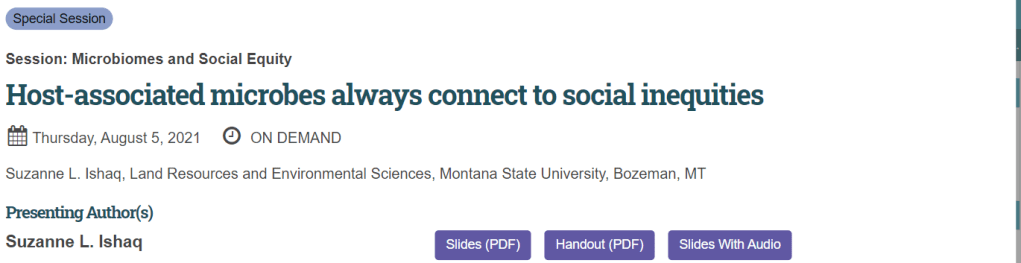
SS 17: “Microbiomes and Social Equity” (19205)
Prerecorded content available on demand.
Live discussion: Thursday, August 5th, 2021, 9:30 AM – 10:30 AM Pacific Time
Microbiomes — environmental, human and other organismal symbionts — are increasingly seen as critical physiological, developmental and ecological mediators within and among living things, and between the latter and our abiotic environments. Therefore, it is no surprise that microbial communities may be altered, depleted or disrupted by social and economic determinants. Social inequality entails concrete alterations and differentiation of microbial communities among social groups, by way of such factors as nutritional access, environmental pollutants or green space availability, often to the detriment of human and ecosystem health. This special session will be organized as a panel discussion with break-out groups in order to provide participants the opportunity to discuss the ways in which social inequity interacts with microbiomes, and how we might intervene as scientists and communities to promote favorable microbiomes while advancing social equality. We hope to generate research questions and actionable items.
Panel speakers: Michael Friedman, Naupaka Zimmerman, Justin Stewart, Monica Trujillo, Sue Ishaq, Sierra Jech, Jennifer Bhatnagar, and Ariangela Kozik ESA meeting program: https://www.esa.org/longbeach/
Citation: The Microbes and Social Equity Working group, “Special Session 17: “Microbiomes and Social Equity” (19205).”, Ecological Society of America 2021. (virtual). Aug 5, 2021.
Recent Publication:
Ishaq, S.L., Parada Flores, F.J., Wolf, P.G., Bonilla, C.Y., Carney, M.A., Benezra, A., Wissel, E., Friedman, M., DeAngelis, K.M., Robinson, J.M., Fahimipour, A.K., Manus, M.B., Grieneisen, L., Dietz, L.G., Chauhan, A., Pathak, A., Kuthyar, S., Stewart, J.D., Dasari, M.R., Nonnamaker, E., Choudoir, M., Horve, P.F., Zimmerman, N.B., Kozik, A.J., Darling, K.W., Romero-Olivares, A.L., Hariharan, J., Farmer, N., Maki, K., Collier, J.L., O’Doherty, K., Letourneau, J., Kline, J., Moses, P.L., Morar, N. 2021. Introducing the Microbes and Social Equity Working Group: Considering the Microbial Components of Social, Environmental, and Health Justice. mSystems 6:4.
The Microbes and Social Equity Working Group is delighted to make its published debut, with this collaboratively-written perspective piece introducing ourselves and our goals. You can read about us here.
This piece also debuts the special series we are curating in partnership with the scientific journal mSystems; “Special Series: Social Equity as a Means of Resolving Disparities in Microbial Exposure“. Over the next few months to a year, we will be adding additional peer-reviewed, cutting edge research, review, concept, and perspective pieces from researchers around the globe on a myriad of topics which center around social inequity and microbial exposures.
Ishaq, S.L., Parada, F.J., Wolf, P.G., Bonilla, C.Y., Carney, M.A., Benezra, A., Wissel, E., Friedman, M., DeAngelis, K.M., Robinson, J.M., Fahimipour, A.K., Manus, M.B., Grieneisen, L., Dietz, L.G., Pathak, A., Chauhan, A., Kuthyar, S., Stewart, J.D., Dasari, M.R., Nonnamaker, E., Choudoir, M., Horve, P.F., Zimmerman, N.B., Kozik, A.J., Darling, K.W., Romero-Olivares, A.L., Hariharan, J., Farmer, N., Maki, K.A., Collier, J.L., O’Doherty, K., Letourneau, J., Kline, J., Moses, P.L., Morar, N. 2021. Introducing the Microbes and Social Equity Working Group: Considering the Microbial Components of Social, Environmental, and Health Justice. mSystems 6:4.
A few weeks ago, I sat down with Sheba A-J, one of the producers of the WeTalkScience podcast, to talk about one of my recent publications in the research journal iScience, at which Sheba is also an editor. Listen to find out how lobsters are like humans, how I got involved on a project working with ants and nematodes, and how you can help make science a more welcoming place.
Ishaq, S.L., A. Hotopp, S. Silverbrand, J.E. Dumont, A. Michaud, J. MacRae, S. P. Stock, E. Groden. 2021. Bacterial transfer from Pristionchus entomophagus nematodes to the invasive ant Myrmica rubra and the potential for colony mortality in coastal Maine. iScience 24(6):102663. Article.
Now that she has defended, Tindall will focus on revising the research thesis chapter which was not already published into a manuscript to submit for review at a scientific journal. After that, she is planning on pursuing her career in agricultural sustainability research and outreach.
RESPONSE OF SOIL BACTERIAL COMMUNITIES TO CROPPING SYSTEMS, TEMPORAL CHANGES, AND ENVIRONMENTAL CONDITIONS IN THE NORTHERN GREAT PLAINS
by
Laura Tindall Ouverson
Master of Science
Land Resources and Environmental Sciences
MONTANA STATE UNIVERSITY
Bozeman, Montana
July 12 2021
ABSTRACT
Soil bacterial communities are essential components of the soil ecosystem that support crop production and indicate a soil’s health. However, agriculture in semiarid drylands and their associated soil bacterial communities face increasingly warmer and drier conditions due to climate change. Two complementary studies were conducted to assess the response of soil bacterial communities to cropping systems, temporal changes, and soil temperature and moisture conditions in semiarid, dryland agricultural systems of the Northern Great Plains.
The first study focused on soil bacterial community response to crop phase (i.e., crop species) of a rotation in contrasting cropping systems (chemical inputs and no-till, USDA-certified organic tilled, and USDA-certified organic sheep grazed) over a growing season. Organic grazed management supported more diverse bacterial communities than chemical no-till, though diversity in all systems decreased over the growing season. Organic grazed bacterial communities were distinct from those in the organic tilled and chemical no-till systems. An interaction between cropping system and crop phase affected community dissimilarity, indicating that overarching management systems and environmental conditions are influential on soil bacterial communities.
The second study evaluated soil bacterial communities in a winter wheat-cover crop or fallow rotation. Observations were conducted in the summer fallow and two cover crop mixtures differing by species composition and phenologies, terminated by three different methods (chemical, grazing, or haying), and subjected to either induced warmer/drier or ambient soil conditions. Only the presence and composition of cover crops affected bacterial community dissimilarity. Bacterial communities responded to an interaction between the presence and composition of cover crops and environmental conditions, but not termination. Additionally, soil bacterial communities from mid-season cover crops were distinct from early season and fallow. No treatments affected bacterial communities in 2019, which could be attributed to historic rainfall. Cover crop mixtures including species tolerant to warmer and drier conditions can foster diverse soil bacterial communities compared to fallow soils.
Overall, these studies increased our understanding of how soil bacterial communities respond to soil health building practices in the Northern Great Plains. Cropping systems can foster unique soil bacterial communities, but these effects may be moderated by environmental and temporal conditions.









 The Ishaq Lab