The symposium will convene researchers from different disciplines, foci, and geographic locations, and fosters in-depth conversations and research skills development. It is an ideal venue for training graduate students and incubating their burgeoning ideas. Thus, students in the class will attend the symposium, engage in conversations before and after attending sessions to reflect on how our perspectives changed, and create written assignments that will receive peer and instructor feedback. If the course is successful, I hope to add additional instructors and enrollment, we will expand the course and host it again each year we host the symposium.
The last paper to be generated from the large-scale, multi-year, collaborative research I participated in as a postdoc at Montana State University in the Menalled Lab in 2016 has finally been accepted for publication! At the time, I was working on the soil bacteria associated with winter wheat crops under different simulated climate change scenarios, and with added stressors like weed competition and different farming strategies. I was part of a large team of researchers looking at various aspects of agricultural stressors on long-term food production, including several agroecologists who led the development of this paper.
Understanding the impact of biological and environmental stressors on cropping systems is essential to secure the long-term sustainability of agricultural production in the face of unprecedented climatic conditions. This study evaluated the effect of increased soil temperature and reduced moisture across three contrasting cropping systems: a no-till chemically managed system, a tilled organic system, and an organic system that used grazing to reduce tillage intensity. Results showed that while cropping system characteristics represent a major driver in structuring weed communities, the short-term impact of changes in temperature and moisture conditions appear to be more subtle. Weed community responses to temperature and moisture manipulations differed across variables: while biomass, species richness, and Simpson’s diversity estimates were not affected by temperature and moisture conditions, we observed a minor but significant shift in weed community composition. Higher weed biomass was recorded in the grazed/reduced-till organic system compared with the tilled-organic and no-till chemically managed systems. Weed communities in the two organic systems were more diverse than in the no-till conventional system, but an increased abundance in perennial species such as Cirsium arvense and Taraxacum officinale in the grazed/reduced-till organic system could hinder the adoption of integrated crop-livestock production tactics. Species composition of the no-till conventional weed communities showed low species richness and diversity, and was encompassed in the grazed/reduced-till organic communities. The weed communities of the no-till conventional and grazed/reduced-till organic systems were distinct from the tilled organic community, underscoring the effect that tillage has on the assembly of weed communities. Results highlight the importance of understanding the ecological mechanisms structuring weed communities, and integrating multiple tactics to reduce off-farm inputs while managing weeds.
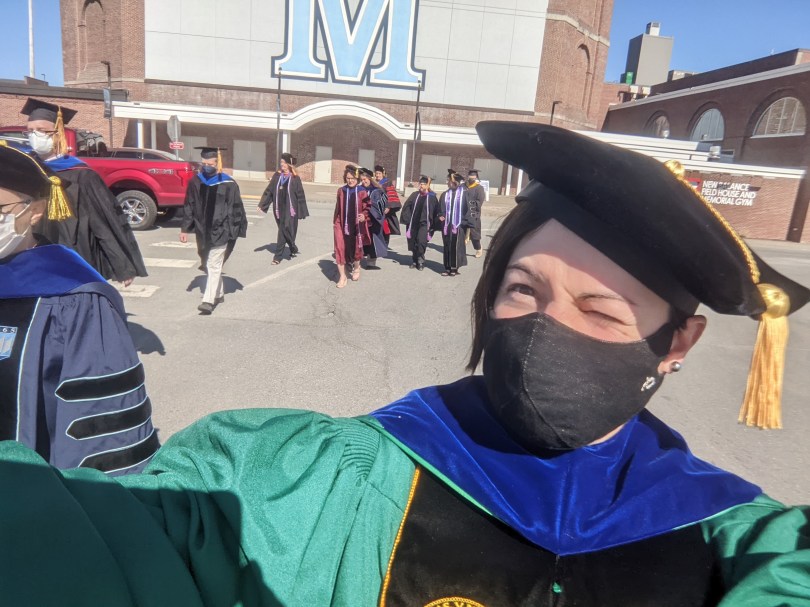
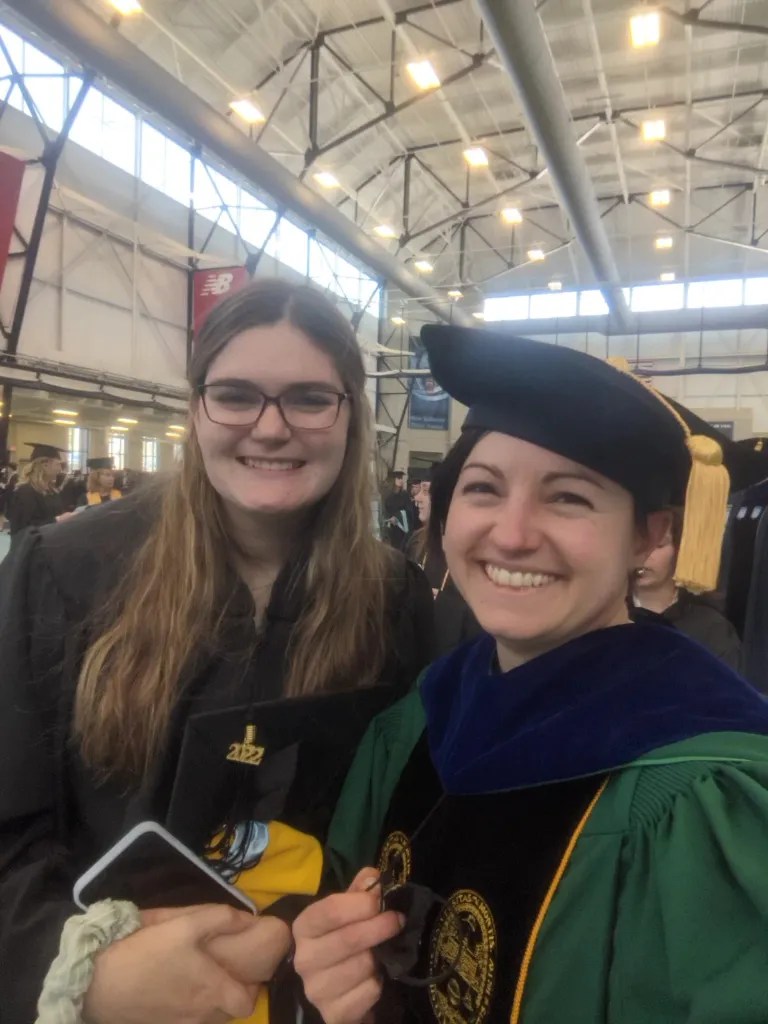
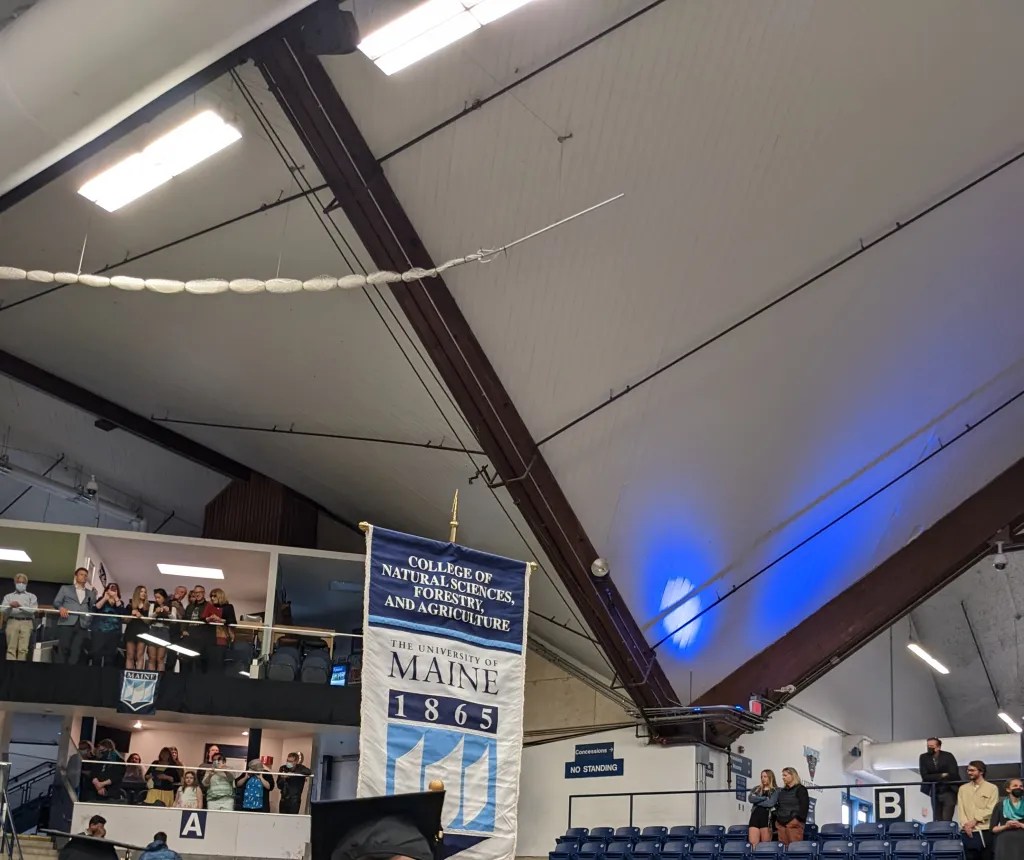
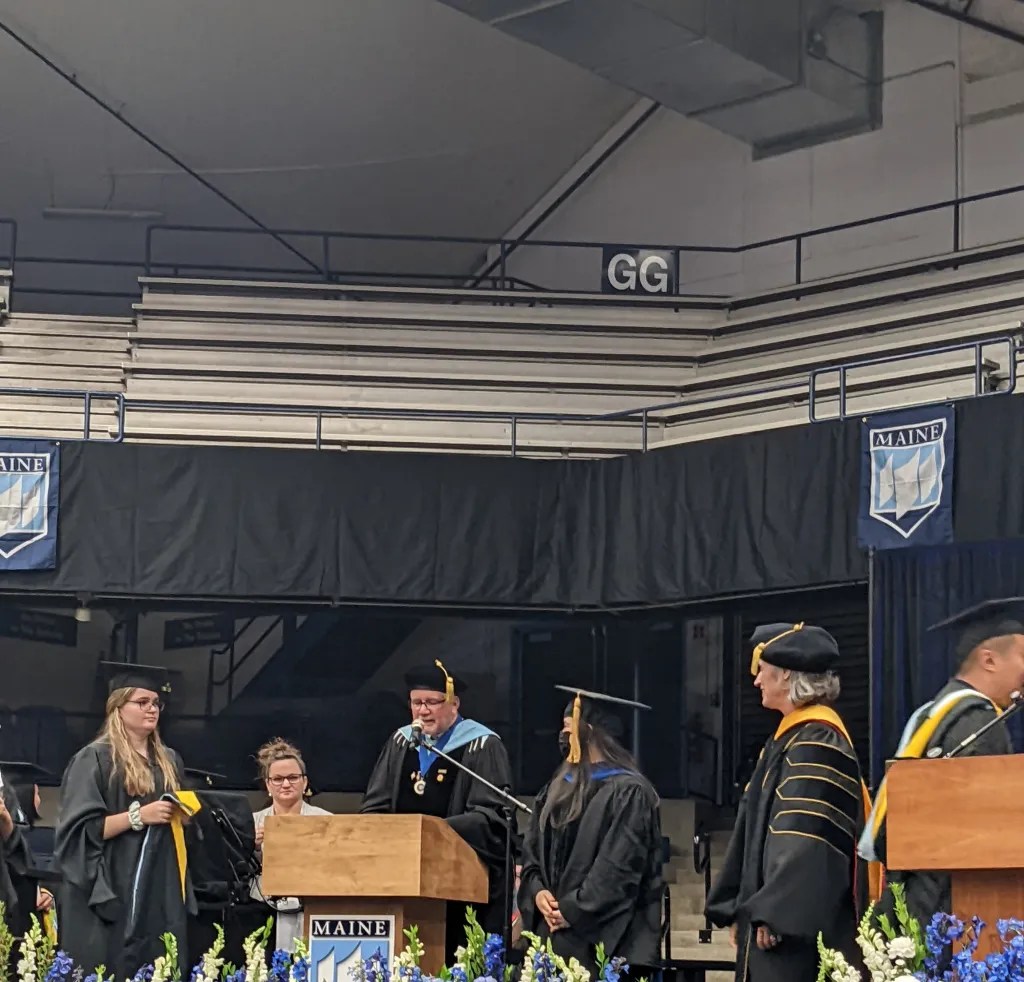
UMaine and many other universities are having in-person graduation ceremonies, and welcoming students who are graduating this year, as well as those who finished in 2021 and 2020 who were not able to walk in a regular ceremony. I made it to the ceremony for the graduates, so I could cheer on Sarah, where over 400 of the more 600 total graduate students matriculating got hooded and recognized for their achievement.
This year, many Ishaq Lab members walked across the stage and off into the next step in their life.
Sarah Hosler, Animal and Veterinary Science Master’s of Science student, who will be defending her thesis this summer and is considering her next career step.
Johanna Holman, Food Science and Nutrition Master’s of Science student, who will be defending her thesis this summer and returning this fall for a PhD!
Rebecca French, AVS undergrad who did her Capstone project as part of the squirrel pilot project I ran this past year. Rebecca won a research grant for this work. She is heading to vet school in Long Island!
Morgan Rocks, AVS undergrad who did her Capstone project as part of the squirrel pilot project I ran this past year. She is heading to vet school in the midwest!
Natalie Sullivan, AVS undergrad who did her Capstone project as part of the Cryptosporidium pilot project we are running. She is planning to work for a year before pursuing vet school.
Jade Chin, AVS undergrad who defended her Honor’s Thesis in 2021 and was awarded High Honors for it, has been in Glasgow, Scotland, for her senior year/first year of veterinary school there.
Myra Arshad, an REU student who is graduating from Stoney Brook University. She’s taking a year to work in research before pursuing a graduate degree.
In addition, we had a handful of other undergraduate students who performed their independent research for their Capstone projects in the Ishaq Lab graduate this year.
Some of the 2021/2022 Ishaq Lab members. From the left: Sophia, Isabelle, Rebecca, Morgan, Natalie, and Sue.Some of the 2021/2022 Ishaq Lab members. From the left: Maria, Sue, Sarah, and Ayodeji.
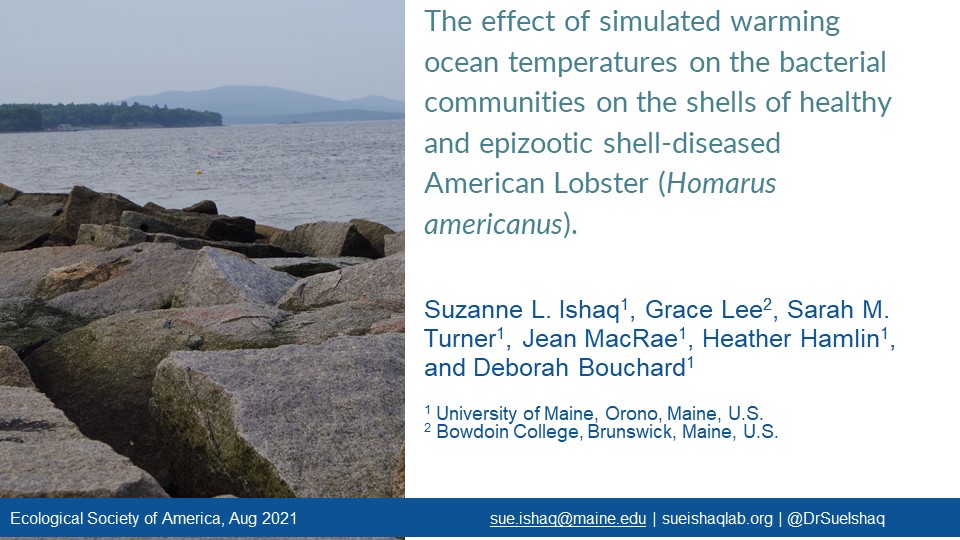
A collaborative perspective article was just published in Frontiers in Microbiology, which discusses epizootic shell disease in American lobsters, the role of microbes, and the movement of microbes in an aquatic environment. Because this is a perspective article, it is more of a thought exercise than my other publications, which either report findings or review other published literature, but it was intriguing to think about animal health in the context of rapidly-changing environmental conditions and microbial communities.
I previously presented some of the microbial community data related to the larger project from which this perspective piece came about, and this research team will continue to work on analyzing data from several experiments to develop into a research article later this year.
Epizootic shell disease is becoming more prevalent on lobsters in the Gulf of Maine as waters get warmer each year.
At the time, Grace Lee was a rising senior at Bowdoin College, and accepted to my lab for the UMaine REU summer 2020 session, which was canceled. Instead, I hired Grace to perform DNA sequence analysis remotely, by independently learning data analysis following the teaching materials I had generated for my sequencing class. I invited Joelle Kilchenmann to this piece after a series of conversations about microbes and social equity, because her graduate work in Joshua Stoll’s lab focuses on lobster fishing communities in Maine and understanding the challenges they face.
Abstract: Despite decades of research on lobster species’ biology, ecology, and microbiology, there are still unresolved questions about the microbial communities which associate in or on lobsters under healthy or diseased states, microbial acquisition, as well as microbial transmission between lobsters and between lobsters and their environment. There is an untapped opportunity for metagenomics, metatranscriptomics, and metabolomics to be added to the existing wealth of knowledge to more precisely track disease transmission, etiology, and host-microbe dynamics. Moreover, we need to gain this knowledge of wild lobster microbiomes before climate change alters environmental and host-microbial communities more than it likely already has, throwing a socioeconomically critical industry into disarray. As with so many animal species, the effects of climate change often manifests as changes in movement, and in this perspective piece, we consider the movement of the American lobster (Homarus americanus), Atlantic ocean currents, and the microorganisms associated with either.
The second MSE speak series wrapped up this week, and we had another very successful season! We heard about some incredible research, shared perspectives from other disciplines, and engaged in discussions on soil and food systems, human health, sanitation and water quality, ecological modeling to understand microbiomes better, and using the incredible diversity of the microbial world to better understand the diversity of human life. This year’s series featured 14 talks from researchers, including one that was a group presentation from an author team, and gathered 411 total attendees and 901 total registrations!
If you missed some or all of the talks, you are in luck! Most of the sessions were recorded and are available online through UMaine.
If you are eager to continue the conversation, MSE is putting together a summer symposium which will bring us together for a week in July to work on developing research skills. Stayed tuned for more details in the next few weeks!
Today is final installment in the spring 2022 Microbes and Social Equity speaker series! Each week, we have been hearing from a researcher who shared their work and perspective on how microbes are involved in all aspects of our lives, and how those microbes can affect individuals, communities, and ecosystems.
This series ran from Jan 19 – May 4, Wednesdays at 12:00 – 13:00 EST. These are presented over Zoom, and open to researchers, practitioners, students, and the public. Registration is free, and required for each individual seminar you would like to attend. You can find the full speaker list, details, and recordings from previous talks here.
“It’s about time: ecological and eco-evolutionary dynamics across the scales”
About the speaker: Dr. Liat Shenhav is an independent research fellow at the Center for Studies in Physics and Biology at the Rockefeller University. Prior to that, Liat received a B.Sc. and. M.Sc. in Mathematics and Statistics from Tel-Aviv University, and a Ph.D. in Computer Science from University of California, Los Angeles. Liat’s research focuses on developing computational methods for studying spatiotemporal dynamics of complex ecosystems and their contribution to human health and disease.
About the talk: Complex microbial communities play an important role across many domains of life, from the female reproductive tract, through the oceans, to the plant rhizosphere. The study of these communities offers great opportunities for biological discovery, due to the ease of their measurement, the ability to perturb them, and their rapidly evolving nature. Yet, their complex composition, dynamic nature, and intricate interactions with multiple other systems, make it difficult to extract robust and reproducible patterns from these ecosystems. To uncover their latent properties, I develop models that combine longitudinal data analysis and statistical learning, and which draw from principles of community ecology, complexity theory and evolution.
I will briefly present methods for decomposition of microbial dynamics at an ecological scale (Shenhav et al., Nature Methods 2019; Martino & Shenhav et al., Nature Biotechnology). Using these methods we found significant differences in the trajectories of the infant microbiome in the first years of life as a function of early life exposures, namely mode of delivery and breastfeeding. I will then show how incorporating eco-evolutionary considerations allowed us to detect signals of purifying selection across ecosystems. I will demonstrate how interactions between evolution and ecology played a vital role in shaping microbial communities and the standard genetics code (Shenhav & Zeevi, Science 2020).
Inspired by these discoveries, I am currently expanding the scope beyond the microbiome, modeling multi-layered data on human milk composition. I will present results from an ongoing study in which I am building integrative models of nasal, gut and milk microbiota, combined with human milk components, to predict infant respiratory health. I found that the temporal dynamics of microbiota in the first year of life, mediated by milk composition, predict the development of chronic respiratory disease later in childhood. These models, designed to identify robust spatiotemporal patterns, would help us better understand the nature and impact of complex ecosystems like the microbiome and human milk from the time of formation and throughout life.
Today is the last installment in the spring 2022 Microbes and Social Equity speaker series! Each week, we’ll hear from a researcher who will share their work and perspective on how microbes are involved in all aspects of our lives, and how those microbes can affect individuals, communities, and ecosystems.
This series will run from Jan 19 – May 4, Wednesdays at 12:00 – 13:00 EST. These are presented over Zoom, and open to researchers, practitioners, students, and the public. Registration is free, and required for each individual seminar you would like to attend. You can find the full speaker list, details, and registration links for each seminar in the series here.
“What Connects Us: stories of working across difference with humans and microbes”
About the speaker: Dr. Maya Hey is a postdoctoral researcher with the Future Organisms project as part of an international trans-disciplinary team investigating Responsible Research and Innovation (RRI). She brings a humanities and social science perspective to the life sciences, calling upon feminist, intersectional, and multispecies approaches to map out human response-ability in a more-than-human world. She is vested in questions related to fermentation, particularly as they relate to discourses of health, the rhetoric of microbiomes, and how we come to know microbial life.”
Talk summary: What connects us across different scales of life? This talk examines three case studies—on fermentation, conversation, and innovation—to better understand how micro-organisms affect macro-cultures and vice-versa, with emphasis on working with difference instead of resolving them.
The Dairy Forage Crops Educator with the University of Maine Cooperative Extension will develop and conduct educational outreach and applied research (on farm or Experiment Station) with an emphasis on dairy forage production and quality, including regenerative pasture management. The dairy industry in New England will be the audience of focus. The individual will collaborate with the University of Vermont and their research team to conduct research and Extension education for dairy farmers in New England looking to increase forage production and utilization while facing a changing climate. Along with production, the faculty member will also address aspects of forage harvest, storage and feeding management.
Search Timeline is as follows: Review of applications to begin: April 30, 2022 Screening interviews to begin no earlier than: May 2, 2022 Final interviews to begin no earlier than: May 9, 2022 Tentative start date: June 6, 2022
Johanna Holman received the 2022 Norris Charles Clements Graduate Student Award from the University of Maine College of Natural Sciences, Forestry, and Agriculture (NSFA), for her research and academics over the last two years for her Master’s of Science in Nutrition!! This award highlights the achievements and potential for positive impact of graduate students in agriculture, is more often awarded to doctoral students who have had more years of graduate work in which to accomplish their research, give presentations, mentor undergraduates, and otherwise develop their professional skills.
Despite the setbacks and challenges of the pandemic, Johanna has been extremely productive and has done an extraordinary amount in just a year and a half (from start to the time of application submission) for her masters work. Johanna is currently writing up the results of her masters work into three manuscripts that we plan to submit to scientific journals for peer review this summer. She will defend her thesis at the end of the summer, just in time to start in September as a PhD student working with Dr. Yanyan Li and I!
Artwork by Johanna Holman
From the NSFA award page: “The Norris Charles Clements Graduate Student Award was established in the University of Maine Foundation in May 1997 for the benefit of the University of Maine, Orono, with a bequest from Laurel Clements ’48 in honor of her father, Norris Charles Clements, a distinguished Maine poultry farmer who in 1953 was honored by the University of Maine as Maine’s Outstanding Farmer. Income shall be used to provide financial assistance for rewarding outstanding graduate students in agricultural sciences and to recognize the accomplishments of graduate students whose studies have the potential to make a significant contribution to Maine agriculture. Candidates should have training and be doing research in disciplines related to Maine agriculture, such as agronomy, soil science, animal and veterinary sciences, agricultural economics, entomology, plant pathology, agricultural engineering and other disciplines the dean deems contribute significantly to the well being of Maine agriculture. Students will be chosen for awards on the basis of their high academic standing, the quality of their research and their personal integrity.”
Today there is another installment in the spring 2022 Microbes and Social Equity speaker series! Each week, we’ll hear from a researcher who will share their work and perspective on how microbes are involved in all aspects of our lives, and how those microbes can affect individuals, communities, and ecosystems.
This series will run from Jan 19 – May 4, Wednesdays at 12:00 – 13:00 EST. These are presented over Zoom, and open to researchers, practitioners, students, and the public. Registration is free, and required for each individual seminar you would like to attend. You can find the full speaker list, details, and registration links for each seminar in the series here.
“Microbiomes and climate change at the intersection of human and ecosystem health in the North”
Dr. Catherine Girard is an Associate Professor at the Université du Québec à Chicoutimi, where she works on the response of microbiomes to climate change in the Arctic. In the past, she has worked on the human microbiome and how it is shaped by tradition, culture and global warming. She now explores how ice-dwelling microbes are responding to change, from a conservation and ecosystem service perspective. She is involved in collaborative research with partners from the Inuit Nunangat, and views microbiomes as part of our heritage.













 The Ishaq Lab