Hosting Organizations: MSE and the University of Maine Institute of Medicine.
Panel discussion on Gut microbiome, nutrition, and food security
February 8, 2023; Wednesday,11:00 AM – 12:00 PM EST. This event has passed, and was not recorded.
Today, we’ll be bringing all of our Theme 1 speakers back to engage in a panel discussion together on the gut microbiome. Panel will be hosted by Sue Ishaq.
Please note, this session will only be featured live in real-time and will not be recorded.
Dr. Yanyan Li, PhD, who presented on “Broccoli Sprout Bioactives and Gut Microbiota: A Dietary Approach for Prevention and Management of Inflammatory Bowel Disease”.
Dr. Dany Fanfan, Ph.D., MSN, RN, who presented on ” Exploring Health determinants, Gut Microbiome, and Health Outcomes in Immigrants”.
Dr. Sean Gibbons, PhD, who presented on “Personalized nutrition and the human gut microbiome”.
Hosting Organizations: MSE and the University of Maine Institute of Medicine.
Panel discussion on Gut microbiome, nutrition, and food security
February 8, 2023; Wednesday,11:00 AM – 12:00 PM EST. This event has passed, and was not recorded.
This week, we’ll be bringing all of our Theme 1 speakers back to engage in a panel discussion together on the gut microbiome. Panel will be hosted by Sue Ishaq.
Please note, this session will only be featured live in real-time and will not be recorded.
Dr. Yanyan Li, PhD, who presented on “Broccoli Sprout Bioactives and Gut Microbiota: A Dietary Approach for Prevention and Management of Inflammatory Bowel Disease”.
Dr. Dany Fanfan, Ph.D., MSN, RN, who presented on ” Exploring Health determinants, Gut Microbiome, and Health Outcomes in Immigrants”.
Dr. Sean Gibbons, PhD, who presented on “Personalized nutrition and the human gut microbiome”.
February 1, 2023; Wednesday,11:00 AM – 12:00 PM EST. This event has passed, watch the recording here.
Dr. Sean Gibbons is an Associate Professor at the Institute for Systems Biology, a non-profit research consortium. His lab develops computational and experimental tools for exploring and manipulating host-microbe systems.
Added by Sue: The work from Sean’s group and collaborators has been reshaping the way that host microbial researchers approach their work, by revealing trends through large metanalyses and novel perspectives on using data. Their most recent work has evaluated host-microbial interactions, metabolites, and health.
For the last three years, Sean’s lab has hosted the ISB Virtual Microbiome Series, which is freely available and attracts several thousand participants. The series includes a two day workshop that teaches data analysis skills, and a day-long symposium featuring discussions of current discoveries and conceptualizes the future of microbiome research.
Finally, Sean and his research group have been making science a more welcoming and inclusive place.
Up next week: Panel discussion on Gut microbiome, nutrition, and food security
This week, we’ll be bringing all of our Theme 1 speakers (Drs. Yanyan Li, Dany Fanfan, and Sean Gibbons) back to engage in a panel discussion together on the gut microbiome. Panel will be hosted by Sue Ishaq.
Please note, this session will only be featured live in real-time and will not be recorded.
February 1, 2023; Wednesday,11:00 AM – 12:00 PM EST. This event has passed, watch the recording here.
Dr. Sean Gibbons is an Associate Professor at the Institute for Systems Biology, a non-profit research consortium. His lab develops computational and experimental tools for exploring and manipulating host-microbe systems.
Added by Sue: The work from Sean’s group and collaborators has been reshaping the way that host microbial researchers approach their work, by revealing trends through large metanalyses and novel perspectives on using data. Their most recent work has evaluated host-microbial interactions, metabolites, and health.
For the last three years, Sean’s lab has hosted the ISB Virtual Microbiome Series, which is freely available and attracts several thousand participants. The series includes a two day workshop that teaches data analysis skills, and a day-long symposium featuring discussions of current discoveries and conceptualizes the future of microbiome research.
Finally, Sean and his research group have been making science a more welcoming and inclusive place.
Up next week: Panel discussion on Gut microbiome, nutrition, and food security
This week, we’ll be bringing all of our Theme 1 speakers (Drs. Yanyan Li, Dany Fanfan, and Sean Gibbons) back to engage in a panel discussion together on the gut microbiome. Panel will be hosted by Sue Ishaq.
Please note, this session will only be featured live in real-time and will not be recorded.
January 25, 2023; Wednesday,11:00 AM – 12:00 PM EST. This event has passed, watch the recording here.
Dr. Dany Fanfan is an Assistant Professor at the University of Florida (UF) College of Nursing. Before becoming a faculty, she completed a Bachelor’s degree in Nursing at Florida International University, Master’s and Doctoral degrees in Nursing at the University of South Florida, and a post-doctoral fellowship at UF focused on mental health research with and for underrepresented populations (e.g., Latino/Haitian immigrant farmworkers, rural Latino/LGBTQ+ adolescents) using a community-based participatory research approach and social network analysis. She teaches and engages in multidisciplinary mixed-methods research dedicated to advancing the science and practice of reducing mental health disparities among minoritized immigrants by exploring the underlying biobehavioral, cultural, and psychosocial mechanisms of distress symptoms. With support from an NIH K23 career development award, she is now incorporating microbial metagenomics and bioinformatics methods in her research by examining the associations between post-migration social determinants of health, gut microbiome, and psychological distress among recent Haitian immigrants. The long-term goal of her interdisciplinary translational program of research is to identify and address the conditions that create and sustain health disparities in minoritized populations as well as develop and test culturally responsive interventions that target social, behavioral, and biological determinants of health to improve long-term health outcomes, reduce behavioral and mental health disparities, and increase health equity.
Upcoming Seminars of the ‘Gut microbiome, nutrition, and food security’ theme
“Personalized nutrition and the human gut microbiome”
This week, we’ll be bringing all of our Theme 1 speakers back to engage in a panel discussion together on the gut microbiome. Panel will be hosted by Sue Ishaq.
Please note, this session will only be featured live in real-time and will not be recorded.
January 25, 2023; Wednesday,11:00 AM – 12:00 PM EST. This event has passed, watch the recording here.
Dr. Dany Fanfan is an Assistant Professor at the University of Florida (UF) College of Nursing. Before becoming a faculty, she completed a Bachelor’s degree in Nursing at Florida International University, Master’s and Doctoral degrees in Nursing at the University of South Florida, and a post-doctoral fellowship at UF focused on mental health research with and for underrepresented populations (e.g., Latino/Haitian immigrant farmworkers, rural Latino/LGBTQ+ adolescents) using a community-based participatory research approach and social network analysis. She teaches and engages in multidisciplinary mixed-methods research dedicated to advancing the science and practice of reducing mental health disparities among minoritized immigrants by exploring the underlying biobehavioral, cultural, and psychosocial mechanisms of distress symptoms. With support from an NIH K23 career development award, she is now incorporating microbial metagenomics and bioinformatics methods in her research by examining the associations between post-migration social determinants of health, gut microbiome, and psychological distress among recent Haitian immigrants. The long-term goal of her interdisciplinary translational program of research is to identify and address the conditions that create and sustain health disparities in minoritized populations as well as develop and test culturally responsive interventions that target social, behavioral, and biological determinants of health to improve long-term health outcomes, reduce behavioral and mental health disparities, and increase health equity.
Upcoming Seminars of the ‘Gut microbiome, nutrition, and food security’ theme
“Personalized nutrition and the human gut microbiome”
This week, we’ll be bringing all of our Theme 1 speakers back to engage in a panel discussion together on the gut microbiome. Panel will be hosted by Sue Ishaq.
Please note, this session will only be featured live in real-time and will not be recorded.
January 18, 2023; Wednesday,11:00 AM – 12:00 PM EST. This event has passed, view the recording.
Dr. Li is an Assistant Professor at the University of Maine. She received her PhD degree in Nutrition and Food Science from Ohio State University. She has been dedicating herself to studying the mechanisms of diet-derived bioactives in protecting against disease process and harnessing the gained knowledge to develop dietary approaches for disease prevention and management for more than a decade. Since 2016, she has been focusing on the interactions between dietary components, in particular glucosinolates from cruciferous vegetables such as broccoli and broccoli sprouts, and gut microbiota, aiming to develop a combined approach for inflammatory bowel disease. Her current research projects are funded by NIH/NIDDK, USDA/NIFA AFRI Foundational Program, and nutrition research programs of private foundations.
Added by Sue: For the past few years, Yanyan and her colleagues have also included the Ishaq Lab, and has led to a rewarding and productive collaboration which has resulted in several recent and forthcoming publications, funding awards, and students trained.
Upcoming Seminars of the ‘Gut microbiome, nutrition, and food security’ theme
“Exploring Health Determinants, Gut Microbiome, and Health Outcomes in Immigrants”
This week, we’ll be bringing all of our Theme 1 speakers back to engage in a panel discussion together on the gut microbiome. Panel will be hosted by Sue Ishaq.
Please note, this session will only be featured live in real-time and will not be recorded.
January 18, 2023; Wednesday,11:00 AM – 12:00 PM EST. This event has passed, view the recording.
Dr. Li is an Assistant Professor at the University of Maine. She received her PhD degree in Nutrition and Food Science from Ohio State University. She has been dedicating herself to studying the mechanisms of diet-derived bioactives in protecting against disease process and harnessing the gained knowledge to develop dietary approaches for disease prevention and management for more than a decade. Since 2016, she has been focusing on the interactions between dietary components, in particular glucosinolates from cruciferous vegetables such as broccoli and broccoli sprouts, and gut microbiota, aiming to develop a combined approach for inflammatory bowel disease. Her current research projects are funded by NIH/NIDDK, USDA/NIFA AFRI Foundational Program, and nutrition research programs of private foundations.
Added by Sue: For the past few years, Yanyan and her colleagues have also included the Ishaq Lab, and has led to a rewarding and productive collaboration which has resulted in several recent and forthcoming publications, funding awards, and students trained.
Upcoming Seminars of the ‘Gut microbiome, nutrition, and food security’ theme
“Exploring Health Determinants, Gut Microbiome, and Health Outcomes in Immigrants”
This week, we’ll be bringing all of our Theme 1 speakers back to engage in a panel discussion together on the gut microbiome. Panel will be hosted by Sue Ishaq.
Please note, this session will only be featured live in real-time and will not be recorded.
The Microbes and Social Equity Speaker Series is back for its third year, starting in just two weeks! We are still finalizing the speaker lineup and the details, but registration is open!
In 2023, we’ll be mixing up the lineup by featuring speakers on a related theme for a few weeks in a row, then inviting them back for a panel discussion. Please note, the talks may be recorded but the panel discussions will not be.
Spring 2023; January 18 – May, Wednesdays from 11:00 AM – 12:00 PM EST.
Dr. Li is an Assistant Professor at the University of Maine. She received her PhD degree in Nutrition and Food Science from Ohio State University. She has been dedicating herself to studying the mechanisms of diet-derived bioactives in protecting against disease process and harnessing the gained knowledge to develop dietary approaches for disease prevention and management for more than a decade. Since 2016, she has been focusing on the interactions between dietary components, in particular glucosinolates from cruciferous vegetables such as broccoli and broccoli sprouts, and gut microbiota, aiming to develop a combined approach for inflammatory bowel disease. Her current research projects are funded by NIH/NIDDK, USDA/NIFA AFRI Foundational Program, and nutrition research programs of private foundations.
Added by Sue: For the past few years, Yanyan and her colleagues have also included the Ishaq Lab, and has led to a rewarding and productive collaboration which has resulted in several recent and forthcoming publications, funding awards, and students trained.
Dr. Sean Gibbons is an Associate Professor at the Institute for Systems Biology, a non-profit research consortium. His lab develops computational and experimental tools for exploring and manipulating host-microbe systems.
Added by Sue: The work from Sean’s group and collaborators has been reshaping the way that host microbial researchers approach their work, by revealing trends through large metanalyses and novel perspectives on using data. Their most recent work has evaluated host-microbial interactions, metabolites, and health.
For the last three years, Sean’s lab has hosted the ISB Virtual Microbiome Series, which is freely available and attracts several thousand participants. The series includes a two day workshop that teaches data analysis skills, and a day-long symposium featuring discussions of current discoveries and conceptualizes the future of microbiome research.
Finally, Sean and his research group have been making science a more welcoming and inclusive place.
Panel discussion on Gut microbiome, nutrition, and food security
This week, we’ll be bringing all of our Theme 1 speakers back to engage in a panel discussion together on the gut microbiome. Panel will be hosted by Sue Ishaq.
Please note, this session will only be featured live in real-time and will not be recorded.
Prenatal to early-life microbes and health
Theme organized by Emily Wissel.
Speaker confirmed but time TBD:
Dr. Eldin Jašarević, Magee-Womens Research Institute, University of Pittsburgh School of Medicine
This week, we’ll be bringing all of our Theme 2 speakers back to engage in a panel discussion together on the microbiome in early life. Panel will be hosted by Emily Wissel.
Please note, this session will only be featured live in real-time and will not be recorded.
The environment, microbes, and us
Anthropology Theme organized by Katherine Daiy and Kieran O’Doherty, and Environmental Theme organized by Mallory Choudoir, Mustafa Saifuddin, and Hannah Holland-Moritz.
Speakers confirmed by time TBD:
Dr. Stephanie Schnorr, University of Vienna, “The human-valued interest in microbiome science is the distillation of human-environmental interactions”
Dr. Aminah Al-Attas Bradford, North Carolina State University, “Religion, Race and the Microbe: Theological Analysis of Public Health Resistance in the Pandemicine”
Dr. Anna Krzywoszynska is starting a position as an Associate Professor of Transdisciplinary Human-Environment Relations, Faculty of Humanities, University of Oulu, Finland.
This week, we’ll be bringing all of our Theme 3 speakers back to engage in a panel discussion together on the importance of environmental microbiomes and our place in ecosystems, and then will continue talking about soil health. Panel will be hosted byKatherine Daiy, Kieran O’Doherty, Mallory Choudoir, Mustafa Saifuddin, and Hannah Holland-Moritz.
Please note, this session will only be featured live in real-time and will not be recorded.
The Microbes and Social Equity working group turned 3 years old in December, and we currently have 170 members from around the globe, as well ~100 newsletter-only subscribers (you can join either list here)! MSE continues to grow and shape the future of research, education, and policy thanks to the enthusiasm and support of our members, and we are grateful to have you with us!
We grew so much that in 2022 we added Directors to the Leadership Team, to support our administration and communication needs. In particular, our Directors and other communications specialists helped MSE to improve the way we share information across platforms and within the organization. In 2023, we will continue to improve how members connect with each other, and how people can connect with MSE. Our mailing list is the primary way to reach our members, but we also have public pages on Facebook and Twitter, as well as group pages on LinkedIn and Slack.
Speaker series
Early in 2022, we hosted our second annual spring seminar series, which was organized by Sue Ishaq, Mustafa Saifuddin, Emily Wissel, Melissa Manus, Francisco Parada, and the University of Maine Institute of Medicine. The series had 411 attendees and 901 registrants total across the 14 talks, which is more than the 2021 series had. These and previous talks have been used for teaching materials at several colleges and universities. In case you missed it or want to relive the moments, you can find links to the talks here.
The talks also garnered more attention in the UMaine community this year. Patricia Kaishian’s April 13 talk was promoted as part of the University of Maine Impact Week, and journalist Samantha Sudol of the MaineCampus wrote summaries on talks by Jake Robinson and Patricia Wolf.
Summer symposium
Our symposium in 2022 was a little different than the first version, in that our 5 themed days focused on “Developing transformative research skills”, organized by Sue Ishaq, Ari Kozik, Ashley Toney, Emily Wissel, Kieran O’Doherty, Mallory Choudoir, Mustafa Saifuddin, Erin Eggleston, Carla Bonilla, Monica Trujillo, and Cecile Ferguson (UMaine Institute of Medicine). Our themes this year were “Context-aware experimental designs”, “Blending biological, social, and humanities writing”, “Transforming your research for policy engagement”, “Community engagement and collaboration”, and “MSE Education Practices and Curriculum design”.
This year’s symposium featured 20 speakers across 5 themed days with 3 plenary-style talks/day, followed by 90 min of small-group discussion led by speakers and MSE members. Participants were encouraged to “problem solve” a suggested topic or one of their own choosing to create action items that were meaningful to them, such as ideas for curricula development, identifying research needs or best practices, suggestions for engaging research in policy, and more. The symposium hosted 220 participants (460 registrations) overall and 121 across the breakout room discussions. Registrants were from 23 countries, students and researchers from various fields and career levels, Maine State legislators, and the public. The symposium led to 16 drafted resources documents written by participants.
Special collection of research articles at mSystems
The MSE special collection in the mSystems Journal has published nearly half of the anticipated contributions so far. The inaugural piece was written by a group of MSE members, and has since been joined by 10 other articles and an editorial.
Indigenous knowledge and the microbiome – bridging the disconnect between colonised places, peoples, and the ‘unseen’ influences which shape our health and well-being (Accepted)
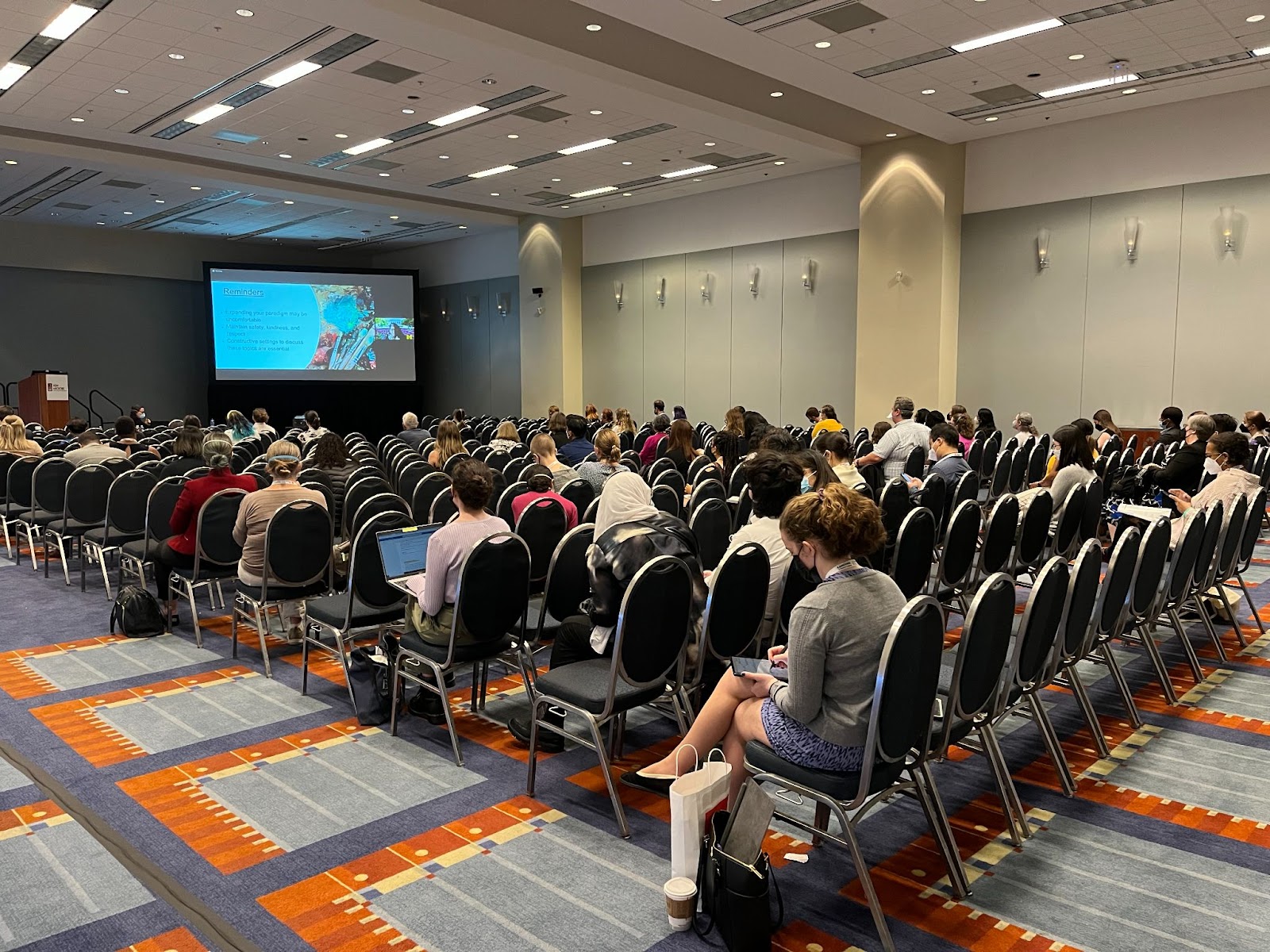
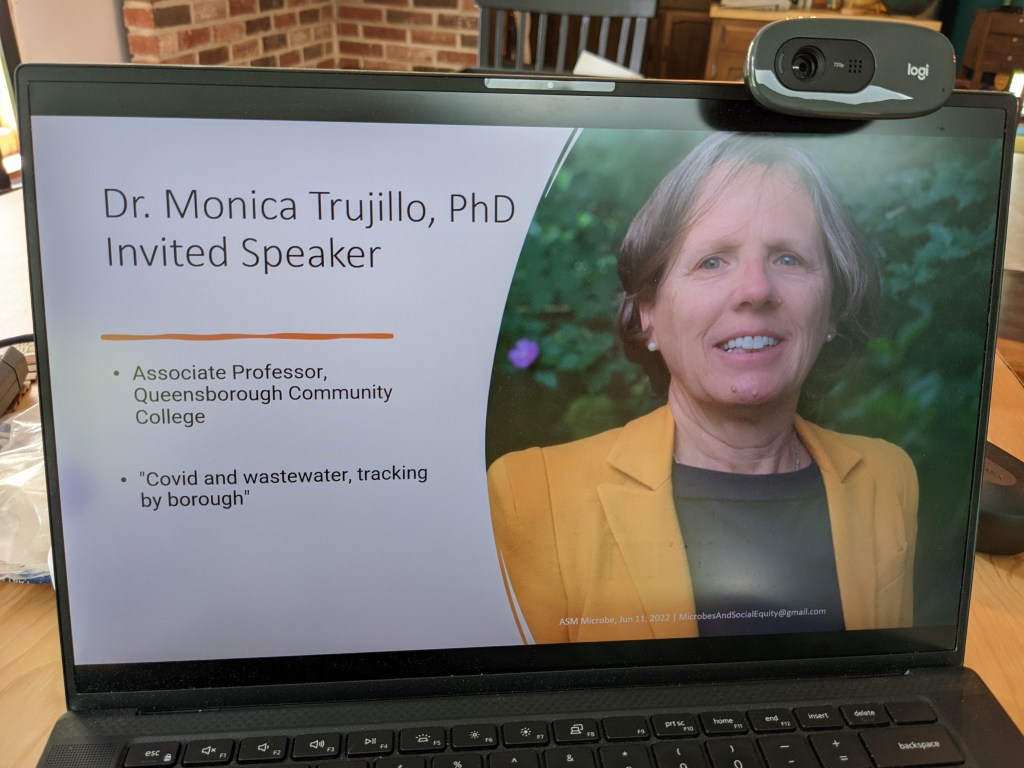
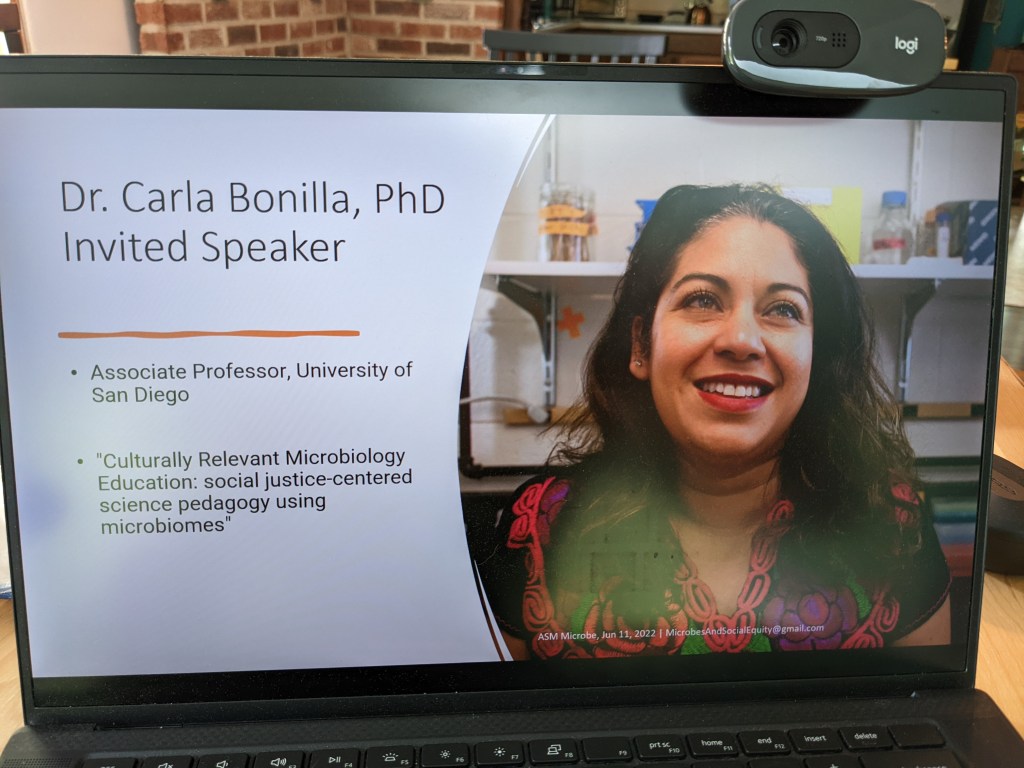
MSE held special sessions at two scientific conferences in 2022. At ASM Microbe, Monica Trujillo, Ariangela Kozik, Carla Bonilla, and Sue Ishaq hosted a panel discussion:Microbes and Social Equity: the Microbial Components of Social, Environmental, and Health Justice. The panelists covered many aspects important to MSE from using collaborative, real-life science in microbiology teaching labs, questioning social inequities and disparities in health outcomes, and practicing critical pedagogy in microbiology education using a social equity lens. The panel was highlighted in an article published by ASM and drew an engaged audience eager to learn and share their experiences and vision for microbiology research.
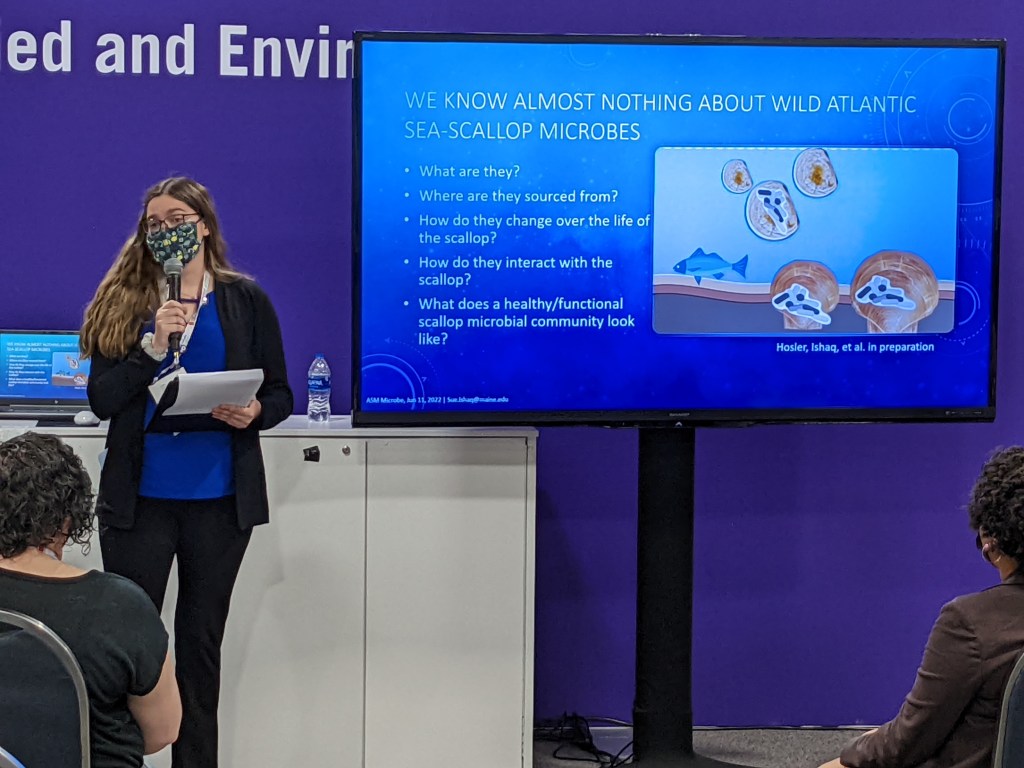
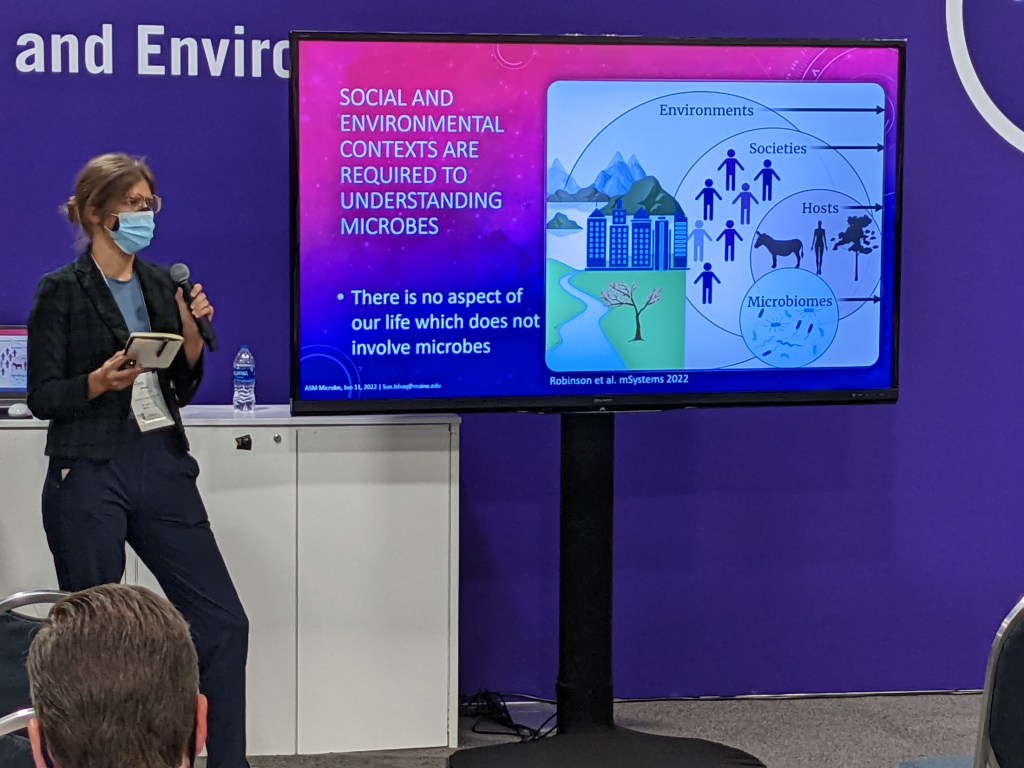
Additionally at ASM Microbe, Emily Wissel, Johanna Holman, and Sarah Hosler were kind enough to give Sue’s presentation on “Microbes and Social Equity: what is it and how do we do it?” for the Field Work and DEI track hub.
Sarah Hosler, Johanna Holman, and Emily Wissel presenting at ASM Microbe.
Sarah Hosler, ASM 2022.
Mallory Choudoir and Naupaka Zimmerman hosted the special session “Adding social contexts to environmental microbiomes” at the 2022 Ecological Society for America meeting in Montreal. A full room gathered to learn about the MSE working group. We drew a diverse crowd (over 40 participants), most were “microbial ecology” graduate students from public research universities, all aiming to learn new information about microbiology and social justice. We held a lively group discussion considering the human dimensions of our research projects and the perceived barriers to broadening our work to explicitly address social and environmental equity. It was fantastic to see so many smiling faces behind masks!
What are we doing in 2023?
In 2023, we will be hosting a speaker series starting in mid January, and this year we will be mixing it up by featuring speakers on a theme for a few weeks and then bringing them back for a panel discussion. We will be sharing the full line-up soon. Also new this year, one link to register them all!
MSE is planning our third annual summer symposium, which is still under development. This will be held virtually, and have a format similar to previous years where we combine plenary talks and discussions. We are hoping to add short talks/posters by students, post docs, and early career researchers this year!
As always, members are encouraged to give presentations or special sessions about MSE at scientific conferences this year, and we have previous session proposals or teaching materials which we can share to facilitate this. We also encourage members to get in touch with MSE with questions about resources, networking, or initiatives you would like to suggest.
MSE is continuing to add the rest of the contributions to the mSystems special collection in the first half of 2023, and as always we are enthusiastic about our members connecting and sparking collaborative projects!







 The Ishaq Lab