Hosting Organizations: MSE and the University of Maine Institute of Medicine.
The environment, microbes, and us
Anthropology Theme organized by Katherine Daiy and Kieran O’Doherty, and Environmental Theme organized by Mallory Choudoir, Mustafa Saifuddin, and Hannah Holland-Moritz.
March 22, 2023; Wednesday,11:00 AM – 12:00 PM EST. This event has passed, watch the recording here.
David Good is a PhD student in microbiology at the University of Guelph, Ontario. His general research goal is characterizing the structural and functional microbial diversity of his Yanomami family, the Irokae-teri, located in the Amazon rainforest of Venezuela. They are of great interest in the microbiome field since the Irokae-teri live fully immersed in the rainforest environment and subsist by an active lifestyle of hunting-gathering and small-scale gardening. Furthermore, their relative isolation deep in the Amazon limits their exposure to microbiome stressors such as antibiotics, highly refined and processed foods, industrial toxins and pollutants, food preservatives, etc. David will discuss this unique and rare opportunity to advance our understanding of the human microbiome of a community largely unperturbed by westernization, while building global awareness on the importance of protecting these few remaining isolated indigenous societies. However, such research brings numerous challenges surrounding bioethics. David hopes to build dialogue around going beyond simple compliance in microbiome research, and how the Yanomami have the right to self-determination and harness their bioeconomic potential to protect their home.
These two weeks, we’ll be bringing our Theme 3 speakers back to engage in a panel discussion together on the importance of environmental microbiomes and our place in ecosystems, and then will continue talking about soil health. Panel will be hosted byKatherine Daiy, Kieran O’Doherty, Mallory Choudoir, Mustafa Saifuddin, and Hannah Holland-Moritz.
Please note, this session will only be featured live in real-time and will not be recorded.
It has been a long time since I have written a reflection-style blog post (as opposed to simply sharing updates and events), and for good reason — I have been overcommitted for my time during (at least) the past year and half and have had little left over for the imagination-based portions of my work. I love what I do and I routinely choose to spend my free time on it, but with the increase in demands for my attention I have lost the freedom to choose when, and how, and how much I think about work.
Many of the non-essential aspects of my job, such as creative writing on the blog, had to be paused to accommodate an increasing number of requests for my time on task-based items (emails, forms, admin, logistics, planning). While many of those requests were simple, the urgent or time-sensitive nature of resolving student, colleague, or university requests with impending deadlines required me to cycle rapidly through tasks/conversations each day, which is mentally taxing over extended time.
More than that, many academics and researchers have had to learn to multi-task even to the point of answering emails during meetings or engaging in multiple conversations simultaneously just to find time to respond to all of the requests for our help and expertise. It might be feasible in short bursts, but after keeping up this pace for so long I started to face burnout over the fall.
I’ve previously written about the value of having time to think in research careers. It is well-recognized that more time off and better-quality time-off (in which you are not just taking work with you to the beach) is needed. But, it is critical to recognize that resolving academic burnout requires universities to increase hiring for faculty and staff rather than cutting positions to lower budgets and redistributing the workload among remaining faculty and staff.
The “too-busy-to-think” problem in academia can never be resolved if we have so many components to our daily task list that we don’t have time to complete the very things we were hired to do: research and teach. To excel in these, we need time to think. Over the past week, I took several vacation days (filled with amazing adventures with friends not al of which is pictured here) prior to attending a small (< 150 people) conference for two days, during which I intentionally minimized the amount of multi-tasking I did while listening to presentations. I never truly stop thinking about my work; it is a part of my identity and I love the problem-solving activities I do, but having this precious time to choose what I consider or spend my time on, and being able to focus on what was in front of me, was immensely rewarding to how I create my own research as well as restorative.
One of those adventures that I remembered to take photos of was a concert. I was lucky enough to catch “Tank and the Bangas” perform live at Belly Up in San Diego. The band’s most recent album has been nominated for a Grammy Award, and their live performance was electric, passionate, and inspiring.
I was even luckier to spend time with the incredible Candace Williams, a friend and researcher at the San Diego Zoo. Candace took another friend of mine and I around the park (most of which is not pictured here), and I really enjoyed the opportunity to hear about and see her work on rhino gut microbiomes in this setting.
Some other conference attendees and I got a tour of the pier from Jack Gilbert, who is the Deputy Director for Research and Associate Vice Chancellor for Marine Sciences there. Jack is also the Editor in Chief for the scientific journal mSystems, and has been a major supporter of my career and the Microbes and Social Equity working group for the past two years. It was awesome to finally meet Jack in person!
Having a small conference venue, and multiple meals and networking events on-site during the day, meant that I had plenty of time to chat with Jack and other storied researchers in my field. For example, I chatted about my work on scallop microbes as well as my unique conference-fashion combinations with one of the foundational researchers in host microbiology. I got ample opportunity to meet with peers and science celebrities-in-the-making, and even to re-meet Dimitry Krementsov, whom I had originally met way back in 2008 due to overlapping friend groups in Burlington, Vermont, well before I went to grad school or though about microbes. It turns out that not only do we have complementary research interests that we’ll be following up on, but had unknowingly shared mice recently through a collaborator we have in common.
The talks on the first two days of the event (I did not attend the third day as it was outside the scope of my work) ranged from gut microbiome, to diet, to agriculture, to the ocean, and because the presentations times were long the researchers were able to tell better stories about their science and progress through their thought process over time. As an early-career researcher, I enjoyed their perspective on the process of discovery. I enjoyed all the presentations, but a few in particular resonated with me. For example, a talk on gut immunology reflected on the idea that commensal bacteria have been anthropomorphized as friendly to us when in reality the commensalism arises from our immune system setting good boundaries for those relationships, which has me thinking about my own work on disrupted gut microbial communities. Rosie’s work on microbes in aquaculture-managed oceanwater got me thinking about how curating agricultural/aquacultural management practices within the context of working with an ecosystem can help reduce the negative impacts of those human activities while boosting production. And one talk on using plant biology and plant-microbe interactions to instill disease resistance in citrus plants was just awesome to hear about; I don’t work on plant microbiomes anymore but the research ideas were so novel to me that it sparked my curiosity and creative thought process.
I spent quite a bit of the conference with Candace with Rosie Alegado, during which we reflected on the scientific research being presented, the tastiness of the food served, and the immense value of ‘capacity sharing’ by inviting community members to participate in the design and performance of research.
Rosie and Candace are both famous for their community-rooted research in ocean and wild animal microbiology, respectively, and I continue to learn and be inspired by them. Equally inspirational is Carla Bonilla (not pictured) who I caught up with (too) briefly while I was in San Diego. In addition to her research, Carla’s work on pedagogy and expanding our views of microbiology is one of the pillars of MSE.
I was also fortunate to spent quite a bit of time with Sean Gibbons and Jotham Suez, both prominent researchers on diet and gut microbiome who both presented their work. In addition to hanging out at the conference, we found time to go on several adventures. We caught the cherry blossoms in peak glory at the Japanese Garden in Balboa Park, as well as spend the day strolling around the rest of the park and La Jolla beach discussing research, judging coffee, laughing hysterically, perusing the art colony in the park, and meeting every dog within petting range. I can’t wait till the next round of shenanigans!
Jotham Suez, Sue, and Sean Gibbons at the Cherry Blossom Festival at the San Diego Japanese Garden.
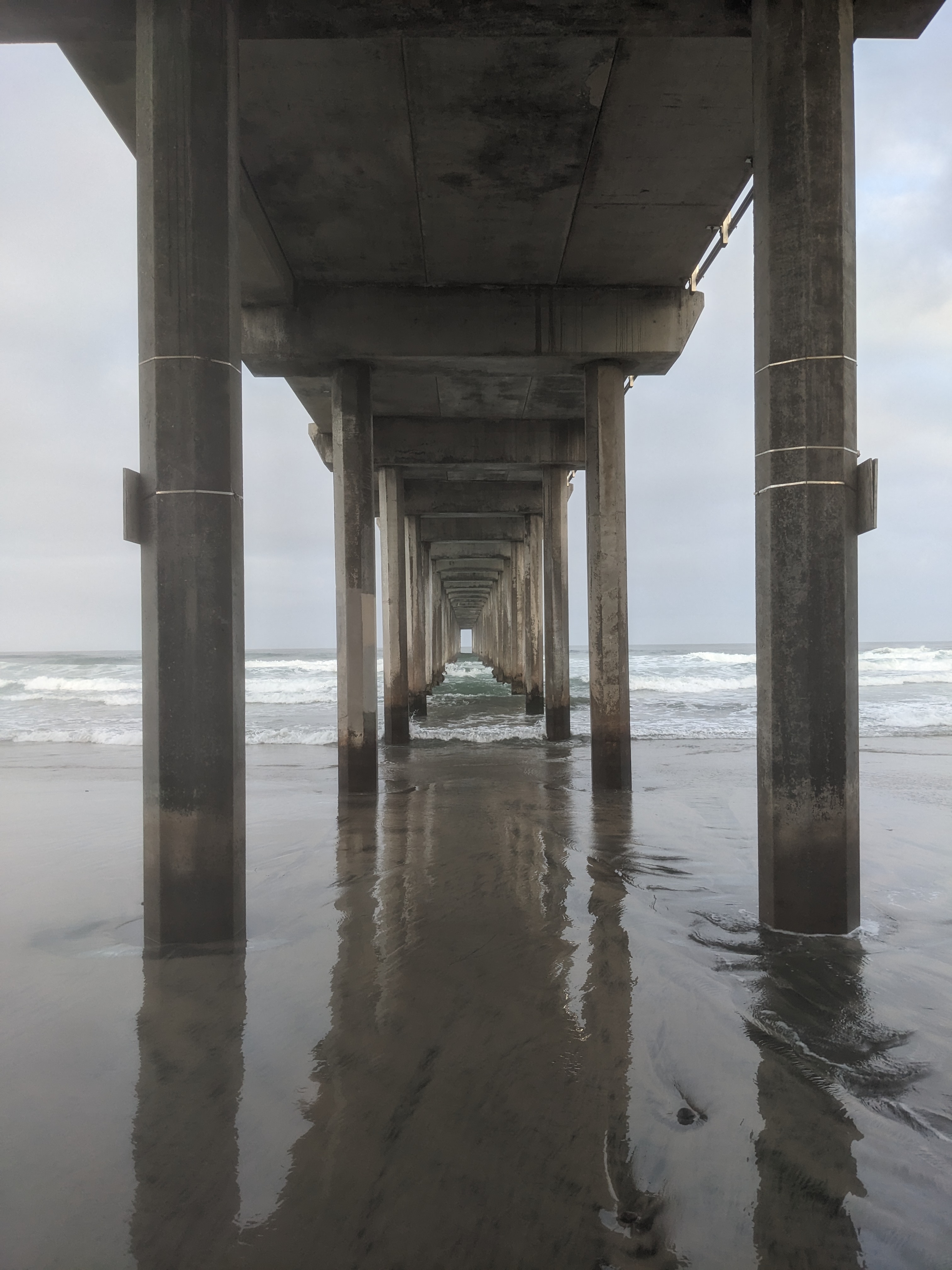
The underside of the research pier at Scripps Institute of Oceanography
An action-shot below the pier where everyone takes a selfie.
The cliff near the Scripps Institute in La Jolla.
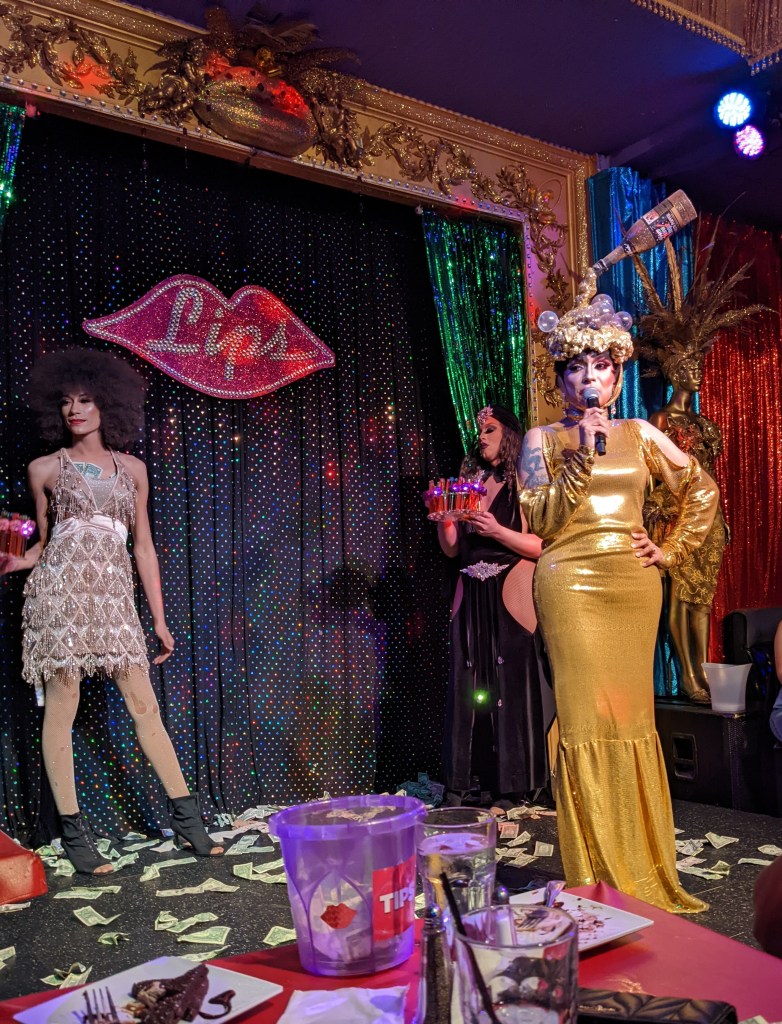
While I was in San Diego, I also went to a drag show with friends and colleagues. For anyone who is not familiar with ‘drag’, it can be presented in many ways but it always an artistic performance in which the performers adorn clothing, hairstyles, and makeup to create a persona for the stage. In the same way that actors don clothing, makeup, and more to create personas in order to tell a story, with drag the chosen persona plays on the idea of gender norms of what society thinks a person should wear or say based on which genitals they have. The performers often sing/lip sync, dance (including some extremely athletic moves while wearing high heels), perform stand-up comedy, read book aloud, or in the case of the show I just went to – host a game of bingo. However it is performed, drag engages in humor, pageantry, and the idea that how we look can be a form of artistic expression rather than the composite of other people’s opinions on how we should look or act. I can’t think of anything more wholesome than an event which welcomes everyone to be their authentic self. If you have never been to a drag show, I highly recommend it, and everyone is welcome at drag shows!
I have included some photos of a previous show I attended there, as I wasn’t able to get good photos of the performance this time (I do have an amazing group photo, but I wasn’t sure if my friends would want to be featured on my professional social media).
Overall, the combination of time to relax, to think, to share, and to have fun was an restorative and enjoyable way to make new friends, deepen connections with previous friends and colleagues, and to enrich my own research by learning from rockstars in my field. You’ll definitely find me at CIMM again next year!
*The title of this blog post is directly inspired by phrasing in Arundhati Roy’s novel, The God of Small Things.
Hosting Organizations: MSE and the University of Maine Institute of Medicine.
The environment, microbes, and us
Anthropology Theme organized by Katherine Daiy and Kieran O’Doherty, and Environmental Theme organized by Mallory Choudoir, Mustafa Saifuddin, and Hannah Holland-Moritz.
“Invisible Friends: How Microbes Shape Our Lives and the World Around Us”
March 15, 2023; Wednesday,11:00 AM – 12:00 PM EST. This event has passed, watch the recording here.
Dr. Robinson is a microbial ecologist based in the UK (soon to be Australia). In 2021, he received a PhD from the University of Sheffield. He is passionate about researching microbes, ecosystems, social equity issues and the connections between them, and at the same time, he is keen to develop ways to conserve and restore nature. Invisible Friends is his first book. This book counters the prevailing narrative of microbes as the bane of society, along the way providing much-needed clarity on the overwhelmingly beneficial role they play. Discover how the microbiome is highly relevant to environmental and social equity issues while there’s also discussion about how microbes may influence our decisions; even the way we think about how we think may need to be revisited. Invisible Friends introduces the reader to a vast, pullulating cohort of minute life – friends you never knew you had! Jake has worked on several publications with the MSE Working Group founder Dr Sue Ishaq and even interviewed her for the Microbes and Social Equity chapter in Invisible Friends.
Upcoming seminars on The environment, microbes, and us
For two weeks, we’ll be bringing back our Theme 3 speakers back to engage in a panel discussion together on the importance of environmental microbiomes and our place in ecosystems, and then will continue talking about soil health. Panel will be hosted byKatherine Daiy, Kieran O’Doherty, Mallory Choudoir, Mustafa Saifuddin, and Hannah Holland-Moritz.
Please note, this session will only be featured live in real-time and will not be recorded.
Hosting Organizations: MSE and the University of Maine Institute of Medicine.
Panel discussion on Prenatal to early-life microbes and health
March 8, 2023; Wednesday,11:00 AM – 12:00 PM EST. This event has passed and was not recorded.
Today, we’ll be bringing all of our Theme 2 speakers back to engage in a panel discussion together on the microbiome in early life. Panel will be hosted by Emily Wissel and Sue Ishaq.
Please note, this session will only be featured live in real-time and will not be recorded.
Dr. Eldin Jašarević, who presented on “The maternal microbiota and offspring development: Towards a translational systems approach in maternal-child health.”
Dr. Merilee Brockway, who presented on “The maternal microbiota and offspring development: Towards a translational systems approach in maternal-child health.”
Dr. Sarah Lebeer, who presented on T’he vaginal microbiome: key for women’s health & healthy newborns’.
Next week, we’ll start our “The environment, microbes, and us” theme!
Every year, The University of Maine releases a summary report of the research efforts of its faculty, staff, and students. I was pleased to discover that the work that Yanyan Li and I have been doing on broccoli sprouts and gut microbes was featured in the report! A screenshot of the story is below, but you can read the story and the entire 2022 UMaine research report here.
Hosting Organizations: MSE and the University of Maine Institute of Medicine.
Panel discussion on Prenatal to early-life microbes and health
March 8, 2023; Wednesday,11:00 AM – 12:00 PM EST. This event has passed and was not recorded.
This Wednesday, we’ll be bringing all of our Theme 2 speakers back to engage in a panel discussion together on the microbiome in early life. Panel will be hosted by Emily Wissel and Sue Ishaq.
Please note, this session will only be featured live in real-time and will not be recorded.
Dr. Eldin Jašarević, who presented on “The maternal microbiota and offspring development: Towards a translational systems approach in maternal-child health.”
Dr. Merilee Brockway, who presented on “The maternal microbiota and offspring development: Towards a translational systems approach in maternal-child health.”
Dr. Sarah Lebeer, who presented on T’he vaginal microbiome: key for women’s health & healthy newborns’.
Next week, we’ll start our “The environment, microbes, and us” theme!
March 1, 2023; Wednesday,11:00 AM – 12:00 PM EST. This event has passed, watch the recording here.
Dr. Sarah Lebeer is a research professor at the Department of Bioscience Engineering of the University of Antwerp, Belgium. She has studied bioscience engineering, with a specialisation in cell and gene biotechnology and food & health and obtained her Master’s degree at KU Leuven (Belgium) in 2004. In 2008, she obtained a PhD degree in Bioscience Engineering with a topic on probiotics and inflammatory bowel diseases (KU Leuven). After a postdoc on the interaction between lactobacilli, viruses and mucosal immunology, Sarah was offered a tenure track position in applied microbiology and biotechnology at the Department of Bioscience Engineering of the University of Antwerp in Nov 2011. In 2020, Sarah obtained an ERC StG Grant (Lacto-Be) that enables her to gain in-depth knowledge of the evolutionary history and ecology of lactobacilli. Within this ERC project, Sarah has launched the Isala citizen-science project to gain new insights in the ecology and role of vaginal lactobacilli for women’s health, but also to actively involve women to contribute with ideas on how to improve vaginal health and break some taboos together (https://isala.be/en). This project has won the communication award from the Young Academy and Royal Academy of Science KVAB in 2021.
Panel discussion on Prenatal to early-life microbes and health
This week, we’ll be bringing all of our Theme 2 speakers back to engage in a panel discussion together on the microbiome in early life. Panel will be hosted by Emily Wissel.
Please note, this session will only be featured live in real-time and will not be recorded.
February 22, 2023; Wednesday,11:00 AM – 12:00 PM EST. This event has passed, watch the recording here.
Dr. Merilee Brockway is a PhD prepared nurse and International Board-Certified Lactation Consultant (IBCLC) with expertise in maternal-child health, infant feeding, and patient engagement. She completed my PhD in nursing at the University of Calgary, examining maternal breastfeeding self-efficacy and infant feeding outcomes in moderate and late preterm infants. She also completed a three year post-doctoral fellowship at the University of Manitoba in Dr. Meghan Azad’s THRIVE Discovery Lab, exploring clinical applications of donor human milk for preterm infants. As an Assistant Professor at the University of Calgary, her program of research examines the use of human milk as a clinical intervention to mitigate early life perturbations to the infant microbiome.
Upcoming seminars on Prenatal to early-life microbes and health
“The vaginal microbiome: key for women’s health & healthy newborns”
This week, we’ll be bringing all of our Theme 2 speakers back to engage in a panel discussion together on the microbiome in early life. Panel will be hosted by Emily Wissel.
Please note, this session will only be featured live in real-time and will not be recorded.
February 15, 2023; Wednesday,11:00 AM – 12:00 PM EST. This event has passed, watch the recording.
Eldin (he/him) is an Assistant Professor in the Departments of Obstetrics, Gynecology and Reproductive Sciences and Computational and Systems Biology at the University of Pittsburgh School of Medicine. He is also Primary Investigator at Magee-Womens Research Institute. Eldin received a PhD in Neuroscience at the University of Missouri and the Thompson Center for Autism and Neurodevelopmental Disorders studying the combined effects of maternal stress and diet on sex-specific brain development in mice. Eldin completed his postdoctoral training in the laboratory of Dr. Tracy Bale at the University of Pennsylvania and University of Maryland School of Medicine. His postdoc work showed that lifetime experiences influence the composition and function of maternal microbiome, and vertical transmission of these communities is causally linked to poor health outcomes in offspring. Current research interests include mining the human maternal microbiota for novel functions that contribute to offspring development, and ultimately gaining a better understanding of the ways in which the prenatal environment shapes the postnatal response to the external microbial world. For this work, Eldin has been selected as a Kavli Fellow of the National Academy of Sciences and is the recipient of a National Research Service Award from NIMH, and a Research Scientist Development Award from NIDDK.
Upcoming seminars on Prenatal to early-life microbes and health
“Intersecting breastmilk and microbiome science with the complexity of working with humans in a clinical context”
This week, we’ll be bringing all of our Theme 2 speakers back to engage in a panel discussion together on the microbiome in early life. Panel will be hosted by Emily Wissel.
Please note, this session will only be featured live in real-time and will not be recorded.
Hosting Organizations: MSE and the University of Maine Institute of Medicine.
Panel discussion on Gut microbiome, nutrition, and food security
February 8, 2023; Wednesday,11:00 AM – 12:00 PM EST. This event has passed, and was not recorded.
Today, we’ll be bringing all of our Theme 1 speakers back to engage in a panel discussion together on the gut microbiome. Panel will be hosted by Sue Ishaq.
Please note, this session will only be featured live in real-time and will not be recorded.
Dr. Yanyan Li, PhD, who presented on “Broccoli Sprout Bioactives and Gut Microbiota: A Dietary Approach for Prevention and Management of Inflammatory Bowel Disease”.
Dr. Dany Fanfan, Ph.D., MSN, RN, who presented on ” Exploring Health determinants, Gut Microbiome, and Health Outcomes in Immigrants”.
Dr. Sean Gibbons, PhD, who presented on “Personalized nutrition and the human gut microbiome”.









 The Ishaq Lab