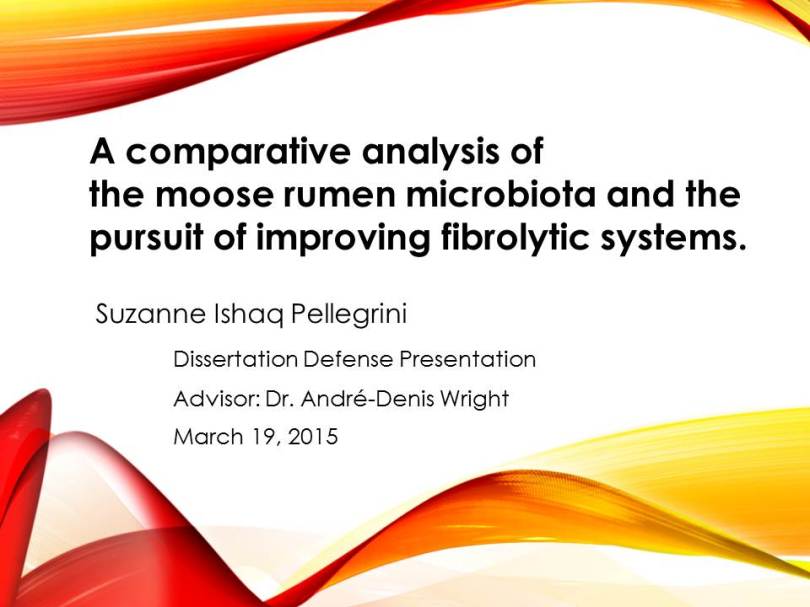
A year ago today I gave the public defense of my PhD dissertation! It was a stressful day, especially because my laptop crashed just 10 minutes beforehand while I was practicing and making last minute adjustments! Luckily, I had prepared by bringing the presentation on a flash drive, and by putting it on an online cloud drive as well. My parents brought enough potato salad, cookies, cake, and Italian meatballs to feed the dozens of attendees and then some. I really appreciated the friends and family that showed up to support me, some had even driven to Burlington, VT from Massachusetts just for me! You can watch my full defense presentation on YouTube.
After a long hour of presenting my work and answering questions from the crowd, my graduate committee and I left for the closed-door portion. For the next two and a half grueling hours, 5 field-leading researchers asked me questions about everything I had done, and what I might have done differently. Finally, they asked me to step into the hallway while they made their final deliberations, where I nervously ate cookies as fast as I could because I hadn’t eaten in hours. They came back out 5 minutes later smiling, and announced that I had passed! You can read my full thesis here.
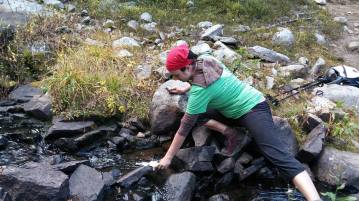
Sampling in September, when the stream wasn’t frozen and we could see the trail.
Yesterday was the winter sampling time point for a large research project I’m volunteering for: Adventurers and Scientists for Conservation is managing sample collection for the ASC Gallatin Microplastics Initiative in the Gallatin Valley watershed. The project samples various streams and lakes, both where they converge with the Gallatin River and at their headwaters. The project is part of a much larger project looking at microplastics in water around the world, the ASC Worldwide Microplastics Initiative. ASC recruits volunteers who have the outdoors-man skills (like hiking, tracking, or boating) and enthusiasm to get to hard to reach places to collect samples, then trains them in how to collect water samples and metadata (like weather, temperature, what we’re wearing during collection), coordinates sample collection times, and makes sure to safely send the samples back to a laboratory in Maine.
Our intrepid, fuzzy researcher stuck by our side the whole way.
Digging down through the snow to find the headwaters of Deer Creek.
A lovely view of the Spanish Peaks.
Lee and I sample Deer Creek, just north of Big Sky, Montana. To do this, we hike 13 miles round trip to Moon Lake, with a 3,288 foot elevation gain up to around 9,000 ft above sea level. This time, the trail was covered in 1-2 feet of undisturbed snow, luckily we had snowshoes that kept us from sinking into all but the most soft of snowdrifts. On the way up it was snowing heavily, though visibility was fine, and on the way down it was raining. In many areas of the trail, drifts meant that the trail was at a 45 degree angle, and we had to break our own trail for nearly all of it. Despite the arduous trek, the views were beautiful, it was wonderful to be out of the office, and it was fun helping a large coordinated study. You can get involved in studies like this through organizations like ASC, or through research universities- volunteers are always needed for all different types of studies.
The trail was very steep and uneven thatnks to snow drifts.
Lee showing what he was wearing, in case our clothing contaminated the sample.
“I was married to Margaret Joan Howe in 1940. Although not a scientist herself she has contributed more to my work than anyone else by providing a peaceful and happy home.” – Dr. Frederick Sanger – From Les Prix Nobel. The Nobel Prizes 1980, Editor Wilhelm Odelberg, [Nobel Foundation], Stockholm, 1981
Lee holding “Laura Jr.” during his daily weighing. Laura Jr. loved to cuddle.
Happy birthday and thank you to my partner and best supporting contributor, Lee. Dr. Sanger was absolutely correct when he attributed his success at work to the support his wife gave him at home. I don’t mean that our partners should run the entire household because we are too important (I’m all for egalitarian chore wheels). What I mean is that it takes a special (and patient) type of person to emotionally support us and our work. As researchers and/or academics, we lead busy work lives, have variable schedules, have sudden deadlines that crop up and glue us to our laptops, we can’t always take vacation during the school year and if we do take a vacation it always seems to coincide with a scientific conference we are presenting at. We can be cranky without regular coffee infusions, and sometimes we come home smelling of whatever it is we were working on. And, sometimes we can never find enough undergraduate students to help us and ask you to help us clean sheep pens with no compensation.
Lee helping catch sheep in a pasture under the hot July sun. Generally, all my sheep liked him and would walk right up to him.
Our jobs can also require us to move often, or to hard-to-reach locations. Roughly a year ago, I accepted a job (my current post-doc position) in Bozeman, MT, a place I had never been to 2,600 miles from where I was living in Vermont. I asked Lee to drop everything and relocate with me- something that every partner of a graduate student, post-doc, or tenure-track professor has been asked at least once. Relocating with a researcher is no small proposition- it usually comes with a variable-length timeline; you might have to move again in a year or three or you might get stuck there and have to put down roots. I am delighted to say that Lee came with me, we drove all 2,600 miles across country to Montana, and we have been having a wonderful time under the Big Sky since! Happy birthday Lee, and to everyone else: go home and thank your partner, parents, coworkers, friends, pets, house plants, or whatever else for giving you the emotional support you need to be your best scientist.
Great news! I’ll be presenting a poster this year at the American Society for Microbiology’s (ASM) Microbe Conference in Boston, MA this June 16th-20th. I’ll have a date and time later this month, and will of course post the full abstract and poster after the presentation.
“Farming Systems Modify The Impact Of Inoculum On Soil Microbial Diversity”
Suzanne L. Ishaq¹, Stephen P. Johnson², Zach J. Miller³, Erik A. Lehnhoff4, Carl J. Yeoman¹, Fabian D. Menalled²
1 Montana State University, Department of Animal and Range Science, Bozeman, MT 2 Montana State University, Department of Land Resources & Environmental Sciences, Bozeman, MT 3 Montana State University, Western Agriculture Research Center, Bozeman, MT 4 New Mexico State University, Department of Entomology, Plant Pathology and Weed Science, Las Cruces, NM
A year ago today, I submitted my doctoral dissertation to my committee: 315 pages, 10 chapters, 73,009 words, 376 total citations (202 of which in the literature review). It was the culmination of almost 5 years of research, over two months of writing, and the entire Buffy the Vampire series in reruns. It seems fitting that the last two months of this year I have been equally busy writing a handful of grants, though without the help of old TV scifi dramas.
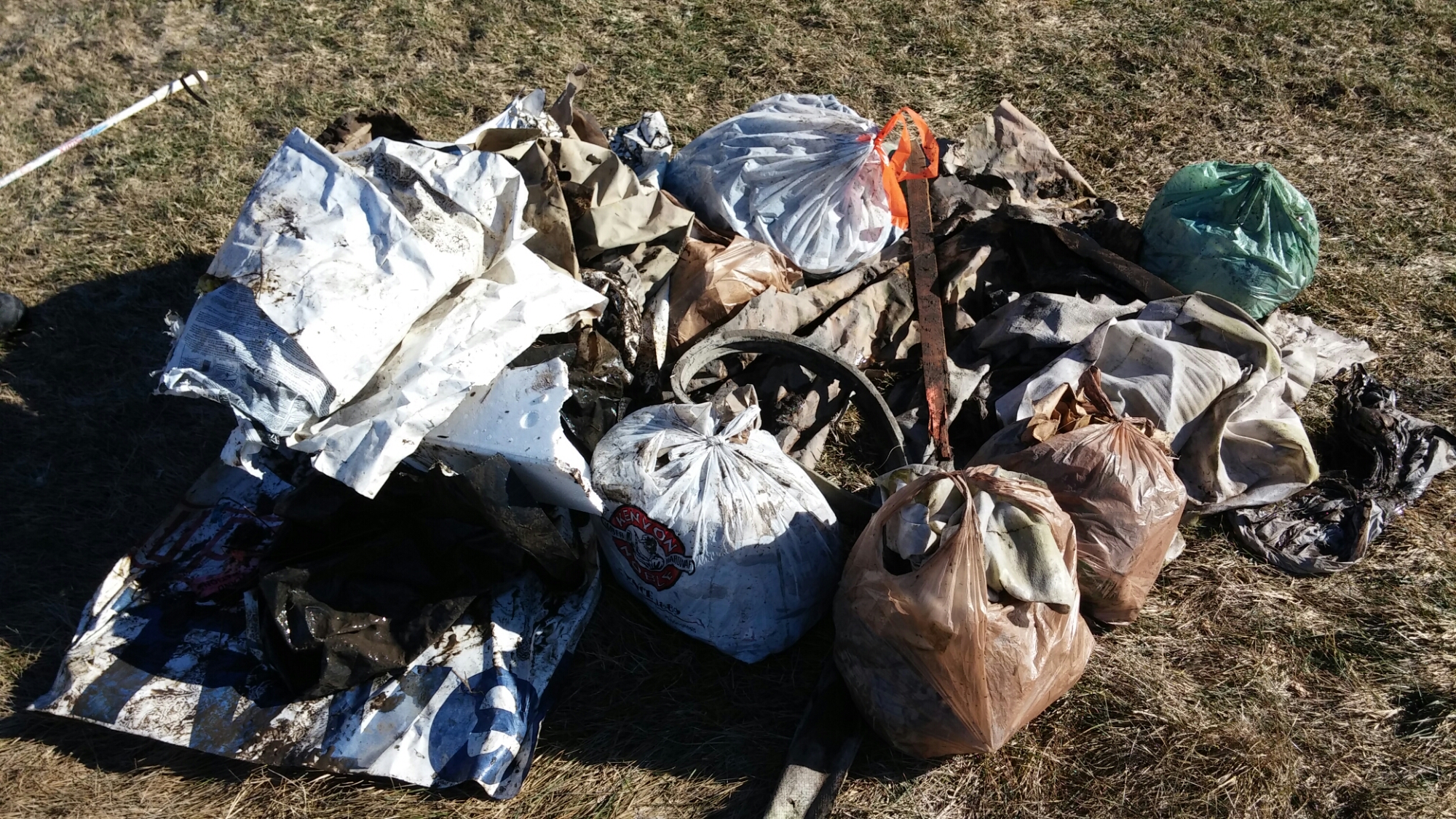
Today I spent a few hours picking trash out of some steams bordering my housing development. It’s very windy on the plains of Montana, and wind storms contribute to pollution by spreading trash. These steams are home to ducks, fish, musk rats, snakes, and frogs, and they link to larger water systems which run through local farms and provide water to cattle. Since the water table isn’t very deep here, any pollution can have far reaching effects. In just two and a half hours, I managed to pull all this out using only a ski pole, proving that one person can make a difference. As an environmental scientist, it’s important to me to give back. Next time you’re looking for something to do, why not try some green up?
For the last few months (and for at least two more) I’ve been hard at work writing several large grants for future projects: one looking at plant species’ interactions with soil microbes, one on the microbiome of women on hormonal contraceptives, one on grazing systems in sheep, and a few more that are under conceptual development. It’s intensive work, that requires a lot of time reading journal articles to formulate an argument for your proposed work, while making sure you are proposing something new and aren’t just repeating previous research. To top it all off, you have to do it within a certain page limit.
Grant season typically lasts from late November to early April: it’s when many agencies in the US put out general or topic-specific calls for funding. Each agency (ex. USDA, NIH, DOE, etc.) has it’s own requirements for formatting, the information that gets included, who can apply, etc. They are very picky, too; sometimes proposals will be sent back for having more than the requisite maximum of citations on your CV– without the agency having read your proposal at all. Many will also turn away proposals that they feel are not aligned with the goals of that agency or that funding call, even if they like your submission.
Despite the long hours and the nit-picky attention to detail required, I’ve enjoyed being able to hone my grant writing skills, to learn about different research topics, and to be part of so many exciting projects over the new few years. Most of these will be submitted in March, and we probably won’t hear back until mid-summer- fingers crossed!
It’s 2016 and already it seems like the year is flying by. Between grant writing, manuscript writing, data analysis, and the thousand other little things you find yourself doing, it can be difficult to find time for outreach. As such, my 2016 New Year’s Resolution as a researcher is to solidify my online footprint to better disseminate my work. This site seeks to manage citations, connect all those online professional site profiles, give updates on my day-to-day, and to provide insight into the microbial communities that I investigate.




 The Ishaq Lab