Speaker lineup confirmed for ‘Session 4: Community engagement and collaboration’ at the July 2022 MSE virtual symposium!

The speaker lineup is set for the fourth day of the July 2022 MSE virtual symposium, which is focused on “Community engagement and collaboration”. This session will feature three talks featuring researchers who have experience creating research with communities. This session will explore different styles of interdisciplinary collaborations centered on community needs, such as community advisory boards, community partnerships, community-led research design, and how to implement this into microbiome research. Our hope is that attendees for this session learn from different perspectives how foster their own community connections which would benefit their work.

The program for the July 2022 MSE virtual symposium, “Developing transformative Research Skills”, is beginning to take shape as we continue to confirm speakers for the 5 sessions, the full program for which can be found here.

Session 4: “Community engagement and collaboration”

Thursday, July 21st, 12:30 ~ 16:00 EST. Register for this session.

Session leaders:

Portrait of Mustafa Saifuddin, Ph.D.,

Mustafa Saifuddin, Ph.D., Staff Scientist, Sustainable Food and Farming Program at Earthjustice
Ashley M. Toney, Ph.D., Postdoctoral Research Fellow, UTHealth School of Public Health, El Paso. Translational/Clinical Nutrition Researcher focused on Latine Health Disparities.

Scope: Due to the interconnectedness of microbial processes and social justice, many types of microbial research could benefit from closer collaborations with communities impacted directly by the public health, environmental and climate justice implications of microbiomes. Some styles of microbiome research would yield more positive outcomes if the collaboration was built around mutual long-term goals, instead of specific projects, and if it was initiated during project conceptualization instead of after the project has been designed. This session will explore different styles of interdisciplinary collaborations centered on community needs, such as community advisory boards, community partnerships, community-led research design, and how to implement this into microbiome research.

Learning Objective of Session: Attendees will learn 1) approaches to community-centered collaborations, 2) how to leverage community professionals (e.g. health workers) in a ‘train the trainer model’, 3) how to start ethical conversations around environmental samples & broader experimental design, and 4) how to emphasize collaborations – including public health, government, policy makers, etc. as a collaborator and how to ask for their help/mindful collaborations.

Format of talks: Three 30-min lecture-style talks from researchers who have successfully built research collaborations with communities.

Format of breakout rooms: Each room creates a plan for engagement, and each room has a designated topic area (e.g. environmental restoration) to help audience members group by research discipline.

Session Speakers:
Dr. Pajau (PJ) Vangay, PhD. Science Community Manager, National Microbiome Data Collaborative, Lawrence Berkeley National Laboratory.

“Advancing microbiome science, in partnership with communities”

Dr. Arbor Quist, PhD., Postdoctoral Fellow in Environmental Justice & Community-Driven Epidemiology at the University of Southern California.

Dr. Rosie Alegado, PhD., Associate Professor of Oceanography & Sea Grant College Program at  University of Hawaiʻi at Mānoa

12:30 – 14:15 Introduction and Speakers

14:15 – 14:30 Break

14:30 – 16:00 Breakout room discussions based on skills development, in smaller groups

  • Topics in development

Prior to this session, you may want to watch these recorded talks:

Johanna sets a date for her master’s thesis defense!

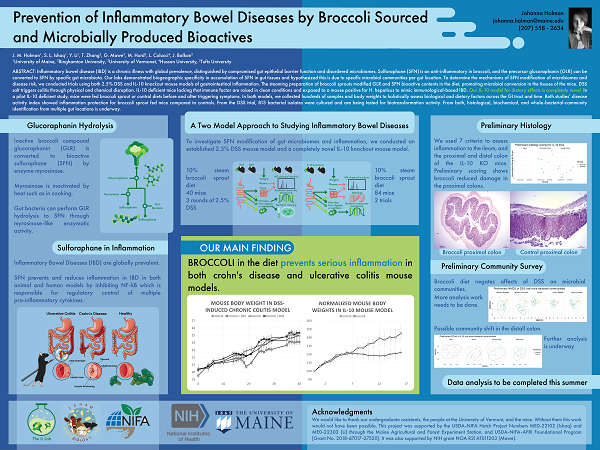
Prevention of Inflammatory Bowel Diseases by Broccoli Sourced and Microbially Produced Bioactives.

Presented by Johanna Holman in fulfillment of her Master’s of Science in Nutrition degree at the University of Maine. Jul 25, 2022 09:30 – 10:30 AM Eastern Time (US and Canada)

Register in advance to attend this presentation over Zoom, which will also be held in person in 206 Rogers Hall at the University of Maine (no RSVP required). After registering, you will receive a confirmation email containing information about joining the meeting.

About Johanna

I met Johanna in the fall of 2019, when I was just establishing myself as a new Assistant Professor at UMaine and she was looking for an advisor for a graduate degree.  Right away, she impressed me with her background and enthusiasm for research.  I learned that Johanna began her undergraduate study as an art student before transitioning fluidly to science.  The ability to design visual aids and graphical representations of data is hugely important to science and sadly, not always a skill that scientists are trained to do, and Johanna has made some incredible art for her research.  

Once she became a science student during her undergraduate study, she worked in the laboratories of Drs. Yanyan Li, previously an Associate Professor (of nutrition) in the College of Science and Humanities, and Tao Zhang, Assistant Professor of Basic Pharmaceutical Sciences, both of Husson University in Bangor.  There, she performed nutritional biochemistry, worked with mouse models, and developed an idea of what she wanted to study in graduate school and pursue as a career.  Johanna continues to work closely with both researchers, especially now that Dr. Li has taken a position at UMaine. 

Johanna and I continued to plan her graduate work and career goals, she officially joined my lab as a Master’s Student of Nutrition at UMaine in fall 2020, and immediately got to work.  Not only did she begin preparations for the massive undertaking that is part of her project, but she began mentoring several undergraduates on and off campus, and started as a first time teaching assistant for the Chemistry department, which required navigating virtual labs.  She served as a chemistry TA for academic year 20/21 and 21/22, with up to 60 students per semester. For the last year and a half, she has been coordinating a large-scale research project with investigators at 4 different institutions and undergraduate researchers from 3 different institutions, involving hundreds of samples – while being a masters student, a graduate teaching assistant, and mentoring undergrads in the lab, and all during a pandemic!  She managed that all so well, that despite being a first-year graduate student, she was awarded a 2020-2021 University of Maine Graduate Student Employee of the Year award, and the 2022 Norris Charles Clements Graduate Student Award from the College of Natural Sciences, Forestry, and Agriculture. 

Johanna’s project focuses on whether consumption of specific broccoli sprout preparations will elicit changes in the gut microbiota, to the effect of improving the production of microbiota-specific bioactives that have local anti-inflammatory effects, and promoting intestinal homeostasis by reducing dysbiosis. Broccoli sprouts represent an effective, and accessible way to add dietary intervention to existing treatment and prevention strategies for IBD patients. This project is a continuation of previous research on bioactive compounds in broccoli, completed in the labs of Drs. Yanyan Li and Tao Zhang at Husson University in Bangor.  While some of the work may be similar, the skill set she has gained in her graduate work is entirely new.  For the 2020/2021 winter break, Johanna was managing a 40-mouse study looking at DSS-treatment and different preparations of a broccoli sprout diet for 5 weeks, which resulted in hundreds of samples collected, hundreds of data time points, and enough follow-up laboratory and analysis work to keep her occupied for an entire year.  She has learned how to culture bacteria in an anaerobic chamber, which is a notoriously fussy machine that requires regular attention, as well as to grow them under different conditions for biochemical analysis and enzyme activity.  She is currently learning additional histology skills, DNA extraction, DNA sequencing library preparation, DNA sequence analysis, and more. Recently, she has participated in a pilot study to develop an immunological model of IBD, using IL-10 knockout mice. While IL-10 mice have been used to study IBD, they have never been applied in this way to study the interaction of diet, microbes, and disease.

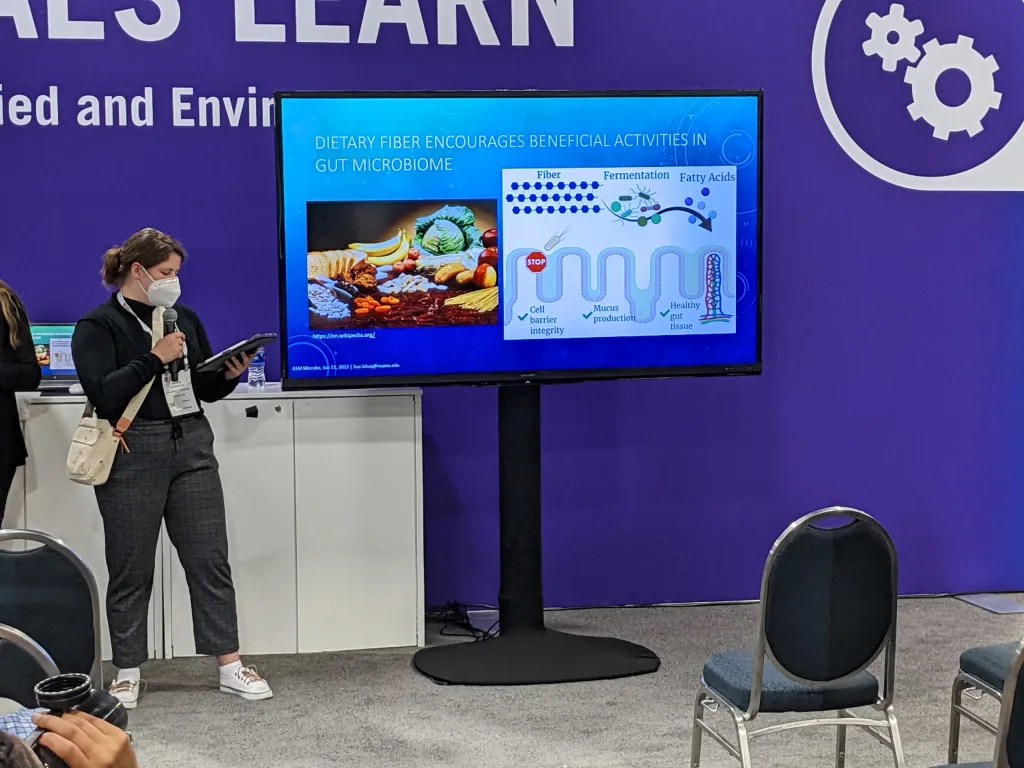
She has presented this work at the American Society for Microbiology annual meeting, and at the UC Davis Research Experience for Undergraduates (REU) symposium, and has several conference presentations planned for 2022. Johanna has an author on a paper in early 2022 for work she contributed to as an undergraduate, and is preparing 3 manuscripts generated from her masters work which will be submitted for peer review at a scientific journal in 2022.

Johanna has been accepted to the Nutrition PhD program at UMaine, and will continue working with Dr. Li and I, as well as the full research team. Based on those preliminary results, Johanna’s doctoral work will focus on developing that new model, synthesizing information from both models, and using those results to develop diet intervention trials in human patients. After her PhD, Johanna intends to conduct research at an institution here in Maine, and to continue her work connecting the biochemistry of nutrition with gut microbiology and human health.

Speaker lineup confirmed for ‘Session 3: Transforming your research for policy engagement’ at the July 2022 MSE virtual symposium!

The speaker lineup is set for the third day of the July 2022 MSE virtual symposium, which is focused on “Transforming your research for policy engagement”. This session will feature three talks featuring researchers who have experience bringing research to the public and to legislative bodies. So often, the positive outcomes of research are limited because it can be difficult to get the word out to people who can put our results into practice. Our hope is that attendees for this session learn from different perspectives how to write their research to inform the general public, professionals in healthcare, or policy makers.

The program for the July 2022 MSE virtual symposium, “Developing transformative Research Skills”, is beginning to take shape as we continue to confirm speakers for the 5 sessions, the full program for which can be found here.


Session 3: “Transforming your research for policy engagement”

Wednesday, July 20th, 12:30 ~ 16:00 EST. Register for this session, it’s free and will be held over Zoom.

Section leaders:

Mallory Choudoir, Ph.D. Soil microbial ecologist. Postdoctoral Researcher at University of Massachusetts Amherst. Assistant Professor and Extension Specialist at North Carolina State University September 2022. 

Mustafa Saifuddin, Ph.D., Staff Scientist, Sustainable Food and Farming Program at Earthjustice

Mustafa Saifuddin, Ph.D., Staff Scientist, Sustainable Food and Farming Program at Earthjustice

Amali Stephens, PhD Student, Interdepartmental Microbiology, Iowa State University

Scope: Microbiomes drive processes in all environments and are intimately intertwined with all aspects of our lives. Despite the central role of microbes in shaping systems, microbial researchers are often detached from shaping policies related to conservation, public health, land use, environmental justice, climate and other areas of intersection. Policy engagement is not typically included in the academic training of microbiome researchers, and there is a need for greater coordination between policy needs and microbial research. This session will explore integrated, collaborative approaches to research and policy making.

Learning Objectives of Session: Attendees will discuss 1) how to develop research in collaboration with policy needs, 2) policy levels and types (government, private), 3) how to identify stakeholders, and 4) how to communicate your research to policymakers.

Format of talks:  Three 30-min lecture-style talks will describe interdisciplinary research outcomes which transcend typical academic endpoints and engage in shaping policy.

Format of breakout rooms: Each room will create a policy brief outline or ideas list around a particular topic area (e.g. environmental restoration) to help audience members group by discipline.

Session Speakers: In development, details provided soon!

Dr. Caitlyn Hall

Dr. Caitlyn Hall, PhD., Assistant Professor of Practice, University of Arizona

“The Elephant in the Lab: How can scientists engage in policy and advocacy?”

Dr. Kathleen Treseder

Dr. Kathleen Treseder, PhD., Howard A. Schneiderman Endowed Chair and Professor of Biology at the University of California Irvine; Climate Activist; Irvine City Council Candidate

“My experience advocating for environmental policy with local policy makers: What worked, what didn’t.”

Dr. Sonja Birthisel, Ph.D., Director, The Wilson Center at the University of Maine; Councilor, Orono Maine Town Council; Faculty Associate, University of Maine School of Forest Resources

“Public Policy Engagement & Personal Sustainability: What’s Your “Sparkle Zone”?”

12:30 – 14:15 Introduction and Speakers

14:15 – 14:30 Break

14:30 – 16:00 Breakout room discussions based on skills development, in smaller groups

  • How to talk to your politicians about science
  • How scientists get involved with policy
  • Curriculum for science policy
  • Environmental microbial policy issues
  • Microbial conservation
  • Soil carbon & climate justice issues
  • Agricultural antibiotic use
  • Microbial exposures (residential, worker exposure)

Prior to this session, you may want to watch these recorded talks:

Speaker lineup confirmed for ‘Session 2: Blending biological, social, and humanities writing’ at the July 2022 MSE virtual symposium!

The speaker lineup is set for the second day of the July 2022 MSE virtual symposium, which is focused on “Blending biological, social, and humanities writing”. This session will feature one talk and one panel discussion, featuring researchers who have published, reviewed, and edited interdisciplinary writing and appreciate the difficulty that many microbiome researchers face: getting their work published when it does not fit a typical experimental layout. Our hope is that attendees for this session learn from different perspectives how to write across disciplines, find the right journal and pitch the relevancy of their manuscript to the journal’s scope, how to find reviewers with disparate professional backgrounds (for example microbiology and legal policy), and more.

The program for the July 2022 MSE virtual symposium, “Developing transformative Research Skills”, is beginning to take shape as we continue to confirm speakers for the 5 sessions, the full program for which can be found here.


Session 2: “Blending biological, social, and humanities writing”

Tuesday, July 19th, 12:30 ~ 16:00 EST. Register for this session, which is free and will be held over Zoom

Session leaders:

Ashley Toney, PhD

Ashley M. Toney, Ph.D., Postdoctoral Research Fellow, UTHealth School of Public Health, El Paso. Translational/Clinical Nutrition Researcher focused on Latine Health Disparities.

Dr. Kieran O'Doherty.

Kieran C. O’Doherty, PhD., Professor of Psychology, University of Guelph, and Director of the Discourse, Science, Publics research Group

Emily Wissel, Ph.D. candidate, Emory University. MSE Director of Resource Dissemination

Scope: Interdisciplinary experimental designs have been called for in research, but finding a publication venue can be tricky when manuscripts or presentations are deemed not discipline-specific, or are labeled opinion instead of research. This session will explore common gatekeeping problems of interdisciplinary research, cross-disciplinary writing categorization discussions (i.e. theoretical framing, etc.), and writing strategies and publication venues to make the most of your work.

Learning Objectives of Session: Attendees will become familiar with different expectations within research design/publishing across fields, and learn about tangible suggestions from research publishers. Audience members should walk away with more confidence in interdisciplinary publishing.

Format of talks: This will feature a 30-min plenary topic to introduce the concept that theory in psychology/philosophy is regarded as opinion in the natural sciences, followed by 1 hour of a panel of research journal editors to discuss flexible publication guidelines.

Format of breakout rooms: Each room creates a document, and each room has a designated topic area (e.g. environmental restoration) to help audience members group by discipline

Session Speaker:

Dr. Mark Risjord, PhD. Professor of Philosophy, Emory University
“Crossing boundaries, building bridges: some reflections on interdisciplinary writing.”

After which, the Speaker will be joined by additional Panelists to discuss interdisciplinary research, challenges, and opportunities.

Dr. Susan L. Prescott, MD, PhD, FRACP. President, inVIVO Planetary Health @ the Nova Institute for Health, Baltimore, USA; Director, ORIGINS PROJECT Telethon Kids Institute; Professor of Paediatrics, UWA Medical School; Paediatric Immunologist, Perth Children’s Hospital; Editor in ChiefChallenges journal.

Dr. James Stegen

Dr. James Stegen, PhD., Physical & Computational Sciences Directorate, Pacific Northwest National Laboratory

Dr. Michela Gambino, professional headshot

Dr. Michela Gambino, PhD. Assistant Professor at the Department of Veterinary and Animal Sciences, University of Copenhagen; mSystems editor

12:30 – 14:15 Introduction, Speaker, and Panel discussion

14:15 – 14:30 Break

14:30 – 16:00 Breakout room discussions based on skills development, in smaller groups

  • Pitching your paper to the right journal 
  • Finding and directing reviewers
  • “Ask a philosopher!”
  • TBD

Prior to this session, you may want to watch these recorded talks:


The Ishaq Lab is hosting Dr. Rabee, a Visiting Researcher from Egypt, to work on rumen microbes

After two years of postponement, the Ishaq Lab is excited to welcome Dr. Alaa Rabee as a Visiting Researcher from now until December of this year!! This is made possible by a prestigious award to Dr. Rabee from the Central Department of Missions at the Ministry of Higher Education, Egypt, which fosters research collaboration between Egypt and the U.A.

Dr. Rabee joins us from the Desert Research Institute in Cairo, Egypt, where his work focus on researching microbial communities in the digestive tract of ruminants and how they can be used for animal production, bioengineering, and sustainable development. 

Last year, Alaa and I published our first collaborative paper together, based on his work on microbial enzymes from the rumen of sheep and camels and potential for use in biofuel production. We are also working on another, based on microbial activity (transcriptomics) in the rumen of camels on different diets. That project has engaged two undergraduate students in data visualization, including Myra Arshad who started in my lab as an REU student last summer.

During his six month stay, he’ll be working with rumen microbes from various livestock, as well as giving seminars and sharing his experience in research.

Speaker lineup confirmed for ‘Session 5: MSE Education Practices and Curriculum Design’ at the July 2022 MSE virtual symposium!

The speaker lineup is set for the fifth (and final) day of the July 2022 MSE virtual symposium, which is focused on “MSE Education Practices and Curriculum Design”. This session will feature three talks featuring educators who have brought sociology into their microbiome courses, and vice versa, and who have experience creating out-of-the-box curricula to engage students in learning while helping them to see themselves as scientists. Our hope is that attendees for this session learn from different perspectives how to creatively present microbiology courses which situate learning about the microbiome with learning about social and environmental systems.

The program for the July 2022 MSE virtual symposium, “Developing transformative Research Skills”, is beginning to take shape as we continue to confirm speakers for the 5 sessions, the full program for which can be found here.

Session 5: “MSE Education Practices and Curriculum Design”

Friday, July 22nd, 12:30 ~ 16:00 EST. Register for this session.

Session leaders:

Erin Eggleston, PhD, Assistant Professor of Biology, Middlebury College

Monica Trujillo

Monica Trujillo, Ph.D., Associate Professor, of Biology Queensborough Community College, The City University of New York

Carla Bonilla, Ph.D., Assistant Professor, University of San Diego

Scope: Curriculum which blends disciplines is highly engaging, and can be used to teach complex concepts, and can help students combine their existing cultural and social identities with their growing researcher identity. However, creating an interdisciplinary curriculum can be challenging. This session frames educational conversations in MSE, and gives perspectives on creating courses that blend microbiome and social sciences for different levels of education.

Learning Objectives of Session: Attendees will 1) identify successes and barriers to entry for MSE curriculum at different education levels (K-12, UG, grad, general public), 2) Share ways in which we incorporate MSE in our curricula (i.e. assignments, class period, multi-day module, full course, etc.); 3) develop ideas for further curriculum design for their own courses.

Format of talks: Three 30-min lecture-style talks from education practitioners who have successfully built courses around MSE topics, including an outline of learning goals, approach to course, lessons learned/challenges, and more.

Format of breakout rooms: Each room creates a lesson plan outline, and each room has a designated topic area (e.g. human microbiome equity) to help audience members group by teaching discipline.

Session Speakers

Sarah Miller

Sarah Miller, M.S., Executive Director of Tiny Earth at University of Wisconsin-Madison

“Tiny Earth, A Course-based Undergraduate Research Experience (CURE)”

Dr. Ally Hunter
Dr. Melissa Zwick

Dr. Ally Hunter, PhD., Lecturer, iCONS Program & Postdoctoral Fellow, Center for Youth Engagement, University of Massachusetts, Amherst. Part of NSF Project RAISE (Reclaiming Access to Inquiry Science Education for Incarcerated Learners), and NSF Project INSITE (INtegrating STEM Into Transition Education for Incarcerated Youth).

Dr. Melissa Zwick, PhD., Associate Professor of Biology, Stockton University

“Science through storytelling:  Using case study pedagogy as inclusive practice in undergraduate microbiology.” 

Dr. Davida Smyth

Dr. Davida Smyth, Ph.D., Associate Professor of Molecular Microbiology at Texas A&M University in San Antonio

“Using wicked problems to CURE your teaching”

12:30 – 14:15 Introduction and Speakers

14:15 – 14:30 Break

14:30 – 16:00 Breakout room discussions based on skills development, in smaller groups

  • Undergraduate microbiology courses resources/MSE integration
  • Pedagogy as scholarship/publishing mechanisms/resources
  • Assessing case study style teaching

Prior to this session, you may want to watch these recorded talks:


Speaker lineup confirmed for ‘Session 1: Context-aware experimental designs’ at the July 2022 MSE virtual symposium!

The speaker lineup is set for the first day of the July 2022 MSE virtual symposium, which is focused on “Context-aware experimental designs”. The three talks, featuring a total of 5 researchers, will present perspectives on the human microbiome and studying it within broader contexts to better understand our interactions with microbes. Our hope is that attendees for this session learn from different perspectives how to more creatively design or analyze their research to account for the effects that social policy and local environment can have on microbial exposures.

The program for the July 2022 MSE virtual symposium, “Developing transformative Research Skills”, is beginning to take shape as we continue to confirm speakers for the 5 sessions, the full program for which can be found here.

Session 1: “Context-aware experimental designs”

Monday, July 18th, 12:30 ~ 16:00 EST. Register for this session.

Session leaders:

Dr. Ariangela Kozik, Ph.D., Postdoctoral Research Fellow, University of Michigan, and the Co-founder and Vice President of the Black Microbiologists Association

Sue Ishaq

Dr. Sue Ishaq, Ph.D., Assistant Professor at University of Maine and Founder of the Microbes and Social Equity working group.

Scope: Microbiome research often uses broad categorical factors as proxy factors for complex social or environmental contexts, but these can ignore or obscure underlying trends. This session will unpack proxy terms like race, Western diet, dysbiosis, rural/urban, and more, to differentiate what variables we actually want to measure and how to accomplish this in data collection and analysis. This session will also discuss how to communicate microbiome results in relation to broader contexts of lived experiences, rather than attributing results to broad proxy categories.

Learning Objectives of Session: Attendees will learn 1) the process of identifying more precise and appropriate measurement variables when engaging in human-adjacent microbiome research, instead of using proxy factors, 2) how to include more resolution to factorial data during collection, and 3) examples of how to process complex social data during microbiome data analysis.

Format of talks: Three 30-min lecture-style talks will disambiguate proxy categorizations into more precise variables that consider social contexts, approach to course, lessons learned/challenges.

Format of breakout rooms: Each room creates a concept map which disambiguates a proxy category into specific variables, and discusses how to frame surrey questions or leverage existing data to obtain this information. Each room has a designated topic area (e.g. environmental restoration) to help audience members group by discipline or type of information they are looking for.

Session Speakers:

Dr. Elizabeth Roberts

Dr. Elizabeth F.S. Roberts, PhD., Professor of Anthropology, University of Michigan

Making better numbers through bioethnography

“Proposal of Neighborhood Socioeconomic Status Based Analysis of Human Microbiome Project”

Dr. Katherine Maki, PhD., Assistant Clinical Investigator, Translational Biobehavioral and Health Disparities Branch, National Institutes of Health Clinical Center

Dr. Nicole M. Farmer, M.D., Principal Investigator, Translational Biobehavioral and Health Disparities Branch, NIH Clinical Center

Dr. Kelly K. Jones, Ph.D., RN, Research Fellow, Neighborhoods and Health Lab, Division of Intramural Research, National Institutes of Health

Dr. Osama Tanous, M.D., Palestinian pediatrician based in Haifa and a board member of Physicians for Human Rights – Israel; Visiting Scientist, FXB Center for Health and Human Rights, Harvard University; Hubert H. Humphrey Fellow of Public Health and Health Policies, Emory University. His recent publication can be found here.

“From bedside to the journal – understanding bacteria in a settler colonial setting”

12:30 – 14:15 Introduction and Speakers

14:15 – 14:30 Break

14:30 – 16:00 Breakout room discussions based on skills development, in smaller groups

  1. Deconstructing race as a biological variable
  2. Common pitfalls/challenges to experimental design 
  3. Matching clinical work to social contexts.
  4. Bioethnography to generate hypotheses
  5. Planning for variables in microbiome and social research
  6. Combining microbiome and social data analysis
  7. TBD

Prior to this session, you may want to watch these recorded talks:


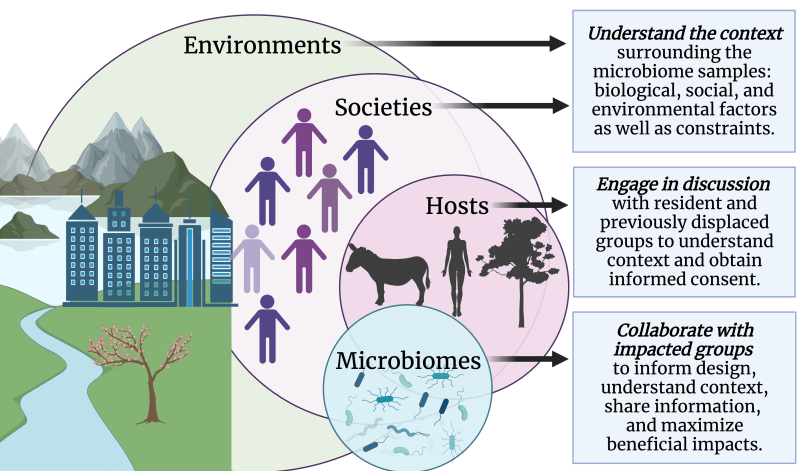
Featured image from Robinson et al. 2022.

Welcome Alexis, for the 2022 REU program!

The Research Experience for Undergraduates (REU) 2022 summer program has begun again, and the Ishaq Lab is pleased to welcome Alexis!

Alexis Kirkendall

Undergraduate Researcher, Biology, Heidelberg University

Alexis is from Ohio and is majoring in Biology at Heidelberg University. Her research interests are in genetics and she has a love for the fascinating world of microbes. She joined the lab through the Summer 2022 REU. She is researching Cryptosporidium in cows, helping in the MSE Symposium, and aiding in the Camel Rumen Microbiome Project this summer.

Across the U.S., REU programs are intended to engage undergraduates in research, including those who have no or very little research experience and no opportunity to do so at their home institution. The program I volunteer for is through the UMaine Initiative for One Health and the Environment, which brings about 10 students to campus for 10 weeks to engage in research and professional development. In addition to participating in research, the students attend workshops of coming up with research plans and questions, professional development plans, their resumes, posters, presentations, and other skills.

Ishaq Lab and MSE at ASM Microbe 2022 conference

Ishaq Lab posters

Initial Descriptions of the Microbes of Farmed Atlantic Sea Scallop (Placopecten magellanicus) Veligers and Rearing Tanks. S. Hosler, E. Grey, A. Dankwa, J. Perry, T. Bowden, B. Beal, S. Ishaq. Poster Session AES10 – Marine Microbiology, June 10, 2022, 10:00 AM – 5:00 PM Exhibit and Poster Hall. Presenter available during Poster Presentation 1 (10:30 am – 11:30 am) and Poster Presentation 2 (4 pm – 5 pm) at their assigned poster board.

Prevention of Inflammatory Bowel Disease by Broccoli Sourced and Microbially Produced Bioactives
J. M. Holman, S. Ishaq, Y. Li, T. Zhang, G. Mawe, L. Colucci, J. Balkan. Exhibit and Poster Hall. Poster session HMB06 Microbiome-Host Interactions III. June 12, 2022, 10:00 AM – 4:00 PM. Presenter available during Poster Presentation 1 (10:30 am – 12:30 pm).

The Microbes and Social Equity working group is hosting a special session

CTS16 (PPS). Microbes and Social Equity: the Microbial Components of Social, Environmental, and Health Justice

June 11, 2022, 1:45 PM – 3:45 PM, Room 206

Microorganisms are critical to many aspects of biological life, including human health. The collective microbial community, our microbiome, can be impacted by the details of our lifestyle, including diet, hygiene, health status, and more, but many are driven by social, economic, medical, or political constraints that restrict available choices that may impact our health. Access to resources is the basis for creating and resolving social equity, access to healthcare, healthy foods, a suitable living environment, and to beneficial microorganisms, but also access to personal and occupational protection to avoid exposure to infectious disease. This special session explores the way that microbes connect public policy, social disparities, and human health, as well as the ongoing research, education, policy, and innovation in this field.

5 Presentations

1:45 PM – 3:45 PMMicrobes and Social Equity: the Microbial Components of Social, Environmental, and Health Justice
Suzanne Ishaq; Univ. of Maine, Orono, ME
1:45 PM – 2:15 PMInvited Speaker
Monica Trujillo; Queensborough Community Coll., New York, NY
2:15 PM – 2:45 PMInvited Speaker
Ariangela Kozik; Univ. of Michigan, Ann Arbor, MI
2:45 PM – 3:15 PMInvited Speaker
Carla Bonilla; Gonzaga Univ., Spokane, WA
3:15 PM – 3:45 PMPanel Discussion

Upon completion of this Cross-Track Symposium, the participant should be able to:

  • Recognize the connections that microbiomes have to social equity. This will be demonstrated with examples/case studies presented by speakers.
  • Discuss relevant issues in microbiomes and their connection to social equity and identify issues which could be explored further.
  • Appraise your own work for these connections between microbiomes and social equity, to designate places for professional growth and applying equitable design.

After this session, MSE will be having an informal meet up, as most of us have never met in person!

Presentations and posters from some of our Microbes and Social Equity group members

Please note, the presenters’ names are bolded, and this is not to denote which author is part of MSE. We have included these in order to cross-promote talks, but these presentations may be independent of members’ MSE activities. This is a non-exhaustive list.

In-depth Symposium. EEB05. Interacting Stressor Effects on Microbial-Climate Change Feedbacks
June 10, 2022, 8:15 AM – 10:15 AM, room 144ABC, Convener, Adriana Romero-Olivares
 
8:15 AM – 8:45 AM
Fungal responses to drought and disturbance in a desert ecosystem and potential feedbacks to climate change, Adriana Romero-Olivares

9:30 AM – 9:45 AM
Soil Bacteria Adapt to a Warming World, K. M. DeAngelis, A. Narayanan, A. Eng, M. Choudoir
Benchmarking Software to Predict Antibiotic Resistance Phenotypes in Shotgun Metagenomes Using Simulated Data.
E. F. Wissel, B. M. Talbot, B. Johnson, R. Petit, III, V. Hertzberg, A. Dunlop, T. Read. SESSION Rapid Fire. S102. Rapid Fire: Omics and Machine Learning on the Fight against AMR. June 10, 2022, 8:15 AM – 9:05 AM/ Lounge and Learn 1.
A Model within a Model: Using Cheese Microbiomes to Investigate Host-Phage Interactions within a Community. T. Spencer, A. Sarabia, G. Heussler, S. Villareal, R. Dutton. Session HMB07 Phage-Host Interactions. June 10, 2022, 10:00 AM – 5:00 PM. Exhibit and Poster Hall.
Peril And Healthy Trichosporon Asahii: The Similar Capability To Adhere And Form Biofilms. S. H.S, S. Mandya Rudramurthy, N. Nayak. Poster. CPHM06 Diagnostic Mycology. June 10, 2022, 10:00 AM – 5:00 PM Exhibit and Poster Hall
Dispersal Limitation and Density-Dependent Processes Structure Streptomyces Populations at Small Spatial Scales. J. Hariharan, D. Buckley. Rapid Fire. S107. Rapid Fire: Ecology, Evolution, and Biodiversity. June 11, 2022, 8:15 – 9:05 AM. Lounge and Learn 2.
Comparison of Antibiotic Resistance in Biofilm, Sediment, and Planktonic Communities in an Urbanized River. M. B. Coughter, R. Franklin. Session AES03 – Antimicrobial Resistance in the Environment 2.  June 11, 2022, 10:00 AM – 5:00 PM  Exhibit and Poster Hall
Microbes and Social Equity: what is it and how do we do it?.
S. Ishaq. Session AES018 – Field Work & DEI: Fostering Equitable Partnerships with the Communities in Your Field. June 11, 2022, 11:45 AM – 12:30 PM. AES Track Hub, located in the Exhibit Hall.
Panel discussion: Encouraging culture change for open data
Pajau Vangay. Session ASM Town Hall Title: Advancing collaborative research with the National Microbiome Data Collaborative. Panel discussion: Encouraging culture change for open data.  June 11, 2022, 11:15 AM – 11:30 AM.  202AB
Antibiotic Resistance at the Human-Animal Interface in Southeast Asia.
M. Nadimpalli, M. Stegger, R. Viau, V. Yith, A. de Lauzanne, N. Sem, L. Borand, B-t. Huynh, S. Brisse, V. Passet, S. Overballe-Petersen, M. Aziz, M. Gouali, J. Jacobs, T. Phe, B. Hungate, V. Leshyk, A. J. Pickering, F. Gravey, C. M. Liu, T. J. Johnson, S. Le Hello, L. B. Price. SESSION Poster. EEB01 – Ecology of host-associated microbiomes. June 12, 2022, 10:00 AM – 4:00 PM. Exhibit and Poster Hall. Presenter available during Poster Presentation 1 (10:30 am – 12:30 pm).

MSE Research Design Skills course will be piloted this summer!

In conjunction with the Microbes and Social Equity virtual symposium being held in July, I will be piloting a special topics graduate course called AVS 590: Research skills combining microbes and social equity. Information about enrollment can be found through the UMaine Summer University program.

The symposium will convene researchers from different disciplines, foci, and geographic locations, and fosters in-depth conversations and research skills development. It is an ideal venue for training graduate students and incubating their burgeoning ideas. Thus, students in the class will attend the symposium, engage in conversations before and after attending sessions to reflect on how our perspectives changed, and create written assignments that will receive peer and instructor feedback. If the course is successful, I hope to add additional instructors and enrollment, we will expand the course and host it again each year we host the symposium.