
Ideation in Ontario

Last week in Guelph, Ontario, Canada, I had the unique please of “nerding out” with long-time colleagues (who I was meeting in-person for the first time) about microbial ecology questions that we wanted to answer, the science fiction we were reading, which metal band to listen to for the winter holidays, how to perform large-scale research on a tight budget, and whether the next season of whatever show had piqued our interest would be any good. The nerds-in-question are the Microbiome Stewardship research group, led by the intrepid Kieran O’Doherty, that I’ve been a part of for the past few years (and longer, counting the time we’ve collaborated through the Microbes and Social Equity working group).
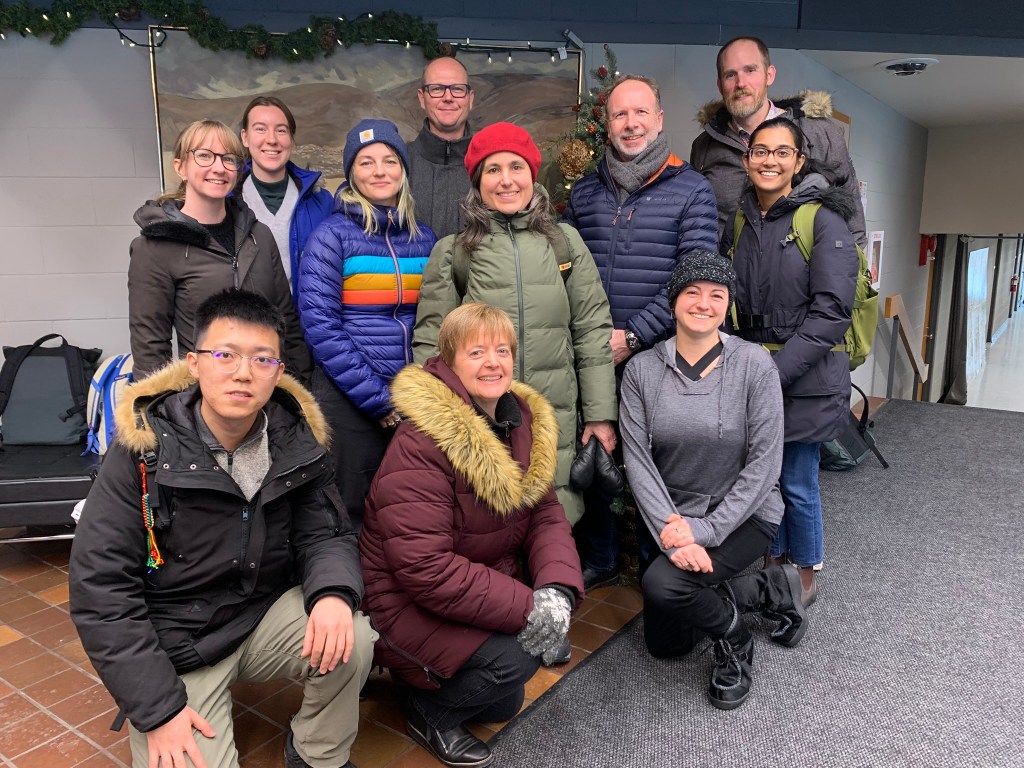
Group photo of Left to right; front: Zhongzhi (Michael) Sun, Emma Allen-Vercoe, Sue Ishaq; middle: Mikaela Beijbom, Mallory Choudoir, Sarah Elton, Kieran O'Doherty, Panuya Athithan; back: Grace Gabber, Andreas Heyland, Rob Beiko.
Left to right; front: Zhongzhi (Michael) Sun, Emma Allen-Vercoe, Sue Ishaq; middle: Mikaela Beijbom, Mallory Choudoir, Sarah Elton, Kieran O’Doherty, Panuya Athithan; back: Grace Gabber, Andreas Heyland, Rob Beiko.

Over two days, my microbiome stewardship colleagues and I (both original team and expansion pack researchers) shaped our concept of what it means to share microbes between individuals, communities, and ecosystems; what it would mean to consider microbes as a natural resources to which everyone had an innate right to; and how it would look for public and planetary health to reduce the harm of human industry and consumerism to live more sustainably and regain all the benefits that the microbial world can provide us. Our of this meeting, we imagined what the focus of our next year or two of research will look like, as individual researchers and as a group, as we embark on the next phase of our multi-year project: case studies of how microbiome stewardship could be tailored, implemented, and evaluated. These studies will be published as they are completed and pass peer review, in a scientific journal online (announcement forthcoming).

This research ideation meeting followed two years of conversation, presentations, a symposium (sessions can be viewed here), journal articles, and a whole lot of research-, personnel-, and travel-coordination on the part of our research wrangler, Mikaela Beijbom, who has been helping us to organize our words and activities for the past 8 months.

As this tumultuous and combative year comes to a close, and as I prepare to end the “break” which was my semester-long sabbatical and return to 50-hour work weeks, the precious opportunity to let our minds wander – through work, life, and play – was a brief return to the pure joy of scientific discovery which drew us all to our careers. This year, scientists have faced hurdle after hurdle placed by the very public research institutions which were created to help us seek knowledge on behalf of the public good. Funding cuts have reduced the scientific workforce; lost precious time, expertise, and data; and disrupted the innovation and ideation process which research forges. Yet, the time I spent with colleagues last week was a reminder that knowledge generation, public good, scientific inquiry, and collaboration are values which cannot be defunded, banned, or curtailed so easily. As for our group, we’ll keep meeting (virtually, at least) throughout 2026 and beyond, for the love of science.

The 2025 MSE Summit: Pathways to Microbiome Stewardship was a success!

Summary reposted from the MSE newsletter, now hosted by AMI! Subscribe to the newletter or join the group here.

MSE recently hosted its 5th annual summit, this year dedicated to exploring the concept of Microbiome Stewardship. Microbiome Stewardship is a concept that is intended to provide guiding insights, articulate responsibilities, and suggest practices aimed at maintaining microbial biodiversity and microbiome functioning across microbial habitats, which, in turn, supports the health and well-being of humans, animals, plants, and ecosystems. The summit consisted of two days of presentations (webinars) and two days of virtual workshop discussions.

We opened with two days of webinars featuring 12 speakers from wide-ranging fields of expertise, all focused on how social or environmental conditions impact health and microbiomes. This included an introduction to the concept of microbiome stewardship and guiding principles for its implementation, the need for diversification of fecal microbiome donors for health interventions, degradation of waterways and microbial transfer, the industrialization of food systems and the rise of antimicrobial resistance, the use of too-vague population descriptors in microbiome science, integrating systems-level thinking in microbiology curricula, and working with Indigenous communities on microbiome research. The webinars sparked imaginative and thoughtful questions from the 200 attendees (nearly 300 registrants), and set the stage for the subsequent two days of workshops. We also shared a working draft of the Microbiome Stewardship Guiding Principles document with attendees, and welcomed feedback. We hope to submit that manuscript for peer review and publication soon.


Workshop attendance was by application, and restricted to 50 attendees across the two days, which focused on host and environmental microbiomes, respectively. For each workshop day, attendees self-organized into breakout rooms focusing on different disciplines or themes. Speakers, MSE and Microbiome Stewardship researchers, and attendees discussed the challenges and opportunities for their respective fields, what was needed to achieve more integration between research and education or policy, and how to incorporate the principles of stewardship into their respective research. These conversations helped realize existing areas of  overlap between our work, and identify compatible expertise that was needed to explore these interdisciplinary research questions. Similar themes and challenges emerged across workshop days and discussion groups, highlighting opportunities to strengthen the microbiome stewardship and paths to implementation.

The live sessions were recorded to accommodate our global audience who were unable to make the session, and can be viewed here. While the workshops were not recorded, the thoughtful discourse from throughout the seminar and workshops will be used to inform that guiding principles publication-in-development, as well as future publications and output over the next 2-3 years from the collaborations which germinated during the breakout room sessions.