
It takes a village to write a scientific paper

Every scientist I know (myself included) underestimates how long it will take to write, edit, and submit a paper.  Despite having 22 publications to date, I still set laughably-high expectations for my writing deadlines.  Even though scientists go into a project with a defined hypothesis, objectives, and workflow, by the end of data analysis we often find ourselves surprised.  Perhaps your assumptions were not supported by the actual observations, sometimes what you thought would be insignificant becomes a fascinating result.  Either way, by the time you have finished most of the data analysis and exploration, you face the difficult task of compiling the results into a meaningful paper.  You can’t simply report your data without giving them context and interpretation.  I’ve already discussed the portions of scientific manuscripts and how one is composed, and here I want to focus on the support network that goes into this process, which can help shape that context that you provide to your data.

One of the best ways in which we can promote rigorous, thoughtful science is through peer-review, which can take a number of forms.  It is worth noting, that peer-review also allows for professional bullying, and can be swayed by current theories and “common knowledge”.  It is the journal editor’s job to select and referee reviewers (usually 2 – 4), to compile their comments, and to make the final recommendation for the disposition of the manuscript (accept, modify, reject).  Reputation, and personal demographics such as gender, race, or institutional pedigree can also play a role in the quality and tone of the peer-review you receive. Nevertheless, getting an outside opinion of your work is critical, and a number of procedural changes to improve transparency and accountability have been proposed and implemented.  For example, many journals now publish reviews names online with the article after it has been accepted, such that the review does not stay blind forever.

Thorough reading and editing of a manuscript takes time.  Yet peer-reviewers for scientific journals almost unanimously do not receive compensation.  It is an expected service of academics, and theoretically if we are all acting as peer-reviewers for each other then there should be no shortage.  Unfortunately, due to the pressures of the publish-or-perish race to be awarded tenure, many non-tenured scientists (graduate students, post-docs, non-tenure track faculty, and pre-tenured tenure-track faculty) are reluctant to spend precious time on any activity which will not land them tenure, particularly reviewing.  Moreover, tenured faculty also tend to find themselves without enough time to review, particularly if they are serving on a large number of committees or in an administrative capacity.  On top of that, you are not allowed to accept a review if you have a conflict of interest, including current or recent collaboration with the authors, personal relationships with authors, a financial stake in the manuscript or results, etc.  The peer-review process commonly gets delayed when editors are unable to find enough reviewers able to accept a manuscript, or when reviewers cannot complete the review in a timely manner (typically 2 – 4 weeks).

I have recently tried to solicit peer-review from friends and colleagues who are not part of the project before I submit to a journal.  If you regularly follow my blog, you’ll probably guess that one of the reasons I do this is to catch spelling and grammatical mistakes, which I pick out of other works with hawk-like vision and miss in my own with mole-like vision.  More importantly, trying to communicate my work to someone who is not already involved in the project is a great way to improve my ability to effectively and specifically communicate my work.  Technical jargon, colloquial phrasing, sentence construction, and writing tone can all affect the information and data interpretation that a reader can glean from your work, and this will be modulated by the knowledge background of the reader.

I’ve learned that I write like an animal microbiologist, and when writing make assumptions about which information is common knowledge and doesn’t need a citation or to be included at all because it can be assumed.  However, anyone besides animal microbiologists who have been raised on different field-specific common knowledge may not be familiar with the abbreviations, techniques, or terms I use.  It may seem self-explanatory to me, but I would rather have to reword my manuscript that have readers confuse the message from my article.  Even better, internal review from colleagues who are not involved with the project or who are in a different field can provide valuable interdisciplinary perspective.  I have been able to apply my knowledge of animal science to my work in the built environment, and insights from my collaborators in plant ecology have helped me broaden my approach towards both animals and buildings.

No scientific article would be published without the help of the journal editorial team, either, who proof the final manuscript, verify certain information, curate figures and tables, and type-set the final version.  But working backwards from submission and journal staff, before peer-review and internal peer-review, there are a lot of people that contribute to a scientific article who aren’t necessarily considered when contemplating the amount of personnel needed to compose a scientific article.  In fact, that one article represents just the tip of the iceberg of people involved in that science in some way; there are database curators, people developing and maintaining open-source software or free analysis programs, laboratory technicians, or equipment and consumables suppliers.  Broadening our definition of science support network further includes human resources personnel, sponsored projects staff who manage grants, building operational personnel who maintain the building services for the laboratory, and administrative staff who handle many of the logistical details to running a lab.  It takes a village to run a research institution, to publish a scientific article, to provide jobs and educational opportunities, and to support the research and development which fuels economic growth.  When it comes time to set federal and state budgets, it bears remembering that that science village requires financial support.


Featured Image Credit: Kriegeskorte, 2012
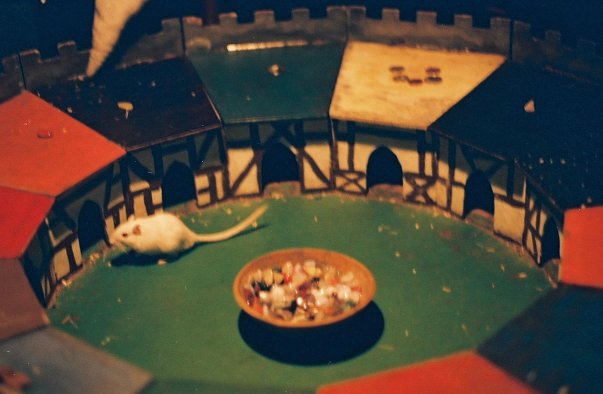
How is manuscript editing like roulette?

Because you play another round until your number wins!

Manuscript writing seems like it should be a straightforward ordeal. You explain the current body of research on the subject and identify the knowledge gap that your hypothesis fills, explain the rationale and objectives for the study, describe all the methods you used, present the data results, and then interpret them in the discussion. Oh and don’t forget the bibliography. Simple!

Oh contraire. Many manuscripts grow and then end up splitting into two or more, or you add a collaborative project on after the fact using the samples you’ve already collected. Sometimes you just say “let’s test these and see what happens”, and you don’t have a specific hypothesis except for “it could be cool”. Moreover, when you work in a very novel, difficult, unpopular, or boring field, there often isn’t a lot of previous research for you to read up on.  It makes it more challenging to write what should be the easiest section, the Introduction, because you don’t have much background to introduce.  While this does justify your work and the need for more research, it also makes it difficult to plan an experiment because you don’t know what outcomes or problems will crop up, and it can make your interpretation of the data problematic.

Methods: probably the worst section.

Sometimes you end up with more or less data than you planned. And most often, you didn’t just use commercial kit instructionDSCN1272s, you probably had to piece together methods from two to ten different journal articles, many of which were not verbosely described to maintain a sort of proprietary hold on the procedures, until you end up with a heavily-citationed Frankenstein’s monster of a Methods section. Not to mention that you probably had to mess around with procedures to find just the right settings on your equipment, so you have to go back through your lab notebook and try to tease apart what you did months or years ago. My suggestion: write the Methods while you are running the experiment. Whenever you finish a procedure that worked, type it up, especially if you are stuck waiting for something to process or grow anyway.
sue_23_smallg

In 2015, I worked on the DNA sequencing section of a project that had begun four years earlier when the original animal feeding trials were run, and which had been sequenced nearly a year prior to my taking over the data. Not only did the original Principal Investigator (PI) have trouble digging up the project files from four years ago, but the technician who had sequenced the data was no longer a member of the lab. Between the two, it was very difficult to track down what had been done, and which sequencing file name corresponded to which sheep sample. Even if you think the project will never be published, TAKE GOOD NOTES. Really specific, legible ones, trust me- you’ll thank me later.


Results and Discussion: Let’s be honest, the only two sections anyone actually reads.

exopolysaccahride
Exopolysaccharide production (white) prevents colonies from being ctained by red dye in the media.

Results is the easiest section to write, but possibly the most difficult to make appealing and understandable to a general scientific audience. Naturally, you need to know how to properly summarize your data and how to graph it. Seems easy: something about means and standard deviations, liberally sprinkle in some p-values…  But in reality, there are lots of ways to statistically validate or measure something, and most of these are minor variations on each other to accommodate slightly different data or situations. Maybe your data has a bell-curve normal distribution like people’s height in North America; maybe it’s heavily skewed to one side, like my preference for maple-frosted donuts over celery. Or you need an ordination plot that takes non-Euclidean distance samples and graphs their relationship to each other by plotting one point, then rotating the axis and plotting another until you’ve plotted all your points. No matter how sophisticated your presentation techniques, if someone can’t look at your graph and the graph summary out of context and understand what you are measuring, you haven’t done your job well. I’ve heard many scientific authors complain that a reviewer demanded changes to the manuscript because they did not under the results or statistical analysis. That can be frustrating, and sometimes it feels like the reviewer is just being obtuse, but as scientific authors it’s our job to properly explain what we did.

acid production
Acid production from different carbohydrates by Streptococcus gallolyticus shown by a pink color change.

The Discussion section is always my favorite, because now you interpret your results into the context of other findings and speculations- in short, you finally get to tell the story of what is happening and why in a more interesting way.

The rest is just details. The Conflict of Interest section is always very interesting. Here you must disclose any conflicts you have, anything from a funding source that paid for your work and may or may not have had input in the experimental design (sometimes commercial companies will contract researchers to do a specific experiment that they more-or-less designed), or that the commercial lab you sent your samples to be tested at has you on the payroll. The Conflict of Interest is usually blank for studies coming out of academic universities, but it’s a good way to track down researchers who might be biased towards or against something.

sue_25_small

You have an acknowledgements section where you can thank personnel that may have assisted you in some small way, someone who you bounced ideas off of in planning and interpretation, someone who gave you samples to work with free of charge. In my case, I most often thanked the hunters who had dutifully collected a jar of rumen (stomach) contents, and sometimes colon contents, from moose while they were field dressing. Or the numerous undergrads that helped feed my newborn lambs five times a day until they were weaned.

Last but not least, the Bibliography or References Cited. Sounds easy enough. But you’d be surprised how pesky it can be. Different journals often want different formatting for your submission, some want authors lists to look like “Last, First; Last, First”, or maybe “Last, F., Last, F.”, or even “Last F, Last F”. Some want years in parentheses, others don’t. Some want issue number, or the journal name to be abbreviated, or a certain part of the reference to be bolded. Trying to reformat 50-100 references for submission to a different journal can be a nightmare. Luckily, there are plenty of citation managers that will create a digital library for your references, and allow you to search for citations while you are writing. Then, you hit “Insert Bibliography” and it numbers or alphabetizes it, and puts them into the desired format. That is, assuming you had put all the correct bibliographic information in. I like Mendeley because I can import references from my web browser; however, on older PDFs sometimes it can’t pick up the info it needs and you have to do it manually. I’ve gotten some interesting inputs for authors’ names when it gets confused.

Manuscript writing can take months, especially with complicated projects or those with many co-authors, as all co-authors need to approve the final version before it can be submitted. Once submitted, a Journal Editor will send the manuscript out to two or three Journal Reviewers, who are researchers in academia or industry that are in that field of expertise and can opt to volunteer to read and review the article. Nearly always, the authors do not know who the reviewers are, and in many cases the reviewers do not know who the authors are, although it is helpful for reviewers to see the authors’ names. If they have a conflict of interest with the author, such as they  don’t get along personally, they might be married, or they are currently working on another project together (anything that might bias them for or against), the reviewers are supposed to decline to review. Reviewers have two to four weeks, depending on the journal, but some will submit their reviews late. The Editor considers all the reviews and makes their final decision to accept as is, accept with minor revisions, accept with major revisions, decline with major revisions (authors may edit and submit a new manuscript for consideration), or decline.  It takes a few weeks to find reviewers, several more to get the revisions in, and another one or two for the editor to make a decision, so this can take anywhere from six weeks to four months.

Often journals will decline without reviewing if they are not interested in the subject material or feel it is outside the scope of the journal. If you have revisions, some journals request that you submit two new versions of the manuscript- one with the changes highlighted. Additionally, you need to address each reviewer comment by explaining what you did. For spelling mistakes, this is as simple as writing “corrected” after the comment. For more complex things, you need to explain the change along with quoting the new text, or explain why you aren’t changing things. If the Editor and Reviewers do not feel that you made all the changes, they may reject the re-submission or send you more edits. Usually they send you more edits that they didn’t notice the first time.

Eventually, a journal might accept your manuscript, and then you only have to approve the author proofs – unless your figures don’t have 18746_603831005730_3060064_na high enough resolution, and then you need to remake them or figure out how to increase your dpi.  Typically it takes between six months to a year to complete the whole peer-review process, depending on the study results and the journal’s internal process.

While tedious and arduous, the manuscript peer-reviewing procedure works very well. Experts in your field can assess the validity of your work, and experts in related fields can give you an outside perspective, especially when you have gotten used to using a very specific jargon or not completely explaining things. Most importantly, it improves the quality of the writing and presentation, and it maintains a standard of integrity and excellence. By the end of the submission process, you are dizzy and you want to get off the ride. But by the time you get through the next project, or eat a soft pretzel, you’ll be ready to climb back on that carousel horse.