Congratulations to Alexis Kirkendall, PhD candidate in the Microbiology Program, for passing her comprehensive exam!! The exam involved writing a research proposal on a topic outside of her main focus, and presenting her idea for an hour to her faculty committee, who then asked detailed questions about her work and understanding of this research for almost two hours.
Over the next two or three years, her dissertation research will focus on culturing bacteria that we previously isolated from mice consuming a steamed broccoli sprout diet, to test their capacity to grow amongst the gut pathogen Helicobacter pylori and produce the anti-inflammatory sulforphane under different conditions, as well as which bacteria produce sulforaphane in the gut, how they do it, and under which circumstances. It complements the collective lab research on how broccoli sprouts and gut microbes can be used to resolve Inflammatory Bowel Disease.
Alexis Kirkendall
Doctor of Philosophy candidate, Microbiology
Alexis is from Ohio and initially joined the lab in 2022 when she was majoring in Biology at Heidelberg University, through the Summer 2022 REU, during which she divided her time researching Cryptosporidium in cows, helping in the MSE Symposium, and aiding in the Camel Rumen Microbiome Project. Alexis continued her work remotely, and returned to Maine in summer 2023 as a research assistant for several projects related to gut microbes, diet, and Inflammatory Bowel Disease. Her research interests are in genetics and she has a love for the fascinating world of microbes.
She returned in January 2024 as a graduate student in the Microbiology program!
Lab rockstar, Marissa Kinney, successfully defended her master’s thesis today!!! After a well-earned holiday break, Master Kinney is pursuing a career in biomedical/microbiological research.
Marissa was Master of Science student in Microbiology, and a researcher in the One Health and the Environment program, both of which are prestigious graduate programs at UMaine, from Jan 2023 – Dec 2024. She loves learning and bench microbiology, and she employed these passions on multiple lab projects investigating the bacteria which transform glucoraphanin in broccoli sprouts into the anti-inflammatory sulforaphane in the gut. The focus of her time has been to develop new lab protocols, refine existing ones and make them easier for new lab members to learn, and to share her expertise by teaching other students in the lab. She’s excelled at these objectives so well, that in the past two years many people assumed she was a Lab Manager rather than a student.
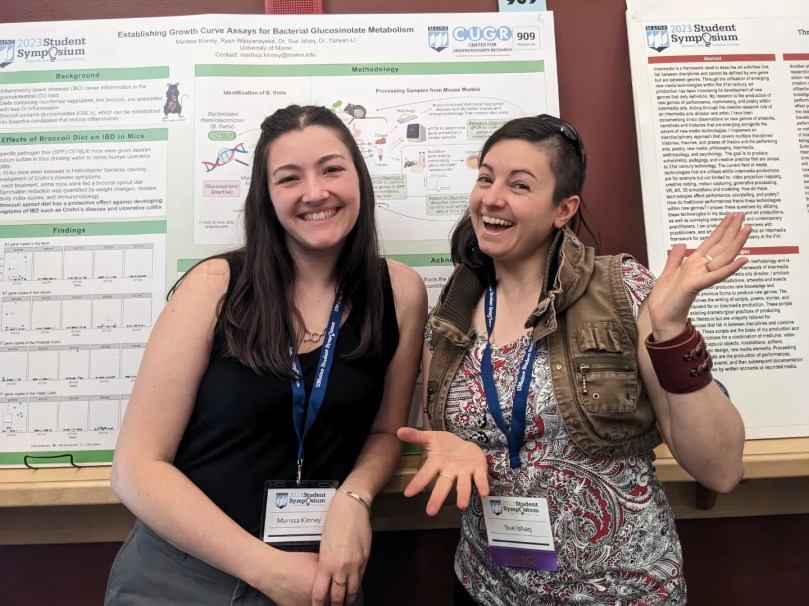
Marissa has been extremely productive in the last two years: in her first three months she contributed lab work to two publications on broccoli sprout diets in mouse models of Inflammation Bowel Disease in 2023, and has since contributed to another manuscript currently in review on glucoraphanin supplements and gut microbiome changes in people, and two more manuscripts in preparation on culturing gut microbiota, and a broccoli sprout diet in people. It’s no surprise that Marissa has been an author on so many papers in so little time — she led a publication when she was an undergraduate! You can check her Google Scholar page for more info on these papers. Marissa has also presented this work on campus at the UMaine Student Research Symposium twice, as well as attended conferences for the American Society for Nutrition and the American Society for Microbiology for professional development.
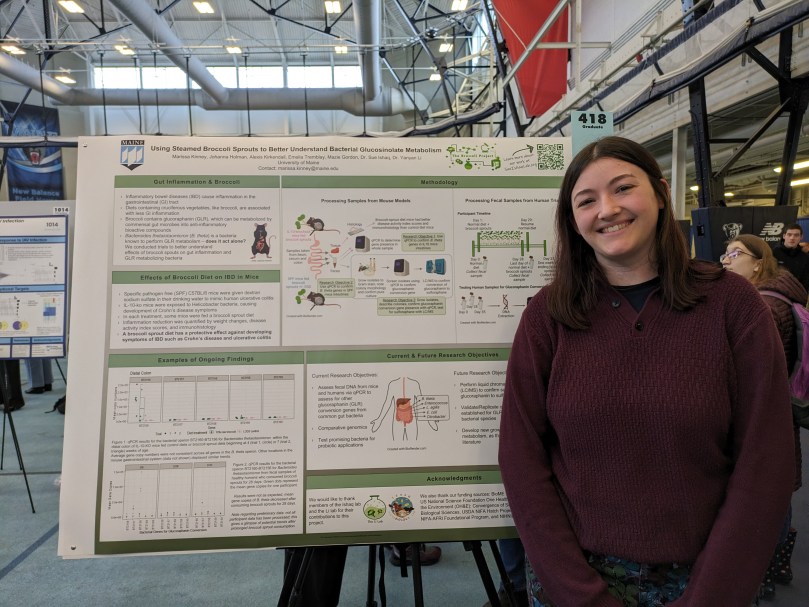
Marissa Kinney presenting research.
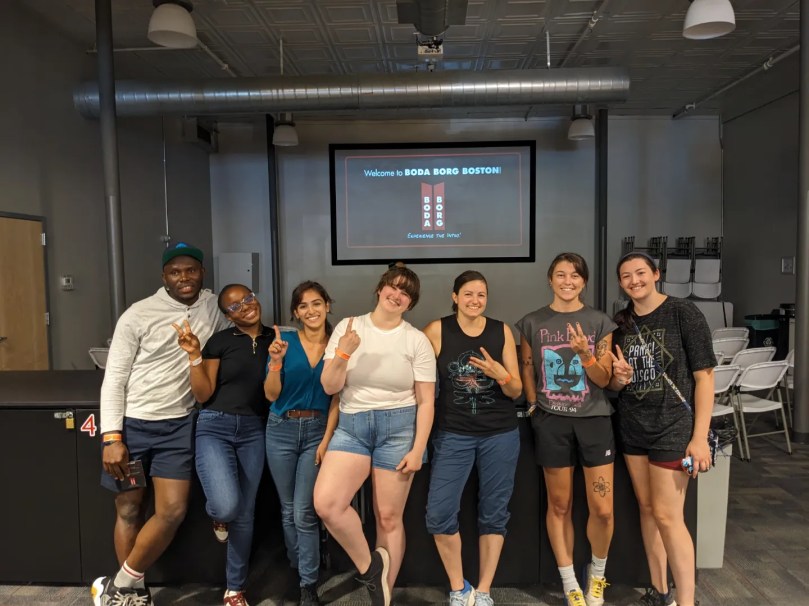
The Ishaq Lab at Boda Borg in Boston, summer 2023. We are showing how many quests we completed.
Lab lunch with Mira Talalay, Sue, and Marissa Kinney
Previous to being in the lab, Marissa completed her undergraduate at the University of Maine in 2021, earning a BS in Microbiology and a BS in Cellular/Molecular Biology. She devoted a large portion of her time in undergrad to research in the laboratories of Dr. Julie Gosse and Dr. Edward Bernard. After graduating, she worked in the field of public health at UMaine’s Margaret Chase Smith Policy Center, collecting and processing data about violent and drug-related deaths in Maine. While her role at the Center was one she loved dearly, she felt a big pull towards laboratory work and academic research, and her graduate work enforced this passion. Marissa has been a core member of the lab, and we’ll miss her!! She plans to pursue a research career here in Maine after defending and enjoying a well-earned vacation.
USING BROCCOLI SPROUT DIETS TO UNDERSTAND GUT BACTERIAL GLUCOSINOLATE METABOLISM TO RESOLVE INFLAMMATORY BOWEL DISEASE
Abstract
Globally, millions of people have been diagnosed with a type of inflammatory bowel disease (IBD). These diseases cause dysfunction of the gastrointestinal (GI) tract, resulting in a wide range of symptoms that create a disruption in overall health. Research has suggested that diet and the microbial community composition of the gut microbiome play a significant role in regulating gastrointestinal inflammation. Specifically, studies have shown that diets high in cruciferous vegetables, such as broccoli, are associated with a reduction in gastrointestinal inflammation. Glucoraphanin is a compound present in broccoli that can be metabolized by gut bacteria to become an anti-inflammatory compound known as sulforaphane. Our initial research showed that the administration of a broccoli sprout diet to mouse models for Crohn’s disease and ulcerative colitis, two major types of IBD, yields inflammation reduction and symptom resolution. For these trials, fecal samples obtained from different sections of the mouse bowel were tested for presence of glucoraphanin-metabolizing genes present in a common gut bacteria, Bacteroides thetaiotaomicron (B. theta). Glucoraphanin conversion is higher and more reliable in mice than in people, however mouse models are not perfect representatives of humans. Hoping to understand the impacts of broccoli sprouts on the human gut microbiome, fecal samples were obtained from healthy individuals who consumed broccoli sprouts for 28 consecutive days, as long-term diet interventions are needed to meaningfully change gut microbial communities. In a separate trial conducted by the scientists at Brassica Protections Product, fecal samples were collected from people who were administered a single dietary supplement containing a high dose of glucoraphanin with and without plant-sourced myrosinase, as a means of evaluating the effectiveness of glucoraphanin conversation which was or was not reliant on gut microbiota, respectively. These samples were analyzed for glucoraphanin metabolizing genes from B. theta and other commensal gut bacteria. Data collected from these human trial experiments aided in understanding the impacts of a whole food broccoli sprout diet and supplementation of glucoraphanin on the bacterial community composition of the gut microbiota. Additionally, this work will help grow and strengthen the current knowledge on broccoli as an anti-inflammatory and the variabilities present in the gut microbiomes of humans.
Congratulations to Lola Holcomb, PhD candidate in the Graduate School for Biomedical Sciences and Engineering program, for winning a graduate student research award from the Bioscience Association of Maine!!
Over the next few months, she’ll focus on characterizing candidate anti-inflammatory bacterial species and genes of the gut microbiome, using whole genome sequence data from bacteria we previously isolated during a broccoli sprout diet study. This is part of Lola’s larger PhD project investigating which bacteria produce sulforphane in the gut, how they do it, and under which circumstances. It complements the collective lab research on how broccoli sprouts and gut microbes can be used to resolve Inflammatory Bowel Disease.
Lola Holcomb, B.S.
Doctorate of Philosophy candidate, Biomedical Science
Lola entered as a rotating first-year GSBSE student in March 2022, and declared the Ishaq Lab her dissertation lab soon after. Troubled with indecisiveness and the desire to research, well, everything, she quickly found that using bioinformatics and big data as a lens to study microbial ecology (and in time, its relation to social equity) allowed her to do the kind of meaningful interdisciplinary research she’s always wanted to do. Lola is currently working on 16s data analysis for other ongoing lab projects, comparing gut microbiomes of mouse models of Inflammatory Bowel Disease with broccoli as a dietary treatment. Lola is currently doing 16S data analysis for ongoing lab projects and developing a metagenomic analysis workflow to compare gut microbiomes of mouse models of Inflammatory Bowel Disease with broccoli as a dietary treatment. In addition to research, she instructs a graduate-level Genetics course, tutors several Biology undergraduate students, and serves as a GSBSE senator in the Graduate Student Government here at UMaine.
Congratulations to Alexis Kirkendall, PhD student in the Microbiology Program, for winning a graduate student research award from the Bioscience Association of Maine!!
Over the next year, she’ll focus on culturing bacteria that we previously isolated from mice consuming a steamed broccoli sprout diet, to test their capacity to grow amongst the gut pathogen Helicobacter pylori and produce the anti-inflammatory sulforphane under different conditions. This will be part of Alexis’ larger PhD project investigating which bacteria produce sulforaphane in the gut, how they do it, and under which circumstances. It complements the collective lab research on how broccoli sprouts and gut microbes can be used to resolve Inflammatory Bowel Disease.
Alexis Kirkendall
Doctor of Philosophy student, Microbiology
Alexis is from Ohio and initially joined the lab in 2022 when she was majoring in Biology at Heidelberg University, through the Summer 2022 REU, during which she divided her time researching Cryptosporidium in cows, helping in the MSE Symposium, and aiding in the Camel Rumen Microbiome Project. Alexis continued her work remotely, and returned to Maine in summer 2023 as a research assistant for several projects related to gut microbes, diet, and Inflammatory Bowel Disease. Her research interests are in genetics and she has a love for the fascinating world of microbes.
She returned in January 2024 as a graduate student in the Microbiology program!
Lab rockstar, Marissa Kinney, is set to defend her Master’s of Science thesis in Microbiology on Wednesday, December 18th!! The thesis abstract is below.
You can register here for the publicly available seminar portion from 1 – 2 pm ET on Zoom
Marissa has been a Master of Science student in Microbiology, and a researcher in the One Health and the Environment program, both of which are prestigious graduate programs at UMaine, for the last two years. She loves learning and bench microbiology, and she employed these passions on multiple lab projects investigating the bacteria which transform glucoraphanin in broccoli sprouts into the anti-inflammatory sulforaphane in the gut. The focus of her time has been to develop new lab protocols, refine existing ones and make them easier for new lab members to learn, and to share her expertise by teaching other students in the lab. She’s excelled at these objectives so well, that in the past two years many people assumed she was a Lab Manager rather than a student.
Marissa has been extremely productive in the last two years: in her first three months she contributed lab work to two publications on broccoli sprout diets in mouse models of Inflammation Bowel Disease in 2023, and has since contributed to another manuscript currently in review on glucoraphanin supplements and gut microbiome changes in people, and two more manuscripts in preparation on culturing gut microbiota, and a broccoli sprout diet in people. It’s no surprise that Marissa has been an author on so many papers in so little time — she led a publication when she was an undergraduate! You can check her Google Scholar page for more info on these papers. Marissa has also presented this work on campus at the UMaine Student Research Symposium twice, as well as attended conferences for the American Society for Nutrition and the American Society for Microbiology for professional development.
Marissa Kinney presenting research.
The Ishaq Lab at Boda Borg in Boston, summer 2023. We are showing how many quests we completed.
Lab lunch with Mira Talalay, Sue, and Marissa Kinney
Previous to being in the lab, Marissa completed her undergraduate at the University of Maine in 2021, earning a BS in Microbiology and a BS in Cellular/Molecular Biology. She devoted a large portion of her time in undergrad to research in the laboratories of Dr. Julie Gosse and Dr. Edward Bernard. After graduating, she worked in the field of public health at UMaine’s Margaret Chase Smith Policy Center, collecting and processing data about violent and drug-related deaths in Maine. While her role at the Center was one she loved dearly, she felt a big pull towards laboratory work and academic research, and her graduate work enforced this passion. Marissa has been a core member of the lab, and we’ll miss her!! She plans to pursue a research career here in Maine after defending and enjoying a well-earned vacation.
USING BROCCOLI SPROUT DIETS TO UNDERSTAND GUT BACTERIAL GLUCOSINOLATE METABOLISM TO RESOLVE INFLAMMATORY BOWEL DISEASE
Abstract
Globally, millions of people have been diagnosed with a type of inflammatory bowel disease (IBD). These diseases cause dysfunction of the gastrointestinal (GI) tract, resulting in a wide range of symptoms that create a disruption in overall health. Research has suggested that diet and the microbial community composition of the gut microbiome play a significant role in regulating gastrointestinal inflammation. Specifically, studies have shown that diets high in cruciferous vegetables, such as broccoli, are associated with a reduction in gastrointestinal inflammation. Glucoraphanin is a compound present in broccoli that can be metabolized by gut bacteria to become an anti-inflammatory compound known as sulforaphane. Our initial research showed that the administration of a broccoli sprout diet to mouse models for Crohn’s disease and ulcerative colitis, two major types of IBD, yields inflammation reduction and symptom resolution. For these trials, fecal samples obtained from different sections of the mouse bowel were tested for presence of glucoraphanin-metabolizing genes present in a common gut bacteria, Bacteroides thetaiotaomicron (B. theta). Glucoraphanin conversion is higher and more reliable in mice than in people, however mouse models are not perfect representatives of humans. Hoping to understand the impacts of broccoli sprouts on the human gut microbiome, fecal samples were obtained from healthy individuals who consumed broccoli sprouts for 28 consecutive days, as long-term diet interventions are needed to meaningfully change gut microbial communities. In a separate trial conducted by the scientists at Brassica Protections Product, fecal samples were collected from people who were administered a single dietary supplement containing a high dose of glucoraphanin with and without plant-sourced myrosinase, as a means of evaluating the effectiveness of glucoraphanin conversation which was or was not reliant on gut microbiota, respectively. These samples were analyzed for glucoraphanin metabolizing genes from B. theta and other commensal gut bacteria. Data collected from these human trial experiments aided in understanding the impacts of a whole food broccoli sprout diet and supplementation of glucoraphanin on the bacterial community composition of the gut microbiota. Additionally, this work will help grow and strengthen the current knowledge on broccoli as an anti-inflammatory and the variabilities present in the gut microbiomes of humans.
Events will be hosted January – December, 2024, on the last Friday of every month, 12:00 – 14:00 pm ET. Presented over Zoom.
After each talk, we will continue the discussions in an informal social meeting with MSE. All speakers and members of the audience are welcome to join the social meeting.
Hosted by: Sue Ishaq, MSE, and finacially supported by the University of Maine Institute of Medicine and the UMaine Cultural Affairs/Distinguished Lecture Committee.
“Linking Plant, Animal, and Human Health in Livestock Systems: a Metabolomics Approach.”
Dr. Stephan van Vliet, Phd.
Apr 26, 2024 12:00 PM Eastern Daylight Time. This event has passed, watch the recording here.
Dr. Stephan van Vliet is a nutrition scientist with metabolomics expertise in the Center for Human Nutrition Studies at Utah State University. Dr. Stephan van Vliet earned his PhD in Kinesiology as an ESPEN Fellow from the University of Illinois at Urbana-Champaign, and received training at the Washington University in St Louis School of Medicine and Duke University School of Medicine. Dr. van Vliet’s research is performed at the nexus of agricultural and human health. He routinely collaborates with farmers, ecologists, and agricultural scientists to study critical linkages between sustainable agriculture, the nutrient density of food, and human health. His work has been published in the American Journal of Clinical Nutrition, Scientific Reports, the Journal of Nutrition, and the Journal of Physiology.









 The Ishaq Lab