Li and Ishaq labs receive NIH R15 award to study broccoli bioactives, gut microbes, and inflammation!

The Li and Ishaq labs at UMaine, along with collaborators from multiple institutions, have been awarded R15 funding from the National Institute Of Diabetes And Digestive And Kidney Diseases of the National Institutes of Health!

This award will complement other projects/awards led by our team, which has been investigating inflammatory bowel diseases, anti-inflammatories, gut microbes, and nutrition, separately for decades and collaboratively for over two years.

  • Dr. Yanyan Li, PhD (lead PI), Assistant Professor at the University of Maine with expertise in nutrition and food science, particularly dietary bioactives and colitis;
  • myself (co-PI), with expertise in host-associated microbiology, especially GI tract;
  • Dr. Grace Chen, MD, PhD (co-I), Associate Professor at the University of Michigan, expertise in mouse models for gut microbiome and colonic host immune responses;
  • Dr. Tao Zhang, PhD (consultant), Assistant professor at Binghamton University, with expertise in metabolism, kinetics, and bioanalysis of natural products;
  • Dr. Gary Mawe, PhD (consultant), Professor at the University of Vermont, with expertise in translational research on GI tract regulation, inflammation, and IBD;
  • Dr. Peter Moses, MD (consultant), Professor Emeritus at the University of Vermont College of Medicine and Senior Researcher at GSK, with expertise in IBD and functional gastrointestinal disorders.

R15 Research Enhancement Awards are designated for projects which involve a large number of student researchers. Between the Li and Ishaq labs, there are three current graduate students, and two former undergrads who have contributed to this research, and we anticipate bringing in 1-2 additional graduate students and almost a dozen undergrads in the next year! That will include undergrads in Honors, Top Scholars, and Capstone programs at UMaine. We’ve also been assisted by the work of students, postdocs, technicians, and investigators through our collaborators, and we are ecstatic about the opportunity to continue to grow our team across institutions. And, this project will generate research that will feed back into education at UMaine through the courses that we teach, such as my microbiomes and DNA sequence analysis courses.

“Harnessing gut microbiota to reduce inflammation using broccoli-sprout diets.”

Project Summary:

Inflammatory bowel disease (IBD) is a poorly understood gastrointestinal (GI) condition characterized by inflammation. The prevailing theory is that combined genetic and environmental factors disrupt the host immune system’s interaction with gut microbiota. Our central hypothesis is that consumption of specific broccoli sprout preparations elicits changes in the gut microbiota that not only improve the production of anti-inflammatory bioactives, but also promote intestinal homeostasis. Our labs have shown there is an anatomical pattern along the GI tract where broccoli sprout-derived bioactive levels are high which correspond to diet-induced changes in gut microbial communities. We showed that gut microbiota contribute to the transformation of inactive precursors to bioactives, and that specific broccoli sprout preparations alter their capacity for biotransformation, and the susceptibility of mice to colitis. However, a significant knowledge gap remains regarding the mechanisms by which dietary bioactives modify disease risk and the role of gut microbiota. Our immediate goal is to identify the mechanisms by which broccoli sprout diets affect susceptibility to IBD in mice. Our long-term goal is to develop a dietary preparation of
broccoli sprouts which has therapeutic effects against IBD in humans. Our innovative approach uses different preparations of broccoli sprouts to help differentiate gut microbiota versus plant-derived
enzymatic activities. We employ a combination of “omics” approaches to spatially-map the microbial community and metabolite profile changes along the GI tract, to better assess changes induced by broccoli sprout diets. We complement “omics” approaches with culturing, and validate our study design using two complementary models for strategic research.

A cartoon of three gastrointestinal tracts showing the locations of inflammation in ulcerative colitis, crohn's disease, or healthy tissue. At the bottom are cross-sections showing thickening of the intestinal wall in patients with Crohn's, and ulcers in patients with colitis.
Created by Johanna Holman.

Aim 1 tests the hypothesis of an anatomical pattern where the GI tract microbiota transform broccoli compounds into bioactives, and helps us determine whether this microbial biotransformation is sensitive to dose of broccoli compounds. We will use our established DSS-mouse-model of ulcerative colitis to investigate the effects of different broccoli sprout preparations and concentrations on the microbiota along the GI tract; on the resulting concentration of bioactives in gut tissues; and on the development of colitis in mice.

A cartoon schematic of the experimental design of the project. Four mice are at the top, two have "DSS" written above them, one of which is also holding a broccoli sprout. One of the mice without DSS written on it is holding a broccoli sprout. Below the mice is a cartoon of the digestive tract with arrows emanating from it to indicate samples of microbes will be taken from different locations. The microbe images have arrows pointing to culturing equipment, and also to a biochemical pathway showing the compound glucoraphanin being converted to sulforaphane.
Created by Sue Ishaq, made with Biorender

Aim 2 tests the benefits of using an immunosuppressed mouse model in the dietary prevention study to provide a stronger translational strategy for the use of broccoli sprouts for IBD prevention. When exposed to a specific bacterial pathogen, the immunosuppressed mice develop chronic enterocolitis resembling Crohn’s disease. This diet-based approach provides critical information for developing accessible and equitable strategies for improving health of IBD patients.

A cartoon schematic of the experimental design of the project. Two mice are at the top, with the label "IL-10" crossed out above them. One mouse is also holding a broccoli sprout.  Below the mice is a cartoon of the digestive tract with arrows emanating from it to indicate samples of microbes and tissue will be taken from different locations. The words weight and plasma indicate those will also be collected. The plasma and tissue samples will be used for mass-spectroscopy and histology, and the microbes will be used for DNA sequencing.
Created by Sue Ishaq, made with Biorender

Johanna receives a UMaine College of Natural Sciences, Forestry, and Agriculture Graduate Student Award for her research!

Johanna Holman received the 2022 Norris Charles Clements Graduate Student Award from the University of Maine College of Natural Sciences, Forestry, and Agriculture (NSFA), for her research and academics over the last two years for her Master’s of Science in Nutrition!! This award highlights the achievements and potential for positive impact of graduate students in agriculture, is more often awarded to doctoral students who have had more years of graduate work in which to accomplish their research, give presentations, mentor undergraduates, and otherwise develop their professional skills.

Person in a research facility holding up their arm with a mouse on it. Person is wearing a hairnet, nitrile gloves, surgical mask, and a surgical gown. They are holding their left arm up to the camera to show off a mouse with dark brown fur sitting on their arm. In the background is a metal shelf with containers of research materials.

Despite the setbacks and challenges of the pandemic, Johanna has been extremely productive and has done an extraordinary amount in just a year and a half (from start to the time of application submission) for her masters work. Johanna is currently writing up the results of her masters work into three manuscripts that we plan to submit to scientific journals for peer review this summer. She will defend her thesis at the end of the summer, just in time to start in September as a PhD student working with Dr. Yanyan Li and I!

Artwork by Johanna Holman

From the NSFA award page: “The Norris Charles Clements Graduate Student Award was established in the University of Maine Foundation in May 1997 for the benefit of the University of Maine, Orono, with a bequest from Laurel Clements ’48 in honor of her father, Norris Charles Clements, a distinguished Maine poultry farmer who in 1953 was honored by the University of Maine as Maine’s Outstanding Farmer. Income shall be used to provide financial assistance for rewarding outstanding graduate students in agricultural sciences and to recognize the accomplishments of graduate students whose studies have the potential to make a significant contribution to Maine agriculture. Candidates should have training and be doing research in disciplines related to Maine agriculture, such as agronomy, soil science, animal and veterinary sciences, agricultural economics, entomology, plant pathology, agricultural engineering and other disciplines the dean deems contribute significantly to the well being of Maine agriculture. Students will be chosen for awards on the basis of their high academic standing, the quality of their research and their personal integrity.”

Of mice and many samples

The first mouse study of the Ishaq Lab (in conjunction with the Zhang and Li labs at Husson University) has concluded phase 1, which means that over a few short days, an incredible number of samples needed to be collected, preserved, and processed for further laboratory work (phase 2) which will take through the summer to complete.

Sample collection was made more challenging by the pandemic, because we needed to distance as much as possible, disinfect objects and surfaces, wear masks, and increase the amount of ventilation in a space. Luckily, this type of work lends itself to these types of precautions – not only did we already need to wear a significant amount of protective gear to work with mice or handle their feces, but biosafety work like this requires higher than usual ventilation and frequent sanitation of objects and spaces. Since some of this work could be performed simultaneously in different rooms, we were able to use both Ishaq lab spaces and the ‘mouse house’ to keep people distanced.

During the 40-day mouse study, ‘Team Broccoli’ collected:

  • 640 mouse body weight data measurements
  • 433 fecal samples, which were archived for possible culturing and/or sequencing
  • 400 additional samples collected over two days:
    • 40 blood samples for immune factor identification
    • 360 gut samples
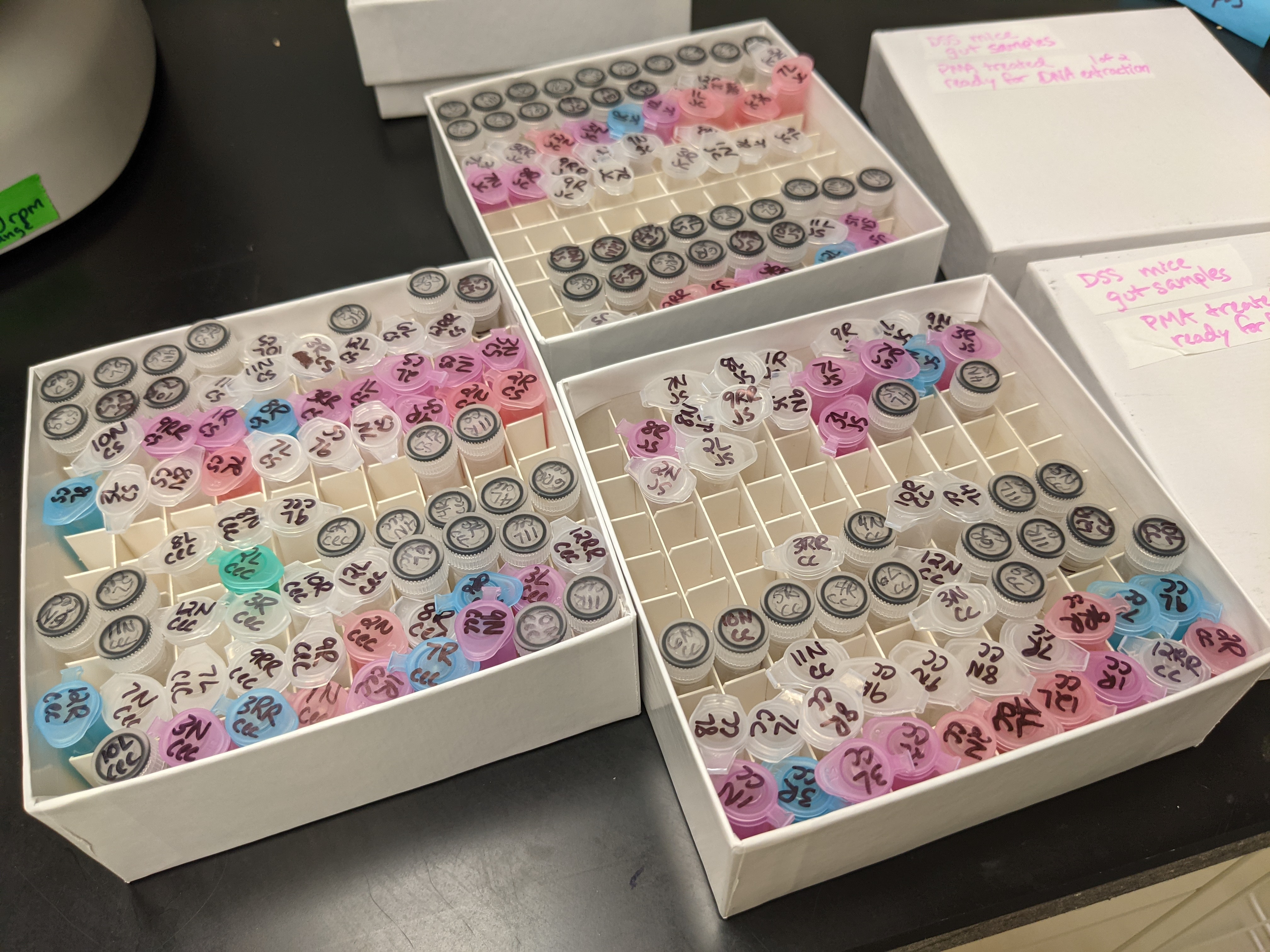
      • Of which, 200 were PMA treated within 12 hours of collection for use in DNA sequencing
      • 160 of which will be cultured to isolate bacteria. This will create 1 ~ 8 isolates per sample that will need to be grown on its own plate, transferred to broth media, and then frozen with glycerol at -80C until they can be revived and studied later this year.