Events will be hosted January – December, 2024, once a month on a Friday, 12:00 – 14:00 pm ET. Presented over Zoom.
After each talk, we will continue the discussions in an informal social meeting with MSE. All speakers and members of the audience are welcome to join the social meeting.
Hosted by: Sue Ishaq, MSE, and finacially supported by the University of Maine Institute of Medicine and the UMaine Cultural Affairs/Distinguished Lecture Committee.
Dr. Aidee Guzman is an assistant professor at Stanford University in the Department of Biology in the Ecology and Environmental Science group. Her research group examines agroecological approaches that could harness biodiversity and ecosystem functioning for improved agricultural resilience. Specifically, they investigate how agricultural management impacts biotic interactions (e.g. between plants, insects, and soil microbes) across scales (e.g. shifts in community structure, cascading changes in ecosystem functioning). The overarching goal of her research program is to support farmers, especially those who are historically underserved, through research, education, and outreach that builds on their innovations and demonstrates ecological pathways to agricultural resilience.
I’m delighted to announce the public release of a white paper on queer- and trans-inclusive faculty hiring practices, and a perspective piece introducing it!! This is the culmination of months of writing by an international group of talented scientists led by Dr. JL Weissman, and I was honored to participate in these and future efforts from the group.
The newly-formed group, Advancing Queer and Trans Equity in Science (AQTES), wants to improve the field of research by making the hiring process fair and welcoming for everyone. No matter what your personal identity is, we can all agree that fair and unbiased job searches are critical to hiring the best talent. But, sometimes a poorly-organized job search prevents the people with the best talent from applying at all.
In our white paper, we give suggestions on how to host a job search that is better for everyone. We provide examples and advice on how to write job adverts, create the agenda and atmosphere for the job search, how to make the interview process more accessible for everyone by remembering that we are humans and not robots, and how to support your new faculty.
Weissman, JL, Chappell, C.R., Rodrigues de Oliveira, B.F., Evans, N., Fagre, A.C., Forsythe, D., Frese, S.A., Gregor, R., Ishaq, S.L., Johnston, J., Bittu, K.R., Matsuda, S.B., McCarren, S., Ortiz Alvarez de la Campa, M., Roepkw, T.A., Sinnott-Armstrong, N., Stobie, C.S., Talluto, L., Vargas-Muñiz, J., Advancing Queer and Trans Equity in Science (AQTES).
Abstract
Queer and transgender scientists face documented systemic challenges across the sciences, and therefore have a higher attrition rate than their peers. Recent calls for change within science have emphasized the importance of addressing barriers to the success and retention of queer and trans scientists to create a more inclusive, equitable, and just scientific establishment. Crucially, we note these calls come primarily from early career researchers; relatively few queer and trans scientists have passed through the gauntlet of the faculty job search to become faculty ourselves, which is typically key to long-term persistence in academia. Our lack of representation creates a self-reinforcing cycle in which queer and trans trainees do not see our needs considered in established processes and power structures. Moreover, this status quo has historically been and continues to be harmful, disproportionately impacting those of us who have multiple intersecting marginalized identities. Here, we provide concrete guidance to search committees to support queer and trans candidates throughout the faculty selection process based on our personal experiences as early career scientists who have been on the job market.
Graphics in the post and the article created by Callie R. Chappell.
Citations
Citation for the paper: Weissman, JL, Chappell, C.R., Rodrigues de Oliveira, B.F., Evans, N., Fagre, A.C., Forsythe, D., Frese, S.A., Gregor, R., Ishaq, S.L., Johnston, J., Bittu, K.R., Matsuda, S.B., McCarren, S., Ortiz Alvarez de la Campa, M., Roepkw, T.A., Sinnott-Armstrong, N., Stobie, C.S., Talluto, L., Vargas-Muñiz, J., Advancing Queer and Trans Equity in Science (AQTES). 2024. Running a queer- and trans-inclusive faculty hiring process. EcoEvoRvix repository 6791.
This work is being presented at the American Geophysical Union annual meeting in Washington DC in December, in the session on “ED12A: Advances and Progress Toward a More Inclusive, Diverse, Equitable, and Accessible Scientific Community II”.
Events will be hosted January – December, 2024, on the last Friday of every month, 12:00 – 14:00 pm ET. Presented over Zoom.
After each talk, we will continue the discussions in an informal social meeting with MSE. All speakers and members of the audience are welcome to join the social meeting.
Hosted by: Sue Ishaq, MSE, and finacially supported by the University of Maine Institute of Medicine and the UMaine Cultural Affairs/Distinguished Lecture Committee.
Events will be hosted January – December, 2024, on the last Friday of every month, 12:00 – 14:00 pm ET. Presented over Zoom.
After each talk, we will continue the discussions in an informal social meeting with MSE. All speakers and members of the audience are welcome to join the social meeting.
Hosted by: Sue Ishaq, MSE, and finacially supported by the University of Maine Institute of Medicine and the UMaine Cultural Affairs/Distinguished Lecture Committee.
“Examining antibiotic resistance in biofilm and planktonic bacterial communities along an urban river”
Mary Coughter, M.S.
Sep 27 2024 12:00 PM Eastern Daylight Time
Mary Coughter is a PhD Candidate in Integrative Life Sciences at Virginia Commonwealth University under the advisory of Dr. Rima Franklin. She also holds her master’s degree in Biology at VCU, and her bachelor’s at Virginia Tech in Environmental Science. Located in Richmond, Virginia, her current research takes place in the James River, a huge resource of food, water, and recreation in the area as well as a tributary to the Chesapeake bay. Here she examines the spread of antibiotic resistance in bacteria and their genes in these public waterways, looking at different communities of bacteria as resistance reservoirs – both the water column and riverine biofilms. Based in a city historically known for redlining communities and where environmental stressors and adverse health impacts have been observed along those lines, she’s very interested in exploring if antibiotic prescription rates along communities in the watershed follow similar patterns.
Events will be hosted January – December, 2024, on the last Friday of every month, 12:00 – 14:00 pm ET. Presented over Zoom.
After each talk, we will continue the discussions in an informal social meeting with MSE. All speakers and members of the audience are welcome to join the social meeting.
Hosted by: Sue Ishaq, MSE, and finacially supported by the University of Maine Institute of Medicine and the UMaine Cultural Affairs/Distinguished Lecture Committee.
“The PATHOME Study: Leveraging contrasts in urban socio-economic living conditions and pathogen diversity in humans, animals, and the environment to prioritize intervention policy in Kenya”
Dr. Kelly K. Baker, PhD., is an Associate Professor of Epidemiology and Environmental Health at the State University of New York Buffalo School of Public Health, and Director of the Center for Climate Change and Health Equity research. She conducts One Health focused eco-epidemiology studies in the US and globally that identify practical intervention strategies that can prevent transmission of enteric viruses, bacteria, and parasites between humans, animals, and the environment. Her funded research includes the development and testing of rapid diagnostics as well as projects like PATHOME, which develop virtual laboratories that can model the impact of different global development strategies on enteric disease burden. These transdisciplinary studies use pathogen diversity in children, animals, and the environment as means for identifying which living conditions, alone or in combination, best contribute to a decline in disease burden in high transmission settings. This evidence can then be used by policy makers and practitioners to select high impact investments.
Our collaborative team of researchers (Drs. Kieran O’Doherty, Rob Beiko, Sue Ishaq, Emma Allen-Vercoe, Mallory Choudoir, and Diego Silva – check out their biographies below) has been awarded funding from the Canadian Institutes for Health Research (CIHR) for a four-year project on how our collective microbiomes (the diverse microbes we share between humans and our environments) impact health!
We are seeking a suitable candidate for a post-doctoral fellowship to work on the concept of microbiome stewardship. This is a unique interdisciplinary opportunity to develop skills and a research profile across natural sciences, social sciences, and humanities scholarship. Microbiome stewardship is a new concept that combines:
knowledge from microbiology about the importance of microbiomes for health and development of humans, other animals, and plants;
knowledge from bioethics about the importance of developing ethical guidance and policy to ensure the health of humans and others;
knowledge from the social sciences about public and stakeholder engagement to develop principles for microbiome stewardship that are informed by a broad set of perspectives and areas of expertise;
recognition of the environmental determinants of health of microbiomes of organisms.
We require a highly accomplished individual to assist in developing a guiding framework for microbiome stewardship. This will involve conceptual work, networking with microbiome and other scientists, and strong project management skills.
Required skills for the position include: project management; high standard of writing. Preferred (not required) skills include: microbiology/microbiome science; social science methods (interviewing; focus groups); experience with policy.
Successful candidate should have a PhD in a discipline relevant to the needs of the project (e.g., public health; environmental science; microbiology; human geography; science & technology studies). It is not necessary that the candidate has expertise in all aspects of the project. For the initial phases of the project, we will favour applicants with expertise in the social sciences, policy development, or public health. However, individuals with expertise in other fields (for example, microbiology) are also encouraged to apply if they can demonstrate skills or experience in translating their knowledge into policy.
Location: Ideally, the position will be based at the University of Guelph (Canada); however, it is also possible to work from one of the other project sites in Canada or the USA (University of Maine; Dalhousie University; North Carolina State University). The position is supported by funding from the Canadian Institutes of Health Research.
Starting date: negotiable with possibility to start immediately
Salary: dependent on candidate skill and experience
To apply, send an email to Kieran O’Doherty at odohertk@uoguelph.ca indicating your interest in the position. Please include a cv or resume; academic transcripts; publications or other writing samples (e.g., course papers; policy documents; research reports).
What is “microbiome stewardship”?
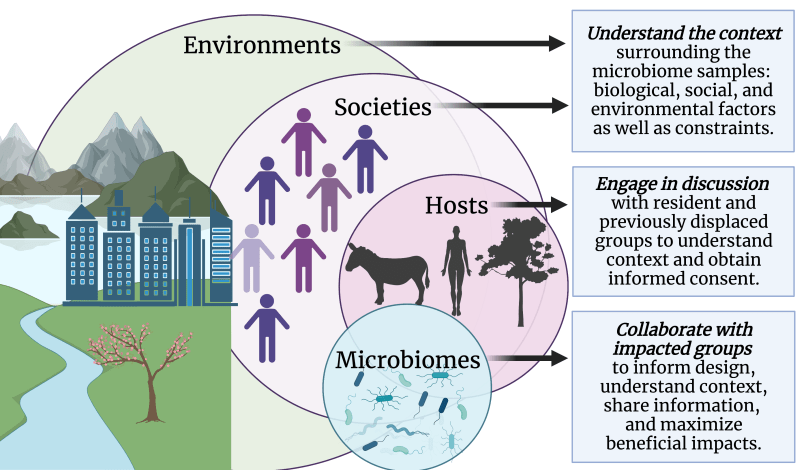
Microbiome stewardship is the broad idea that we need to consider ecosystem-level factors when we think about public health, as our environment, behaviors, and public policy affects interactions between microbes and human health. Microbiomes are highly dynamic systems, featuring bacteria, archaea, protozoa, fungi, and viruses; and our personal microbiomes are derived from a larger shared, collective microbial resource.
The importance of the human microbiome (the bacteria, fungi, archaea, protozoa, and viruses that we directly and indirectly interact with throughout our lives) for health and well-being has been well established. However, despite their demonstrated impact, there is limited information on the interconnectivity of non-host habitats (e.g., the built environment or other less intensively managed environments) and their collective contributions to human health. This includes interactions across scales such as with others in shared spaces, cultural and dietary practices, food systems and industrialized food processes, natural environments, built environments, and air pollution.
The concept of the collective microbiome reinforces the idea of microbiomes as a public good from which all humans, plants, and animals derive benefit. Deterioration of the collective microbiome, and the increasing prevalence of microbiome dysbiosis in humans and elsewhere, is the least well-understood but the most-important facet of biodiversity loss and ecosystem health decline. Microbiome stewardship recognizes the necessity of microbial communities in sustaining human health, and emphasizes the imperative to protect them through policy and other action. Recognizing the importance of microbiome stewardship is a critical step, but we also lack the clear articulation needed to guide its implementation in policy and practice. We need a broadly applicable and inclusive definition of microbiome stewardship, a framework that can guide principles for implementation, and tools to assess microbiome health and to support informed decision making.
About the research team
Dr. Kieran C. O’Doherty, PhD.,is professor in the department of psychology at the University of Guelph, where he directs the Discourse, Science, Publics research Group. His research focuses on the social and ethical implications of science and technology and public engagement on science and technology. He has published on such topics as data governance, vaccines, human tissue biobanks, the human microbiome, salmon genomics, and genetic testing. A particular emphasis of his research is on theory and methods of public deliberation, in which members of the public are involved in collectively developing recommendations for the governance of science & technology. Recent edited volumes include Psychological Studies of Science and Technology (2019) and The Sage Handbook of Applied Social Psychology (2019). He is editor of Theory & Psychology.
Dr. Rob Beiko, PhD., is a Professor and Head of the Algorithms and Bioinformatics research cluster in the Faculty of Computer Science at Dalhousie University. His research aims to understand microbial diversity and evolution using machine learning, phylogenetics, time-series algorithms, and visualization techniques. His group is developing software tools and pipelines to comprehensively survey genes and mobile genetic elements in bacterial genomes, and understand how these genomes have been shaped by vertical inheritance, recombination, and lateral gene transfer. He is also a co-founder of Dartmouth Ocean Technologies, Inc., a developer of environmental DNA sampling devices.
Dr. Sue Ishaq, PhD., is an Assistant Professor of Animal and Veterinary Sciences, University of Maine; and founded MSE in 2020. Over the years, her research has gone from wild animal gut microbiomes, to soils, to buildings, and back to the gut. Since 2019, her lab in Maine focuses on host-associated microbial communities in animals and humans, and in particular, how host and microbes interact in the gut and can be harnessed to reduce inflammation. She is also the early-career At Large member of the Board of Directors for the American Society for Microbiology, 2024- 2027.
Dr. Emma AllenVercoe, PhD, is a Professor of Microbiology at the University of Guelph, and a Tier 1 Canada Research Chair in Human Gut Microbiome Function and Host Interactions. Her research portfolio is broad, encompassing host-pathogen interplay, live microbial products as therapeutic agents, gut microbiome and anaerobic culture (humans and animals), and the study of ‘missing gut microbes’ i.e. those that are present in hunter-gatherer societies but missing in the industrialized world. She has developed the Robogut – a culture system that allows for the growth of gut microbial communities in vitro, and is currently busy a centre for microbiome culture and preservation at the University of Guelph.
Dr. Mallory Choudoir, PhD, is an Assistant Professor & Soil Microbiome Extension Specialist in the Department of Plant & Microbial Biology at North Carolina State University. The goal of her applied research and extension program is to translate microbiome science to sustainable agriculture. She aims to develop microbial-centered solutions for optimizing crop productivity, reducing agronomic inputs, and enhancing agroecosystem resilience to climate change.
Diego Silva, PhD, is a Senior Lecturer in Bioethics at Sydney Health Ethics and the University of Sydney School of Public Health. His research centers on public health ethics, particularly the application of political theory in the context of infectious diseases and health security, e.g., tuberculosis, COVID-19, antimicrobial resistance, etc. He is currently the outgoing Chair and a member of the Public Health Ethics Consultative Group at the Public Health Agency of Canada and works with the World Health Organization on various public health ethics topics on an ad hoc basis.
Principal Investigator: Kieran O’Doherty, University of Guelph
co-Principal Investigators: Rob Beiko, Dalhousie University; Suzanne Ishaq, University of Maine.
co-Investigators: Emma Allen-Vercoe, University of Guelph; Mallory Choudoir, North Carolina State University; Diego Silva, The University of Sydney School of Public Health.
Funding agency: Canadian Institute for Health Research
Abstract
The human microbiome is essential for healthy human development and immunity, and maintaining its health is a collective activity. In Canada and worldwide, there is increasing prevalence of chronic illnesses attributed to dysbiosis of human microbiomes. The causes for microbiome dysbiosis vary. In part, the constitution of the human microbiome depends on genetic factors and personal lifestyle choices, such as diet and exercise. To a large extent, however, individuals’ and collective microbiomes are shaped by environmental factors including natural environments, built environments, food systems, air and other pollutants, and the microbiomes of other people and animals around us. Microbes, by their nature, are shared across humans, and between humans and the environments in which we live. Although our decisions as individuals may have some impact, it is mainly our actions as a society that shape macro-social influences such as environmental pollution, industrial food production, and guidelines for anti-biotic use, all of which profoundly affect human microbiomes. This suggests that we need a collective vision or principles that would act to coordinate and guide societal efforts to ensure healthy microbiome environments. In 2014 an interdisciplinary group of scholars proposed the concept of microbiome stewardship to recognise our shared microbial environment as a common good that needs to be protected. Although this was an important first step, the notion of microbiome stewardship needs to be developed in much more detail to be useful in guiding policy and practice. The purpose of this project is to develop an authoritative definition of microbiome stewardship, to develop guiding principles for its implementation, and to develop a framework for its assessment. We will use a series of interviews, workshops, and deliberative processes to engage a wide range of experts and stakeholders to develop a sustainable and comprehensive articulation of microbiome stewardship.
Events will be hosted January – December, 2024, on the last Friday of every month, 12:00 – 14:00 pm ET. Presented over Zoom.
After each talk, we will continue the discussions in an informal social meeting with MSE. All speakers and members of the audience are welcome to join the social meeting.
Hosted by: Sue Ishaq, MSE, and finacially supported by the University of Maine Institute of Medicine and the UMaine Cultural Affairs/Distinguished Lecture Committee.
Dr. Davida Smyth, PhD., is an Associate Professor at Texas A&M University – San Antonio. She received her Ph.D. in Microbiology from the University of Dublin, Trinity College, Ireland, and completed her postdoctoral training at New York Medical College, the University of Mississippi Medical Center, and New York University. She has served as an Associate Professor and Chairperson of the Department of Natural Sciences in Mercy College’s School of Health and Natural Sciences, an Assistant Research Scientist in Richard Novicks lab at NYU Langone Medical Center, an Adjunct Lecturer for the online Masters in Bioinformatics program at NYU Tandon School of Engineering, and an Assistant Professor of Biology at New York City College of Technology (NYCCT). She is an external committee member for Mercy Colleges Adjunct Academy component of their Inclusive Excellence Project and Peer-Led Team Learning Program for Biology, Chemistry, and Psychology students. In 2019, she was invited to the steering committee of the Research Experiences in Microbiomes Network (REMNet) of CUNY and became a Co-PI in 2020. Her research focuses on epidemiology of microbes in wastewater, and she is deeply committed to improving STEM education with integrated social impacts, such as her course on “How the Toilet Changed the World” about the role and impact of sanitation on our society and about the ongoing and future challenges associated with both access to toilets and sustainable toilet design.
This talk will focus on how microbes in our built environment can tell us much about the biological and chemical processes occurring. From their transmission through the air and their accumulation in our wastewater, we can learn much about the health of our communities, at different levels of scale and over time. Using novel sampling techniques and next generation sequencing we’re studying the microbes in our classroom air, those present in the soils around our campus, and in our city’s wastewater to determine the prevalence of pathogens as well as antibiotic resistance.
Her lab website is here; they research microbiology, sustainability, pedagogy, and inclusion.
Events will be hosted January – December, 2024, on the last Friday of every month, 12:00 – 14:00 pm ET. Presented over Zoom.
After each talk, we will continue the discussions in an informal social meeting with MSE. All speakers and members of the audience are welcome to join the social meeting.
Hosted by: Sue Ishaq, MSE, and finacially supported by the University of Maine Institute of Medicine and the UMaine Cultural Affairs/Distinguished Lecture Committee.
Dr. Erica Hartmann, PhD., Associate Professor at Northwestern University. Dr. Erica Marie Hartmann is an environmental microbiologist interested in the interaction between anthropogenic chemicals and microorganisms, as well as bio-inspired mechanisms for controlling microbial communities.
Her career began at the Johns Hopkins Bloomberg School of Public Health, where she worked on mass spectrometry-based methods for detecting microbial enzymes necessary for bioremediation. She then moved to Arizona State University where she was the first graduate of the interdisciplinary Biological Design PhD program. She then moved to France on a Fulbright, studying microbes that degrade carcinogenic pollutants at the Commission for Atomic Energy. She began leading studies on antimicrobial chemicals and microbes found in indoor dust at the Biology and the Built Environment Center at the University of Oregon. She is currently continuing that work, as well as developing novel non-chemical antimicrobials, as an associate professor at Northwestern University. She was recently awarded an NSF CAREER to support her work on antimicrobial textiles.
Events will be hosted January – December, 2024, on the last Friday of every month, 12:00 – 14:00 pm ET. Presented over Zoom.
After each talk, we will continue the discussions in an informal social meeting with MSE. All speakers and members of the audience are welcome to join the social meeting.
Hosted by: Sue Ishaq, MSE, and finacially supported by the University of Maine Institute of Medicine and the UMaine Cultural Affairs/Distinguished Lecture Committee.
Dr. Emily Vogtmann is an Earl Stadtman Investigator in the Metabolic Epidemiology Branch of the Division of Cancer Epidemiology & Genetics in the National Cancer Institute. She received her B.S. in biochemistry and molecular biology and B.A. in Spanish from Michigan State University, M.P.H. in international health epidemiology from the University of Michigan, and Ph.D. in epidemiology in 2013 from the University of Alabama at Birmingham. Dr. Vogtmann’s research focuses on the association between the human microbiome and cancer risk and the evaluation of methods for collection, storage, and processing of samples and data for study of the human microbiome.
Events will be hosted January – December, 2024, on the last Friday of every month, 12:00 – 14:00 pm ET. Presented over Zoom.
After each talk, we will continue the discussions in an informal social meeting with MSE. All speakers and members of the audience are welcome to join the social meeting.
Hosted by: Sue Ishaq, MSE, and finacially supported by the University of Maine Institute of Medicine and the UMaine Cultural Affairs/Distinguished Lecture Committee.
“Linking Plant, Animal, and Human Health in Livestock Systems: a Metabolomics Approach.”
Dr. Stephan van Vliet, Phd.
Apr 26, 2024 12:00 PM Eastern Daylight Time. This event has passed, watch the recording here.
Dr. Stephan van Vliet is a nutrition scientist with metabolomics expertise in the Center for Human Nutrition Studies at Utah State University. Dr. Stephan van Vliet earned his PhD in Kinesiology as an ESPEN Fellow from the University of Illinois at Urbana-Champaign, and received training at the Washington University in St Louis School of Medicine and Duke University School of Medicine. Dr. van Vliet’s research is performed at the nexus of agricultural and human health. He routinely collaborates with farmers, ecologists, and agricultural scientists to study critical linkages between sustainable agriculture, the nutrient density of food, and human health. His work has been published in the American Journal of Clinical Nutrition, Scientific Reports, the Journal of Nutrition, and the Journal of Physiology.









 The Ishaq Lab