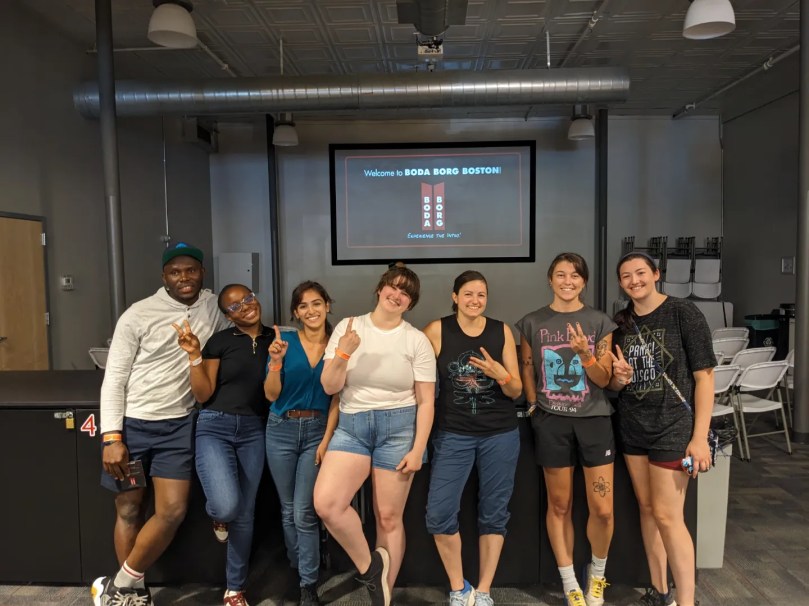
Marissa Kinney defended her master’s thesis on glucosinolate metabolism by gut bacteria!

Marissa Kinney

Marissa was Master of Science student in Microbiology, and a researcher in the One Health and the Environment program, both of which are prestigious graduate programs at UMaine, from Jan 2023 – Dec 2024. She loves learning and bench microbiology, and she employed these passions on multiple lab projects investigating the bacteria which transform glucoraphanin in broccoli sprouts into the anti-inflammatory sulforaphane in the gut. The focus of her time has been to develop new lab protocols, refine existing ones and make them easier for new lab members to learn, and to share her expertise by teaching other students in the lab. She’s excelled at these objectives so well, that in the past two years many people assumed she was a Lab Manager rather than a student.

Marissa has been extremely productive in the last two years: in her first three months she contributed lab work to two publications on broccoli sprout diets in mouse models of Inflammation Bowel Disease in 2023, and has since contributed to another manuscript currently in review on glucoraphanin supplements and gut microbiome changes in people, and two more manuscripts in preparation on culturing gut microbiota, and a broccoli sprout diet in people. It’s no surprise that Marissa has been an author on so many papers in so little time — she led a publication when she was an undergraduate! You can check her Google Scholar page for more info on these papers. Marissa has also presented this work on campus at the UMaine Student Research Symposium twice, as well as attended conferences for the American Society for Nutrition and the American Society for Microbiology for professional development.
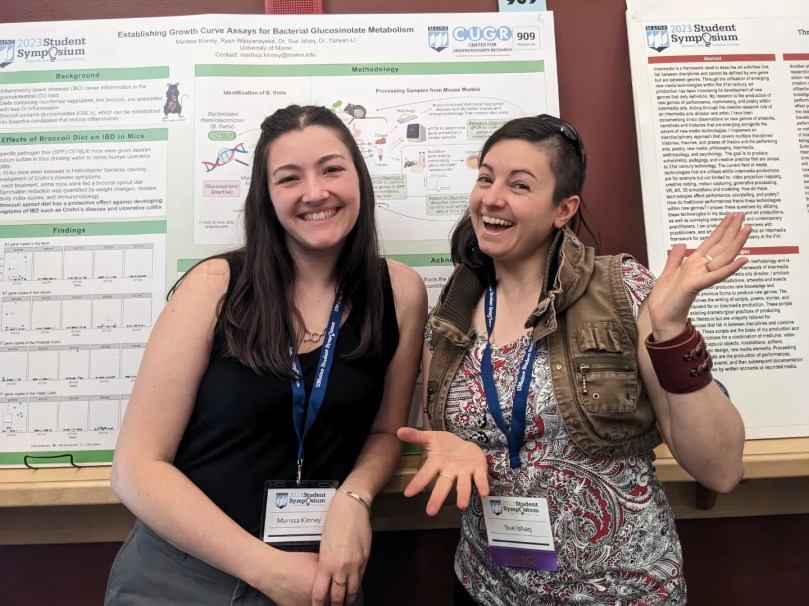
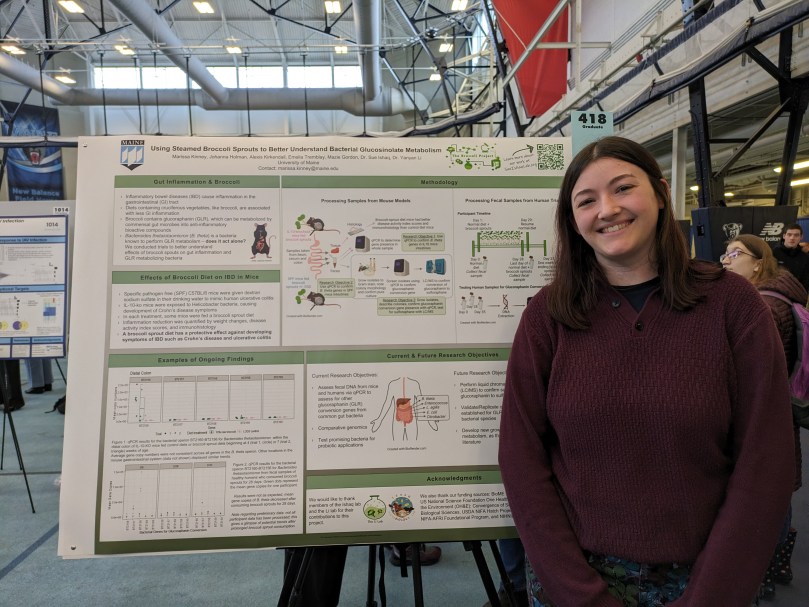
Previous to being in the lab, Marissa completed her undergraduate at the University of Maine in 2021, earning a BS in Microbiology and a BS in Cellular/Molecular Biology. She devoted a large portion of her time in undergrad to research in the laboratories of Dr. Julie Gosse and Dr. Edward Bernard. After graduating, she worked in the field of public health at UMaine’s Margaret Chase Smith Policy Center, collecting and processing data about violent and drug-related deaths in Maine. While her role at the Center was one she loved dearly, she felt a big pull towards laboratory work and academic research, and her graduate work enforced this passion. Marissa has been a core member of the lab, and we’ll miss her!! She plans to pursue a research career here in Maine after defending and enjoying a well-earned vacation.

USING BROCCOLI SPROUT DIETS TO UNDERSTAND GUT BACTERIAL GLUCOSINOLATE METABOLISM TO RESOLVE INFLAMMATORY BOWEL DISEASE

Abstract

Globally, millions of people have been diagnosed with a type of inflammatory bowel disease (IBD). These diseases cause dysfunction of the gastrointestinal (GI) tract, resulting in a wide range of symptoms that create a disruption in overall health. Research has suggested that diet and the microbial community composition of the gut microbiome play a significant role in regulating gastrointestinal inflammation. Specifically, studies have shown that diets high in cruciferous vegetables, such as broccoli, are associated with a reduction in gastrointestinal inflammation. Glucoraphanin is a compound present in broccoli that can be metabolized by gut bacteria to become an anti-inflammatory compound known as sulforaphane. Our initial research showed that the administration of a broccoli sprout diet to mouse models for Crohn’s disease and ulcerative colitis, two major types of IBD, yields inflammation reduction and symptom resolution. For these trials, fecal samples obtained from different sections of the mouse bowel were tested for presence of glucoraphanin-metabolizing genes present in a common gut bacteria, Bacteroides thetaiotaomicron (B. theta). Glucoraphanin conversion is higher and more reliable in mice than in people, however mouse models are not perfect representatives of humans. Hoping to understand the impacts of broccoli sprouts on the human gut microbiome, fecal samples were obtained from healthy individuals who consumed broccoli sprouts for 28 consecutive days, as long-term diet interventions are needed to meaningfully change gut microbial communities. In a separate trial conducted by the scientists at Brassica Protections Product, fecal samples were collected from people who were administered a single dietary supplement containing a high dose of glucoraphanin with and without plant-sourced myrosinase, as a means of evaluating the effectiveness of glucoraphanin conversation which was or was not reliant on gut microbiota, respectively. These samples were analyzed for glucoraphanin metabolizing genes from B. theta and other commensal gut bacteria. Data collected from these human trial experiments aided in understanding the impacts of a whole food broccoli sprout diet and supplementation of glucoraphanin on the bacterial community composition of the gut microbiota. Additionally, this work will help grow and strengthen the current knowledge on broccoli as an anti-inflammatory and the variabilities present in the gut microbiomes of humans.

Marissa Kinney set to defend her master’s thesis on glucosinolate metabolism by gut bacteria!

Marissa Kinney

Marissa has been a Master of Science student in Microbiology, and a researcher in the One Health and the Environment program, both of which are prestigious graduate programs at UMaine, for the last two years. She loves learning and bench microbiology, and she employed these passions on multiple lab projects investigating the bacteria which transform glucoraphanin in broccoli sprouts into the anti-inflammatory sulforaphane in the gut. The focus of her time has been to develop new lab protocols, refine existing ones and make them easier for new lab members to learn, and to share her expertise by teaching other students in the lab. She’s excelled at these objectives so well, that in the past two years many people assumed she was a Lab Manager rather than a student.

Marissa has been extremely productive in the last two years: in her first three months she contributed lab work to two publications on broccoli sprout diets in mouse models of Inflammation Bowel Disease in 2023, and has since contributed to another manuscript currently in review on glucoraphanin supplements and gut microbiome changes in people, and two more manuscripts in preparation on culturing gut microbiota, and a broccoli sprout diet in people. It’s no surprise that Marissa has been an author on so many papers in so little time — she led a publication when she was an undergraduate! You can check her Google Scholar page for more info on these papers. Marissa has also presented this work on campus at the UMaine Student Research Symposium twice, as well as attended conferences for the American Society for Nutrition and the American Society for Microbiology for professional development.

Previous to being in the lab, Marissa completed her undergraduate at the University of Maine in 2021, earning a BS in Microbiology and a BS in Cellular/Molecular Biology. She devoted a large portion of her time in undergrad to research in the laboratories of Dr. Julie Gosse and Dr. Edward Bernard. After graduating, she worked in the field of public health at UMaine’s Margaret Chase Smith Policy Center, collecting and processing data about violent and drug-related deaths in Maine. While her role at the Center was one she loved dearly, she felt a big pull towards laboratory work and academic research, and her graduate work enforced this passion. Marissa has been a core member of the lab, and we’ll miss her!! She plans to pursue a research career here in Maine after defending and enjoying a well-earned vacation.

USING BROCCOLI SPROUT DIETS TO UNDERSTAND GUT BACTERIAL GLUCOSINOLATE METABOLISM TO RESOLVE INFLAMMATORY BOWEL DISEASE

Abstract

Globally, millions of people have been diagnosed with a type of inflammatory bowel disease (IBD). These diseases cause dysfunction of the gastrointestinal (GI) tract, resulting in a wide range of symptoms that create a disruption in overall health. Research has suggested that diet and the microbial community composition of the gut microbiome play a significant role in regulating gastrointestinal inflammation. Specifically, studies have shown that diets high in cruciferous vegetables, such as broccoli, are associated with a reduction in gastrointestinal inflammation. Glucoraphanin is a compound present in broccoli that can be metabolized by gut bacteria to become an anti-inflammatory compound known as sulforaphane. Our initial research showed that the administration of a broccoli sprout diet to mouse models for Crohn’s disease and ulcerative colitis, two major types of IBD, yields inflammation reduction and symptom resolution. For these trials, fecal samples obtained from different sections of the mouse bowel were tested for presence of glucoraphanin-metabolizing genes present in a common gut bacteria, Bacteroides thetaiotaomicron (B. theta). Glucoraphanin conversion is higher and more reliable in mice than in people, however mouse models are not perfect representatives of humans. Hoping to understand the impacts of broccoli sprouts on the human gut microbiome, fecal samples were obtained from healthy individuals who consumed broccoli sprouts for 28 consecutive days, as long-term diet interventions are needed to meaningfully change gut microbial communities. In a separate trial conducted by the scientists at Brassica Protections Product, fecal samples were collected from people who were administered a single dietary supplement containing a high dose of glucoraphanin with and without plant-sourced myrosinase, as a means of evaluating the effectiveness of glucoraphanin conversation which was or was not reliant on gut microbiota, respectively. These samples were analyzed for glucoraphanin metabolizing genes from B. theta and other commensal gut bacteria. Data collected from these human trial experiments aided in understanding the impacts of a whole food broccoli sprout diet and supplementation of glucoraphanin on the bacterial community composition of the gut microbiota. Additionally, this work will help grow and strengthen the current knowledge on broccoli as an anti-inflammatory and the variabilities present in the gut microbiomes of humans.

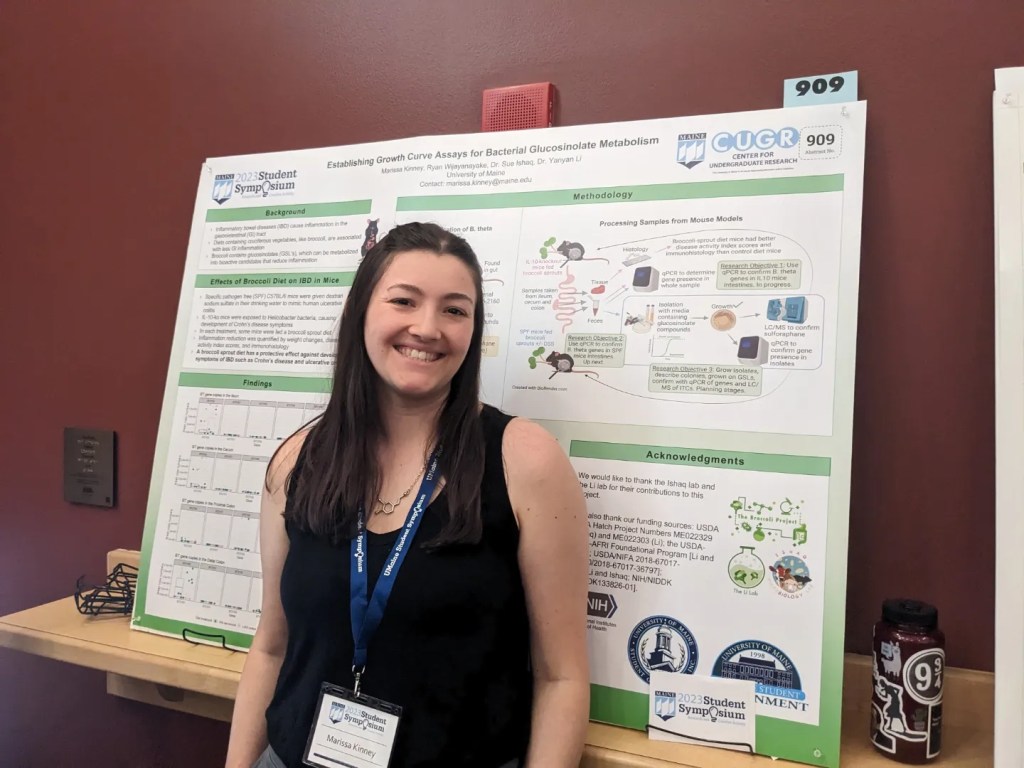
Marissa Kinney awarded an NSF NRT graduate fellowship from the UMaine Initiative for One Health and the Environment!

Masters of Science in Microbiology student, Marissa Kinney, will be joining the 2023/2024 cohort of graduate students in the Initiative for One Health and the Environment group at UMaine, as she was awarded a fellowship through the group’s NSF NRT funding. She’ll be using this fellowship to cross-train in other research disciplines, and explore the economic and social factors concerning people with Inflammatory Bowel Diseases, alongside One Health co-mentor Dr. Mario Teisl, Director and Professor of the School of Economics.

Marissa joins fellow Ishaq Lab grad student, Lola Holcomb, who was awarded a fellowship by the group and started with the 2022/2023 cohort.

Marissa Kinney

Marissa Kinney 

Master of Science student, Microbiology and Animal and Veterinary Sciences

Blurb: Marissa is a Masters student who loves learning and bench microbiology. She completed her undergraduate at the University of Maine in 2021, earning a BS in Microbiology and a BS in Cellular/Molecular Biology. She devoted a large portion of her time in undergrad to research in the laboratories of Dr. Julie Gosse and Dr. Edward Bernard. Since graduating, she worked in the field of public health at UMaine’s Margaret Chase Smith Policy Center, collecting and processing data about violent and drug-related deaths in Maine. While her role at the Center was one she loved dearly, she feels a big pull towards laboratory work and academic research. She recently joined the Ishaq lab and is excited by the new opportunities this position brings. 

Marissa was awarded a One Health and the Environment NRT Fellowship 2023 – 2024 at UMaine.

Now, working in my lab, Marissa is focusing on the microbial communities in the gastrointestinal tract, and particularly in the context of broccoli sprouts in the diet and how certain gut bacteria can use them to create an anti-inflammatory compound of interest. She has been developing new protocols for using growth curve analyses and genomic assays (quantitative PCR) to identify bacteria with the capacity to use broccoli sprouts to create anti-inflammatories along different location in the gut, and under difference health or disease states. Over the next few years, she’ll also be learning DNA sequencing library preparation and data analysis, working with human subjects in a diet trial, performing experiments using mice as a model for humans, and a variety of microbiology, genomic, and biochemical laboratory techniques. Marissa’s project is part of a much larger collaborative on the use of dietary broccoli sprouts to resolve symptoms in Inflammatory Bowel Disease patients.  As part of that larger collaboration, Marissa will be meeting regularly with the various parts of the project team, including students and researchers at 4 different institutions, and helping on three different projects in the lab to build her skillset. This requires a high degree of organization and coordination, and Marissa immediately stepped into her role.

To expand the lab’s existing work on human gut microbiomes, Marissa will use the NRT training and knowledge base as an opportunity to learn techniques in social sciences and economics. IBD is highly impactful on the wellbeing of people experiencing it acutely or chronically, and there is a large social and economic burden, as well. While any IBD patient could already consume broccoli to potentially receive benefit, nuances in how gut microbes respond to diet, and fears about exacerbating symptoms, preclude this. Being able to understand dietary behaviors, and assess the economic impact of a whole-food palliative strategy, would allow us to better implement our dietary intervention.

The Ishaq Lab welcomes a new grad student, Marissa Kinney!

The Ishaq Lab is pleased to welcome Marissa Kinney as a Master’s of Science student in Microbiology, beginning in January 2023! She’ll be joining ‘Team Broccoli‘ to investigate the 806 bacteria we isolated from the digestive tracts of mice eating a broccoli sprout diet, in a previous experiment on broccoli sprouts, microbes, and resolving colitis.

Marissa is a recent graduate of the UMaine Microbiology bachelor’s program, where she was part of an interdisciplinary research group and was the first author on a scientific publication this year: Suppression of Methicillin-Resistant Staphylococcus aureus and Reduction of Other Bacteria by Black Soldier Fly Larvae Reared on Potato Substrate.

Marissa Kinney

Marissa Kinney 

Master of Science student, Microbiology and Animal and Veterinary Sciences

Blurb: Marissa is a Masters student who loves learning and bench microbiology. She completed her undergraduate at the University of Maine in 2021, earning a BS in Microbiology and a BS in Cellular/Molecular Biology. She devoted a large portion of her time in undergrad to research in the laboratories of Dr. Julie Gosse and Dr. Edward Bernard. Since graduating, she worked in the field of public health at UMaine’s Margaret Chase Smith Policy Center, collecting and processing data about violent and drug-related deaths in Maine. While her role at the Center was one she loved dearly, she feels a big pull towards laboratory work and academic research. She recently joined the Ishaq lab and is excited by the new opportunities this position brings.