
Scallop and microbes presentations at NACE/MAS meeting this week

The Ishaq lab and some of our collaborators will be presenting out work on scallop health and microbes in hatcheries at the Northeast Aquaculture Conference & Exposition (NACE) and the 43rd Milford Aquaculture Seminar (MAS), which are being held together in Providence, Rhode Island this week on January 10-12.
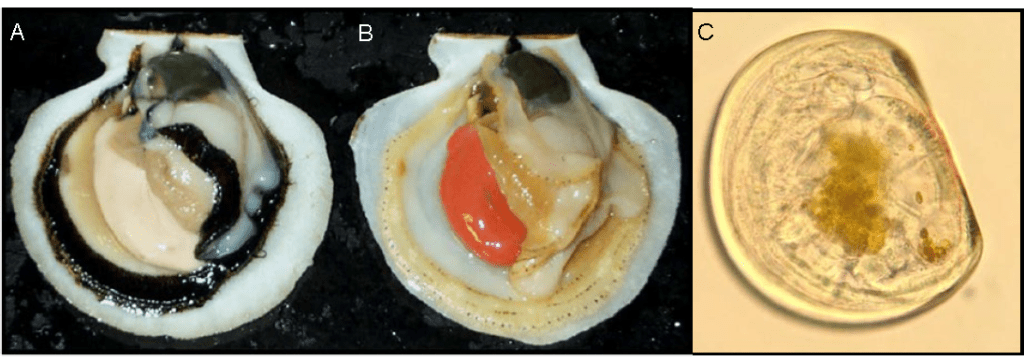
Session: Scallop Health in Hatcheries

Chair: Sue Ishaq

Friday, 8:00 am in the Newport/Washington room

Sue Ishaq, Assistant Professor at UMaineBacterial community trends associated with sea scallop, Placopecten magellanicus, larvae in a hatchery system.
Ayodeji Olaniyi, Master’s student in the Ishaq Lab at UMaineInvestigating the activity of bacteria isolated from tank biofilms in a hatchery system for sea scallop, Placopecten magellanicus, larvae
Adwoa Dankwa, Postdoctoral research in the Perry Lab at UMaineIdentification of bacterial communities and their association with larval mortality in Atlantic sea scallops (Placopecten magellanicus) hatchery system
Kyle Brennan, Master’s student in the Bowden Lab at UMaineProbiotics and pathogens
Jaypee Samson, PhD Student in the Gomez-Chiarri Lab at URIIsolation, Screening, And Selection Of Potential Pathogenic And
Probiotic Bacteria From Bivalve Shellfishes
Sydney Avena, Master’s student at the Darling Marine Center“Cracking the shell”: Lessons learned from a collaborative approach to developing hatchery production of the Atlantic sea scallop, Placopecten magellanicus
Tara Riley, Shellfish and Aquatic Resources Manager for Nanucket, MASaving The Seed: Nantucket Bay Scallop Seed Management Of 2023
The speaker list for the session.

Session: Coastal Systems & Scallops

Chairs: Sue Ishaq and & Phoebe Jekielek

Friday, 1:30 pm in the Newport/Washington room

Samuel GurrDevelopmental mismatch of pCO 2 levels in a second generation of northern bay scallops
Christopher NorenComparing growth of ear hung and lantern net cultured sea scallops, Placopecten magellanicus, over a complete grow-out cycle to determine optimal harvest timing
Phoebe Jekielek A comparative study of sea scallop (Placopecten magellanicus) energy investment strategies in farmed and wild environments
Caitlin CleaverUnderstanding wild sea scallop (Placopecten magellanicus) larval spatial and temporal distribution in Maine to support culture and capture fisheries
Paul RawsonPredicting larval dispersal and population connectivity of Sea Scallops, Placopecten magellanicus, in Downeast Maine.
Griffin HarkinsReview of Nantucket Island’s Bay Scallop Spat Bag Program
Speakers for the session

MSE special session today at the Ecological Society of America virtual meeting!

SS 17: “Microbiomes and Social Equity” (19205)

Live discussion date: “Thursday, August 5th, 2021”

Live discussion time: 9:30 AM – 10:30 AM Pacific Time

Microbiomes — environmental, human and other organismal symbionts — are increasingly seen as critical physiological, developmental and ecological mediators within and among living things, and between the latter and our abiotic environments. Therefore, it is no surprise that microbial communities may be altered, depleted or disrupted by social and economic determinants. Social inequality entails concrete alterations and differentiation of microbial communities among social groups, by way of such factors as nutritional access, environmental pollutants or green space availability, often to the detriment of human and ecosystem health. This special session will be organized as a panel discussion with break-out groups in order to provide participants the opportunity to discuss the ways in which social inequity interacts with microbiomes, and how we might intervene as scientists and communities to promote favorable microbiomes while advancing social equality. We hope to generate research questions and actionable items.Panel speakers: Michael Friedman, Naupaka Zimmerman, Justin Stewart, Monica Trujillo, Sue Ishaq, Sierra Jech, Jennifer Bhatnagar, and Ariangela Kozik

ESA meeting program
: https://www.esa.org/longbeach/

Registration to the ESA meeting is required to attend this event.

Microbes and Social Equity special session at the Ecology Social of America 2021 meeting.

Our proposal for a special session on ‘microbes and social equity’ has been approved for the Ecology Society of America scientific conference this summer, August 2 – 6, 2021! This year’s meeting will be entirely virtual, allowing us to host panel speakers from various locations. This session requires registration to the ESA meeting.

ESA Special Session 19205: “Microbiomes and Social Equity”

09:30 – 12:30 PST/ 12:30 – 15:30 EST

Microbiomes — environmental, human and other organismal symbionts — are increasingly seen as critical physiological, developmental and ecological mediators within and among living things, and between the latter and our abiotic environments. Therefore, it is no surprise that microbial communities may be altered, depleted or disrupted by social and economic determinants. Social inequality entails concrete alterations and differentiation of microbial communities among social groups, by way of such factors as nutritional access, environmental pollutants or green space availability, often to the detriment of human and ecosystem health. This special session will be organized as a panel discussion with break-out groups in order to provide participants the opportunity to discuss the ways in which social inequity interacts with microbiomes, and how we might intervene as scientists and communities to promote favorable microbiomes while advancing social equality. We hope to generate research questions and actionable items.

Panel speakers: Michael Friedman, Naupaka Zimmerman, Justin Stewart, Monica Trujillo, Sue Ishaq, Sierra Jech, Jennifer Bhatnagar, and Ariangela Kozik

Save the date for the Microbes and Social Equity symposium!

Sign up for updates!!

We are in the processing of finalizing our speaker list and program, as well as creating registration links. Stay tuned for more information.

In the meantime, please enjoy our free speaker series!

Symposium presentation at 2019 Joint AFS-TWS Meeting

I’m excited to announce that I’ll be giving a presentation at the American Fisheries Society and The Wildlife Society 2019 Joint Annual Conference this September. I was invited to participate in a symposium: Utility of Microbiomes for Population Management. I’ll be returning to my roots and presenting on moose microbes. See you in Reno!

Abstract 36407 – “Moose Rumen Microbes and Their Relevance to Agriculture and Health”

Upcoming presentations at Indoor Air 2018

This summer, I’ll be presenting a talk at the Indoor Air 2018 conference in Philadelphia, on some of the work I’ve been doing on bacteria in homes!

Biology and the Built Environment Center

Source: Upcoming presentations at Indoor Air 2018

In preparation for the ESA conference next week

I’m counting down the days for my first Ecological Society of America (ESA) conference next week in Portland, OR.  Over the last few weeks, I’ve been diligently working to finish as much analysis as possible on the data from my recent post-doc, as I am presenting a poster on Wednesday, August 9th from 4:30 to 6:30 pm; PS 31-13 – Soil bacterial diversity in response to stress from farming system, climate change, weed diversity, and wheat streak virus.

Several of my new colleagues will also be presenting on their recent work, including a talk from Roo Vandegrift on the built environment and the microbiome of human skin, and one from Ashkaan Fahimipour on the dynamics of food webs.

The theme for this year’s ESA meeting is “Linking biodiversity, material cycling and ecosystem services in a changing world”, and judging from the extravagant list of presenting authors, it’s going to be an extremely large meeting.  It’s worth remembering that large conferences like these bring together researchers from each rung of the career ladder, and many of the invited speakers will be presenting on work that might have been done by dozens of scientists over decades.  Seeing only the polished summary can be intimidating, lots of scientists I’ve spoken to can feel intimidated by these comprehensive meeting talks because the speakers seem so much smarter and more successful than you.  It’s something I jokingly refer to as “pipette envy”: when you are at a conference thinking that everyone does cooler science than you.  Just remember, someone also deemed your work good enough to present at the same conference!