Paper published on the 2021 MSE symposium!

I am delighted to announce that a collaborative paper on the 2021 Microbes and Social Equity Symposium was just published! I was invited by the Challenges journal’s editor-in-chief to submit a contribution about the group’s activities, and the together the session organizers, speakers, student assistants, and I wrote about our experiences putting this together. The journal is dedicated to published highly interdisciplinary research which looks things from multiple perspectives and which contributes to Planetary Health.

We learned that, much like microbes, audiences don’t always act the way you expect them to. Even better: we learned that by providing collaborative working time after listening to speaker sessions, which could be used to get our thoughts down on paper, we could capture the magic and inspiration of the conversations we had post-talks and revisit those later as research and outreach resources.

You can check out the full article here.

And, if you are interested by what you read about last year’s event, check out this year’s symposium, happening next week!

Designing the Microbes and Social Equity Symposium, a Novel Interdisciplinary Virtual Research Conference Based on Achieving Group-Directed Outputs

Suzanne L. Ishaq 1,2,*, Emily F. Wissel 3, Patricia G. Wolf 4,5, Laura Grieneisen 6, Erin M. Eggleston 7, Gwynne Mhuireach 8, Michael Friedman 9, Anne Lichtenwalner 1,10, Jessica Otero Machuca 11, Katherine Weatherford Darling 12,13, Amber L. Pearson 14, Frank S. Wertheim 15, Abigail J. Johnson 16, Leslie Hodges 17, Sabrina K. Young 18, Charlene C. Nielsen 19, Anita L. Kozyrskyj 20, Jean D. MacRae 21, Elise McKenna Myers 22, Ariangela J. Kozik 23, Lisa Marie Tussing-Humphreys 24, Monica Trujillo 25, Gaea A. Daniel 26, Michael R. Kramer 27, Sharon M. Donovan 28, Myra Arshad 29, Joe Balkan 30 and Sarah Hosler 31

Abstract: The Microbes and Social Equity working group was formed in 2020 to foster conversations on research, education, and policy related to how microorganisms connect to personal, societal, and environmental health, and to provide space and guidance for action. In 2021, we designed our first virtual Symposium to convene researchers already working in these areas for more guided discussions. The Symposium organizing team had never planned a research event of this scale or style, and this perspective piece details that process and our reflections. The goals were to 1) convene interdisciplinary audiences around topics involving microbiomes and health, 2) stimulate conversation around a selected list of paramount research topics, and 3) leverage the disciplinary and professional diversity of the group to create meaningful agendas and actionable items for attendees to continue to engage with after the meeting. Sixteen co-written documents were created during the Symposium which contained ideas and resources, or identified barriers and solutions to creating equity in ways which would promote beneficial microbial interactions. The most remarked-upon aspect was the working time in the breakout rooms built into the schedule. MSE members agreed that in future symposia, providing interactive workshops, training, or collaborative working time would provide useful content, a novel conference activity, and allow attendees to accomplish other work-oriented goals simultaneously.

Affiliations:

1    School of Food and Agriculture, University of Maine, Orono, Maine 04469, USA; 2    Institute of Medicine, University of Maine, Orono, Maine 04469, USA; 3    School of Nursing, Emory University, Atlanta, Georgia 30322; 4    Department of Nutrition Science, Purdue University, West-Lafayette, Indiana, USA, 47907; 5    Department of Animal Sciences, University of Illinois, Urbana-Champaign, Urbana, Illinois 61801, USA; 6    Department of Genetics, Cell, & Development, University of Minnesota, Minneapolis, Minnesota 55108, USA; 7    Department of Biology, Middlebury College, Middlebury, Vermont 05753, USA; 8    Department of Architecture, University of Oregon, Eugene, Oregon 97403 USA; 9    Department of Science and Mathematics, Pratt Institute, Brooklyn, New York 11205, USA; 10   Cooperative Extension, University of Maine, Orono, Maine 04469, USA; 11   Mayo Clinic, Orlando, Florida 32837, USA; 12   Social Science Program University of Maine at Augusta Bangor, Maine 04401, USA; 13   Graduate School of Biomedical Science & Engineering, University of Maine, Orono, Maine 04469, USA; 14   Department of Geography, Environment, and Spatial Sciences, Michigan State University, East Lansing, Michigan 48824, USA; 15   Cooperative Extension, University of Maine, Springvale, Maine 04083, USA; 16   Division of Epidemiology and Community Health, School of Public Health, University of Minnesota, Minneapolis, Minnesota 55455, USA; 17   Economic Research Service, United States Department of Agriculture, USA; 18   Economic Research Service, United States Department of Agriculture, USA; 19   School of Public Health, University of Alberta, Edmonton, Alberta, Canada; 20   Department of Pediatrics, University of Alberta, Edmonton, Alberta, Canada; 21   Department of Civil and Environmental Engineering, University of Maine, 5711 Boardman Hall, Orono, Maine 04469, USA; 22   Boston Consulting Group, Bethesda, Maryland 20814, USA; 23   Division of Pulmonary and Critical Care Medicine, Department of Internal Medicine, University of Michigan. Ann Arbor, Michigan 48109, USA; 24   Department of Kinesiology and Nutrition, University of Illinois Chicago, Chicago, Illinois 60612, USA; 25   Department of Biology, Queensborough Community College, Queens, New York 11364, USA; 26   Nell Hodgson Woodruff School of Nursing, Emory University, Atlanta, Georgia 30322, USA; 27   Department of Epidemiology, Rollins School of Public Health, Emory University, Atlanta, Georgia 30322, USA; 28   Department of Food Science and Human Nutrition, University of Illinois, Urbana-Champaign, Urbana, Illinois 61801 USA; 29   Department of Biology, Stoney Brook University, Stony Brook, New York 11794, USA; 30   Department of Chemical and Biological Engineering, Tufts University, Medford, Massachusetts 02155, USA; 31   School of Food and Agriculture, University of Maine, Orono, Maine 04469, USA;

The Ishaq Lab is hosting Dr. Rabee, a Visiting Researcher from Egypt, to work on rumen microbes

After two years of postponement, the Ishaq Lab is excited to welcome Dr. Alaa Rabee as a Visiting Researcher from now until December of this year!! This is made possible by a prestigious award to Dr. Rabee from the Central Department of Missions at the Ministry of Higher Education, Egypt, which fosters research collaboration between Egypt and the U.A.

Dr. Rabee joins us from the Desert Research Institute in Cairo, Egypt, where his work focus on researching microbial communities in the digestive tract of ruminants and how they can be used for animal production, bioengineering, and sustainable development. 

Last year, Alaa and I published our first collaborative paper together, based on his work on microbial enzymes from the rumen of sheep and camels and potential for use in biofuel production. We are also working on another, based on microbial activity (transcriptomics) in the rumen of camels on different diets. That project has engaged two undergraduate students in data visualization, including Myra Arshad who started in my lab as an REU student last summer.

During his six month stay, he’ll be working with rumen microbes from various livestock, as well as giving seminars and sharing his experience in research.

Collaborative paper accepted on winter wheat, weeds, and climate.

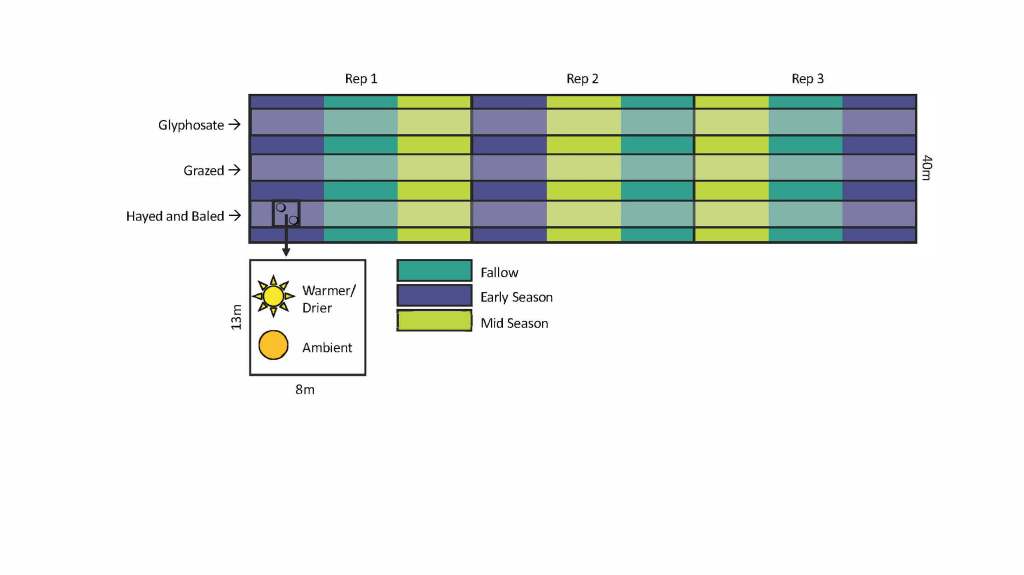
The last paper to be generated from the large-scale, multi-year, collaborative research I participated in as a postdoc at Montana State University in the Menalled Lab in 2016 has finally been accepted for publication! At the time, I was working on the soil bacteria associated with winter wheat crops under different simulated climate change scenarios, and with added stressors like weed competition and different farming strategies. I was part of a large team of researchers looking at various aspects of agricultural stressors on long-term food production, including several agroecologists who led the development of this paper.

Weed communities in winter wheat: responses to cropping systems and predicted warmer and drier climate conditions.

Tim Seipel, Suzanne L. Ishaq, Christian Larson, Fabian D. Menalled. Sustainability 202214(11), 6880; https://doi.org/10.3390/su14116880. Special Issue “Sustainable Weed Control in the Agroecosystems

Abstract

Understanding the impact of biological and environmental stressors on cropping systems is essential to secure the long-term sustainability of agricultural production in the face of unprecedented climatic conditions. This study evaluated the effect of increased soil temperature and reduced moisture across three contrasting cropping systems: a no-till chemically managed system, a tilled organic system, and an organic system that used grazing to reduce tillage intensity. Results showed that while cropping system characteristics represent a major driver in structuring weed communities, the short-term impact of changes in temperature and moisture conditions appear to be more subtle. Weed community responses to temperature and moisture manipulations differed across variables: while biomass, species richness, and Simpson’s diversity estimates were not affected by temperature and moisture conditions, we observed a minor but significant shift in weed community composition. Higher weed biomass was recorded in the grazed/reduced-till organic system compared with the tilled-organic and no-till chemically managed systems. Weed communities in the two organic systems were more diverse than in the no-till conventional system, but an increased abundance in perennial species such as Cirsium arvense and Taraxacum officinale in the grazed/reduced-till organic system could hinder the adoption of integrated crop-livestock production tactics. Species composition of the no-till conventional weed communities showed low species richness and diversity, and was encompassed in the grazed/reduced-till organic communities. The weed communities of the no-till conventional and grazed/reduced-till organic systems were distinct from the tilled organic community, underscoring the effect that tillage has on the assembly of weed communities. Results highlight the importance of understanding the ecological mechanisms structuring weed communities, and integrating multiple tactics to reduce off-farm inputs while managing weeds.

The related works from that project include:

Similar work has been done by that group, including:

New perspective paper published on microbial transmission and lobsters.

A cookie in the shape of a lobster with icing to make it look like a pirate.

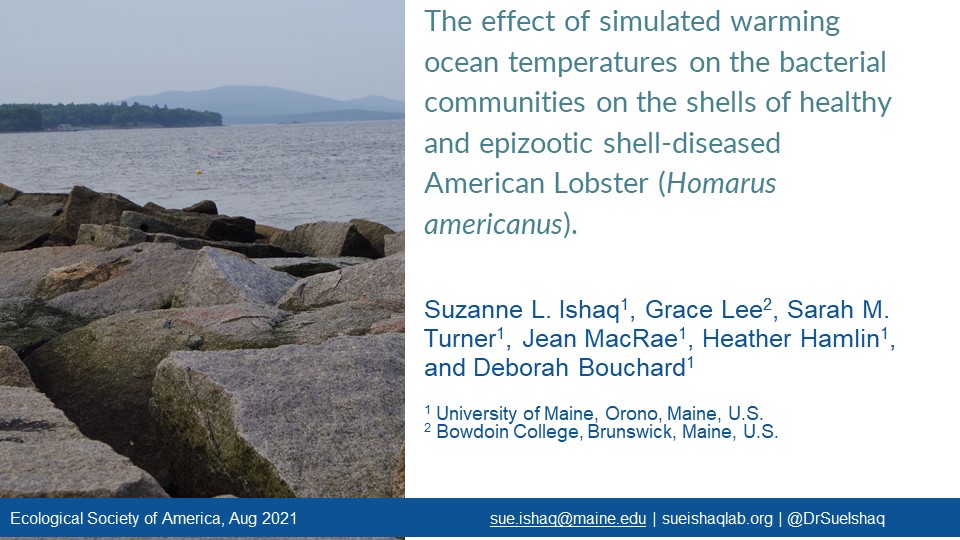
A collaborative perspective article was just published in Frontiers in Microbiology, which discusses epizootic shell disease in American lobsters, the role of microbes, and the movement of microbes in an aquatic environment. Because this is a perspective article, it is more of a thought exercise than my other publications, which either report findings or review other published literature, but it was intriguing to think about animal health in the context of rapidly-changing environmental conditions and microbial communities.

I previously presented some of the microbial community data related to the larger project from which this perspective piece came about, and this research team will continue to work on analyzing data from several experiments to develop into a research article later this year.

A steamed lobster on a plate.

This larger, collaborative project on lobster shell disease and warming ocean waters was begun by researchers at the Aquaculture Research Institute: Debbie Bouchard, Heather Hamlin, Jean MacRae, Scarlett Tudor, and later Sarah Turner as a grad student. I was invited to participate in the data analysis aspect two years ago.

At the time, Grace Lee was a rising senior at Bowdoin College, and accepted to my lab for the UMaine REU summer 2020 session, which was canceled. Instead, I hired Grace to perform DNA sequence analysis remotely, by independently learning data analysis following the teaching materials I had generated for my sequencing class.  I invited Joelle Kilchenmann to this piece after a series of conversations about microbes and social equity, because her graduate work in Joshua Stoll’s lab focuses on lobster fishing communities in Maine and understanding the challenges they face.


Ishaq, S.L., Turner, S.M., Tudor, M.S.,  MacRae, J.D., Hamlin, H., Kilchenmann, J., Lee1, G., Bouchard, D. 2022. Many questions remain unanswered about the role of microbial transmission in epizootic shell disease in American lobsters (Homarus americanus). Frontiers in Microbiology 13: 824950.

This was an invited contribution to a special collection: The Role of Dispersal and Transmission in Structuring Microbial Communities

Abstract: Despite decades of research on lobster species’ biology, ecology, and microbiology, there are still unresolved questions about the microbial communities which associate in or on lobsters under healthy or diseased states, microbial acquisition, as well as microbial transmission between lobsters and between lobsters and their environment. There is an untapped opportunity for metagenomics, metatranscriptomics, and metabolomics to be added to the existing wealth of knowledge to more precisely track disease transmission, etiology, and host-microbe dynamics. Moreover, we need to gain this knowledge of wild lobster microbiomes before climate change alters environmental and host-microbial communities more than it likely already has, throwing a socioeconomically critical industry into disarray. As with so many animal species, the effects of climate change often manifests as changes in movement, and in this perspective piece, we consider the movement of the American lobster (Homarus americanus), Atlantic ocean currents, and the microorganisms associated with either.

Ishaq Lab students present at the 2022 UMaine Student Research Symposium

This year, the UMaine Student Research Symposium was held in person and virtually, and undergrads and grads from the Ishaq Lab shared their research with the Maine community. You can check out the recorded presentations in the links below.

French*, R., Beale, J., Ishaq, S. Abstract 0402. Climate Change Affects Wild Mammal Ranges and Health; Will That Also Affect Infectious Disease Exposure Risk at Maine Farms? UMaine Student Symposium (virtual presentation). April 15, 2022.

Holcomb*, Coffman, J., Harrison, B., Tucker, K., Ishaq, S. Abstract 1080. An Overview of Three Biomedical Science Projects across Three Research Institutes. UMaine Student Symposium (virtual presentation). April 15, 2022.

Hosler*, S., Grey, E., Dankwa, A., Perry, J., Bowden, T., Beal, B., Ishaq, S. Abstract 0816. Initial descriptions of the microbes of farmed Atlantic sea scallop (Placopecten magellanicus) veligers and rearing tanks. UMaine Student Symposium (virtual presentation). April 15, 2022.

Pelletier*, E., Taylor, T., Ishaq, S. Abstract 830. Assessing the Veterinary Needs of Rural Maine and Implementing an Effective Management Plan. UMaine Student Symposium (poster presentation). April 15, 2022.

Presentations galore in 2022!

I have had the pleasure of sharing my work, both Ishaq lab led and collaborative, to many venues thus far in 2022, and I am grateful to the invitations I received even though I was not able to accept all of them. These have ranged from seminar series, to student groups, to scientific conferences. Some of these events have already passed, but several are forthcoming and available by registration.

  1. Ishaq* S. Microbes and Social Equity: what is it and how do we do it? Part of Track Hub: ‘Field Work & DEI Part 1: Fostering Equitable Partnerships with the Communities in Your Field Work Location’. American Society for Microbiology (ASM) Microbe 2022, Washington, DC (USA), June 9-13, 2022. (invited)
  2. Hosler2*, S., Grey, E., Dankwa, A., Perry, J., Bowden, T., Beal, B., Ishaq, S. Initial descriptions of  the microbes of farmed Atlantic sea scallop (Placopecten magellanicus) veligers and rearing tanks. American Society for Microbiology Microbe 2022 meeting. Washington, D.C.. June 9-13, 2022.
  3. Hosler2*, S., Grey, E., Ishaq, S. Comparing the microbiome of wild and farmed Atlantic sea scallop (Placopecten magellanicus) veligers. Northeast Aquaculture Conference & Exposition (NACE) and the 41st Milford Aquaculture Seminar (MAS). Portland, Maine. POSTPONED to April 27-28, 2022
  4. Ishaq*, S., Li, Y., Holman2, J., Zhang, T., Chen, G. “Biogeography may be key to microbial anti inflammatory production using dietary precursors.” Maine Biological and Medical Sciences Symposium, Bar Harbor, ME, April 22-23, 2022. (invited)
  5. Holcomb2*, L., Coffman, J., Harrison, B., Tucker, K., Ishaq, S.L. Abstract 1080. An Overview of Three Biomedical Science Projects across Three Research Institutes. UMaine Student Research Symposium (virtual). Apr 15, 2022.
  6. Pelletier1*, M., Taylor, T., Ishaq, S. Abstract 830. Assessing the Veterinary Needs of Rural Maine and Implementing an Effective Management Plan. UMaine Student Research Symposium (virtual). Apr 15, 2022
  7. French1*, R., and Ishaq, S. Abstract 402. Climate Change Affects Wild Mammal Ranges and Health; Will That Also Affect Infectious Disease Exposure Risk at Maine Farms? UMaine Student Research Symposium (virtual). Apr 15, 2022.
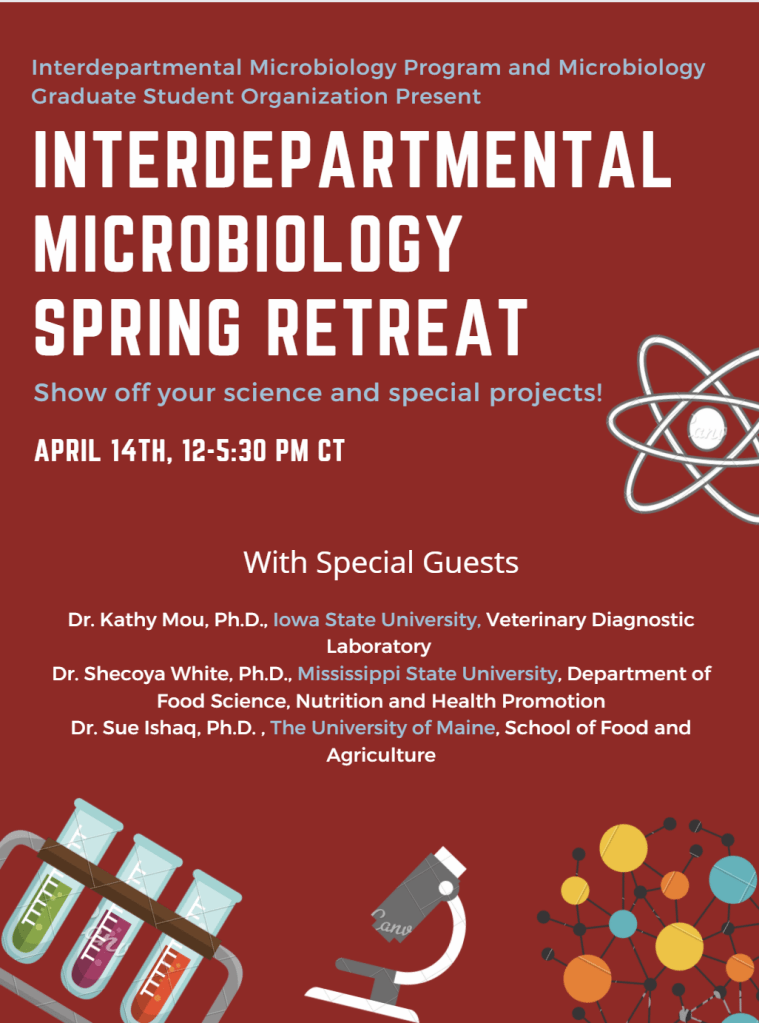
  8. Ishaq, S. “Microbes at the nexus of environmental, biological, and social research.” Iowa State University Spring Microbiology Graduate Student Organization retreat. (virtual). April 14, 2022 (invited co-plenary).
    1. see poster below
  9. Ishaq*, S., Li, Y., Holman2, J., Zhang, T., Mawe, G., Hurd, M., Lavoie, B. Baudewyns1, D., Colucci1, L., Balkan1, J., Chen, G, Moses, P. “Biogeography may be key to microbial anti inflammatory production using dietary precursors.”  Congress of Gastrointestinal Function (CGIF), April 11 – 13, 2022.
  10. “My science journey”, invited presentation and discussion of my career path to undergraduate women in STEM, UMaine WiSTEMM group, March 28, 2021
  11. Ishaq, S. “Moose rumen microbes and you.” The Wildlife Society Nutritional Ecology Working Group Webinar series, (virtual), March 9, 2022.
  12. Ishaq*, S., Li, Y., Holman2, J., Zhang, T., Mawe, G., Hurd, M., Lavoie, B. Baudewyns1, D., Colucci1, L., Balkan1, J., Chen, G, Moses, P. “Biogeography may be key to microbial anti inflammatory production using dietary precursors.”  Dartmouth Molecular Microbiology and Pathogenesis (M2P2), February 24 – 25, 2022. (invited)
    • 120 students and faculty researchers.
  13. Ishaq, S. “Microbes at the nexus of environmental, biological, and social research” The Microbes and Social Equity 2022 speaker series, virtual, University of Maine and the Microbes and Social Equity working group. January 19, 2022.
    1. 67 participants, 131 registrants, faculty, students, public
  14. Ishaq, S. ​”Microbes at the nexus of environmental, biological, and social research.” 2nd Rhode Island Microbiome Symposium, virtual, University of Rhode Island Kingston, RI, January 14, 2022. (invited plenary)
    • 50 participants, researchers and graduate students
  15. Booker, Y., Ishaq, S., Levesque*, D.L. “The role of the microbiome in responses to heat stress in endotherms.” The Society of Integrative and Comparative Biology (SICB) annual meeting. Phoenix, AZ. January 3-7, 2022.

Note: an asterisk denotes the speaker if multiple authors contributed, 1 after a name denotes undergrad in the Ishaq lab, 2 after a name denotes grad in the Ishaq Lab.

Microbes and Social Equity journal collection up to 6 published contributions!

The Microbes and Social Equity working group has been working with the scientific journal mSystems for the past year to develop a special collection of articles which highlight the connections between microbiomes, microbial exposures, social structures, and political contexts, as well as ways in which social, political, or economic changes could improve the way we interact with microbes to induce positive effects on our health and our planet.

The sixth contribution has just been published, and we have a handful more currently in the peer-review process! We plan to collect 25 invited contributions by the end of this year. You can check out the entire collection as it grows using the link below.

For more real-time discussions about microbes and social equity, check out our speaker series which is currently running until May 4th. You can also check out recordings from past talks.

mSystems Special Series: Social Equity and Disparities in Microbial Exposure

New publication on rumen microbes which may have uses in biofuel production

A scientific article led by my colleague Dr. Alaa Rabee at the Desert Research Center in Egypt was just published online and is now available! Dr. Rabee and I have been collaborating remotely on projects related to the bacteria in the rumen of camels, sheep, and cows, as Dr. Rabee’s work focuses on the isolation of bacteria which can degrade plant materials efficiently and could be used to produce biofuels. He will be spending 6 months working in my lab as a visiting scholar, which was delayed until this year because of the pandemic.


Rabee, A.E., Sayed Alahl, A.A., Lamara, M., Ishaq, S.L. 2022. Fibrolytic rumen bacteria of camel and sheep and their applications in the bioconversion of barley straw to soluble sugars for biofuel production. PLoS ONE 17(1): e0262304. Article.

Abstract

Lignocellulosic biomass such as barley straw is a renewable and sustainable alternative to traditional feeds and could be used as bioenergy sources; however, low hydrolysis rate reduces the fermentation efficiency. Understanding the degradation and colonization of barley straw by rumen bacteria is the key step to improve the utilization of barley straw in animal feeding or biofuel production. This study evaluated the hydrolysis of barley straw as a result of the inoculation by rumen fluid of camel and sheep. Ground barley straw was incubated anaerobically with rumen inocula from three fistulated camels (FC) and three fistulated sheep (FR) for a period of 72 h. The source of rumen inoculum did not affect the disappearance of dry matter (DMD), neutral detergent fiber (NDFD). Group FR showed higher production of glucose, xylose, and gas; while higher ethanol production was associated with cellulosic hydrolysates obtained from FC group. The diversity and structure of bacterial communities attached to barley straw was investigated by Illumina Mi-Seq sequencing of V4-V5 region of 16S rRNA genes. The bacterial community was dominated by phylum Firmicutes and Bacteroidetes. The dominant genera were RC9_gut_group, RuminococcusSaccharofermentansButyrivibrioSucciniclasticumSelenomonas, and Streptococcus, indicating the important role of these genera in lignocellulose fermentation in the rumen. Group FR showed higher RC9_gut_group and group FC revealed higher RuminococcusSaccharofermentans, and Butyrivibrio. Higher enzymes activities (cellulase and xylanase) were associated with group FC. Thus, bacterial communities in camel and sheep have a great potential to improve the utilization lignocellulosic material in animal feeding and the production of biofuel and enzymes.

MSE paper published on “Twenty important research questions in microbial exposure and social equity”

The Microbes and Social Equity working group has published its second collaborative paper together, led by Dr. Jake Robinson and featuring 25 other MSE group researchers in various fields related to microbiomes, social equity, and ecosystems. In developing this paper, we had many conversations about what had been accomplished in research related to microbial exposure, as well as what had yet to be done. We provide some background information as context, and spend the majority of the paper outlining twenty of the most poignant research directions. There are so many questions yet to be answered about the way the microbial communities interact with human lives, and how our lives impact them back. In our enthusiasm for the topics, we could have endlessly chatted about research, such that we decided to limit ourselves to twenty questions. We hope that this piece becomes a source for inspiration for others who continue this conversation and future research in these areas.

You can find a link below to read the full article, and links to the authors’ twitter feeds if you’d like to check them out on social media. You’ll be able to hear more about this publication in an upcoming seminar from Jake, as part of the 2022 MSE speaker series, which is open to all and free to attend over zoom.


Robinson, J.M., Redvers, N., Camargo, A., Bosch, C.A., Breed, M.F., Brenner, L.A., Carney, M.A., Chauhan, A., Dasari, M., Dietz, L.G., Friedman, M., Grieneisen, L., Hoisington, A.J., Horve, P.F., Hunter, A., Jech, S., Jorgensen, A., Lowry, C.A., Man, I., Mhuireach, G., Navarro-Pérez, E., Ritchie, E.G., Stewart, J.D., Watkins, H., Weinstein, P., and Ishaq, S.L. 2022. Twenty important research questions in microbial exposure and social equity. mSystems 7(1): e01240-21. Special Series: Social Equity as a Means of Resolving Disparities in Microbial Exposure

ABSTRACT

Social and political policy, human activities, and environmental change affect the ways in which microbial communities assemble and interact with people. These factors determine how different social groups are exposed to beneficial and/or harmful microorganisms, meaning microbial exposure has an important socioecological justice context. Therefore, greater consideration of microbial exposure and social equity in research, planning, and policy is imperative. Here, we identify 20 research questions considered fundamentally important to promoting equitable exposure to beneficial microorganisms, along with safeguarding resilient societies and ecosystems. The 20 research questions we identified span seven broad themes, including the following: (i) sociocultural interactions; (ii) Indigenous community health and well-being; (iii) humans, urban ecosystems, and environmental processes; (iv) human psychology and mental health; (v) microbiomes and infectious diseases; (vi) human health and food security; and (vii) microbiome-related planning, policy, and outreach. Our goal was to summarize this growing field and to stimulate impactful research avenues while providing focus for funders and policymakers.

iScience Backstory on our collaborative work on ants, nematodes, and bacterial transfer

Over the summer, an article was published which featured a handful of researchers from across the US and research spanning a decade on the bacterial communities associated with invasive ants and nematodes in Maine. At the time, we were invited to also contribute a “Backstory” article to the scientific journal iScience which described the journey and the ideas.

That story authored by myself and Ellie Groden (senior researcher on the journal article) has just been published, and can be found here. I’d like to thank Dr. Sheba Agarwal, who was the editor on the paper, helped us develop our Backstory, and also spoke to me about this and other work as a guest on the WeTalkScience podcast.