Teaching Statement development series: science and society

Over the next few weeks, I’ll be sharing selected portions of my Teaching Statement here as part of a development series, as I refine my philosophies for the submission of my second-year review this fall. I welcome feedback! Feel free to comment on the post (note, all comments require my approval before appearing publicly on the site), or contact me directly if you have more substantial edits.

*Please note, these are selected portions of my Statement which have been edited to remove sensitive information. These are early drafts, and may not reflect my final version. Tenure materials that I generate are mine to share, but my department chair, committee, and union representative were consulted prior to posting these. Each tenure-granting institution is unique, and departments weigh criteria differently, thus Statements can’t really be directly compared between faculty.*


Tying science course content to other aspects of society

I have two goals in my attempt to connect my science curricula to other aspects of society: to provide a broader educational perspective on science, and to stimulate imagination regarding the application of scientific knowledge to community building and civic engagement. Students need to understand that science is ongoing, and that there are yet many questions in the field for them to answer.

One technique to connect science and society in my coursework is to encourage students to self-identify as scientists, and to understand that they are able to participate in it. For example, on the first day of AVS 401 (Capstone), the students made a word-cloud of adjectives to describe their idea of a scientist, shown below.  At the end of the academic year, after participating in research and learning about the process, students will make another collaborative world-cloud.  As a class, students will reflect on whether their understanding of science and scientists has changed, and whether they are more (or less) likely to perceive science as a field that they are able to engage with.  Hopefully, this participation in research and reflective exercise will accentuate their use of effort-based descriptors, such as “patient” or “methodical”, rather than ability-based descriptors, such as “gifted”, when thinking about scientists, and thereby when thinking about themselves.  It is important for students to learn that science is a process to participate in, not a gift that you are born with.  In fact, a large-scale research study found that student achievement gaps were more dramatically narrowed when the instructor held the personal view that ability could be taught, rather than ability was fixed, i.e. you are born with it  (Canning et al. 2019, DOI: 10.1126/sciadv.aau4734).

Word-cloud of adjectives to describe a scientist, AVS 401, Sept 1, 2020.

Another technique is to highlight the importance of the principles of research (i.e. finding and testing information for accuracy) and how those principles can be integrated into daily life or future careers, regardless of what those are. This includes teaching the AVS 401 students about why we need research, for example, in order to be more objective and remove our personal biases.  I explain how search engines work, and how the design of algorithms can contribute to the popularity of search results outweighing the quality and correctness of the information.  I talk about the importance of unbiased data in training sets, highlighting examples of artificial intelligence programs which were trained on social media interactions espousing violent rhetoric because human users thought it was fun to tell the AI that all humans held such views. 

In addition to providing information about the process of research and how to design an experiment, I give AVS 401 students information on the administrative aspects of research, including personnel and project management.  For example, I teach students about how researchers find funding and the goals of writing research proposals, and highlight the importance of including descriptions of project management in research proposals to prove you have the capacity to perform the experiment  I also give examples of demonstrated implicit bias in proposal reviewing that creates inequality in funding availability to different demographics of scientists, and how this artificially makes them look less competent when it comes time for internal review.  While this may seem immaterial to the class, reminding students that science cannot be divorced from the views of society, and that in order to overcome our bias as scientists we need to overcome our bias as people, too.

Thus, I provide background information of science and society to my classes, where pertinent.  For AVS 254, Introduction to Animal Microbiomes, the first section of the course (8 lectures) are devoted to the development of microbial ecology theory and technology over time, from the discovery of “wee animalcules” to the use of metagenomics. During these lectures, I provide annotations on historic scientists who have been lauded for their work, but who used that science for discrimination.  For example, James Watson, one of the researchers credited with determining the structure of DNA and the process of replication, was famously racist, sexist, and anti-Semitic, to the point where some of his awards were later revoked by institutions.  In one of his biographies, he devoted an entire paragraph to denigrating the appearance of Rosalind Franklin, whose originally-uncredited work was integral to Watson’s own success (https://www.vox.com/2019/1/15/18182530/james-watson-racist).  By telling this story in lecture, and following up with a discussion on “Elitism and Credit for Intellectual Contribution”, I place what is clearly a monumental scientific discovery in the context of society and human interactions.  It is critically important for students to understand that the journal articles they read about animal microbes in the rest of the class is the result of hundreds of years of effort and thousands of contributors, because it starts a discussion about power dynamics in science and in workplaces, in general.  It is important for them to understand how implicit bias, stereotypes, elitism, or even poor interpersonal relationships can affect science, as well as for them to learn that they have rights to their intellectual property and that they can actively make their future workplaces more equitable such that we do not continue to make the mistakes of the past.

Another technique is getting students to appreciate the hundreds of years-and-counting worth of history which led us to our current understanding of the microbes that interact with us. Without that history, and a discussion of how that technological journey shaped our current scientific understanding, I cannot do justice to the majority of the coursework. By and large, DNA sequencing is the technology behind much of the subject material in my AVS 254, Intro to Animal Microbiomes class. Sequencing is often portrayed as a panacea for all scientific questions, yet I teach students that as this technology improved we realized our experimental procedures were biased.  Being able to see this change over time requires perspective and time spent in a field, something that most undergraduates do not yet possess for microbial ecology.  And without the historical perspective, how can we understand that the most prevalent DNA sequencing technology today owes its success, in partm to the acquisition of a patent the company bought in a ‘fire sale’ because no one wanted to buy the patent outright from an African American with no higher education degree. In science courses, we only have so much time to disseminate information, and for that reason we often skip to the results, the end point, the cutting edge. Yet in telling only one story, or only the ending of the story, we rob students of the opportunity to see that science is a living process over time.  To see that scientists may be fallible, or that technology has both limited and informed our understanding of the natural world, or to understand why “some scientists” may disagree about the effects or scope of climate change.  Students need to understand that science is ongoing, and that just because knowledge is not fixed does not mean that is unreliable.

Towards the second goal, I use assignments and in-class discussions to stimulate imagination towards applying scientific knowledge to life outside of the classroom for the purpose of community building and active citizenship. In fact, the AVS 254 discussion on “Elitism and Credit for Intellectual Contribution” is a great example. Students engage with this topic because it is a situation that they can identify with. An in-class discussion on “Are your microbes really yours?” similarly stimulates student engagement. I think this topic succeeds because it is a novel concept and it sparks curiosity, and because it is a neutral topic in that there is no wrong stance, and asking questions about the topic is not associated with a moral judgement.

However, not all topic discussions are successful with all student groups.  For example, “Do we have a right to tell people how to conduct agricultural practices?”, after a lecture about agricultural practices which affect gut microbes and may trigger disease in livestock  This topic is one that I had devised at the University of Oregon for non-science-majors, who were interested in human connection to animal-microbe interactions.  Asking them questions which deliberately set up a pro/con side appealed to them because they were used to being asked to debate stances they did not espouse and they found it an interesting thought experiment.  However, at UMaine, teaching to animal- and life science students, the same question failed to engage them because the topics were not hypothetical as they had direct experience in it and they had already formed conclusions about the topic.  UMaine students also felt that the phrasing of this question was insensitive, which had been my point – I wanted them to practice arguing a stance for agricultural sustainability in the face of opposition.  Because UMaine students had already come to the same conclusion about this topic – that agricultural sustainability was important and could be used to improve economic security of food systems, they felt there was no question for them to answer.  

As my first semester teaching AVS 254 has been fall 2020, in a remote format during a pandemic, the conversational interaction that I typically have with my students is lacking, which is usually the basis for how I develop the topic and phrasing of discussions. Instead, to improve my curricula and my strategy for using discussions to improve student critical thinking skills over the course of the semester, I workshopped my approach to discussions in an ad hoc Pedagogy in STEM working group on campus.  The working group meets semi-weekly to discuss curriculum development, and in particular, weaving social issues into science courses. I led a one-hour meeting on re-thinking tense classroom conversations, as well as making student contributions equitable and productive during discussions. My re-devised strategy (a direct result of that working-group meeting) for discussion topics which do not elicit student engagement is to ignore the topic discussion and jump to resolution planning in the short and long-term using starting scenarios which include cost/benefit analyses, if applicable.  Instead of “Do we have a right to tell people how to conduct agricultural practices?”, the set-up will be “How do we plan for more sustainable ruminant agriculture?”  Students will be given a scenario of a farmer in Florida that wants to switch their cattle herd to a heat tolerate breed.  A brief economic analysis will be provided, such as cost to buy new cattle, as well as management concerns such as availability of markets to sell off current stock or sourcing new animals from less-common breeds.  Students will then have to decide how they will “get there from here”: what will they do today? Tomorrow? In one year? In ten years?  Changing industries and human societies is a slow path, and many people get discouraged by their lack of progress and move away from active citizenship.  Having students plan out short and long-term goals for change will ideally help them to learn to apply knowledge to planning actions today, and in the future.


Previous installments:

Teaching Statement development series: research mentorship.

Teaching Statement development series: research and education.

Teaching Statement development series: scientific literacy.

Teaching Statement development series: developing curricula.

Teaching Statement development series: accessibility.

Teaching Statement development series: research mentorship

Over the next few weeks, I’ll be sharing selected portions of my Teaching Statement here as part of a development series, as I refine my philosophies for the submission of my second-year review this fall. I welcome feedback! Feel free to comment on the post (note, all comments require my approval before appearing publicly on the site), or contact me directly if you have more substantial edits.

*Please note, these are selected portions of my Statement which have been edited to remove sensitive information. These are early drafts, and may not reflect my final version. Tenure materials that I generate are mine to share, but my department chair, committee, and union representative were consulted prior to posting these. Each tenure-granting institution is unique, and departments weigh criteria differently, thus Statements can’t really be directly compared between faculty.*


Research mentorship (modified to remove sensitive information)

For students in my lab, who are listed in the Student Research Mentoring section, I approach mentorship the same way I do my in-class pedagogy, which is to say that I stress the importance of both technical skills and communication skills.  A large portion of their time is spent developing laboratory skills, many of which are translatable to other fields and types of research.  These skills include sample collection, DNA extraction, polymerase chain reaction (PCR), qualitative PCR (qPCR), DNA purification and quantification, gel electrophoresis, DNA sequencing library preparation, DNA sequence data analysis, microbial isolation from mixed communities, microbial culture under aerobic and anaerobic conditions, microbial biochemical testing and microbiology, microscopy, as well as some mammalian cell culture.  In addition to learning these skills, students are responsible for performing related data analysis, developing or refining protocols, and learning to care for the equipment they are using. As for communication skills, students must read and translate information found in scientific articles, perform literature reviews, present their updates or results in lab meetings, write scientific protocols, generate and give scientific presentations, and write scientific manuscripts or other documents for dissemination.

However, I feel that learning to manage scientific research is also a critical skill for students, and all participate to some degree, including my undergraduate students. Students are asked to take the lead on contacting other faculty with questions, calling manufacturers for information on supplies and reagents, generating shopping lists for materials and comparing products, updating inventory, and sharing and curating information or data. Once students feel proficient in a particular skill, they are encouraged to teach it to another student.  Likewise, multiple students are grouped together on projects, giving them a cohort of peers to trouble-shoot and discuss their research with.  For projects involving culturing work, this also requires them to learn division of labor, time management, and coordination of research efforts in order to maintain the experiment and share equipment.  For graduate students, these project management skills also include a small amount of personnel management, as they are designated as project team leaders and participate in coordinating undergraduate students in the lab.

I have been mentoring student researchers at the University of Maine since January 2020, beginning with undergraduates and a non-thesis graduate student, and adding two thesis-based graduate advisees as of fall 2020.  I am currently a documented committee member for three graduate students, including two in the School of Food and Agriculture, and one at Montana State University in Land Resources and Environmental Sciences.  For each of these students, I provide mentoring, training, and high-level perspective on microbiology lab work, including DNA extraction, PCR, qPCR, and sequencing library preparation, as well as DNA sequence data analysis. All three projects relate to my work on microbial communities in agriculture, or which would impact the gut. Several of these students are working on collaborative projects between myself and other researchers, including those on and off campus.  In particular, students from other majors and departments bring their scientific skills to my microbiology and microbial genetics work, and increase the overall competency and skill set of my lab. These students support interdisciplinary work, and have contributed or will contribute to scientific publications and presentations as authors. 

I strongly believe that students who contribute to research should have the option to contribute at an author level, if they choose, but many are unaware of their intellectual property and publication rights that the University supports.  In my varied experiences in academia, I have been witness to research disputes on authorship which inevitably ended in the student researcher being negatively affected by the resolution of the dispute.  In nearly all of these cases, guidelines on publication rights and expectations in the lab were not clearly outlined between the student and the advisor.  Nor were there guidelines in place for resolving disputes via mediation from a true third party. In one of the labs I trained in, a Memorandum of Understanding was developed by the researcher to outline rights and responsibilities for new lab members, and over the years I adopted this document to be pertinent for my research situations.  At the University of Maine, I heard a similar need for this type of document from students, and have been working with students, faculty, and administrative staff to revise an MOU for use on campus.  At present, we are in the process of finalizing a clear first draft, after which we will invite campus members, such as those in the Graduate College, unions, tech-transfer office, and Student Life, to a focus group to discuss the document. It is my goal to have the Graduate College adopt a modifiable version of the MOU and encourage faculty to discuss it with new lab members.

[The rest has been removed for this post as it contains student information.]


Previous installments:

Teaching Statement development series: research and education.

Teaching Statement development series: scientific literacy.

Teaching Statement development series: developing curricula.
Teaching Statement development series: accessibility

Teaching Statement development series: research and education

Over the next few weeks, I’ll be sharing selected portions of my Teaching Statement here as part of a development series, as I refine my philosophies for the submission of my second-year review this fall. I welcome feedback! Feel free to comment on the post (note, all comments require my approval before appearing publicly on the site), or contact me directly if you have more substantial edits.

*Please note, these are selected portions of my Statement which have been edited to remove sensitive information. These are early drafts, and may not reflect my final version. Tenure materials that I generate are mine to share, but my department chair, committee, and union representative were consulted prior to posting these. Each tenure-granting institution is unique, and departments weigh criteria differently, thus Statements can’t really be directly compared between faculty.*


Integrating research and teaching

AVS 454/554 DNA Sequencing Analysis Lab encourages students to bring their own microbial community data, or allows them to work on unpublished data donated by my research collaborators.  By working with unpublished data, and connecting to active research projects,  students have the opportunity to develop real-world skills in a lifelike research context.  While I teach them how to perform statistics or create figures, as well as when they are contextually appropriate, the development of their research narrative and results presentation is somewhat-student led.  They learn to explain their data, not only to me or to other students during peer-review, but to researchers who typically have expertise in fields other than microbial ecology.  And, the use of unpublished data creates the possibility to pursue submission of their manuscripts, generated for class assignments, for scientific publication along with cooperating researchers, which engages students in research beyond the scope of the class.  

There is a critical need in the research community for analysis of small projects like the ones used in this class; often these data are from low-priority small projects, or researchers simply do not have the time or expertise to train students in data analysis and interpretation.  The special topics version (AVS 590) in spring 2020 was composed of 7 students, with 2 additional graduate students informally attending the class as they were graduating that semester.  The work in class resulted in 3 scientific manuscripts submitted for review in fall 2020, all with student authors and some with student first-authors. In particular, the extended interactions of students through internal and external review offers them an opportunity for guidance through what can be a challenging process for new researchers. For the spring 2020 class, I was presented with two unpublished datasets from collaborators at UMaine and across the US, and I view this class as an opportunity to assist UMaine students in networking to improve their career trajectory. I anticipate more enrolled students, and more collaborative projects, in future offerings of this course.

 Beginning in the 2020/2021 academic year, I began teaching AVS 401 (fall) and 402 ( spring), Senior Paper in Animal Science I and II, respectively.  Together, they form the Capstone Experience for AVS seniors.  The scope of this class was and remains student involvement in a research project, for which students develop a research proposal in written and oral presentation formats, and then develop a research report in written and oral presentation formats. Animal and Veterinary Science is heavily focused on professional development for animal science, production, and veterinary careers, which most accurately serves the interest of the majority of our students.  The final component of their education with us is to learn to apply that knowledge in an informational-seeking capacity, i.e. research.  Most students in the department and on campus, in general, have no prior experience participating in research. Or, their participation extends to sample collection and processing, and data analysis.  It is difficult to incorporate the aspects of experimental design conceptualization and project management, despite being critical aspects of scientific research and development.  Thus, in fall 2020 I began with an academic approach to applying these aspects of research in education, through the use of lectures.  Feedback from students early on in the fall semester indicated that many of the concepts I included in my lectures (see Developing curricula section) were almost or completely new to them. 

To provide a more comprehensive experience in conceptualizing research questions and developing plans to test them, I required students to include other components in their research proposals in addition to the background information, hypothesis, objectives/aims, and experimental design or project description.  These additional components include a project timeline, a list of project personnel and their responsibilities or contributions, a statement on data management and sharing, and a statement on information dissemination and sharing, with specific outcomes or outputs listed (if applicable). The infection-preventative measures enacted to contain the SARS-CoV-2 pandemic has shifted the amount and type of research on campus, and the way that students are able to engage in active research.  Thus, for fall 2020 I did not require students to consider some aspects while writing their research proposal in the fall for AVS 401, such as budgets and justification, whether they had available equipment, and a description of their available facilities, but these will likely become small written components in future years.  For the research proposal, I do not consider any of the materials that students generate to be binding, as projects evolve during their course and many student projects are redirected by advisors, and I clarified this point to students.  As long as a research proposal was well-thought out, it could be materially different from the research report they generate by the end of the spring semester.


Previous installments:

Teaching Statement development series: scientific literacy.

Teaching Statement development series: developing curricula.

Teaching Statement development series: accessibility

Teaching Statement development series: scientific literacy

Over the next few weeks, I’ll be sharing selected portions of my Teaching Statement here as part of a development series, as I refine my philosophies for the submission of my second-year review this fall. I welcome feedback! Feel free to comment on the post (note, all comments require my approval before appearing publicly on the site), or contact me directly if you have more substantial edits.

*Please note, these are selected portions of my Statement which have been edited to remove sensitive information. These are early drafts, and may not reflect my final version. Tenure materials that I generate are mine to share, but my department chair, committee, and union representative were consulted prior to posting these. Each tenure-granting institution is unique, and departments weigh criteria differently, thus Statements can’t really be directly compared between faculty.*


Improving scientific literacy and communication skills

In all of my curricula development, I put particular emphasis on designing assignments which build technical and communication skills. The technical skills are developed through walkthroughs for learning to use online databases such as NCBI’s Nucleotide (https://www.ncbi.nlm.nih.gov/nucleotide/) and MG-RAST (https://www.mg-rast.org/), learning to read scientific articles, and learning to analyze data as needed.  AVS 454/554 is primarily skills-based, and specific skills are listed in the Developing curricula section.

The communication skills are primarily practiced through written assignments. Scientific writing is particularly important in microbial ecology and host-microbe interactions, fields in which strict memorization might not prove useful, as the body of knowledge changes rapidly. Rather, the material lends itself to critical thinking and debating theory, to presenting a scientific argument, to problem solving, or to composing technical/scientific writing, which is different than much of the written assignments students have accomplished in other coursework. In allowing students the word count to work through their thoughts, instead of providing short answers, they are able to find the words to express their opinion on, for example, the Hygiene Hypothesis when only weeks before they didn’t know that some microbes can turn the immune system on or off. 

Written assignments allow me to provide students with more substantial feedback, including suggestions on grammatical corrections, sentence structure or placement, or leaps-of-logic where they left readers behind, and of course, on the strength of the scientific argument. This is particularly helpful when learning to write technical science.  These written assignments are narrowed to a specific topic but are otherwise open-scope, and while I provide a recommended reading list, multiple options are available for most of the lectures, which allows students to select the journal articles and scientific information used as the reference material for their assignments. In giving students the agency to choose a topic to write about from the curricula tasting menu I’ve provided in my lectures, I receive back more diverse topics than just what I provided, which keeps things interesting for me. Students are more engaged when they can connect to material of their own choosing and select something relevant to their life. And, in giving them assignments which practice their writing voice, I witness their progression towards mature scientific writing.  

For most of the students I have taught, my class is their first formal introduction to the subject, whether it be research, host-microbe interactions, or DNA data analysis. To give students more time to practice the material, and to improve retention, I give topic-related readings, have a guided discussion at the end of lectures, and ‘stack’ assignments. For example, in AVS 254, Introduction to Animal Microbiomes, students write a non-technical summary of a scientific article: 1-2 paragraph summary in which they have to introduce the paper and its purpose, the methods used, and a major result or two. Trying to explain a complex experiment in simple terms is more challenging than it seems, because students need to understand the material in order to recreate it into their own words. By restricting the length in these assignments, it forces students to be more direct in their explanation. When it comes time to write an essay for a take-home exam, I allow the students to build off those summaries, if they choose, having received my feedback.

I also promote more creative information presentation in assignments, including “concept maps”. The assignment is to create a visual outline (diagram) around the specified topic. Starting with a main idea or topic in the center, branches are created out to secondary ideas, and so on, like a spider web, to create a concept map/diagram of important related topics and information. The goal of this is to create a study guide based on what students felt are the important concepts, centered around the material we have covered in that section of the course material.  Creating a visual map in this way helps students create order out of the information, by setting up a hierarchy of importance to better understand the relationships between ideas. An example is provided below, with permission from the student.

Concept Map on ‘Microbes and Technology’, by Kiera O., student in AVS254 Fall 2020.  Used with permission.

Previous installments:

Teaching Statement development series: developing curricula.

Teaching Statement development series: accessibility

Teaching Statement development series: developing curricula

Over the next few weeks, I’ll be sharing selected portions of my Teaching Statement here as part of a development series, as I refine my philosophies for the submission of my second-year review this fall. I welcome feedback! Feel free to comment on the post (note, all comments require my approval before appearing publicly on the site), or contact me directly if you have more substantial edits.
*Please note, these are selected portions of my Statement which have been edited to remove sensitive information. These are early drafts, and may not reflect my final version. Tenure materials that I generate are mine to share, but my department chair, committee, and union representative were consulted prior to posting these. Each tenure-granting institution is unique, and departments weigh criteria differently, thus Statements can’t really be directly compared between faculty.*


Developing curricula

The first course I proposed which was accepted by the University undergraduate curriculum committee is AVS 254, Introduction to Animal Microbiomes, which I have begun teaching annually starting fall 2020.  This lecture and discussion-based course introduces students to host-associated microbiomes; the genomic collection of bacteria, archaea, fungi, protozoa, and viruses present in a host ecosystem. In each lecture, we focus on an anatomical location, theory, or a mode of microbial transfer.  We discuss the host and environmental pressures which select for the resident microbial community there, and the dynamics involved in community recruitment, function, transmission, and interactions with the host.  The material is primarily in animals, including mammals, birds, fish, amphibians, and humans, with occasional material on insects. This course is anticipated to have broad appeal to students in the School of Food and Agriculture, as well as Microbiology and Molecular Biology.  It is my hope that students are introduced to the field of host-associated microbiology through this course, and go on to participate in relevant research, during which they would generate microbial community DNA sequence datasets.  Students could then take AVS 454 in the spring of their senior year to learn to analyze this data and generate a scientific manuscript. In this way, AVS 254 sets the academic track for undergraduates to follow to learn about microbiomes from theory to application.  The course assignments feature a variety of written assignments, including ones to introduce them to online databases of microbial studies, to communicate science to the general public, and to synthesize information from various sources. The full syllabus and information about the class is relayed on my professional blog, https://sueishaqlabdotorg.wordpress.com/teaching/avs-254-intro-to-animal-microbiomes/

The second, which I taught as an AVS special topics course in spring 2020, and which has been approved for spring 2021 as a formal course,  is AVS 454/554 DNA Sequencing Analysis Lab, with undergraduate and graduate sections, respectively.  This course takes students from raw DNA sequencing data through quality assurance, data interpretation, statistical analysis, and presentation of the results as a draft scientific manuscript.  Multiple drafts of the manuscript are submitted, and in addition to my reviews, students provide single-blind peer review, collectively allowing for students to refine and improve their presentation of results over time. Students are encouraged to bring their own microbial community data, or I provide unpublished data from my research collaborators, thus students have the opportunity to pursue submission of their assignment manuscripts for scientific publication along with cooperating researchers.  There is a critical need in the research community for analysis of small projects like the ones used in this class; often these data are from low-priority small projects, or researchers simply do not have the time or expertise to train students in data analysis and interpretation.  The special topics version had 7 students, with 2 additional students informally attending the class, and resulted in 3 scientific manuscripts submitted for review in fall 2020, all with student authors. The full syllabus and information about the class is relayed on my professional blog, https://sueishaqlabdotorg.wordpress.com/teaching/avs-454-554-dna-sequencing-analysis-lab/

Beginning in fall 2020, I began teaching AVS 401 and 402, Senior Paper in Animal Science I and II, respectively.  Together, they form the Capstone Experience for AVS seniors.  The scope of this class was and remains: student involvement in a research project, for which students develop a research proposal in written and oral presentation formats, and then develop a research report in written and oral presentation formats. However, I developed new lectures for the class to introduce students to the proposal writing process, and research in general, as many AVS students have focused on professional applications and not on research.  These include, “What is research”, “Conducting ethical research” which also features a guest lecture from the Paula Portalain at the Office for Research Compliance, “How to read a scientific article”, “Conducting a literature review” which also features a guest lecture by Anne Marie Engelsen a Science Librarian at Fogler Library, “The proposal writing process: experimental design”, “The proposal writing process: project management.”, and “Giving a scientific presentation”. To develop their presentation skills, students first give a 3-min, non-technical “elevator speech”, then a professional presentation at the end of the semester.  To develop their written skills, students write a project summary/abstract, an outline of their proposal, and two more substantial drafts of the proposal.  For the outline and second draft, students will continue single-blind peer review of other proposals, to provide feedback and to improve their skills in science review and critique. The full syllabus and information about the class is relayed on my professional blog, https://sueishaqlabdotorg.wordpress.com/teaching/avs-401-senior-paper-in-avs-i/.

The following sections detail how these curricula are developed and the intent behind assignments. 


Previous installments:

Teaching Statement development series: accessibility

Teaching Statement development series: accessibility

Over the next few weeks, I’ll be sharing selected portions of my Teaching Statement here as part of a development series, as I refine my philosophies for the submission of my second-year review this fall. I welcome feedback! Feel free to comment on the post (note, all comments require my approval before appearing publicly on the site), or contact me directly if you have more substantial edits.

*Please note, these are selected portions of my Statement which have been edited to remove sensitive information. These are early drafts, and may not reflect my final version. Tenure materials that I generate are mine to share, but my department chair, committee, and union representative were consulted prior to posting these. Each tenure-granting institution is unique, and departments weigh criteria differently, thus Statements can’t really be directly compared between faculty.*


Improving the accessibility of course materials

While course content might seem like a more pertinent place to begin this Statement, the intellectual content of a course is predicated on the ability of students to access and connect with those materials. The pandemic and social turmoil of 2020 has made this a year like no other for our students, and in conversations with them, I have gathered that it has created new challenges for them and exacerbated existing ones. The primary obstacle for students to attend live lectures and provide effort on assignments is the general increased workload related to online classes, the necessity of employment, and the inflexibility of employers who schedule student employees in a way that precludes them from attending live lectures.  Further, students are under an overwhelming amount of stress, and this has exacerbated learning disorders and created its own obstacles to engaging with course material. To that end, I have made a number of improvements in my course presentation to make materials more approachable and inclusive to learning style and student life outside of the classroom, which have been adopted in 2020 but will persist.

All the course materials for these classes are made available in Brightspace at the beginning of the semester, so students may download readings and lectures when they have access to internet services.  This also allows them to a priori assess the coursework and gauge the expectations on their time, to better plan their effort over the semester in relation to other engagements.  Assignments may be submitted early, and are accepted late with grade penalties applying in some cases.  In 2020-2021, grade penalties are waved to facilitate student scheduling during the pandemic.  For presentations, students may schedule time blocks well in advance, or may opt to record their presentation and submit videos.  Live lectures are recorded and videos are made available to students immediately after class, and previous to the pandemic I gave students the option to attend via remote video conferencing when they were home sick but did not want to miss class.

The availability of coursework in advance and the flexibility of format allows for students to engage with the work at their own pace and in a way that feels more comfortable to them.  In particular, the use of online discussion forums in Brightspace has given a voice to even the quietest of students and allowed for more diverse perspectives to contribute to the topic.

The use of online teaching platforms also allows for more accessibility in the materials for students with additional challenges. For example, after conferring with a student about understanding course materials, I added audio instructions to assignments (a recording of me reading the directions), which allows students with language dysmorphia or visual impairment to more easily understand what is being asked of them.

The use of online teaching software helps me curate assignments to more accurately test student learning and not just how clearly I asked the quiz questions.  For example, it is much easier to track student performance over time and per assignment, and assess which portions of the assignment should be revised to improve their clarity.

Finally, one barrier to student engagement in coursework appears to be a lack of student confidence stemming from an underestimation of their own agency in asking for help, accommodation, or more visibility in the class. Students appear resigned to accept a zero instead of asking for deadline extensions, or for asking for more effort from their instructor. Students appear to internalize poor performance as a personal failure, rather than a discrepancy between how the information is communicated and how it is received.  To that end, I solicit feedback using anonymous polls, and in lectures or assignments which do not generate student engagement I ask students how they would have rephrased the questions I pose to them.  

Something which I have not yet tried, but intend to implement in the future, is a self-reflection assignment at the beginning of the semester for each class. The goal is for students to feel welcome, to feel that they have agency in their education in this class, and to feel that they can let go of control in order to try something new. First, students will be asked to watch a reading of the children’s story, If You Give A Mouse a Cookie (https://youtu.be/QCDPkGjMBro), about a mouse that keeps asking for things.  Next, students will watch a TEDTalk, “Asking for Help is a Strength, Not A Weakness” (https://www.youtube.com/watch?v=akiQuyhXR8o&feature=youtu.be&ab_channel=TED). Then, students will watch the TEDTalk “The Art of Letting Go… Of The Floor” (https://www.ted.com/talks/siawn_ou_the_art_of_letting_go_of_the_floor/details). Finally, students will reflect and write down their goals for the class; 1 thing they want (the cookie), 1 thing they need (the help), and 1 thing they want to let go of (their floor).  

A series of blogs planned about developing my Teaching Statement!

One aspect of my journey in academia that I did not receive any formal training in (few do but that’s beginning to change), was the development of a Teaching Statement. Which is to say, how to develop my personal philosophy on how I approach university-level education, how I decide which facets of information or skills to include and foster in students, and how to assess whether my teaching style and content are effective.

Over the next few weeks, I’ll be sharing selected portions of my Teaching Statement here, as I refine my philosophies for the submission of my second-year review this fall. I welcome feedback! Feel free to comment on the post (note, all comments require my approval before appearing publicly on the site), or contact me directly if you have more substantial edits.

The Teaching Statement is a component for most academic positions which include a lecture or teaching component as a primary effort of the job. I had to write one for my assistant professor applications, but not for any of my post-doctoral or graduate positions even though those included some teaching. For my job applications, my Teaching Statements reflected my previous experiences, explained the courses I wanted to develop, and gave a brief introduction to how I approach teaching.

As a tenure-track assistant professor, I will spend the first 5-ish years of my position creating a tenure packet – a massive document that amalgamates all my accomplishments, failures, and explanations of my actions. Since 50% of my appointment is teaching, my packet will include student evaluations of my courses, a list and description of the courses I developed, and a detailed Teaching Statement. I will use the Statement section to outline my teaching strategies, how I implemented them at UMaine, and how I improved them over time. Since I have only been teaching for a few months at UMaine, my current Teaching Statement includes a lot of strategies which have been implemented only once so far. My Statement will refine over time as I have more to add to it, as I work out the kinks in my course materials, and as I incorporate new aspects of learning and application into my pedagogy.

Teaching Statements are not confidential (assuming they do not contain sensitive information), but are generally only shared at the request and by the discretion of the faculty member. Each tenure-granting institution is unique, and departments weigh criteria differently, thus Statements can’t really be directly compared between faculty. That being said, I thought it would be beneficial to share some of my content and the process, in part because I might as well get the extra credit for writing a blog post on content I have already generated, but also because I feel that transparency can improve my competency and academia in general.

Looking back on my first year as an assistant professor

Almost year ago, I woke up early to drive an hour and a half from the place I was staying to the University of Maine campus in Orono. My housing had fallen through after I had driven across country from Oregon to Maine, and apartments were difficult to find as students were returning for the fall semester. I took my highway exit, and almost immediately joined a mile and a half long line of cars waiting to get to campus. This may not sound like a lot, but Orono is small – really small. There are three bridges onto the island, each with a single lane of traffic in either direction. It was 8 am, and I still needed to get to campus and find parking before my 8:30 am meeting with my new department chair, something I very much did not want to be late for.

View from the bridge in Orono.

After moving only 100 yards in 10 min, I was able to turn around in a side street and get back on the highway to the next exit, in Old Town, from where I could drive southward on the island. In another 10 minutes, I had made it back to the highway, onto campus, and had found parking. That simple detour makes a nice metaphor for starting out as new faculty: there is probably an easier way to accomplish your task, you just don’t know yet that that way exists.

Last September, I joined the University of Maine as an Assistant Professor. It’s my first academic faculty position, and with it comes a variety of new responsibilities (you can read here about the differences in academic positions). There’s a learning curve to any new job, but faculty positions, in particular, require a level of expertise in time management that you likely have never encountered.

I needed to establish a laboratory and order things for it, recruit students and develop career development plans for them; develop research plans spanning the next five years; propose and then develop new classes; learn a new institutional system for ordering, reporting, teaching, advising; meet new people; and the myriad other administrative tasks that go along with teaching, advising, and managing a laboratory.

There is pressure, some from external sources but primarily from ‘the thorn in your side which seeks accomplishment’, to advance each of your goals immediately and simultaneously. You need to show progress early on, but it is not possible to devote the time and focus that each of these goals demand to all of them at once. If you try, you will find yourself buried in unmet objectives and overcooked marshmallows.

Instead, plan well in advance and try to concentrate on one objective at a time. I’ve compiled some examples, thoughts, and advice on navigating the first year of a faculty position, which is hopefully entertaining if not also useful.

Bring a campus map

One of the largest draws on my time in the first few weeks was simply finding things: buildings, services on campus, my mailbox, where the faculty parking lots were, and where the best coffee was. Make sure you have a campus map handy. I learned the hard way not to run a generic search for building names to find addresses, when I went to the wrong building which shared the name of, and was across the campus from, the building I needed to be in for a meeting. Facilities buildings can be particularly challenging to locate as they aren’t always marked, but may store excess and available office or laboratory furniture, key services, chemical supply, and more.

In addition to physical resources, I also needed to find personnel resources: who handled my startup funds? Purchasing? Hiring students? To whom do I submit course proposals? I politely framed my emails to people when fishing for the applicable administrative staff personnel, and made sure to thank them for redirecting me to the correct person.

Do not neglect the mountain of paperwork

There are so many forms you need to fill out in the first year, and you keep finding new forms as you go. I needed to sign and return my contract, funds letters, health insurance, financial conflict of interest, and more. I needed to sign paperwork to hire students, get my travel approved and more to submit my travel receipts, paperwork to propose courses, to request approval to be listed as graduate school faculty (which is not automatically conferred), and request approval to be graduate faculty in other departments or programs to be able to advise students there. You need to fill out order forms to purchase supplies, and sign off on monthly expenditure summaries. I suggest finding access to a scanner or fax, and/or software that allows you to edit and digitally sign PDFs, especially if you’ll be remote while you are trying to relocate and find housing.

Also be prepared for hours and hours of training: you’ll need to know how to use the university online system for employees, online teaching software, advising tracking programs, and any other online systems the university uses. And you need an extensive amount of compliance or professional development training your university requires, including FERPA for working with student information, OSHA and CITI safety training for working in a lab (often annual), university-based safety training for working in a lab, and implicit bias or inclusion training. Many schools also offer training in course development, and many of the other basic skills needed by professors. And be sure to keep all that paperwork, just in case you ever get audited!

Take time to generate new materials

Despite keeping copies of old protocols, lectures, and written materials that I might reuse, I found myself generating an immense amount of new written materials. While institutions often have templates available for safety materials available for use, they still require personalization to the hazards specific to the working conditions in your research location (lab, farm, field, etc.). Even the course materials that I had previously generated all needed to be reformatted and personalized to the student audiences I will have at UMaine. Here are a few examples of materials I had to generate this year:

  1. Lab safety training records (mine is a 2 page in-lab walk-through and spreadsheet linking to up to 15 other training modules)
  2. Chemical hygiene plan (how to protect yourself from the hazards in the lab)
  3. Updated lab protocols for every procedure and culture media recipe to be used
  4. Lab handbook on expectations, finding campus resources
  5. New curricula, which requires a draft syllabus, a course proposal form explaining learning outcomes and how they will be measured, not to mention the lectures, reading, assignments, and assessments to go along with it.
  6. Research proposals – by far the most intensive. I have written/co-written eight this year, ranging from one to several dozen pages in length and varying complexity.
A stack of papers facedown on a table.

Writing, especially technical writing, takes time, which was something UMaine gave me. I had almost no teaching obligation, and no undergraduate academic advising, for my first year. This gave me the opportunity to spend blocks of time focused on developing research plans that will guide me over the next 5 years, or create 15 – 40 lectures per course. This time was a luxury not afforded to all new faculty, and while you can often ask for it during job contract negotiations, many institutions pressure their new faculty to take on a lot of obligation in their first year. In that case, have as much written material ready before you begin the job would have been helpful. But, since I went from gut microbiology to soil to dust, and because I was teaching science to primarily liberal arts students, none of my old written materials were appropriate to use without some amount of revision.

Ask for help

As new faculty, you don’t yet know what to ask or who has the answer. Even finding your mailbox can be a challenge at first. Rather than waste your time trying to figure it out, doing it wrong, and then having to fix it, just ask someone for help. Portions of your funded research proposals will go to paying for administrative staff, you should use their services to help minimize the time you spend on administrative tasks. Especially since you may spend hours trying to order supplies through the university ordering system, matching receipts to expense reports, allocating expenses to different funding chartstrings, and setting up contracts with outside vendors, but you don’t get any credit in your tenure review for having spent all that time on it.

This also extends to facilities management staff, especially safety and environmental management personnel. They are the ones that have approval rights over the work you propose to do in the research spaces allotted to you. They are always incredibly enthusiastic people who value organization, preparation, and training in keeping you and your students safe on the job. If you are proactive about reaching out to them, they will generously give you their time to help you access the resources you need to be in compliance.

Ask for help even if you think you don’t need it

It’s worth putting that one twice, and it includes asking for help on course development and grant proposal writing. When you are focused on your own work, it can be difficult to review your own materials. Asking a colleague to check over your syllabus, lectures, manuscripts, or proposals can help improve their quality and save you time on revisions later. Be mindful of others’ time, but know that there are faculty who would be happy to mentor you and help you establish yourself.

Level up your time management

In part, this can be achieved by scheduling yourself in ways that make sense in the context of the academic calendar or department preferences. For example, in my current department, faculty prefer to teach Tuesday/Thursday and have meetings Mondays and Fridays. So, I asked to teach M/W/F, and will fill in meetings and advising around it. Teaching tends to interrupt the flow of my day, since I need to prepare before class and handle student queries after it. I find I work better if I stack my responsibilities which deal with communication, brain-storming, or large amounts of interaction into blocks or whole days. That leaves large chunks of uninterrupted time on Tuesdays and Thursdays to write papers, proposals, curricula, or work in the lab, while everyone else is busy with their own teaching.

Image source, Pixabay.

Leave yourself plenty of flexibility in your schedule

Avoid the temptation to schedule things as soon as possible and fill up your calendar. Especially in the first few months, you need to have flexibility in your time such that you can drop everything for a day or two in order to meet a sudden deadline you didn’t know about until it occurred to someone to tell you about it. This includes course proposals to curricula committees, which meet a year in advance of when you would actually teach the course, internal review reports, internal budget reports, and more. Don’t worry that you might delay networking with your new colleagues, people will be eager to meet and collaborate with you, you won’t have any trouble filling your dance card.

Track everything you do

Start immediately, and keep a running list of your efforts and accomplishments. All of them, no matter how small. At your annual reviews, and in particular your three-year and tenure reviews, you need to show what you have been up to and that you have been using your time effectively. You’ll never remember it all trying to write the report all at once, and you are liable to forget the smaller things. For example, in no particular order, here are the heading from my tracking list so far: advising (subset into as primary adviser and as grad committee member), publications, press releases/interviews, presentations, guest lectures, courses developed, courses taught (with number of students), professional development activities, research initiated (including student projects and things under my startup funds), proposals submitted, proposals accepted (a much shorter list), service efforts, and reviewing efforts (manuscripts, grant panels, etc.). When it comes time for me to justify myself, all I have to do is hit the “share” button.

Be kind to yourself

Despite the fact that you have been intensively training for this job for years, when you begin a faculty position you are, in a sense, starting from scratch. Most faculty have to relocate long distances to their new institution, which in itself is very disruptive and time consuming. Your laboratory space is almost always inherited from a previous lab which very likely was not specialized in what you study, and needs to be rearranged, renovated, restocked, and reenvisioned to fit your needs. This can delay your lab work by months, and if you were not provided with a lab space immediately, for years.

Most new faculty also expand their range of methodology and propose to incorporate other aspects into their research. Or, like me, have come from previous positions that were relevant, but perhaps not exactly in the same field, and need to re-acclimate and reassemble current laboratory protocols, which is time consuming. I was trained in rumen microbial ecology, but took detours into soil and indoor/building microbial ecology, as well. Even though I was returning to my primary field of experience with my position at UMaine, I still needed to remind people that I was not, in fact, an indoor microbiologist or even a soil scientist. I addressed this in the opening lines of my cover letter:

How is a rumen, a rhizosphere, and a room like a writing desk?
I have written on all of them.

You are also dropped into a thriving community of people and need to build an entirely new social network. While many faculty and graduate students will know you have arrived and reach out to you, you will need to actively recruit undergrads to your classes and your lab, as undergraduate students are not commonly involved in the interview process and won’t have an idea of your reputation or expertise before you arrive. And social interaction is tiring! You are creating new neural pathways by trying to assimilate to a new social group.

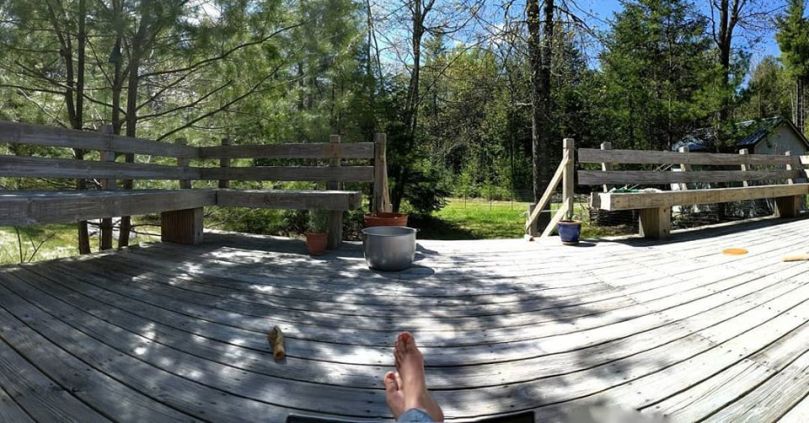
Being a new faculty member is extremely rewarding, but can also be exhausting, especially for those also trying to establish a family as well as a laboratory. Many academics report that they meet their deadlines, but fail to take care of themselves and their health and family suffers as a consequence. Take the opportunity to slow down, even if it’s just taking your laptop to a location with a better view.

View of a wooden deck with forest behind it.

5-year anniversary of my PhD graduation!

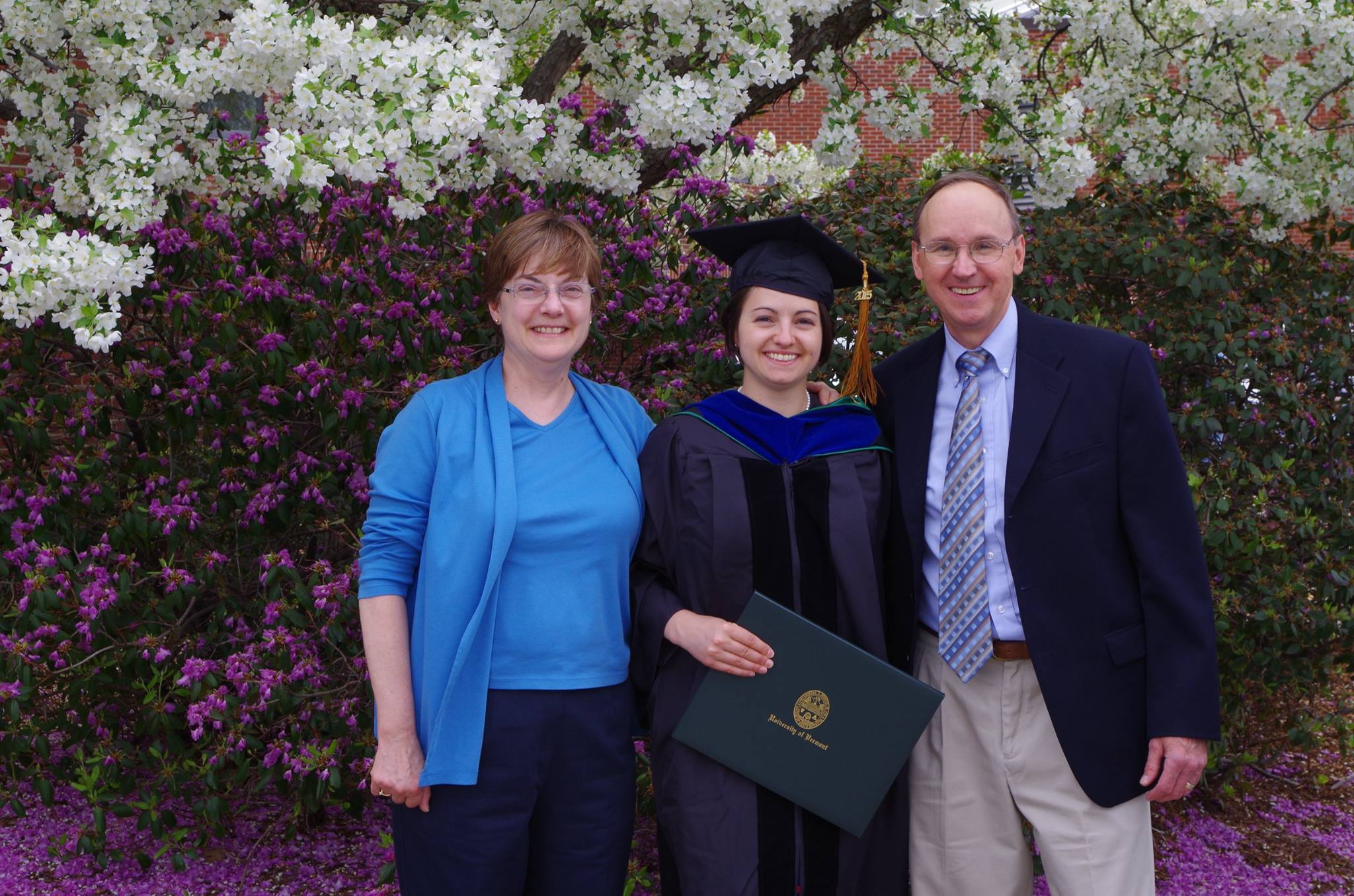
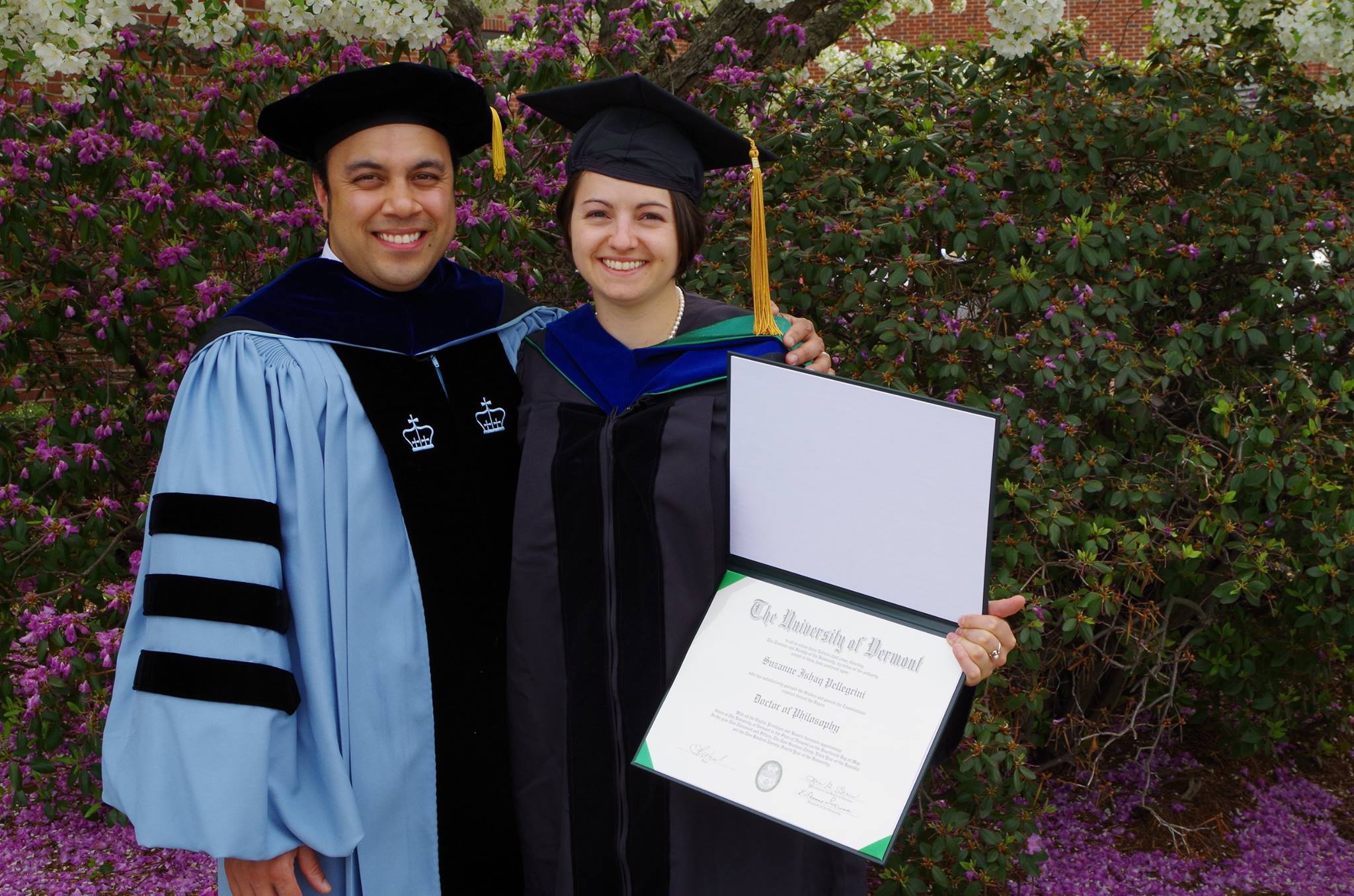
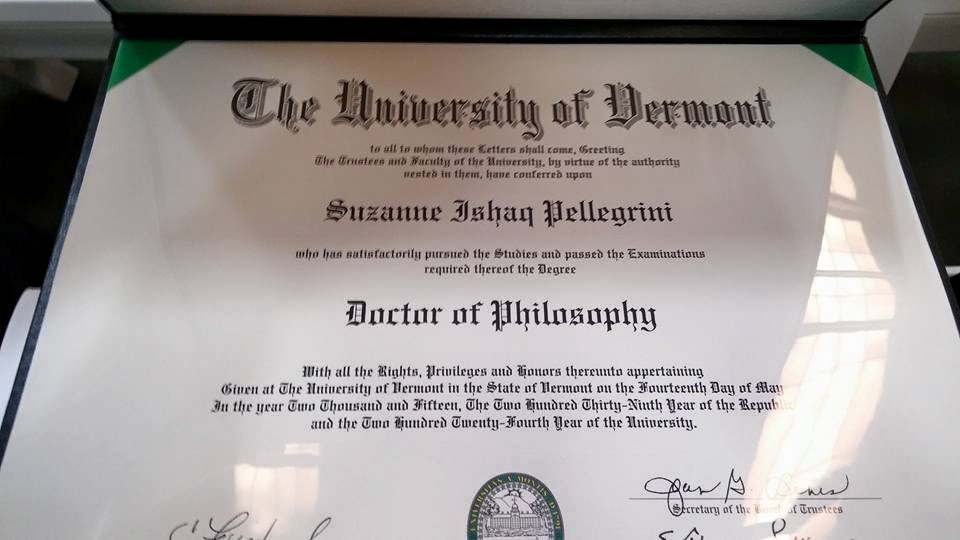
Seems like a lifetime ago that I walked the stage and was hooded during the graduation for my doctoral degree, just 5 years ago. In 2020, most Universities have cancelled their in-person graduations due to pandemic concerns, with faint hopes that they might be able to host the opportunity for 2020 graduates “to walk” at a future ceremony. It’s a good day to reflect on the opportunities and privileges I’ve been afforded that have helped me along the way.

I defended my PhD in mid March 2015, and within two weeks had driven with Lee from Vermont to Montana, flying back to VT for the ceremony in May. In those 5 years, I moved to Montana, then Oregon, then Maine; I’ve worked for 4 different departments in 3 Universities; I’ve had several different hair styles; I adopted a dog, got married, and bought a house; applied to dozens of jobs almost every year because of the short-term appointments I held; and established a research lab at the University of Maine as an assistant professor. It’s been a pretty busy 5 years, all around. I look forward to the next 5 years, and the opportunity to help the next generation of researchers begin their journey.

Perspective on developing curricula

At the University of Maine, I am currently developing two new courses based on similar material I’ve taught previously at the University of Oregon and Montana State University. I’ve written about several of those classes, including a retrospective after teaching ‘Introduction to Mammalian Microbiomes’ to humanities students. Here, with the spring semester commencing this week, I thought I would share my approaches to developing coursework. While a class doesn’t stand on organizational physique alone, it can go a long way to facilitating your communication with your students, their understanding of course expectations, and their ability to assimilate the information you are disseminating.

Organization of materials

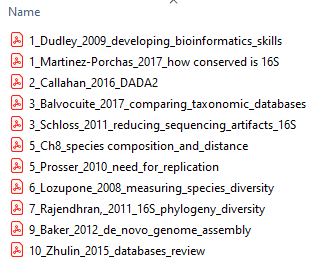
The nature of my teaching means means that I don’t assign readings from a textbook, I curate reading lists for my students from current scientific literature, which changes a little each year. Because of this, and the need for file management, I have a few tricks. First, I have a folder (on my computer and the online teaching tool) specific to readings for that class. I curate the file name with first author, year, and few words from the title so I can keep track of what it is (ex. Zhulin_2015_databases_review). I duplicate that file name in my syllabus, so I can copy and paste instead of writing it out again.

I format my syllabus as a table, and add each reading to the day on which it is assigned. If I move lectures around, I move the whole table row, so I can migrate assignments and readings along with lecture titles. Lastly, because the readings are specific to lecture and date assigned, I mimic that order in my file names by numbering them all instead of leaving them in alphabetic order (ex. 10_Zhulin_2015_databases_review), to facilitate knowing when and which is assigned.

And I don’t just number them by order, I number them by lecture so students or I can just match the lecture number across the lecture files, assigned readings, etc.

Written assignments (when logistically possible)

A stack of papers facedown on a table.

There’s no easy way to grade written assignments from students, but I prefer it to exam-style assessments. Particularly in teaching microbial ecology and sequencing data analysis, there’s not a lot of strict memorization like there is in anatomy. The material lends itself more to critical thinking and debating theory, to presenting a scientific argument, to problem solving, or to composing mock scientific manuscripts. In allowing students the word count to work through their thoughts, they are able to find the words to express their opinion on, say, the Hygiene Hypothesis when only weeks before they didn’t know that some microbes can turn the immune system on or off.

Written assignments allow me to give them feedback, including grammatical corrections, suggestion on sentence structure, pointing out leaps of logic where they left readers behind, and of course, on the strength of the scientific argument. This is particularly helpful when learning to write technical science.

Red pen.
Photo credit: Merriam-Webster

In giving students the agency to choose a topic to write about from the curricula tasting menu I’ve provided in my lectures, I receive back more information than just what I provided, which keeps things interesting for me. And, in giving them assignments which practice their writing voice, I witness their progression towards mature scientific writing.

Stacking assignments for improved retention

It takes time to become familiar with new information. That’s why school subjects are taught multiple times, or in specific orders, as you progress through education. I have 13 – 15 weeks in a semester (or 10 in a quarter!) to on-board students and teach them a skill. For most of the students I have taught, my class is their first introduction, or their first formal introduction, to the subject.

Especially for my host-associated microbial courses, there are hundreds of years-and-counting worth of history which led us to our current understanding of the microbes that inhabit us. Without that history, an explanation of the available technology, and a discussion of how that technology shaped the view we had, I can’t do justice to the majority of the coursework where I explain how we discovered the relationship between salivation and the microbial community geography in your mouth. The first section of my ‘host-associated’ course includes this background information, and a discussion of current technology, which is reiterated when later discussing literature and how technological shortcomings can hamper our understanding of a microbial community.

To give students more time to practice the material, I give related readings, have a guided discussion at the end of lectures, and stack assignments. Students start with a non-technical summary of a paper; 1-ish paragraph where they have to introduce the paper and why it was done, the methods used, and a major result or two. Trying to explain a complex experiment in simple terms is a great way for students to gain familiarity. When it comes time to write a two-page essay for a take-home exam, I allow the students to build off those summaries, if they choose.

An inclusive syllabus

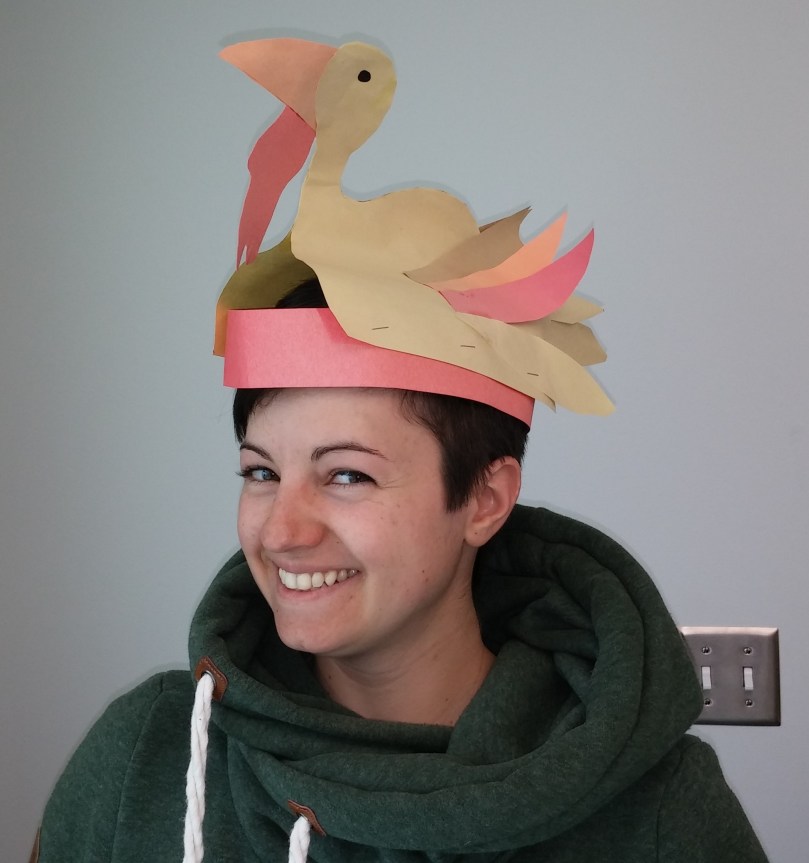
A syllabus is a document which encompasses the important information for the class, including meeting times and rooms, grading policy, lecture and assignment schedule, required reading materials, and more. It can be used to recruit students to sign up for the class, and once in attendance, it’s the first impression students have. It’s where they refer for questions about the course, what’s expected of them, and where to find instructions on assignments. I write my syllabi in a way that makes sense to me, the instructor, and I welcome feedback from students when my instructions are confusing. But, I also welcome feedback from different student populations in order to make the language and presentation of the document more approachable. Sometimes you just need something to break the ice. Like a paper turkey hat.

Sue wearing a paper hat shaped like a turkey.
Wearing the turkey hat that my mentee and I made.

I haven’t actually worn a turkey hat to teach a class, that’s too informal. I dress up like an anatomically-annotated dissected cat, because I’m a professional. Or, I ran regular class discussions that occasionally got heated and were monopolized by a fraction of the class. The next year, I took a stronger moderator stance and would impose more restrictions (“Ok the next comment HAS to use the word “microbes”). I don’t like calling on students, so the next time I have discussions I think I’m going to give them all D20 dice and have them roll for initiative on the order of presenting comments. I also added this to my syllabi:

Class participation: Students are expected to participate in discussions in class.  I strive to create inclusive discussions, but if students still find it challenging to participate please notify me and I will alter the discussion format as needed.

AVS 590 Syllabus spring 2020

Most universities also require text or links to their campus policies, driven by federal, state, or university law. These include a statement about accommodations for disabilities, although many faculty are happy to make accommodations without the student receiving prior approval. I started allowing students to occasionally attend lectures by video conferencing, if they notified me ahead of time. It allowed students who were ill or traveling to keep pace with the material, and I have even remotely conference-videoed in to a student’s laptop to present when I was home sick but didn’t want to cancel class.

New this year, I’ve included text about students missing classes for parenting or caregiving responsibilities, something I don’t currently participate in, so it was not something I thought to include information on until someone else (Jenn Perry) gave me their perspective. Now I have this:

Pregnancy, lactation, and parenting: I am happy to make accommodations for students based on pregnancy, lactation, and parental needs, as well as work with the Office of Equal Opportunities. Maine state and UMaine policy allows students to breastfeed in any space, including in class. If a lactation space is required, please contact E.O. for arrangements.

AVS 590 Syllabus spring 2020

Similarly, a tweet by Dave Baltrus about including inclusive statements such as information for food insecure students led me to add this:

Food insecure? Need clothes? Check out the Black Bear Exchange’s Food Pantry: https://umaine.edu/volunteer/black-bear-exchange/ or Old Town Crossroads Ministry.

AVS 590 Syllabus spring 2020

And finally, I added text about mandatory reporting. As a public university employee, I am obligated to notify the University of Maine Title IX office about criminal actions towards or by anyone on campus. If a student reveals information to me, I have to pass it on to the Title IX office which will then discretely reach out to the student with resources. The office advocates for anyone on campus, but they are particular important in situations involving students who are low on the power scale and cannot advocate for themselves. While my door is always open to students looking for help, I felt it was important for them to know that I might not be able to keep the meeting confidential.

Inclusiveness in the classroom is important to me, because if students don’t feel welcome, comfortable, and free from hunger, they can’t learn. Despite what opponents think, this doesn’t involve “coddling” or “being too soft”. It means being realistic in my expectations about how people learn and what else they are dealing with that might be inhibiting that. It means that I learn to be more proficient at communication and personnel management, which are vital skills for academics. And it means that we all elevate our skills together.

Silhouettes of four people jumping in a dark cave.