White paper and perspective published on “Running a queer- and trans-inclusive faculty hiring process”!!

I’m delighted to announce the public release of a white paper on queer- and trans-inclusive faculty hiring practices, and a perspective piece introducing it!! This is the culmination of months of writing by an international group of talented scientists led by Dr. JL Weissman, and I was honored to participate in these and future efforts from the group.

The newly-formed group, Advancing Queer and Trans Equity in Science (AQTES), wants to improve the field of research by making the hiring process fair and welcoming for everyone. No matter what your personal identity is, we can all agree that fair and unbiased job searches are critical to hiring the best talent. But, sometimes a poorly-organized job search prevents the people with the best talent from applying at all.

In our white paper, we give suggestions on how to host a job search that is better for everyone. We provide examples and advice on how to write job adverts, create the agenda and atmosphere for the job search, how to make the interview process more accessible for everyone by remembering that we are humans and not robots, and how to support your new faculty.

Running a queer- and trans-inclusive faculty hiring process.

Authors

Weissman, JL, Chappell, C.R., Rodrigues de Oliveira, B.F., Evans, N., Fagre, A.C., Forsythe, D.,  Frese, S.A., Gregor, R., Ishaq, S.L., Johnston, J., Bittu, K.R., Matsuda, S.B., McCarren, S., Ortiz Alvarez de la Campa, M., Roepkw, T.A., Sinnott-Armstrong, N., Stobie, C.S., Talluto, L., Vargas-Muñiz, J., Advancing Queer and Trans Equity in Science (AQTES).

Abstract

Queer and transgender scientists face documented systemic challenges across the sciences, and therefore have a higher attrition rate than their peers. Recent calls for change within science have emphasized the importance of addressing barriers to the success and retention of queer and trans scientists to create a more inclusive, equitable, and just scientific establishment. Crucially, we note these calls come primarily from early career researchers; relatively few queer and trans scientists have passed through the gauntlet of the faculty job search to become faculty ourselves, which is typically key to long-term persistence in academia. Our lack of representation creates a self-reinforcing cycle in which queer and trans trainees do not see our needs considered in established processes and power structures. Moreover, this status quo has historically been and continues to be harmful, disproportionately impacting those of us who have multiple intersecting marginalized identities. Here, we provide concrete guidance to search committees to support queer and trans candidates throughout the faculty selection process based on our personal experiences as early career scientists who have been on the job market.

Graphics in the post and the article created by Callie R. Chappell.

Citations

Citation for the paper: Weissman, JL, Chappell, C.R., Rodrigues de Oliveira, B.F., Evans, N., Fagre, A.C., Forsythe, D.,  Frese, S.A., Gregor, R., Ishaq, S.L., Johnston, J., Bittu, K.R., Matsuda, S.B., McCarren, S., Ortiz Alvarez de la Campa, M., Roepkw, T.A., Sinnott-Armstrong, N., Stobie, C.S., Talluto, L., Vargas-Muñiz, J., Advancing Queer and Trans Equity in Science (AQTES). 2024. Running a queer- and trans-inclusive faculty hiring process. EcoEvoRvix repository 6791.

Perspective piece introducing the paper:  Weissman JL, Chappell CR, Francesco Rodrigues de Oliveira B, Evans N, Fagre AC, Forsythe D, et al. (2024) Queer- and trans-inclusive faculty hiring—A call for change. PLoS Biol 22(11): e3002919.

This work is being presented at the American Geophysical Union annual meeting in Washington DC in December, in the session on “ED12A: Advances and Progress Toward a More Inclusive, Diverse, Equitable, and Accessible Scientific Community II”.

This work is being presented as a seminar at the Microbes and Social Equity working group virtual seminar series, Dec 20th, 2024. Registration is free but required.

The first MSE symposium was a success!

Last week, the Microbes and Social Equity working group hosted its first ever symposium! We hosted 15 talks over 5 days, with each session melding presentations and active discussion groups.

In total, the symposium had 254 participants (467 registrants) from 22 countries, and including researchers from various fields and career levels, as well as members of the Maine State Legislation, and members of the general public.  The breakout rooms resulted in 16 draft documents collaboratively written by meeting ideas, which highlight issues/barriers to social equity in research and practice, resources and policy ideas to resolve inequity, research questions yet to be answered, and ideas for curricula development and integrating research and policy into education.

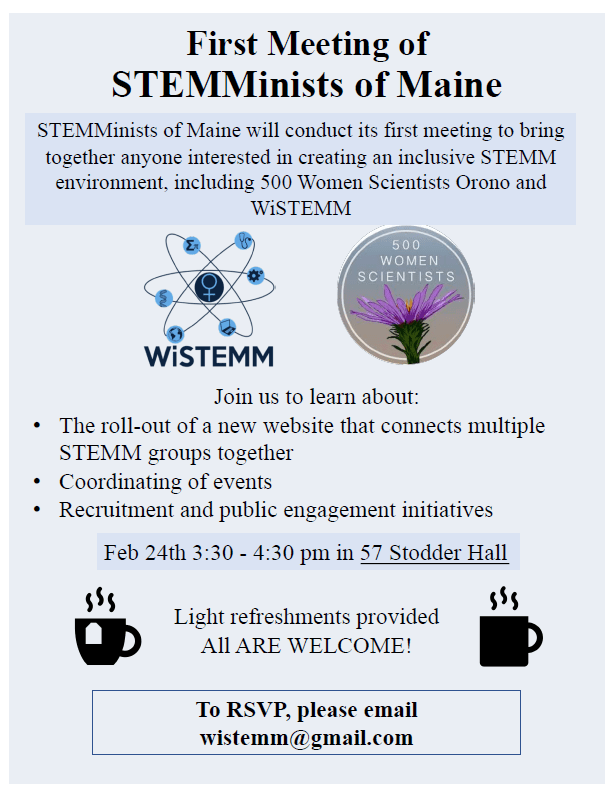
STEMMinists of Maine inaugural meeting announced!

One of the biggest challenges faced by STEMM (science, technology, engineering, math, medicine) advocacy groups is finding the time and resources to propose and execute initiatives, as well as find the time for social media engagement to grow the group. There are a number of groups already established in Maine which seek to promote STEMM advocacy/education, accessibility, diversity/equity/inclusion, campus community members, and the general public. 

STEMMinists of Maine is a newly-formed STEMM advocacy group, which seeks to bring together these various groups. Our goal is to act as an umbrella organization, to create a cohesive social media presence that makes it easier for people interested in STEMM advocacy and inclusion to find resources, coordinate events, and get the message out.  All participating groups will remain autonomous, but participation (which is free) will hopefully allow us all to reach a broader audience and have a greater impact in both campus and state-wide initiatives.

Our inaugural meeting will be held at the University of Maine campus, 57 Stodder Hall, to introduce STEMMinists and invite others to be part of our work to promote a better STEMM community. All are welcome!

Shortly after, our website and social media will be finalized and launched!

Expanding Your Horizons for Girls workshop, MSU 2017

Yesterday I participated in the Expanding Your Horizons for Girls workshop at Montana State University!  EYH brings almost 300 middle-school aged girls from all over Montana for a one-day conference in STEM fields.  Twenty-seven instructors, including myself and other female scientists and educators, ran workshops related to our current research.  My presentations were on “Unlocking the Hidden World of Soil Bacteria”, with the help of undergraduate Genna Shaia from the Menalled Lab.

I gave the girls a brief presentation on microbial ecology, and how bacteria and fungi can affect plants in agricultural soil.  We talked about beneficial versus pathogenic microorganisms, and how different farming strategies can influence soil microbiota.  This was followed by two hands-on activities that they were able to talk home with them.  First, the girls made culture plates from living or sterile soil that was growing wheat or peas to see what kind of microbes they could grow.  Then, they planted wheat seeds in either living or sterile soil so they could track which soil made the seeds germinate faster.


The girls were enthusiastic to learn, asked lots of insightful questions, and it was awesome being able to share microbiology with kids who hadn’t given it much thought before!  If you are a woman in STEM, and have the opportunity to participate in a workshop or mentor a young scientist,  it is not only rewarding but can make a huge impact on encouraging women into STEM.

This slideshow requires JavaScript.

Slideshow photos: Genna Shaia, reproduced with student permission.

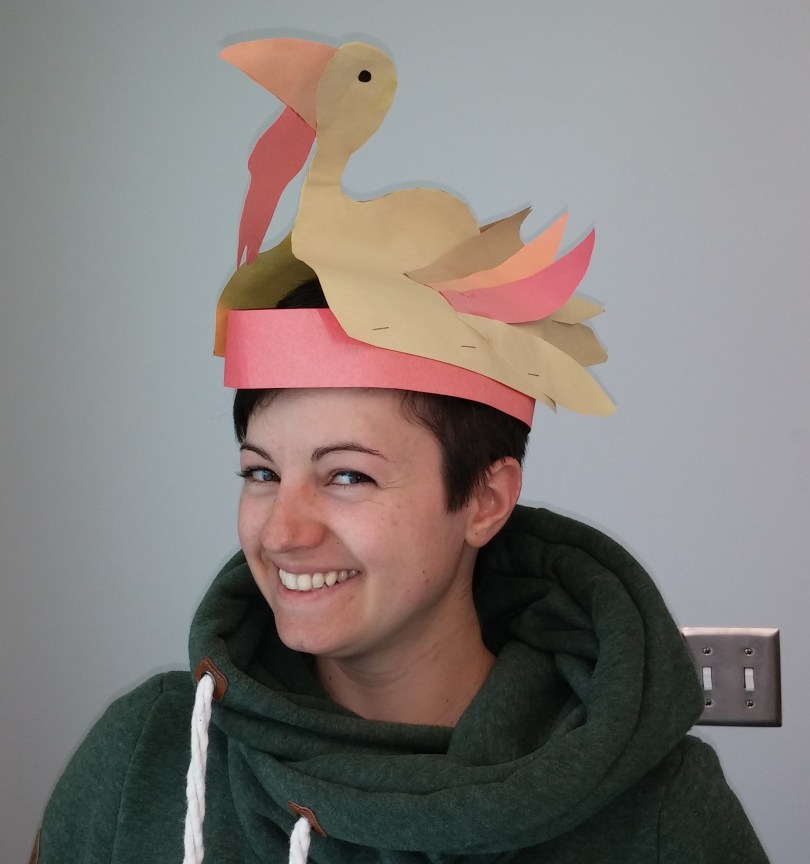
Sue wearing a paper hat shaped like a turkey.

Improving a child’s life is as easy as wearing a paper turkey-hat.

Encouraging girls to go into STEM fields is really important; studies show that female STEM high-school teachers and even online mentors increase the probability of female students following a STEM education.  Moreover, any child benefits academically and psychologically from having positive role models in their life, especially when they were role models that they interacted with as opposed to celebrity role models.  And the benefits don’t just extend to children, adults benefit from positive role models, too.  Certainly I have benefited from strong female role models in my life, from high school art teachers, to undergraduate lecturers, to family (happy birthday, Mom!).

This past fall I started putting my money where my mouth was- I started mentoring an elementary school-aged girl in Bozeman, MT through the Thrive Child Advancement Project (CAP).  So far, we have mostly been making art projects and talking about archaeology.  But we have been talking about trying to learn the Java programming language together!

There are lots of opportunities to mentor kids, either through CAP programs, Big Brother/Big Sister, Girls and Boy Scouts, etc., just a quick internet search brings up dozens of local options.  For less of a time commitment, you can also volunteer for community workshops, like the Girls for a Change summit in Bozeman or the Girls-n-Science in Billings.

This slideshow requires JavaScript.