I'm an assistant professor of animal and veterinary studies at the University of Maine, Orono, studying how animals get their microbes. I am also the Founder and Lead of the Microbes and Social Equity working group.
According to National Day Calendar, it’s National Employee Appreciation Day! Many organizations have an annual Staff Appreciation Day or Week, and rightly so. Research staff in academia, as well as general staff, are often quietly under appreciated. Research staff can be costly, especially because many universities insist that research positions have salary and benefits fully-funded by grants. Many labs thus rely on undergraduate student researchers, who work for minimum wage or might even pay for university “research credits”, to help provide labor.
While many undergraduates find themselves performing unglamorous routine lab maintenance (anything from washing dishes, to pre-weighing commonly used supplies, to dusting, to inventory), as a researcher I can attest to how vital these tasks are. Working in a molecular biology lab, dust and other contaminants had to be minimized and it was extremely helpful to have undergraduates who were able to dust multiple times a day. When culturing bacterial isolates, I would go through hundreds of culturing tubes every week, which all needed to be autoclave sterilized, emptied, washed, and re-sterilized. This was a massive amount of effort unto itself, and I would not have been able to accomplish my culture work without. Perhaps the best example was my study of probiotics in newborn lambs. I had 24 lambs which were only 4 days old, which needed to be fed every 4-5 hours, sometimes by hand, as well as weighed, sampled, and cleaned on a regular basis. Without numerous undergraduate volunteers, I would have found myself sleeping at the barn for two months.
Not only is it polite to appreciate the staff who keep your work moving, but proper gratitude can go a long way towards improving work relationships, job satisfaction, and performance. So get out there and start thanking!
Great news: you can participate in science without going through a decade of higher education (sorry grad students, but thanks for your service!). There are two ways to do this: either you can volunteer to collect samples for a project, or you can volunteer to be the sample for a project. You can volunteer through the National Institutes of Health, third-party match sites that help recruit volunteers for large projects, independent research centers (that are usually under contract to run a study), and most universities and colleges have volunteer-recruiting websites.
Get out there and collect
There is a myriad of environmental science studies that rely on volunteers to collect samples, which may take place in very specific areas, or globally. Some are simple wildlife surveys, often through conservation societies like the Audubon Society, which use volunteers’ bird sightings to estimate populations. Humanitarian volunteer agencies may recruit volunteers for global research studies, as well. Some projects require more technical sampling, or require participants to travel to distant or difficult to reach places, and thus rely on outdoors-people with the gear and ability to safely retrieve water, soil, plants, animal hair or feces, you name it! There are some excellent examples of global projects which can be found through Adventure Scientists. AS recruits and trains volunteers for more difficult environmental sampling, and I am currently participating in their Gallatin Microplastics Initiative (year 1 and 2) along with my sampling team: Lee and Izzy.
This slideshow requires JavaScript.
‘Host’ your own research
Volunteering to be the sample also allows you to participate on a sliding scale of involvement. For example, observational studies only collect information on what is already happening. These might be sociology (human behavior) studies which only require you to fill out surveys (often online) on your personal history or normal routines. You can also donate biological samples (hair, breathe, blood, urine, feces, skin scrapings, etc.) which are minimally invasive but don’t necessarily require any experimental treatments that you have to participate in. A study that I analyzed data for asked participants to use a breathalyzer and submit a fecal sample in a jar. That’s all, and they were financially compensated for their time. The study was trying to correlate microorganisms in the gut with how much hydrogen or methane was in the breath, and whether a breathalyzer test could be used as a rough measure of how many methanogenic archaea lived in your gut. Often, research centers which are focused on medical treatment for a specific disease will collect specific biological samples.
Studies which require actual treatments or testing are clinical medical studies that rely on human volunteers upon whom to test products. At a certain point in drug or vaccine testing, animal or computer models can no longer serve as a proxy and you need to test things in humans. Thanks to HIPPA (Health Insurance Portability and Accountability Act of 1996) and other safety regulations, both at the federal and institutional level, there is a lot of transparency in these studies. You are told exactly what you will be required to do, what data will be collected and who will have access to it, and any possible health concerns that may arise from this study. Any release of tissue “ownership” will require you to sign consent.
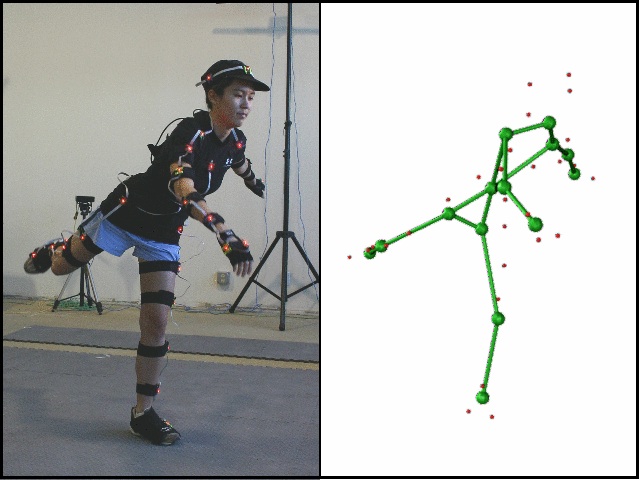
I have participated in antibacterial product testing, a diet study investigating dairy fats during which I could only eat the prescribed diet for two solid months (boy, did I miss chocolate and Thai food!), and a study on chronic back pain (I was in the control group). For the back pain study, I had an EEG net put on my head to measure brainwaves and motion capture balls(examples below) attached all over my body to track my muscle movements as I performed simple tasks that required me to use my lower back muscles. I even had a functional MRI brain scan to measure how muscle pain might change brain function, unfortunately, I was not able to get a photocopy of my brain scan for posterity. The more invasive, time consuming, or risky a study may be, the higher the compensation (some vaccine studies compensate several thousand dollars).
You can participate in science in other ways, too. Try getting involved with science education! There are workshops, summer programs, or school events which encourage kids to learn about science and consider a career in it. Even if you aren’t a scientist yourself and can’t be a presenter, many programs still need people to chaperone, coordinate or market the event, and cater. Many science museums and educational centers have programs, as do many colleges. You can also find opportunities through local government to help clean natural sites or educate the public.
While you are out there collecting water samples from Arctic ice, counting wolves, or surveying land for public use, you are also perfectly situated to help with a little environmental restoration. The Global Microplastics Initiative looks for plastic in water sources from some very remote locations, and this study wouldn’t have been conducted if plastic in the environment wasn’t a concern. So while you are out there, try to leave the area a little cleaner than how you found it. You can volunteer for clean-up events to target specific locations that need help, but you don’t even need to organize for this one, just go out and start picking up trash!
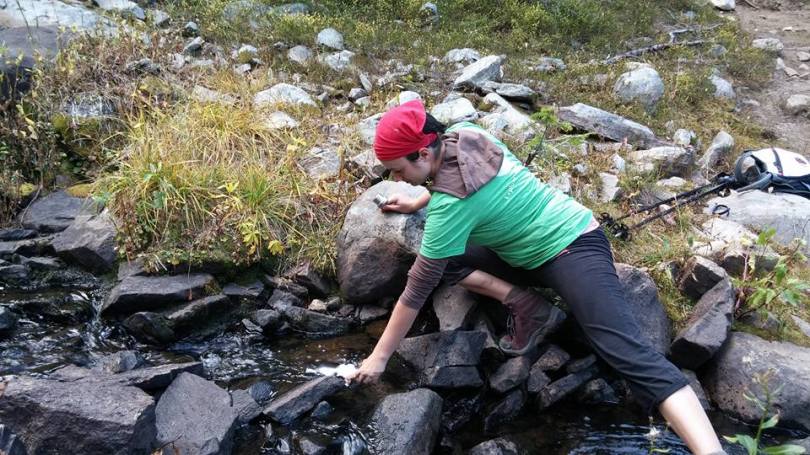
I took it upon myself to clean a stream near my house in Bozeman one day last year.
Finally, most agricultural research studies rely on farmers, ranchers, growers, and producers as a source of project resources (like seeds, land, or cows) and project motivation. After all, federally and state-funded agricultural science exist to help local and national agriculture. You can participate in science by identifying problems that need to be solved and providing objectives for our studies, or by allowing research projects to use your land, animals, or facilities.
So far, you’ve educated yourself on science, and now you can go out and participate. Stay tuned in the next for weeks for Anyone can Science, Step 3: be supportive.
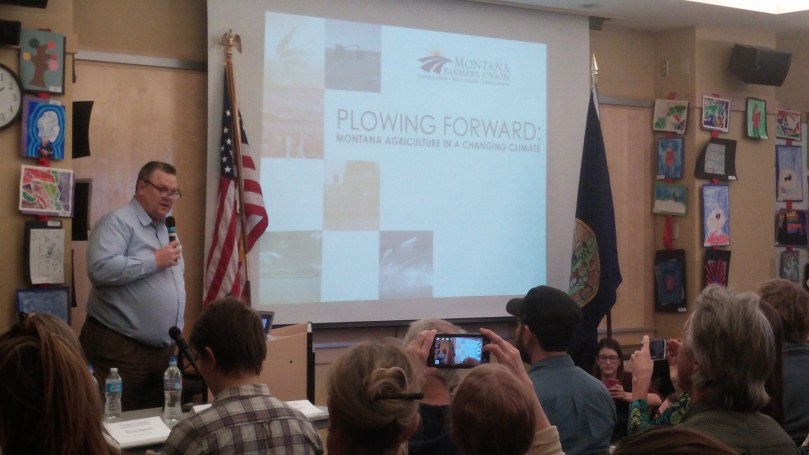
Agriculture is consistently Montana’s largest economic sector, but as an arid state we need to prepare for the challenges brought on by changing weather patterns. Yesterday, agricultural producers, scientists, special interest groups, lawmakers, and the general public came together at the Bozeman Public Library to talk about the future of climate change and what it means for people in the agricultural industry and research sector. The event was organized by Plowing Forward, a collaborative group to coordinate local Ag. education efforts.
“If you’ve eaten today, then you’re involved in agriculture.” -Chris Christiaens at the Plowing Forward meeting in Bozeman, MT, Feb 10, 2017
Opening remarks were led by Chris Christiaens, lobbyist and Project Specialist for the Montana Farmers Union, based in Great Falls, MT. Chris gave us some perspective on how Montana farming and ranching has changed over time, especially over the last 10 years,including changes to the growing season, harvest times, water usage, the types of plants which are able to survive here. He reminded us that the effect of climate on agriculture affects all of us.
Chris Christiaens, Project Specialist for Montana Farmers Union.
Next, we heard from Montana’s Senator Jon Tester, who runs a farm in northern Montana that has been in his family since 1912. The Senator spoke to his personal experiences with farming and how his management practices had adapted over the years to deal with changing temperature and water conditions. Importantly, he spoke about how agriculture is a central industry to the United States in ways that will become even more apparent in the coming years as the negative effects of climate change affect more and more areas. Food security, a peaceful way of life, and economic vitality (not just in Montana or the United States, but globally), were contingent upon supporting agricultural production under adverse events. He assured agricultural stakeholders that he continues to support production, research, and education, including the work we do in the laboratory as well as out in the field to promote agriculture.
Montana Senator Jon Tester
Next, we heard from three professors from Montana State University. Dr. Cathy Whitlock, a Professor of Earth Sciences, who is also the Director for the MSU Institute on Ecosystems, and a Lead Coordinator for the Montana Climate Assessment. The Montana Climate Assessment seeks to assemble past and current research on Montana climate in order to assess trends, make predictions about the future, and help both researchers and producers to tailor their efforts based on what is happening at the regional level. The Assessment is scheduled for release in August, 2017, and will allow for faster dissemination of research information online.
Dr. Whitlock’s introduction to the MCA was continued by Dr. Bruce Maxwell, a Professor of Agroecology, as well as the Agriculture Sector Lead for the Montana Climate Assessment. He summarized current research on the present water availability in Montana, as well as what we might see in the future. He warned that drier summers were likely, and while winters may get wetter, if they continue to get warmer that snow runoff will flow into rivers before the ground has thawed. This means snow melt will flow out of the region more quickly and not be added to local ground water sources for use here. To paraphrase Bruce, a longer growing season does you no good if you don’t have any water.
Dr. Bruce Maxwell, Montana State University
We also heard from my current post-doctoral advisor, Dr. Fabian Menalled, Professor of Weed Ecology Management and Cropland Weed Specialist (Extension). He presented some of the results from our ongoing project at Fort Ellis on the interactions between climate change (hot and dry conditions), farm management system (conventional or organic), disease status, and weed competition on wheat production. Increased temperatures and decreased moisture reduced wheat production but increased the amount of cheatgrass (downy brome), a weed which competes with wheat and can reduce wheat growth. My work on the soil bacterial diversity under these conditions didn’t make it into the final presentation, though. I have only just begun the data analysis, which will take me several months due to the complexity of our treatments, but here is a teaser: we know very little about soil bacteria, and the effects we are seeing are not exactly what we predicted!
Here is the video of Dr. Menalled’s presentation (just under 9 minutes):
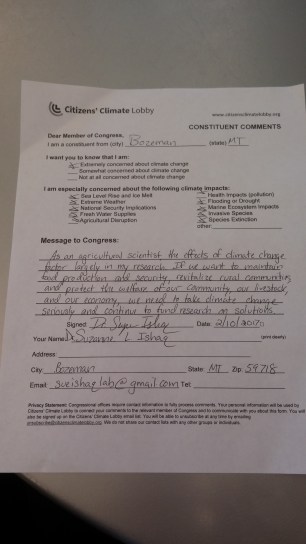
Lastly, we heard from a local producer who spoke to his experience with ranching on a farm that had been run continuously for well over 100 years. His talk reflected the prevailing sentiment of the presentations: that farm practices had changed over the last few decades and people in agriculture were already responding to climate change, even if previously they wouldn’t put a name to it. The presentations concluded with a question and answer session with the entire panel, as well as a reminder that we all have the right and the obligation to be invested in our food system. Whether we grow produce or raise livestock for ourselves or others, whether we research these biological interactions, whether we set the policy that affects an entire industry, or whether we are just a consumer, we owe it to ourselves to get involved and make sure our voice is heard. To that end, I wrote a letter to my legislators (pictured below), and in the next few weeks I’ll be writing posts about how I participate in science (and agriculture) on the local and national level.
Co-written by Dr. Irene Grimberg, Affiliate Associate Research Professor at Montana State University.
Science may seem like an exclusive club, what with the complicated technical jargon, quirky inside jokes that only seem funny to science people, daunting entrance and exit exams, and years of study and self-improvement. And it doesn’t help that many scientists would rather hole up in their lab than give a public presentation or figure that “social media thing” out. But we scientists get coffee stains on our lab coats and use spell-check just like everyone else. And as with ice cream, science comes in a tremendous variety of flavors and sizes of commitment. So, let’s talk about some ways that you can involved today!
Education
Getting acquainted with the vast field of science seems daunting, but it’s actually easy and fun. There are hundreds of museums out there that are eagerly waiting to broaden your perspective on science, technology, engineering, and mathematics (STEM), and will let you give it a try with hands-on activities. Wikipedia has conveniently made some lists on science museums in the US and around the world. In fact, there are organizations like the American Alliance of Museums and the Association of Science-Technology Centers that can help to get you connected to the museum that catches your eye. Many US National Parks also have strong science education programs and information in the visitor centers or around the park (at least, as of January 19th, 2017 they did).
All colleges and universities host daily talks (seminars) on current research and they are open to the public, they just aren’t advertised widely in local media. If you search online for your local university and “seminar”, you can find public presentations for nearly every department or subject, not just the STEM ones. Some presentations are available as webinars and can be found online to watch remotely in real-time so that you can ask questions, or can be replayed later at your leisure. There are many outreach STEM programs sponsored by non-profit organizations, sometimes in collaboration with universities. For example, Farm Days or Field Days are public presentations at university research facilities on issues related to local and national agriculture, food production, and food safety. In fact, most university farms and greenhouses are open to the public and offer free tours and other events on a regular basis. There are also “ask an expert” shows on local public radio and TV in which viewers can call in and ask questions to university researchers. Or you can simply email your questions and get connected to someone in a relevant field. Even NASA has a program in which you can ask questions to an astrophysicist!
Other educational options include science festivals, robotic competitions and shows, Science Olympiads, The National Chemistry Week, and programs that specifically aim to recruit girls to science, such as Expanding Your Horizons and Girls for a Change. As an undergraduate at the University of Vermont, I participated in a service-learning course in spring of 2008 in which we designed a public presentation at the ECHO Center in Burlington, VT. The purpose of the all-day workshop was to educate kids and adults on wolf ecology and potential reintroduction into New England. Our Wolfwise presentation was incredibly fun to host, and it was a huge hit: we were invited to come back and present again the next weekend!
The Wolfwise Team
Here I am as an undergraduate presenting on wolf behavior and how it isn’t so different from human behavior.
We presented information to the public on wolves and their reintroduction.
If leaving the house isn’t your thing, there are an overwhelming amount of resources available online. An increasing number of scientific and research journals are available free of charge online, known as open access. Over 26 million journal articles are available through PubMed, a database for medically-relevant research studies which is curated by the National Center for Biotechnology Information (NCBI). Science News hosts a huge variety of STEM articles compiled from the most prestigious science journals, as well. And any subject under the sun (or inside the sun) has an educational video out there somewhere. There are science shows on TV, a dedicated cable channel, and documentaries including several outstanding educational series with high-definition video footage from around the globe (Plant Earth, Life, and The Blue Planet). There are podcasts, such as Science, Star Talk Radio, and many others that allow you to listen to recorded audio shows on your own time. You can find interactive websites to learn a variety of things, both academic and practical. Or teach yourself computer coding in C++, Java, Ruby, Python, or Perl.
Just be sure that you are getting your information from a credible source. Many online bloggers or websites sound great, but they often have no formal training in what they peddle, or are heavily sponsored by companies to promote an unsubstantiated lifestyle or discredit scientific work. A good rule of thumb is to look for qualifications, citations, and motivations. Does this person or organization have formal education or training? Do they cite their sources for information? And what is their reason for doing this? Here are my qualifications, you’ve seen how much I enjoy citing sources, and since I am (and have always been thus far) federally-funded through different grants, I consider it part of my job to share my work and my experiences free of charge.
I sometimes get a self-depreciating response when I tell people what I do: “oh I could never do that,” “I wouldn’t even know where to begin,” or my least favorite; “I’m not smart enough to do that myself.” Sure, I’m intelligent, but more importantly I am interested in my work and I put a lot of time and effort into practicing it. I didn’t become a microbiologist overnight. And more than that, in my career path I discovered a lot of people and opportunities that helped me get here. I firmly believe that most people could do my job, given the right amount of education, determination, and support (and a heavy dose of enthusiasm for spread sheets). As I move up the ladder, I’m increasingly in a position to educate, help others network, and bring students closer to their career goals. One day I’ll be able to take on graduate and undergraduate researchers of my own, and I find myself asking, how will I find and recruit those students that just need an opportunity to become amazing scientists? The ones that weren’t told by their teachers that they should be microbiologists but still have an aptitude for it, the ones that think they aren’t “smart enough” when really they just aren’t confident enough?
Lessons from the rare biosphere
One of the emergent theories in microbial ecology over the last few decades is that of the “rare biosphere.” It’s the idea that microbial ecosystems are much more intricate than we realized, and there are a great many microorganisms present in any given environment that have very low populations. We just couldn’t see them under a microscope or grow them in culture because their presence was washed out by more abundant microorganisms. It wasn’t until the emergence of DNA-based technologies that we could really understand the depth of that diversity because this technology was able to sequence all or nearly all the DNA in the entire sample.
An anaerobic chamber allows microbes to be grown in an oxygen-free environment, and the different color plates represent different media recipes. Credit: Kristina Bond.
When culturing bacteria in the lab, one must try to mimic the original environment as closely as possible in order to get that microbe to grow. It is incredibly difficult to please “everyone” on just one or even dozens of different culture media types, so you end up getting a biased idea of “who” lives in a natural environment based on what species are able to survive in the mock environment you’ve created. DNA-based technologies don’t require live microorganisms; you can extract DNA or RNA strands directly from your environment and sequence them, although you will need a reference database of previously cultured and sequenced microorganisms to make the identification. Sequencing has its own problems, of course, namely being able to discern between a rare microorganism whose DNA represents a very small percentage of your data, and a random sequencing error inherent to your technology that turns a known sequence into a fake novel one. One way bioinformaticians tackle this is by removing rare sequences altogether, but as Sogin et al. argue, you might be getting rid of significant contributors to your ecosystem.
This is just one example of a major theme in science: how do we detect something if we don’t know it’s there? How to do we differentiate what is real (but rare) from the technological errors and background noise? We constantly improve our technology and revise our understanding of the physical world as we get better at investigating it. But as we rely more and more on technology that we have created (which may operate on the biases we have designed into it), and we want to collect more information with less human effort, we need to remember that it’s our intuition and reasoning skills that make humans so good at data analysis and investigation in the first place. This led me to wonder if we weren’t making the same mistakes in education.
One of the most common errors we commit is to mistake education for intelligence. Intelligence is partially a natural ability for learning and understanding, and partially cultivated by an atmosphere of curiosity and interest in learning. Education, on the other hand, has to be earned. While public schools and other learning resources in the United States exist to give all children an equal chance at education, in practice there are significant biases in quality and quantity in education.
The disparity between education and ability
Student to teacher ratio is correlated with student performance, and can vary widely by type of school (public, private, elementary or secondary), geographic location, urban or rural demographics, etc. Because of that, the national trend for student to teacher ratios in public schools appears to have only slightly increased (more students per teacher) from where it was in 2002, with that increase only since 2008. However, much of the increase in student to teacher ratios is localized, specifically in low-income districts, so there is a disproportionate affect by economic status. Many teachers in low-income school districts cite budget cuts that result in overwhelmingly large class sizes to be the main reason they quit education (discussed here). And a poor school budget does more than just crowd students, it depletes the school of educational resources which reduces the quality of the education and student performance.
Therefore, just because someone appears uneducated does not mean they are not intelligent. For example, Linus Pauling, who was competing with Britain’s Watson and Crick to discover the structure of DNA, didn’t obtain his high school diploma until after he won two Nobel Prizes simply because he didn’t finish some required high school history courses. A recent study looked at grade point average (GPA), SATs (previously the Scholastic Aptitude Test), graduate record examinations (GREs- the standardized tests that most schools use as a graduate entrance qualifier), and whether test scores predicted how well someone performed as a graduate student. Like undergraduate study, most graduate programs require a minimum GPA and GRE score even to be considered. However, the study found that students with higher test scores didn’t actually perform better as graduate students. In fact, here’s a whole website about geniuses that failed IQ or other aptitude tests that went on to change the world. Here’s another about artists, politicians, and business tycoons who failed repeatedly before becoming household names.
Another problem is our biased view of the quality of an education based on the country of origin. Indian mathematician and genius Srinivasa Ramanujan was born in a small village in the late 1880s. He started performing advanced geometry and arithmetic at just 13 years old, and began focusing on mathematics in secondary school and at a local college. At 26, he wrote to British mathematicians looking to discuss his ideas, and was dismissed out of hand by almost all of them. G.H. Hardy, however, wrote back, and began a collaboration of ideas that led to an incredible body of work between the two of them.
The Rare Knowledgesphere- The one that almost got away
This idea of overlooking greatness is important to keep in mind when ranking people by their resume or test scores instead of by an interview. After all, just because you attended Yale doesn’t mean you went to all your classes. This concerns me, because we may be passing over potential undergraduate or graduate students who appear less educated on paper, but aren’t less intelligent or less apt.
So, how do we as educators and mentors get beyond this bias and find the students and researchers-to-be that slip through the cracks? The ones that are out there that aren’t even on our radar. I’ll let you know once I’ve figured it out. But from my experience, it comes down to taking the time to interview and really get to know someone before accepting them as a graduate student, not just selecting the best looking resume. It especially means letting go of your ideas about the quality of someone’s education based on the type or location of their school, as well as stereotypes about their abilities.
And it means being creative about marketing your positions, to make sure you are reaching the individuals that aren’t actively looking for you. This may sound counter-intuitive; why try to recruit someone to graduate study if they aren’t interested? Again, I can speak from experience. My undergraduate degree is in Animal Science, and my interests in graduate study at the time centered vaguely around wildlife conservation. Instead, I entered a graduate program where my primary research and laboratory work were focused on microbiology, genetics, microbial ecology, and bioinformatics. I had no formal academic or practical training in these areas. But I joined, and I excelled, all because my mentor-to-be told me that I was capable. And here I am today, in love with my science.
With all this in mind, stay tuned for my post in the next few weeks on what makes a person a good graduate student, if it isn’t test scores.
2016 started with a bang when I launched this site and joined Twitter for the first time! For the first quarter of the year, I was a post-doctoral researcher in the Yeoman Lab in the Department of Animal and Range Sciences at Montana State University. I was working on a total of eight grants, ranging from small fellowships to million dollar projects, both as a principal investigator and as a co-PI. I was also doing the bioinformatic analysis for multiple projects, totaling nearly 1,000 samples, as well as consulting with several graduate students about their own bioinformatic analyses.
In late spring, my position in the Yeoman lab concluded, and I began a post-doctoral position in the Menalled Lab in the Department of Land Resources and Environmental Sciences at MSU. This position gave me the opportunity to dramatically increase my skill-set and learn about plant-microbe interactions in agricultural fields. My main project over the summer was studying the effect of climate and other stresses on wheat production and soil microbial diversity, and this fall I have been investigating the legacy effects of these stressors on new plant growth and microbial communities. I have extracted the DNA from all of my Fort Ellis summer trial soil samples, and look forward to having new microbial data to work with in the new year. Based on the preliminary data, we are going to see some cool treatment effects!
Over the summer, I attended the American Society for Microbiology in Boston, MA in June, where I presented a poster on the microbial diversity in organic and conventional farm soil, and the Joint Annual Meeting for three different animal science professional societies in Salt Lake City, UT in July, where I gave my first two oral conference presentations. One was on the effect of a juniper-based diet on rumen bacteria in lambs, and the other was on the biogeography of the calf digestive system and how location-specific bacteria correlate to immune-factor expression.
Thanks to a lot of hard work from myself and many collaborators, a number of research projects were accepted for publication in scientific journals, including the microbial diversity of agricultural soils, in reindeer on a lichen diet, and in relation to high-fat diets in mice, it also included work on virulent strains of Streptococcus pyogenes, and a review chapter on the role of methanogens in human gastrointestinal disease.
This slideshow requires JavaScript.
Looking forward
A whopping thirteen manuscripts are still in review at scientific journals or are in preparation waiting to be submitted! Some of those are primarily my projects, and for others I added my skills to the work of other researchers. Editing all those is going to keep me plenty busy for the next few months. I’ll also be writing several more grants in early 2017, and writing a blog post about the Herculean task that can be.
I’ll be concluding my greenhouse study by March of 2017, just in time to prepare for another field season at Fort Ellis, on the aforementioned climate change study that is my main focus. In January, I’ll be spending time in the lab helping to process and sequence DNA from my 270 soil samples, and begin the long task of data quality assurance, processing, and analysis. I’m not worried, though, 270 samples isn’t the most I’ve worked with and bioinformatic analysis is my favorite part of the project!
This year, I am hoping to attend two conferences that I have never previously attended, and present data at both of them. The first will be the 2017 Congress on Gut Function in Chicago, IL in April, and the second will be the Ecological Society of America’s Annual Meeting in Portland, OR in August. Both conferences will give me the opportunity to showcase my work, network with researchers, and catch up with old friends.
If 2017 is anything like the past few years, it’s going to be full of new projects, new collaborators, new skills, and new opportunities for me, and I can’t wait! So much of what I’ve accomplished over the last year has been possible because of the hard work, enthusiasm, and creativity of my colleagues, students, friends, and family, and I continue to be grateful for their support. I’d also like to thank anyone who has been kind enough to read my posts throughout the last year; it’s been a pleasure putting my experiences into words for you and I appreciate the time and interest you put in. I look forward to sharing more science with you next year!
Every political season brings about uncertainty regarding the future of policy, funding, and cultural beliefs, and the field of science is no exception. The surprising results this November have led many scientists and other academics to fear for their jobs and research in the coming years.
Part of this stems from a growing trend of members of the public distrusting scientists (discussed here), or the rise of false information regarding serious issues such as climate change, genetically modified organisms (GMOs), vaccinations, etc., that is leading to a disparity between what scientists accept as true and what the public accepts as true. Regardless of which side of an issue you fall on, the consensus seems to be that the public is lacking scientific literacy and scientists are lacking in public outreach (hence the basis for my website).
Some of this disparity develops from public opinion and governmental policy, which can affect what research is deemed important enough to be funded. For example, if an administration denies the existence and causes of climate change, it sends a message to the public that this research and this theory are invalid or unimportant. Not only can this influence state and federal policy (1, 2), but usually means that the field is unlikely to receive state or federal research grant funding. Not only does this prevent a better understanding of scientific issues, like climate change, but it prevents technological advances which improve quality of life and the economy, especially since a good deal of commercial technology companies utilize basic research from academic institutions as publications and raw date are typically publicly available.
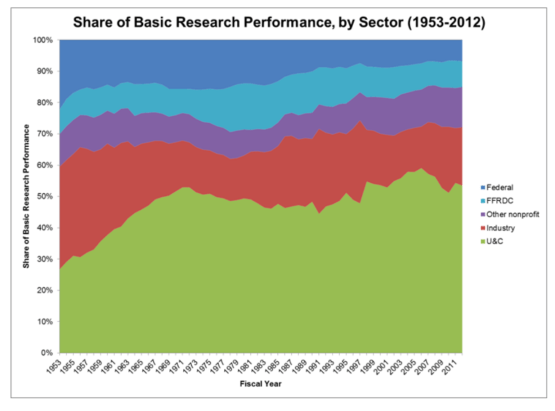
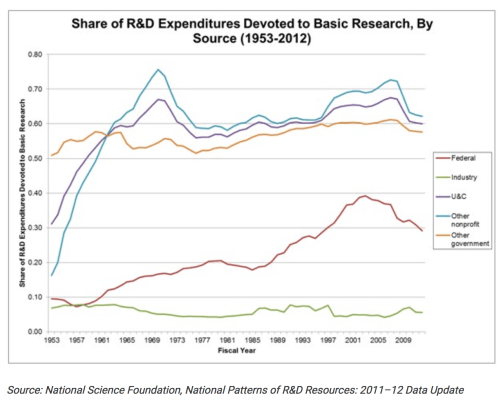
“The Changing Nature of U.S. Basic research: Trends in Performance”, SSTI. U&C = universities and colleges.
It also means that people relying on research grants for salary (like myself, and most other post-doctoral researchers, research associates, graduate and undergraduate researchers, technicians, and some extension outreach personnel) find themselves without jobs. Research-based salary also means that you are limited to a short contract based on the project, anywhere from a month to several years. From experience, a short-term funded position (a year or less) means that you spend a significant amount of time applying to other jobs (a lengthy process) or writing more research grants (an incredibly lengthy process that I’ll discuss in a few months- which take at least 6 – 8 weeks just to write). This can impede on your other job or social responsibilities.
Prior to the jump in federal funding during the Cold War, research was funded by universities themselves and smaller organizations. Most large-scale research grants in the last 50 years, however, have been federally funded. Organizations such as the United States Department of Agriculture (USDA), the National Science Foundation (NSF), the National Institutes of Health (NIH), the National Aeronautics and Space Administration (NASA), the US Department of Defense (DoD), the US Department of Energy (DoE), and others release funding calls on a regular basis. Some funding calls are general and will accept any project type, but many are specific to a particular field or research question (e.g. climate change, cancer, etc.). There are many other organizations or companies which will fund research in a very specific field (such as Sustainable Agriculture Research and Education (SARE), which funds organic and sustainable agriculture), or provide small fellowships. Philanthropic organizations also fund research, usually targeted towards a specific disease or special interest, and tend to be small but which can help bring funding to obscure fields.
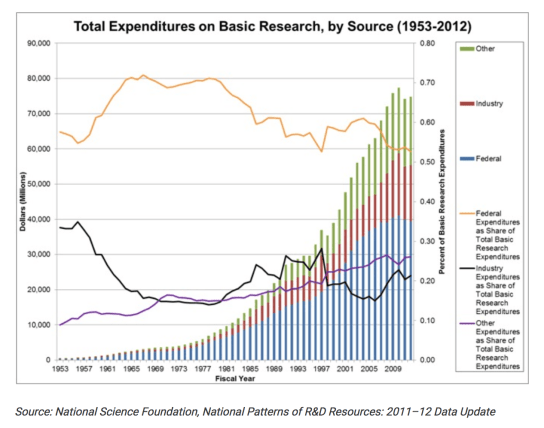
While the total dollar amount of money put into research and development (R & D) in the US has dramatically increased over the last 50 years, the amount the federal government has been putting in has remained relatively stable over the last 10 years. Some cite the availability of other funding sources, such as universities themselves, as making up more of the costs. However, this also comes with a price, as the reduction in state funding has been cited as the cause for rising tuition, and universities are unwilling to reduce tuition even after funding has been reinstated.
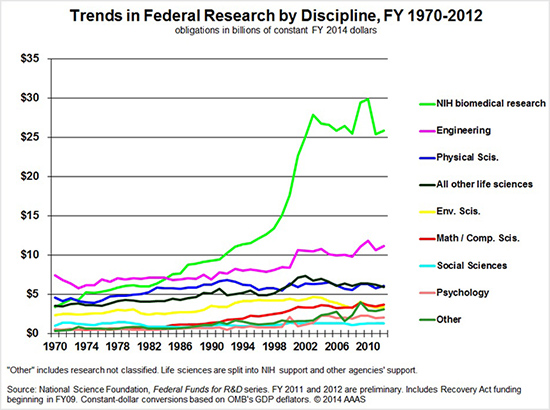
The increase in funding has largely been in biomedical and engineering fields, with other areas of research remaining relatively stable.
Laboratory equipment and technology is much more complex and expensive than it was even a decade ago. The percentage of funding going into basic research, from multiple funding sources, has also declined over the last 10 years, which means research projects have to focus on short-term goals instead of long-term, complex projects that gather more data. Basic research aims to understand a system, rather than manipulate it or develop a product, and is the necessary first step which opens up decades of further, more applied, research.
The increase in number of researchers and projects/researcher, coupled with funding stagnation, can massively increase grant competition. Over the past few years, it has been holding steady at 22% for NSF, and 18-25% for NIH, although their data is more complicated because they saw an increase in budget and an increase in total number of PIs funded, yet a reduction in percent of projects funded (indicating that more many more grants were submitted overall). The USDA is also more complicated to track because of the number of grant programs within the USDA, each of which put forward different targeted grant funding calls each year. In 2013, USDA AFRI had a 10% funding success rate. Manually checking grant funding calls reveals grant-specific success rates, upwards of 30% funding success; however, many of these grants with a higher rate of success also require you to match their funding with funding from another source. So if you have a 1/3 chance of getting that USDA grant, and a 1/5 chance of getting a matching NIH grant, your actual chances of getting all that funding are 1/3 x 1/5 = 1/15.
Taken altogether, the clearest trend regarding research in the US is that it’s an integral part to our way of life and it’s not going anywhere. Whatever your political views, it’s important that scientists, citizens, and politicians come together across the aisle to do what’s best for the future of the US, and that’s going to necessitate a strong support of scientific work.
Finals are upon us and that can only mean that I’ve committed myself to reading a stack of manuscripts that students wrote as the final project for the bioinformatics lab I am teaching! This semester we took raw 16S rRNA sequencing data, analyzed it, interpreted it, and here are the results. Many of my students had never used command line based programs at the beginning of the semester, and now they can discuss the merits of different clustering techniques- I am so proud of them!
A review chapter that I put together last year is now available online or by purchasing the textbook! The chapter explores the current breadth of knowledge about methanogenic archaea that live in the human digestive tract and their involvement in human gut diseases. These archaea produce methane using hydrogen and carbon products that bacteria create during fermentation, and it’s unclear how the interaction of host immune system, bacterial diversity, and archaeal diversity can trigger disease or convalescence.













 The Ishaq Lab