
Designing the Microbes and Social Equity Symposium, a Novel Interdisciplinary Virtual Research Conference Based on Achieving Group-Directed Outputs

This collaborative paper on the 2021 Microbes and Social Equity Symposium was invited by the Challenges journal’s editor-in-chief to submit a contribution about the group’s activities, and the together the session organizers, speakers, student assistants, and I wrote about our experiences putting this together. The journal is dedicated to published highly interdisciplinary research which looks things from multiple perspectives and which contributes to Planetary Health.

We learned that, much like microbes, audiences don’t always act the way you expect them to. Even better: we learned that by providing collaborative working time after listening to speaker sessions, which could be used to get our thoughts down on paper, we could capture the magic and inspiration of the conversations we had post-talks and revisit those later as research and outreach resources.

Ishaq, S.L., Wissel, E.F., Wolf, P.G., Grieneisen, L., Eggleston, E.M., Mhuireach, G., Friedman, M., Lichtenwalner, A., Otero Machuca, J.,  Weatherford Darling, K.,  Pearson, A., Wertheim, F.S., Johnson, A.J., Hodges, L., Young, S., Nielsen, C.C., Kozyrskyj, A.L.,  MacRae, J.D., McKenna Myers, E., Kozik, A.J., Tussing-Humphreys, L.M., Trujillo, M., Daniel, G.A., Kramer, M.R., Donovan, S.M., Arshad, M., Balkan, J., Hosler, S. 2022. Designing the Microbes and Social Equity Symposium, a novel interdisciplinary virtual research conference based on achieving group-directed outputs. Challenges, 13(2), 30.

Abstract: The Microbes and Social Equity working group was formed in 2020 to foster conversations on research, education, and policy related to how microorganisms connect to personal, societal, and environmental health, and to provide space and guidance for action. In 2021, we designed our first virtual Symposium to convene researchers already working in these areas for more guided discussions. The Symposium organizing team had never planned a research event of this scale or style, and this perspective piece details that process and our reflections. The goals were to 1) convene interdisciplinary audiences around topics involving microbiomes and health, 2) stimulate conversation around a selected list of paramount research topics, and 3) leverage the disciplinary and professional diversity of the group to create meaningful agendas and actionable items for attendees to continue to engage with after the meeting. Sixteen co-written documents were created during the Symposium which contained ideas and resources, or identified barriers and solutions to creating equity in ways which would promote beneficial microbial interactions. The most remarked-upon aspect was the working time in the breakout rooms built into the schedule. MSE members agreed that in future symposia, providing interactive workshops, training, or collaborative working time would provide useful content, a novel conference activity, and allow attendees to accomplish other work-oriented goals simultaneously.

Twenty important research questions in microbial exposure and social equity. 

This is the second collaborative paper that the Microbes and Social Equity working group has published together, led by Dr. Jake Robinson and featuring 25 other MSE group researchers in various fields related to microbiomes, social equity, and ecosystems. In developing this paper, we had many conversations about what had been accomplished in research related to microbial exposure, as well as what had yet to be done. We provide some background information as context, and spend the majority of the paper outlining twenty of the most poignant research directions. There are so many questions yet to be answered about the way the microbial communities interact with human lives, and how our lives impact them back. In our enthusiasm for the topics, we could have endlessly chatted about research, such that we decided to limit ourselves to twenty questions. We hope that this piece becomes a source for inspiration for others who continue this conversation and future research in these areas.

You can read the paper online, or hear more about the paper by watching Jake’s seminar on this and his other research:

“20 important questions in microbial exposure and social equity + recent work on urban greenspace microbiomes”. Dr. Jake Robinson, PhD, Feb 23rd, 2022, 12:00 – 13:00 EST. Watch the recorded talk.

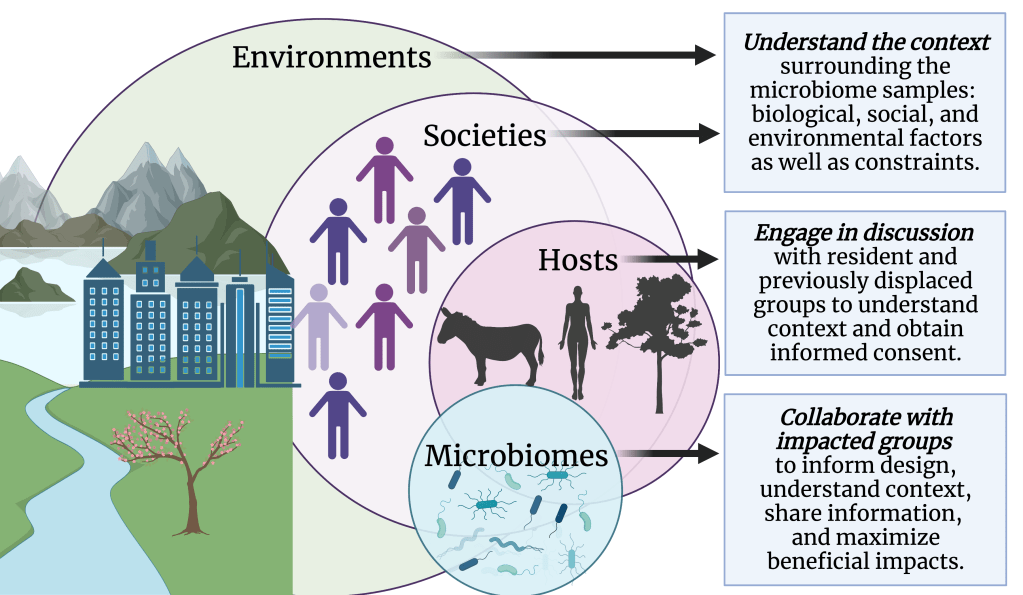
Robinson et al. 2022. FIG 1 A systems-level view of microbiomes, hosts, societies, and ecosystems, and strategies to meld social equity with biology, ecology, politics, or design (made with biorender).

Robinson, J.M., Redvers, N., Camargo, A., Bosch, C.A., Breed, M.F., Brenner, L.A., Carney, M.A., Chauhan, A., Dasari, M., Dietz, L.G., Friedman, M., Grieneisen, L., Hoisington, A.J., Horve, P.F., Hunter, A., Jech, S., Jorgensen, A., Lowry, C.A., Man, I., Mhuireach, G., Navarro-Pérez, E., Ritchie, E.G., Stewart, J.D., Watkins, H., Weinstein, P., and Ishaq, S.L. 2022. Twenty important research questions in microbial exposure and social equitymSystems 7(1): e01240-21. 

This is part of the mSystems Special Series: Social Equity as a Means of Resolving Disparities in Microbial Exposure

ABSTRACT

Social and political policy, human activities, and environmental change affect the ways in which microbial communities assemble and interact with people. These factors determine how different social groups are exposed to beneficial and/or harmful microorganisms, meaning microbial exposure has an important socioecological justice context. Therefore, greater consideration of microbial exposure and social equity in research, planning, and policy is imperative. Here, we identify 20 research questions considered fundamentally important to promoting equitable exposure to beneficial microorganisms, along with safeguarding resilient societies and ecosystems. The 20 research questions we identified span seven broad themes, including the following: (i) sociocultural interactions; (ii) Indigenous community health and well-being; (iii) humans, urban ecosystems, and environmental processes; (iv) human psychology and mental health; (v) microbiomes and infectious diseases; (vi) human health and food security; and (vii) microbiome-related planning, policy, and outreach. Our goal was to summarize this growing field and to stimulate impactful research avenues while providing focus for funders and policymakers.

Framing the discussion of microorganisms as a facet of social equity

In just a four-week course in 2019 when I was working at the University of Oregon, I introduced 15 undergraduates from the UO Clark Honors College to microorganisms and the myriad ways in which we need them. More than that, we talked about how access to things, like nutritious foods (and especially fiber), pre- and postnatal health care, or greenspace and city parks, could influence the microbial exposures you would have over your lifetime. Inequalities in that access – such as only putting parks in wealthier neighborhoods – creates social inequity in resource distribution, but it also creates inequity in microbial exposure and the effect on your health.

By the end of the that four weeks, the students, several guest researchers, and myself condensed these discussions into a single paper (a mighty undertaking, indeed). Interest in this paper sparked the formation of the Microbes and Social Equity working group.

During the course, a number of guest lecturers were kind enough to lend us their expertise and their perspective:


Ishaq, S.L., Rapp, M., Byerly, R., McClellan, L.S., O’Boyle, M.R., Nykanen, A., Fuller, P.J., Aas, C., Stone, J.M., Killpatrick, S., Uptegrove, M.M., Vischer, A., Wolf, H., Smallman, F., Eymann, H., Narode, S., Stapleton, E., Cioffi, C.C., Tavalire, H..  2019Framing the discussion of microorganisms as a facet of social equity in human health. PLoS Biology 17(11): e3000536.

Abstract

What do “microbes” have to do with social equity? These microorganisms are integral to our health, that of our natural environment, and even the “health” of the environments we build. The loss, gain, and retention of microorganisms—their flow between humans and the environment—can greatly impact our health. It is well-known that inequalities in access to perinatal care, healthy foods, quality housing, and the natural environment can create and arise from social inequality. Here, we focus on the argument that access to beneficial microorganisms is a facet of public health, and health inequality may be compounded by inequitable microbial exposure.

Introducing the Microbes and Social Equity Working Group: considering the microbial components of social, environmental, and health justice.

The Microbes and Social Equity Working Group was founded in early 2020 by Sue Ishaq, as interest grew following her publication in fall of 2019, “Framing the discussion of microorganisms as a facet of social equity in human health.”

In summer 2021, MSE group membership blossomed to ~ 90 members from around the globe, and “members represent diverse fields, e.g., anthropology, architecture, bioethics, bioinformatics, data science, ecology, engineering, genetics, medicine, microbiology, nutrition, psychology, and sociology, and exhibit expertise in various hosts, systems, and environments beyond human microbiomes. We are researchers, educators, practitioners, and policymakers spanning the globe and career levels.” (Ishaq et al. 2021).

In this publication, 35 of us collaboratively wrote our Mission Statement, our primary objectives, and introduced the group to the world!


Ishaq, S.L., Parada, F.J., Wolf, P.G., Bonilla, C.Y., Carney, M.A., Benezra, A., Wissel, E., Friedman, M., DeAngelis, K.M., Robinson, J.M., Fahimipour, A.K., Manus, M.B., Grieneisen, L., Dietz, L.G., Pathak, A., Chauhan, A., Kuthyar, S., Stewart, J.D., Dasari, M.R., Nonnamaker, E., Choudoir, M., Horve, P.F., Zimmerman, N.B., Kozik, A.J., Darling, K.W., Romero-Olivares, A.L., Hariharan, J., Farmer, N., Maki, K.A., Collier, J.L., O’Doherty, K., Letourneau, J., Kline, J., Moses, P.L., Morar, N. 2021. Introducing the Microbes and Social Equity Working Group: Considering the Microbial Components of Social, Environmental, and Health JusticemSystems 6:4.

Part of the mSystems Special Series: Social Equity as a Means of Resolving Disparities in Microbial Exposure

ABSTRACT

Humans are inextricably linked to each other and our natural world, and microorganisms lie at the nexus of those interactions. Microorganisms form genetically flexible, taxonomically diverse, and biochemically rich communities, i.e., microbiomes that are integral to the health and development of macroorganisms, societies, and ecosystems. Yet engagement with beneficial microbiomes is dictated by access to public resources, such as nutritious food, clean water and air, safe shelter, social interactions, and effective medicine. In this way, microbiomes have sociopolitical contexts that must be considered. The Microbes and Social Equity (MSE) Working Group connects microbiology with social equity research, education, policy, and practice to understand the interplay of microorganisms, individuals, societies, and ecosystems. Here, we outline opportunities for integrating microbiology and social equity work through broadening education and training; diversifying research topics, methods, and perspectives; and advocating for evidence-based public policy that supports sustainable, equitable, and microbial wealth for all.

Logo designed by Alex Guillen